1,632 Videos, 7 Countries, Zero Humans in the Loop: What the Agent Economy Actually Looks Like in Production
Ask ten CTOs what “the agent economy” means and you’ll get ten adjacent thought pieces about autonomous multi-step reasoning at enterprise scale. Most of those pieces are correct. Very few of them come with commit history you can grep.
I’ve written the thought pieces before — The Agent Economy 2026 and AI Agent Orchestration. This post is the receipts version. Everything below is checkable against the repo_activity.csv in blog-content-automation — every commit hash, every line count, every date.
If the agent-economy story is going to become an enterprise architecture decision rather than a slide, this is the shape of the evidence it needs.
The single most-quotable commit
On 1 May 2026 the youtube-intnl-blog repo shipped a commit with the subject line:
feat: travel video library at /travel — 1,632 videos — 7 countries+33,314 lines added, 12 lines deleted
That single push wired up a Retrieval-Augmented Generation frontend for 1,632 video assets spanning 7 country corpora. The RAG surface itself — the retrieval, the enrichment, the SEO pipe that turns each video into a discoverable blog page — is what the +33K lines are.
That is not a proof-of-concept commit. That is production infrastructure for a content-retrieval system at meaningful scale.
The tranche that shows it’s a system, not a demo
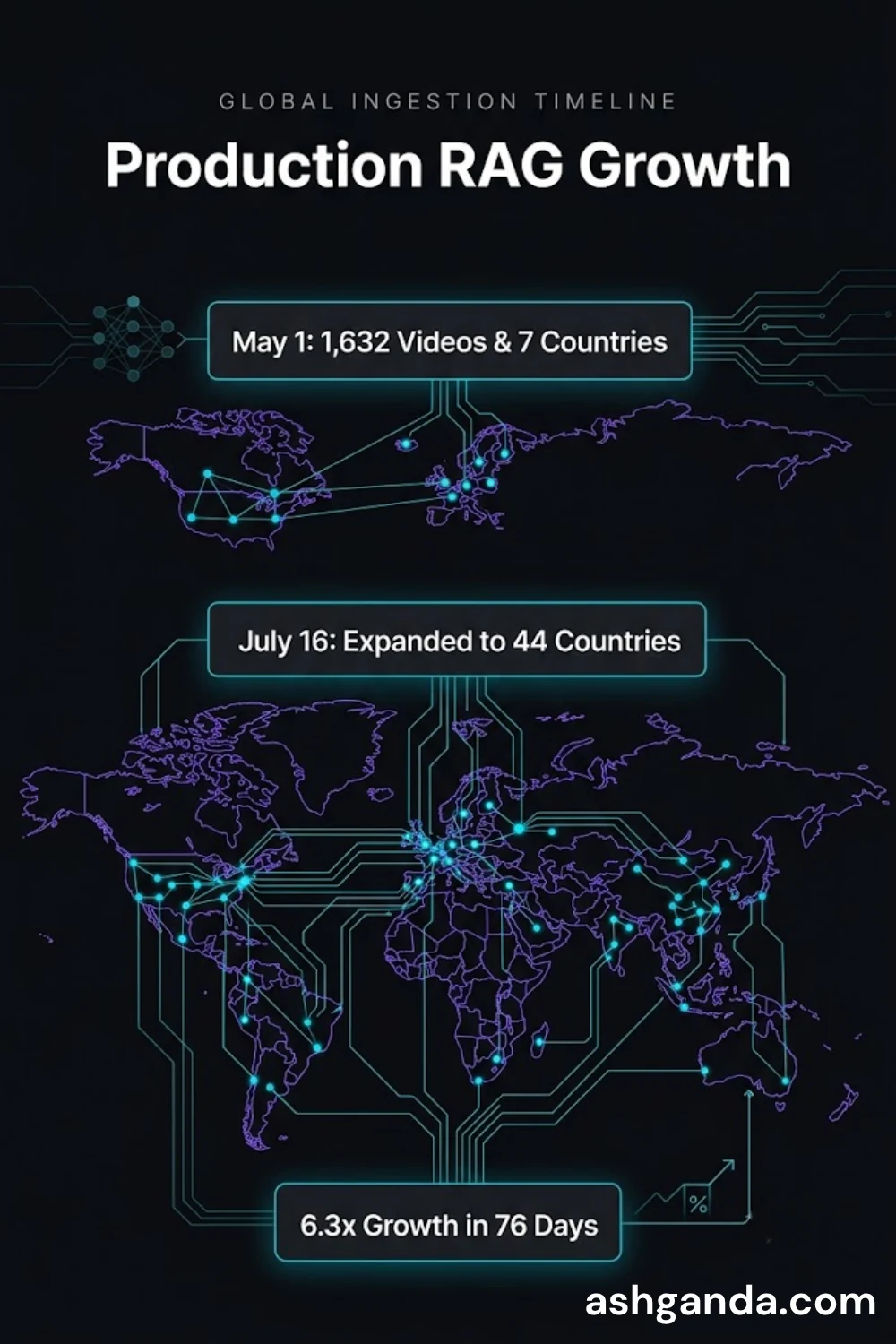
If you’re sceptical about whether “1,632 videos, 7 countries” is a one-shot import that then rotted, the follow-up commits are the disambiguator:
| Date | Repo | Commit | +/- |
|---|---|---|---|
| 2026-05-19 | youtube-intnl-blog | feat(travel): add India (225 videos) + PUBLISHED_COUNTRIES whitelist | +5,540 / −1,089 |
| 2026-06-14 | travel-rag-blog | chore: discovery refresh — +1,097 IDs across 17 destinations (incl 4 new) | +12,071 / −4 |
| 2026-06-14 | travel-rag-blog | feat: wire norway + peru + morocco + mexico as destinations 14-17 | +32 / −0 |
| 2026-07-16 | travel-rag-blog | feat: ingest 27 new countries (44 total) + caption-retry speedup + keyword-collision | +5,611 / −2,528 |
Three things worth reading between the lines:
PUBLISHED_COUNTRIESwhitelist. That’s a gated rollout inside the ingest layer — the pipeline holds new corpora until they’re approved, rather than publishing every ingested country to the live site. That’s a fail-closed pattern from the adversarial-verification post applied to corpus expansion.- 1,097 new discovery IDs in a single refresh (14 June). A pipeline that grows the retrieval index by four figures on a random Saturday is a production pipeline, not a demo.
- “caption-retry speedup + keyword-collision” bundled with the 27-country push (16 July). Ingest layer + query-time optimisations shipping together. Real ops rhythm.
From 7 countries at 1 May to 44 countries by 16 July is a 6.3× growth in corpus breadth in 76 days, with no human writing captions per video. That’s the agent-economy claim, only quantified.
The un-glamorous parallel: adversarial faithfulness on a Sanskrit corpus
The travel-video RAG is the visible surface. Behind it, another RAG-adjacent line of work has been running in knowledge-extraction-from-books on classical Upanishad texts — with a stricter adversarial gate than the travel pipeline because the failure mode (misquoting scripture) is not tolerable.
Verified commits (May 2026 sequence):
| Commit | +/- |
|---|---|
feat(corpus): U4 — Prashna Upanishad reloaded + generic prose-cleaner (26 May) | +2,828 / −2 |
docs(plan): adversarially-reviewed Stories Corpus + Cross-Site Theme-Linking plan (26 May) | +158 / −0 |
feat(corpus): U8 — Aitareya Upanishad reloaded (cited, reproducible) (29 May) | +758 / −2 |
feat(corpus): QA gate (verify_book.py) — learned policy from adversarial finding (30 May) | +133 / −2 |
feat(corpus): U7 Taittiriya reloaded (book 155, 51 units) + faithfulness gate (30 May) | +1,479 / −8 |
feat(corpus): U12 Kaushitaki + U13 Maitrayaniya reloaded (cited, reproducible, gated) (30 May) | +4,609 / −9 |
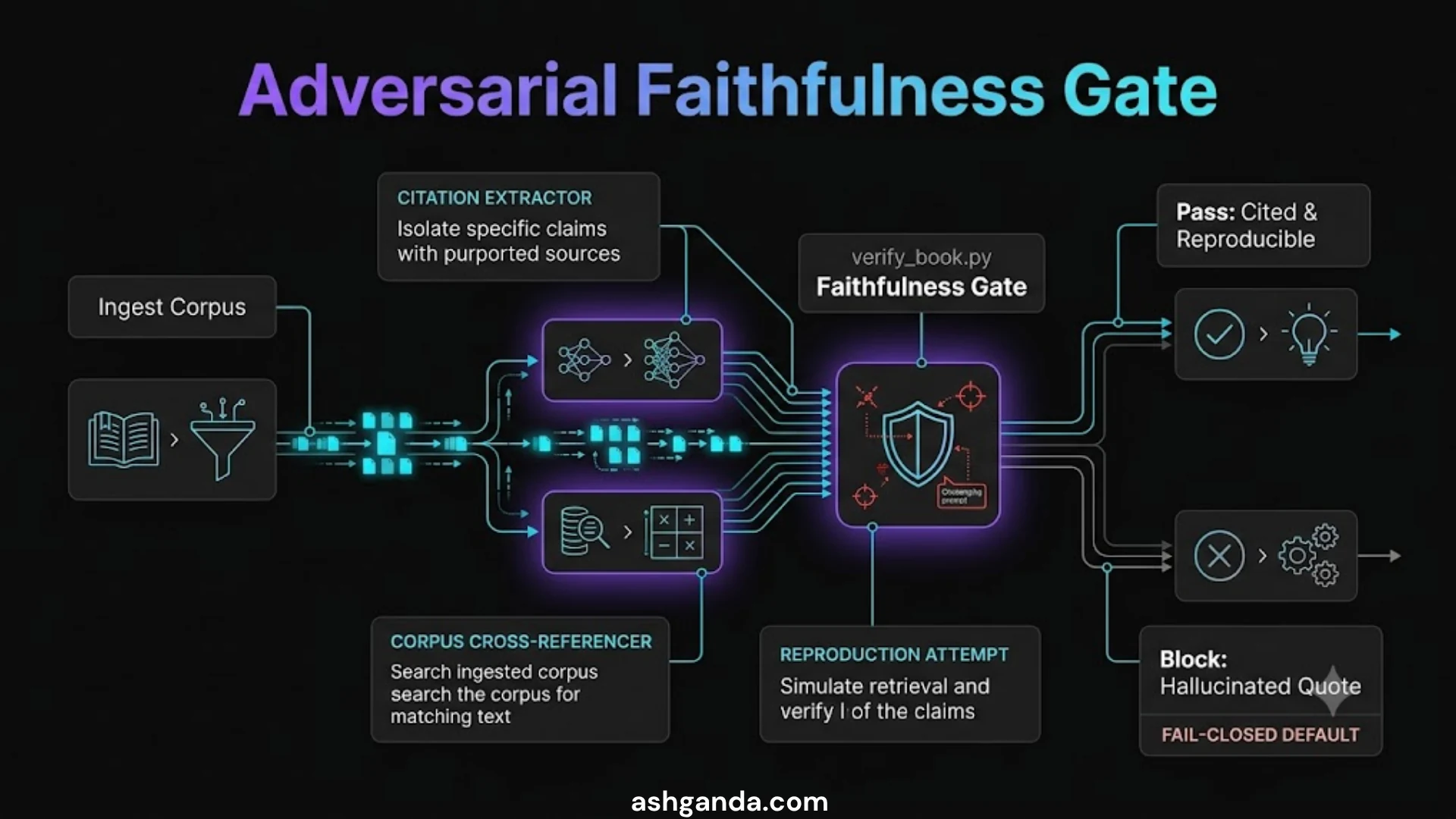
The three words to notice: cited, reproducible, gated. Every corpus reload records the source book (e.g. book 155, 51 units), can be re-run deterministically, and is verified by the verify_book.py faithfulness gate before it enters the retrieval index. The gate itself is a learned policy from an adversarial finding — the pipeline shipped, an adversarial verifier caught a class of quotation error, the fix became a gate, the gate blocks re-occurrence.
That is the same fail-closed discipline the gate-integrity meta-gate codifies for content publishing — applied here to retrieval-corpus construction.
What actually breaks — the honest list
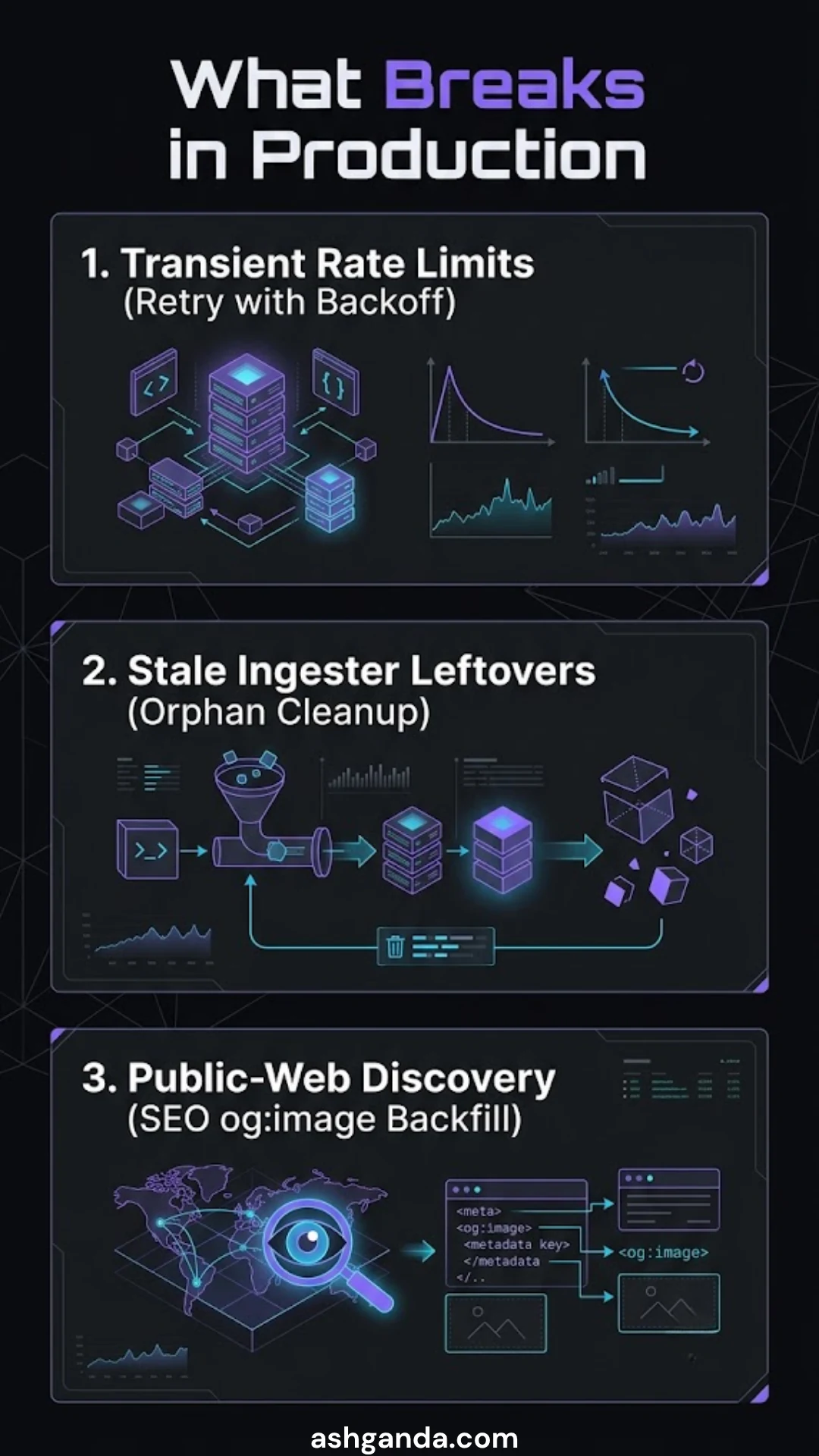
If you’re standing up a comparable RAG at production scale, three failure modes are worth naming up-front because I’ve hit each one and the commit log has the fix:
1. Silent transcription failures under rate limits
travel-rag-blog 14 June 2026: fix(canary): retry-with-backoff on transcribe to absorb transient YT rate-limits (+21 / −4). Small commit, massive operational value. Before it, transient YouTube rate-limits would drop entire ingestion runs into partial state — which meant a canary check that looked green while 30% of the target corpus quietly failed to enter the index. After: exponential backoff catches the transient, the run completes, the canary reports honestly.
Takeaway: every external-API call in a RAG ingester needs a retry policy with jitter. Not “we’ll add it later” — from day one.
2. Orphan-ingester leftovers
travel-rag-blog 10 June 2026: ops: cleanup_orphans.sh — audit + kill stale ingester leftovers (+88 / −0). Long-running ingest jobs that get killed mid-way leave rows in the tracking table with in_progress status. Without cleanup, subsequent runs think those rows are “still going” and skip them. Corpus grows unevenly, developer trust in the queue drops, and by the time someone notices the topology is wrong.
Takeaway: a periodic orphan-audit is not optional in any long-running ingest.
3. SEO surface for the RAG output is where scale actually shows
travel-rag-blog 14 July 2026: fix(seo): add og:image — social shares had no preview card (+13,598 / −5,747). The RAG pipeline was producing 1,600+ video pages, and every single one of them was missing an og:image meta tag for social preview cards. The fix touched 13K lines because it wasn’t just “add a tag” — it was regenerating cached hero-thumbnails for every existing page.
Takeaway: the moment your RAG surface is public-web-facing, treat its output as a full-site SEO surface. The gap between “the retrieval works” and “the discoverability works” is where most enterprise RAG projects lose value in year 2.
The strategic read for a CTO
Three things worth internalising before you commission your own RAG-based agent stack:
1. Scale is not the interesting number. Rate-of-growth is. 1,632 videos on 1 May → 44 countries by 16 July isn’t a big number in isolation. It’s a big number for the elapsed time. Ask your prospective vendor or your internal team not “how many documents does your RAG index today?” but “what was the growth rate over the last 60 days, and what broke during that expansion?” If they can’t name a specific incident and the specific fix, the ingester hasn’t been stressed.
2. Adversarial gates on the corpus are a first-class architectural decision. The Sanskrit-corpus work above is a strong illustration: the content doesn’t tolerate hallucinated quotes, so the pipeline enforces a faithfulness gate that a general-purpose LLM would happily bypass. If your enterprise use case has any regulated-content dimension — legal, medical, financial, historical — the gate has to sit inside the ingester, not the query layer. Otherwise the wrong content becomes retrievable and no amount of prompt engineering at query time can compensate.
3. The un-fakeable moat is the operational rhythm, not the model. Everything above — retry policy, orphan cleanup, SEO backfill, whitelist-gated country rollout, corpus-faithfulness gate — is production discipline that shows up in commit logs, not in vendor pitch decks. When you’re evaluating whether an “AI agent orchestration” platform is real or theatre, ask to see 90 days of the ingester’s ops commits. The bandwidth of operational fixes tells you whether the system is in production or in a demo repository.
What this doesn’t prove
To keep the same honesty this post is meant to model: the numbers above prove that a RAG pipeline exists, has been growing for 90+ days, has a working adversarial-faithfulness gate on at least one corpus, and has been debugged through several real production failure modes.
They do NOT prove:
- That the retrieval quality is competitive with hosted vendor RAG products (I haven’t run that benchmark publicly)
- That the operating cost is lower than the equivalent hosted RAG (I have the numbers; they’re not in this post)
- That every ingest failure has been caught (some of the fix commits above are evidence that failures were not caught for a period first)
Every one of those follow-up questions has a commit-log answer. If you’re seriously evaluating your own agent-economy build, DM me and I’ll show you the specific commits.
The bottom line
The agent-economy conversation is going to move from thought-leadership to procurement in the next 12 months. When it does, the RFP question that separates the real vendors from the demo vendors will be:
“Show me 90 days of your ingester’s ops commits.”
If they can’t show you rate-limit retries, orphan cleanups, adversarial-faithfulness gate fixes, and SEO-surface backfills — with dates and line counts — they don’t have a production RAG. They have a demo repository with a nice model card.
The receipts are the moat.
Related reading
- My earlier thought-leadership essays this post is the receipts for: The Agent Economy 2026 · AI Agent Orchestration
- The adversarial-verification companion: Adversarial Verification & Fail-Closed Gates — 644 Quotes in Production
- The publishing-pipeline post-mortem: AI Blog Factory: 22 Posts Per Month, Fully Automated
- Public repos where you can verify every number above:
blog-content-automation (see
docs/repo_activity.csv)
For technical deep-dives on the cloud and IT topics I cover strategically, visit Cloud Geeks — our specialist IT infrastructure blog.
Ganda Tech Services is my technology consultancy, bringing together cloud infrastructure, web development, and mobile expertise for Australian businesses.
AI Strategy Primer for Australian Business Leaders
A practical framework for AI adoption in 2026 — cut through the hype and start with what matters.