AI Agent Orchestration: Building Enterprise Automation with Autonomous Agents
Large language models have transformed what AI can accomplish in enterprise contexts. Yet for all their capability, standalone LLMs face fundamental limitations: they cannot take actions in the world, access current information, or execute multi-step processes autonomously. The prompt goes in, the response comes out, and humans must do everything else.
AI agents transcend these limitations. By combining LLM reasoning with tools, memory, and orchestration frameworks, agents can accomplish complex tasks that require multiple steps, external integrations, and adaptive decision-making. An agent can research a topic, summarise findings, draft a document, submit it for review, and iterate based on feedback, all with minimal human intervention.
For enterprise CTOs, AI agents represent the next frontier of automation. While chatbots handle simple queries and RPA handles structured processes, agents occupy the middle ground: tasks too complex for scripted automation but too routine for skilled human attention. Customer support escalation paths, procurement workflows, compliance monitoring, and technical troubleshooting all contain work well-suited for agentic automation.
Yet agents also introduce new challenges. Autonomous systems can take unintended actions. Complex agent interactions can produce emergent behaviours. Production reliability requires different approaches than research prototypes. Understanding both the opportunity and the implementation requirements is essential for CTOs charting enterprise AI strategy.
Understanding AI Agents
An AI agent is a system that uses an LLM as its reasoning engine, augmented with capabilities to perceive its environment, take actions, and pursue goals over multiple steps.
Core Agent Components
Reasoning Engine: The LLM provides the cognitive capability: understanding context, breaking down problems, planning approaches, and generating outputs. The quality of the underlying model fundamentally determines agent capability.
Tools: External capabilities the agent can invoke: APIs to access data, functions to perform calculations, integrations to interact with systems. Tools extend what agents can accomplish beyond pure text generation.
Memory: Mechanisms for maintaining context across interactions. Short-term memory holds current conversation state. Long-term memory preserves information across sessions, enabling learning and personalisation.
Planning: The ability to decompose complex goals into steps, determine execution order, and adapt plans based on outcomes. Planning transforms agents from reactive systems into goal-directed ones.
Observation: The ability to perceive outcomes of actions and environmental changes. Observation enables feedback loops where agents adjust behaviour based on results.
Agent Architectures
Several architectural patterns have emerged for agent implementation:
ReAct (Reason + Act): Agents alternate between reasoning (thinking through the problem) and acting (invoking tools). Each reasoning step considers observations from previous actions.
Thought: I need to find the current stock price for ACME Corp.
Action: search_financial_data("ACME Corp stock price")
Observation: ACME Corp (ACME) current price: $142.50
Thought: Now I should check recent news that might affect the price.
Action: search_news("ACME Corp")
Observation: ACME Corp announced Q1 earnings beating expectations...
Thought: I have enough information to summarise.
Output: ACME Corp is currently trading at $142.50, supported by...Plan-and-Execute: Agents first generate a complete plan, then execute steps sequentially. This provides more coherent multi-step execution but less adaptability.
Hierarchical: Complex goals decompose into sub-goals handled by specialised sub-agents. A research agent might coordinate literature search, data analysis, and synthesis sub-agents.
Reflexion: Agents evaluate their own outputs, identify shortcomings, and iterate to improve. Self-critique enables quality improvement without human feedback.
Multi-Agent Systems
Complex enterprise workflows often exceed what single agents can handle effectively. Multi-agent systems distribute work across specialised agents that collaborate toward shared goals.
Collaboration Patterns
Sequential Pipeline: Agents hand off work in sequence, each completing a phase before passing to the next.
┌──────────┐    ┌──────────┐    ┌──────────┐    ┌──────────┐
│ Research │───>│ Analysis │───>│ Drafting │───>│  Review  │
│  Agent   │    │  Agent   │    │  Agent   │    │  Agent   │
└──────────┘    └──────────┘    └──────────┘    └──────────┘
Parallel Execution: Independent agents work simultaneously on different aspects of a problem, with results merged.
Supervisor Pattern: A coordinating agent assigns tasks to worker agents, monitors progress, and synthesises results.
                ┌────────────┐
                │ Supervisor │
                │   Agent    │
                └─────┬──────┘
          ┌───────────┼───────────┐
          ▼           ▼           ▼
     ┌─────────┐ ┌─────────┐ ┌─────────┐
     │ Worker  │ │ Worker  │ │ Worker  │
     │ Agent 1 │ │ Agent 2 │ │ Agent 3 │
     └─────────┘ └─────────┘ └─────────┘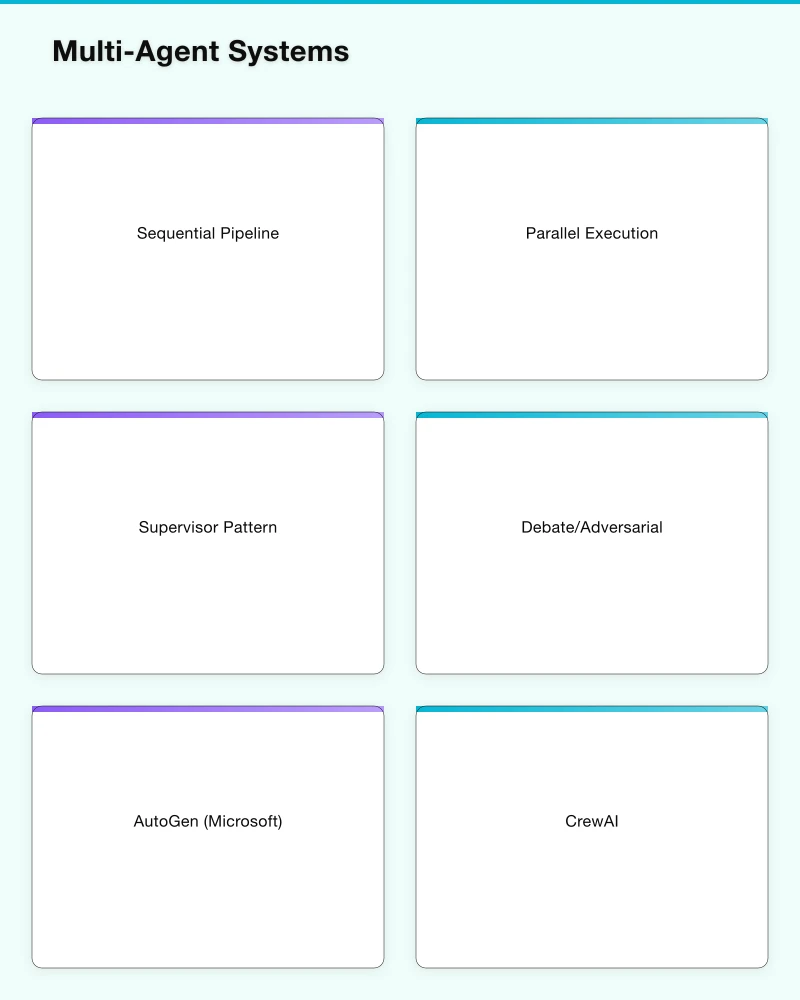
Debate/Adversarial: Multiple agents with different perspectives argue positions, with a judge agent synthesising conclusions. This pattern improves decision quality for complex, ambiguous problems.
Multi-Agent Frameworks
Several frameworks facilitate multi-agent development:
AutoGen (Microsoft): Conversation-based multi-agent framework supporting diverse collaboration patterns. Agents communicate through messages, enabling flexible workflow composition.
CrewAI: Role-based multi-agent framework where agents assume specific roles (researcher, analyst, writer) and collaborate on shared tasks.
LangGraph: Graph-based orchestration enabling complex agent workflows with conditional branching, loops, and human-in-the-loop integration.
Custom Orchestration: For specific requirements, custom orchestration using workflow engines like Temporal or Apache Airflow provides maximum flexibility.
Design Considerations
Agent Specialisation: Specialised agents with focused capabilities often outperform generalist agents attempting everything. Define clear agent responsibilities.
Communication Protocols: Standardise how agents communicate: message formats, handoff conventions, and context passing.
Failure Handling: Multi-agent systems have multiple failure points. Design for agent failures, communication failures, and cascade prevention.
Coordination Overhead: More agents mean more coordination. Balance specialisation benefits against orchestration complexity.
Tool Integration
Tools extend agent capabilities beyond text generation. Effective tool design determines what agents can accomplish.
Tool Design Principles
Clear Interface: Tools should have well-documented inputs, outputs, and behaviours. LLMs must understand tool purpose to use them correctly.
Atomic Operations: Tools should do one thing well. Complex tools are harder for LLMs to use correctly; compose simple tools for complex operations.
Error Handling: Tools must return informative errors. “Failed” tells the agent nothing; “User not found: ID 12345 does not exist” enables recovery.
Idempotency: Where possible, tools should be safe to retry. Agents may invoke tools multiple times due to retry logic or reasoning loops.
Common Tool Categories
Information Retrieval: Search engines, databases, document stores, knowledge bases. Enable agents to access information beyond training data.
Computation: Calculators, code execution, data analysis. Overcome LLM limitations with precise numerical operations.
External APIs: CRM systems, ticketing platforms, ERP systems. Enable agents to interact with enterprise systems.
Communication: Email, messaging, notifications. Enable agents to interact with humans and other systems.
Code Execution: Python interpreters, shell commands, database queries. Enable agents to perform complex operations programmatically.
Tool Selection at Runtime
Agents must choose appropriate tools for each situation. Approaches include:
Function Calling: Modern LLMs support structured function calling, selecting and parameterising tools based on conversation context.
Semantic Search: Vector similarity matches user intent to tool descriptions, presenting relevant tools to the agent.
Planning-Based: During planning phase, agents determine required tools for each step before execution.
Memory Systems
Effective memory enables agents to maintain context, learn from experience, and personalise interactions.
Memory Types
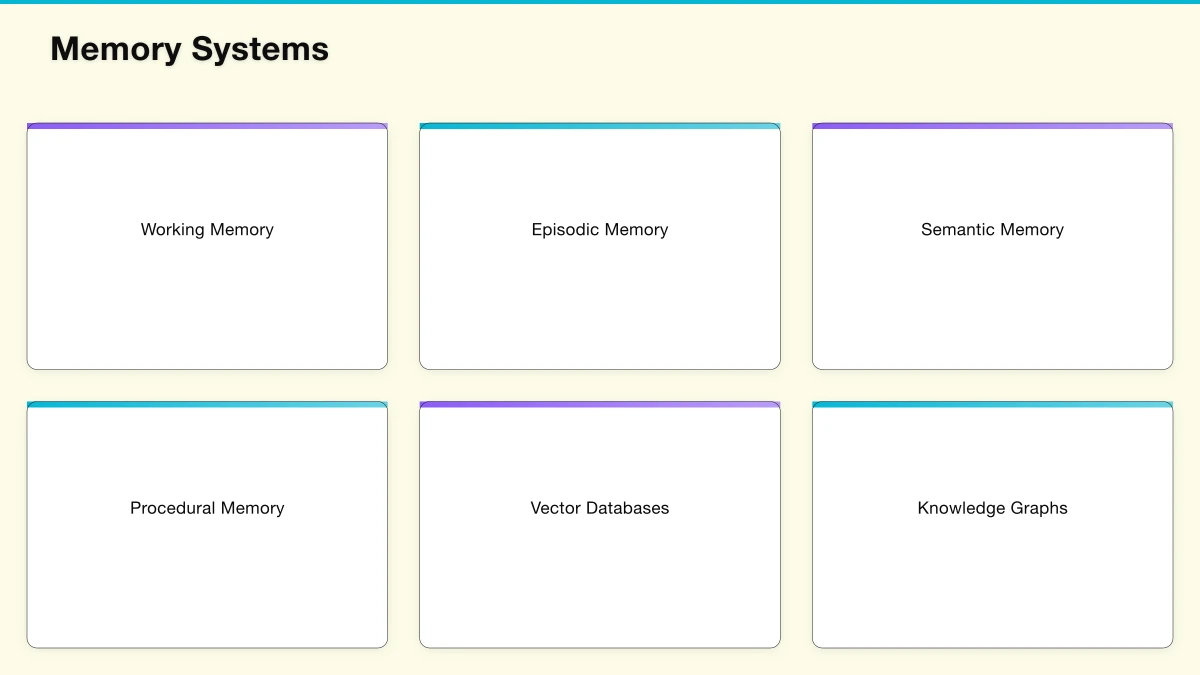
Working Memory: Current conversation context. Typically implemented as messages passed to the LLM in each request. Limited by context window.
Episodic Memory: Records of past interactions and experiences. Enables agents to recall previous conversations, decisions, and outcomes.
Semantic Memory: Structured knowledge about domains, entities, and relationships. Enables agents to retrieve relevant facts and context.
Procedural Memory: Learned procedures and skills. Enables agents to improve at tasks over time based on feedback.
Memory Implementation
Vector Databases: Store embeddings of past interactions, enabling semantic retrieval of relevant context. Popular options include Pinecone, Weaviate, and Chroma.
Knowledge Graphs: Store structured relationships between entities, enabling reasoning over domain knowledge.
Relational Databases: Store structured records of interactions, enabling precise queries over history.
Hybrid Systems: Combine approaches for different memory types; vector search for semantic recall, relational for structured history.
Memory Management
Relevance Filtering: Not all past information is relevant. Retrieval systems must select what matters for current context.
Summarisation: Long histories exceed context limits. Summarisation condenses past interactions while preserving key information.
Forgetting: Outdated information may mislead agents. Implement mechanisms to deprecate stale knowledge.
Privacy: Memory systems may contain sensitive information. Implement appropriate access controls and retention policies.
Production Deployment
Moving agents from prototype to production requires addressing reliability, safety, and operational concerns.
Reliability Engineering
Determinism vs Stochasticity: LLM outputs vary between invocations. Design systems tolerant of output variation while achieving consistent outcomes.
Retry and Recovery: Agent steps may fail due to LLM errors, tool failures, or external system issues. Implement appropriate retry logic with backoff.
Timeout Management: Agent reasoning can extend indefinitely. Set appropriate timeouts and implement graceful degradation.
State Management: Long-running agent workflows require durable state. Implement checkpointing to enable recovery from failures.
Observability
Tracing: Capture complete traces of agent reasoning, tool invocations, and outcomes. Essential for debugging and improvement.
Metrics: Track success rates, latency distributions, token usage, and tool invocation patterns.
Logging: Log agent decisions, tool inputs/outputs, and errors at appropriate detail levels.
Evaluation: Continuously evaluate agent outputs against quality criteria. Human evaluation for complex tasks; automated evaluation for measurable outcomes.
Cost Management
Agent workflows consume significant LLM tokens and compute resources:
Token Optimisation: Minimise context size while maintaining capability. Summarise rather than including full history.
Model Selection: Use appropriate model capability for each task. Simple classification does not require the largest model.
Caching: Cache tool results and intermediate computations where appropriate.
Budget Controls: Implement per-request and per-user budget limits preventing runaway costs.
Safety and Guardrails
Autonomous agents can take unintended actions with real-world consequences. Safety guardrails are essential for enterprise deployment.
Input Guardrails
Prompt Injection Defence: Adversarial inputs may attempt to hijack agent behaviour. Implement input validation and sanitisation.
Scope Limitation: Define what topics and actions are in-scope for each agent. Reject out-of-scope requests.
Authentication Integration: Verify user identity and permissions before agent execution.
Output Guardrails
Content Filtering: Screen agent outputs for inappropriate, harmful, or confidential content.
Action Validation: Before executing consequential actions, validate against policy rules.
Human Approval: For high-risk actions, require human approval before execution. Define clear escalation criteria.
Behavioural Guardrails
Capability Boundaries: Limit what tools agents can access based on context and user permissions.
Rate Limiting: Prevent agents from executing excessive actions in short periods.
Audit Logging: Log all consequential actions for compliance and investigation.
Kill Switches: Implement mechanisms to halt agent execution immediately when problems are detected.
Monitoring for Safety
Anomaly Detection: Monitor for unusual patterns in agent behaviour that might indicate problems.
Outcome Monitoring: Track outcomes of agent actions to identify patterns of errors or harms.
Feedback Loops: Collect user feedback on agent quality and safety to drive improvement.
Enterprise Use Cases
AI agents are finding application across enterprise functions:
Customer Service
Escalation Handling: Agents handle complex customer issues requiring research, system checks, and multi-step resolution. They can investigate problems, identify root causes, and execute resolutions within defined authority.
Proactive Outreach: Agents monitor customer data for indicators requiring outreach (renewal approaching, usage patterns suggesting churn) and conduct personalised engagement.
IT Operations
Incident Response: Agents investigate alerts, correlate with related events, execute diagnostic procedures, and implement remediations within defined runbooks.
Self-Service Support: Agents handle IT support requests, troubleshooting issues, provisioning access, and escalating when human expertise is required.
Knowledge Work
Research and Analysis: Agents research topics, synthesise information from multiple sources, and produce structured analyses.
Document Processing: Agents extract information from documents, validate against requirements, route for appropriate handling, and update systems of record.
Business Operations
Procurement: Agents handle routine procurement requests, validating requirements, identifying suppliers, generating purchase orders within policy constraints.
Compliance Monitoring: Agents monitor systems and processes for compliance violations, generating alerts and documentation when issues are detected.
Implementation Strategy
For CTOs planning AI agent initiatives:
Start with Bounded Problems
Initial agent deployments should have:
- Clear success criteria
- Limited blast radius if things go wrong
- Human oversight and override capability
- Measurable business value
Expand scope as capability and confidence grow.
Build Foundation First
Before deploying production agents, establish:
- Tool integration framework
- Memory and state management
- Observability infrastructure
- Safety guardrails
- Evaluation frameworks
Foundation investments accelerate subsequent agent development.
Plan for Human-Agent Collaboration
Pure autonomy is rarely appropriate initially. Design for:
- Human-in-the-loop for high-stakes decisions
- Escalation paths when agents reach limits
- Feedback mechanisms for continuous improvement
- Override capability when agents fail
Autonomy should expand incrementally as trust is established.
Invest in Evaluation
Agent quality is difficult to measure. Invest in:
- Task-specific evaluation criteria
- Automated evaluation where possible
- Human evaluation processes
- A/B testing infrastructure
Without rigorous evaluation, quality improvements cannot be measured or verified.
Address Organisational Change
Agent automation changes work. Address:
- Role evolution as agents handle routine work
- Skill development for agent oversight
- Process changes to incorporate agents
- Change management for affected teams
Technical success with organisational resistance produces limited value.
Looking Forward
AI agent technology is evolving rapidly. Developments reshaping the landscape:
Improved Reasoning: Newer models demonstrate stronger planning, self-correction, and multi-step reasoning, enabling more reliable agent behaviour.
Standardised Tool Interfaces: Emerging standards for tool definition enable agents to work across tool ecosystems without custom integration.
Agent-to-Agent Communication: Protocols for agents to communicate and collaborate across organisational boundaries enable new forms of automation.
Hardware Acceleration: Specialised hardware reduces inference costs, making sophisticated agent reasoning economically viable for broader applications.
Regulatory Evolution: Governance frameworks for autonomous AI are developing, with implications for enterprise agent deployments.
For CTOs, the strategic question is not whether AI agents will transform enterprise operations, but how quickly to build the capability to deploy them effectively. Early movers are establishing foundations that will enable rapid expansion as technology matures. Late movers may find themselves competing against organisations with substantial agent automation advantages.
The opportunity is significant. The challenges are real but manageable. The time to begin is now.
Orchestration starts with a unified data foundation — which, for most businesses, means consolidating onto a single CRM rather than stitching agents across disconnected tools. My CRM consolidation strategy for Australian SMEs covers how to assess that foundation before automating on top of it.
Ash Ganda advises enterprise technology leaders on AI strategy, automation, and digital transformation. Connect on LinkedIn for ongoing insights on building AI-powered enterprises.
Turning mobile strategy into a shipped app? Awesome Apps covers Flutter, React Native, and native development for Australian businesses.
As founder of Ganda Tech Services, I work with Australian businesses to align technology investments with business growth — across cloud, web, and mobile.
About the Author
Ashish Ganda is the founder of Ganda Tech Services, a Sydney-based technology consultancy specialising in cloud infrastructure, web development, and mobile app solutions for Australian businesses.
AI Strategy Primer for Australian Business Leaders
A practical framework for AI adoption in 2026 — cut through the hype and start with what matters.