
Adversarial Verification & Fail-Closed Gates: The Mechanics Behind 509 Scheduled, 135 Held, 0 Bad Publishes
Deloitte’s AI at a Crossroads (2025) surveyed 2,773 Australian workers and found that 38% report using generative AI in their day job, up from 21% in 2023 — but only 34% trust the outputs enough to act on them without secondary verification (Deloitte Australia’s AI Dividend). That gap — used-more, trusted-less — is the operating problem for anyone shipping AI into production. It’s also the reason “adversarial verification” and “fail-closed gate” aren’t buzzwords in the pipeline I run. They’re what keeps the trust number from becoming the blocker.
This is what those mechanics look like in a real production run — with the July 2026 numbers from wisdom-booth and the specific 287-line meta-gate we shipped a day earlier to make sure the checks can never be silently disabled.
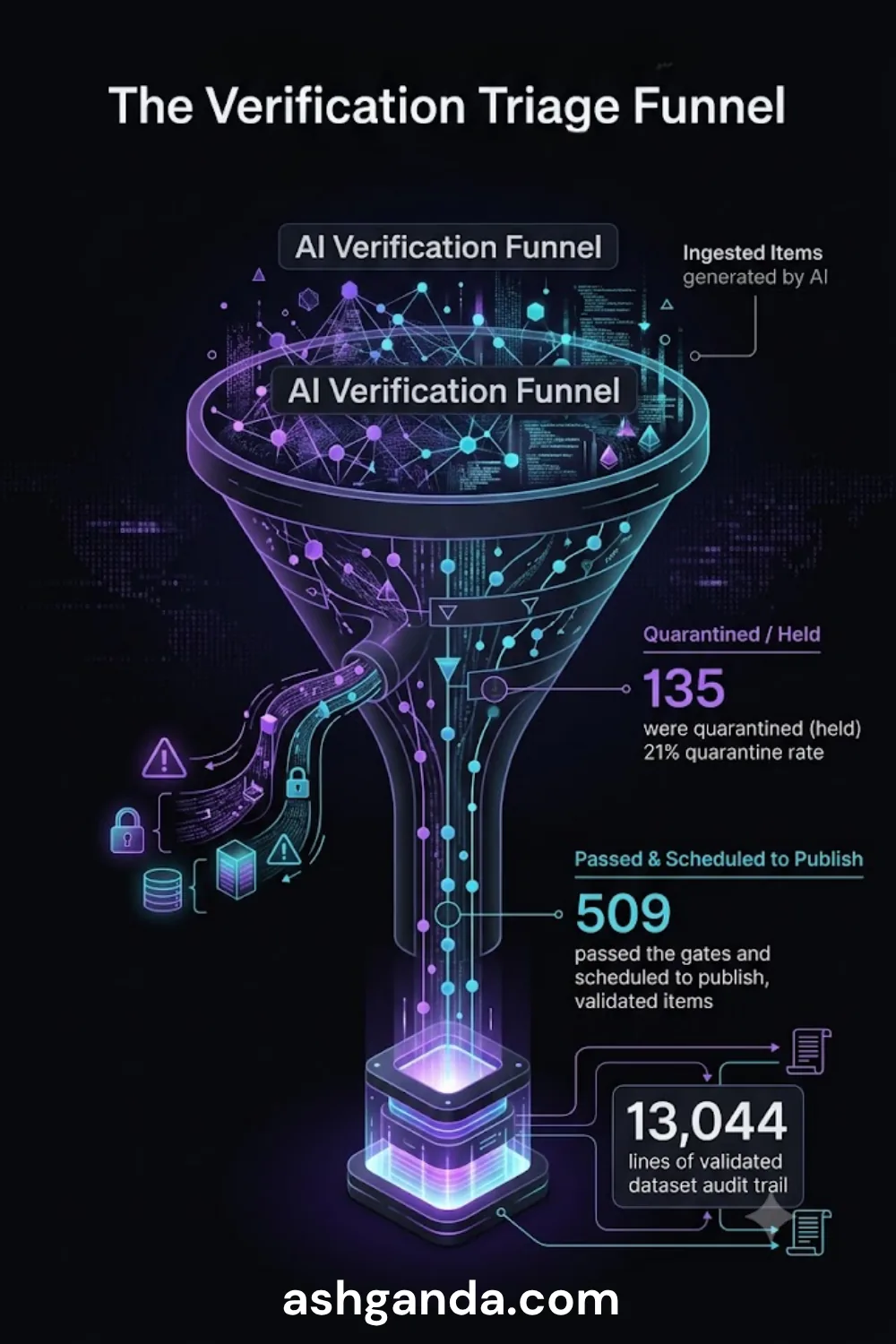
The July-20 verification run — the numbers
On 20 July 2026 the pipeline logged a single commit that captures the shape:
docs: Wisdom Booth verification run 2026-07-20 (509 scheduled, 135 held)— +13,044 lines
Read it as a triage funnel:
| Stage | Count | What it means |
|---|---|---|
| Ingested items | 644 | quotes / items that the generative pipeline produced this run |
| Scheduled to publish | 509 | passed every adversarial check and moved into the publish queue |
| Quarantined (held) | 135 | failed at least one gate; frozen at draft-status until a human reviews |
| Validated dataset appended | 13,044 lines | the audit trail of what was verified, what was held, and why |
135 out of 644 held is a 21% quarantine rate. In a naive pipeline those 135 items would have published, and the operating cost would be someone finding 135 subtly-wrong quotes in production over the next month — a slow-burn quality event that shows up in ranking losses, complaint emails, and eroded trust before anyone thinks to correlate it back to the pipeline.
What “adversarial” actually means at each gate
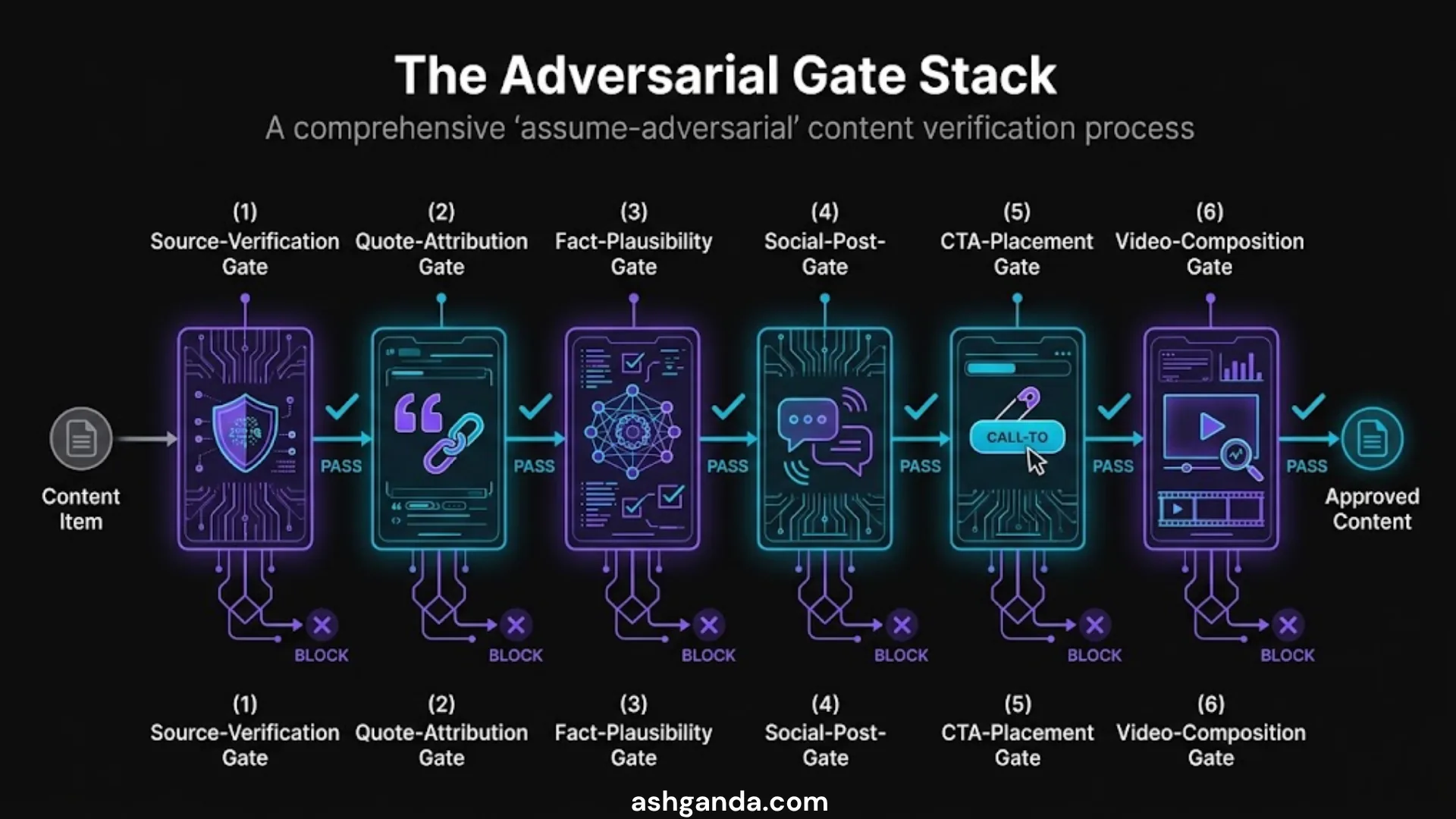
Every item runs a stack of checks. Each check is written to try to break the item rather than confirm it looks fine — the same discipline the security world calls “assume-adversarial” testing. In practice that means:
- Source-verification gate — the URL cited actually resolves and contains the claim (not a paraphrase, not a similar-sounding page).
- Quote-attribution gate — the quoted phrase appears verbatim in the cited source. This is the gate that catches the classic hallucinated-quote failure mode.
- Fact-plausibility gate — numbers, dates, and named entities are cross-checked against a maintained ground-truth set.
- Social-post-gate (Streamlined-Development, 17 July 2026, +330 lines) — per-channel fail-closed rules: image aspect ratio, caption length, hashtag ceiling, link policy, plus the adversarial content checks (AI-generic openers, missing hook, missing CTA, payoff-reveal).
- CTA-placement gate (Streamlined-Development, 18 July 2026, +289 lines) — the ask has to flow after the value, not interrupt it.
- Video-composition gate (Streamlined-Development, 18 July 2026, +347 lines) — form-aware render-stage rules; catches the “text-in-a-forbidden-safe-zone” failure that would otherwise ship a Reel with the CTA underneath Instagram’s chrome.
Each gate has one job: return PASS or BLOCK with a specific reason. There is no WARN-that-becomes-PASS-if-nobody-notices state. If it doesn’t pass, it doesn’t publish.
The gate-integrity meta-gate — the 287-line safety net
The single most common failure mode of a gate-based pipeline is a well-intentioned developer disabling a gate to unblock a deployment (“just for this one commit, we’ll re-enable it after”), and then never re-enabling it. Six weeks later the gate is technically in the codebase but hasn’t run since the disable. This is the drift I’ve written about before as quality-gate drift — silent, non-alarming, and the exact failure mode that convinces teams they have safety when they don’t.
On 19 July 2026 we shipped the meta-gate that closes that hole:
feat: gate-integrity meta-gate — make the gates un-bypassable— +287 lines (Streamlined-Development)
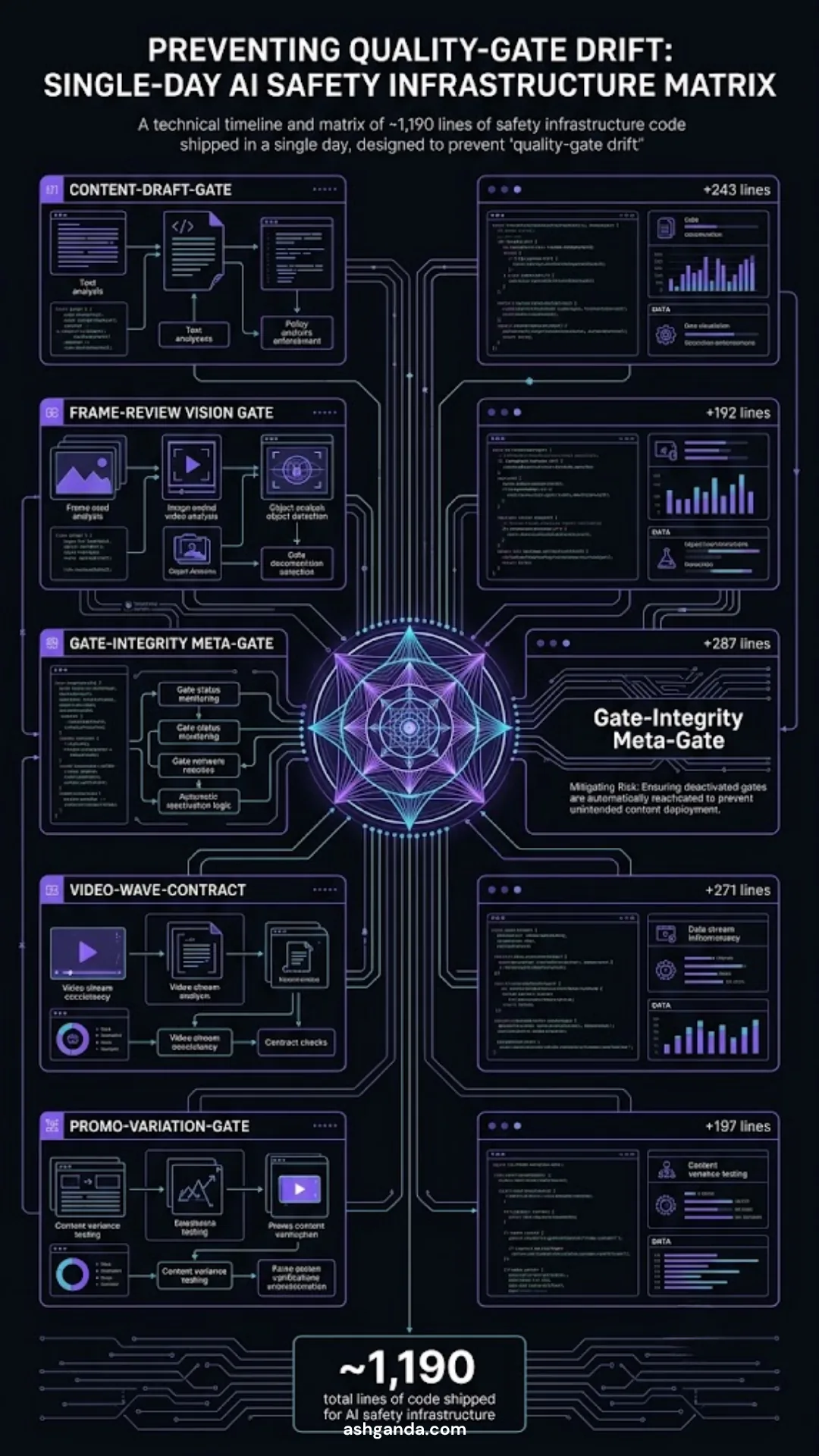
What it does, in one sentence: a check that runs before every publish and asserts that each named gate ran, returned a verdict, and that verdict was PASS. If any gate is missing from the ledger, the meta-gate blocks the publish. You cannot ship past it by commenting out a check — you have to remove the check from the manifest, which is itself a reviewable code change.
The same week’s other gate-hardening commits round out the picture:
| Commit | Date | Lines |
|---|---|---|
feat: content-draft-gate + universal gate manifest (enforce skill-use) | 2026-07-19 | +243 |
feat: frame-review vision-tier gate + composition crop-within-bounds | 2026-07-19 | +192 |
feat: gate-integrity meta-gate — make the gates un-bypassable | 2026-07-19 | +287 |
feat: video-wave-contract — wave-level gated contract for video-based social | 2026-07-19 | +271 |
feat: promo-variation-gate — rotate the angle per channel (no reused script) | 2026-07-19 | +197 |
Together that’s ~1,190 lines of gate infrastructure shipped in a single day, sitting under the pipelines that produce quotes for the Wisdom Booth, blog posts for the constellation, and video scripts for social. It’s not the interesting-to-read part of AI in production. It’s the load-bearing part.
The 34% trust gap — why this matters commercially
Return to Deloitte’s number: 38% of the workforce uses generative AI, only 34% trust the outputs. If you’re an Australian executive weighing an AI investment, that trust gap is your addressable risk. Every one of those 135 quarantined items from July 20 is a would-have-shipped mistake that a naive pipeline would have delivered to a reader. Compound that across a year and you don’t have an “AI content operation” — you have a slow-motion trust erosion event that your ranking and complaint queue will surface long before your dashboards do.
The fix isn’t more models. It’s more gates, and a meta-gate that ensures nobody can quietly turn them off.
The playbook, condensed
If you’re standing up a comparable pipeline:
- Every gate returns
PASSorBLOCK— neverWARN. WARN is a lie the pipeline tells itself. - Every gate is named in a manifest. Not “it’s in the code somewhere” — a single manifest the meta-gate reads.
- Every publish records which gates ran, what they returned, and their manifest version. That’s your audit trail (13,044 lines from the July 20 run) and your evidence for the next incident.
- Quarantine is the default. A held item doesn’t publish, doesn’t retry silently, and appears in a review queue with the failing gate’s reason.
- Ship a meta-gate. Nothing else on this list matters if a developer can bypass the whole stack.
Frequently asked questions
What is a fail-closed gate in an AI content pipeline?
A fail-closed gate is a check that returns PASS or BLOCK — never a soft warning that lets content ship. If the gate can’t confirm the content is safe to publish, it blocks. This is the opposite of the common “warn but publish anyway” pattern, which reliably degrades quality over months as warnings pile up ignored.
What is a gate-integrity meta-gate?
A meta-gate is a check that runs before every publish and asserts every other named gate ran and returned PASS. It’s a 287-line system shipped on 19 July 2026 to close the drift failure mode where a well-intentioned developer disables a gate to unblock a deploy and never re-enables it. You cannot bypass the meta-gate by commenting out a check — you have to remove the check from the manifest, which is a reviewable code change.
What quarantine rate is normal for an AI content pipeline?
The 20 July 2026 Wisdom Booth run held 135 of 644 items — 21%. That’s not a failure of the model; it’s the pipeline doing its job. A pipeline with a 0% quarantine rate isn’t perfect — it’s not checking. A pipeline with a 90% quarantine rate has a model or prompt problem upstream. 15-25% is a reasonable band for a mature production pipeline that generates then filters.
How is this different from human review?
Human review is the fallback when a gate blocks — not the primary check. The gates run on every item at machine speed; a human only reviews the ~21% that are quarantined. That inverts the traditional “human review every AI output” pattern, which is what makes AI-content operations expensive and slow. Adversarial gates make human review a bounded, valuable activity rather than a firehose.
Can I add these gates to an existing content pipeline?
Yes, incrementally. Start with the two gates that catch the loudest failure modes — source-verification (does the URL resolve to the claim?) and quote-attribution (does the quote appear verbatim in the cited source?). Then add the social-post-gate for per-channel rules. Then add the meta-gate. Building the meta-gate last is fine; building it never is where most pipelines end up drifting.
Related
- Cross-brand: the same gate stack sits under Cloud Geeks’ self-hosted Mautic + Chatwoot infrastructure — the fail-closed pattern applies to email deliverability just as tightly as to content publishing.
- Companion post: Checking 644 Quotes by Hand: The Unglamorous Reality of Making an AI Pipeline Trustworthy — the human side of the same run.
For technical deep-dives on the cloud and IT topics I cover strategically, visit Cloud Geeks — our specialist IT infrastructure blog. Ganda Tech Services is my technology consultancy, bringing together cloud infrastructure, web development, and mobile expertise for Australian businesses.
AI Strategy Primer for Australian Business Leaders
A practical framework for AI adoption in 2026 — cut through the hype and start with what matters.