Zero Trust Architecture: Enterprise Implementation Blueprint for 2024
Zero Trust Architecture: Enterprise Implementation Blueprint for 2024
The escalating sophistication of cyber threats, combined with the dissolution of traditional network perimeters, has forced enterprise CTOs to fundamentally reconsider their security architecture. Zero Trust is no longer a forward-looking concept—it’s becoming table stakes for enterprise security posture. With Gartner predicting that 60% of enterprises will implement Zero Trust as their primary security model by 2025, the question for technology leaders is not whether to adopt Zero Trust, but how to execute the transition strategically while maintaining operational continuity.
The stakes are clear. Breaches at major enterprises over the past 18 months—from Uber to Okta—have demonstrated that traditional perimeter security fails catastrophically when attackers gain initial access. Zero Trust architecture fundamentally shifts the security paradigm by operating on the principle of “never trust, always verify,” requiring continuous authentication and authorization for every user, device, and application regardless of location.
The Strategic Imperative: Why Zero Trust Matters Now
The convergence of four enterprise trends has created an inflection point that makes Zero Trust implementation urgent for mid-to-large organizations.
First, the hybrid work model is permanent. With 72% of enterprises maintaining hybrid or remote-first policies post-pandemic, the traditional network perimeter has become meaningless. Employees access corporate resources from home offices, coffee shops, and international locations. The castle-and-moat security model—where everything inside the corporate network is trusted—no longer reflects operational reality.
Second, cloud migration has accelerated. Enterprise workloads now span multiple clouds and on-premises data centers. A typical Fortune 500 company operates applications across AWS, Azure, and GCP, with sensitive data distributed across these environments. This multi-cloud reality creates attack surfaces that perimeter-based security cannot adequately protect.
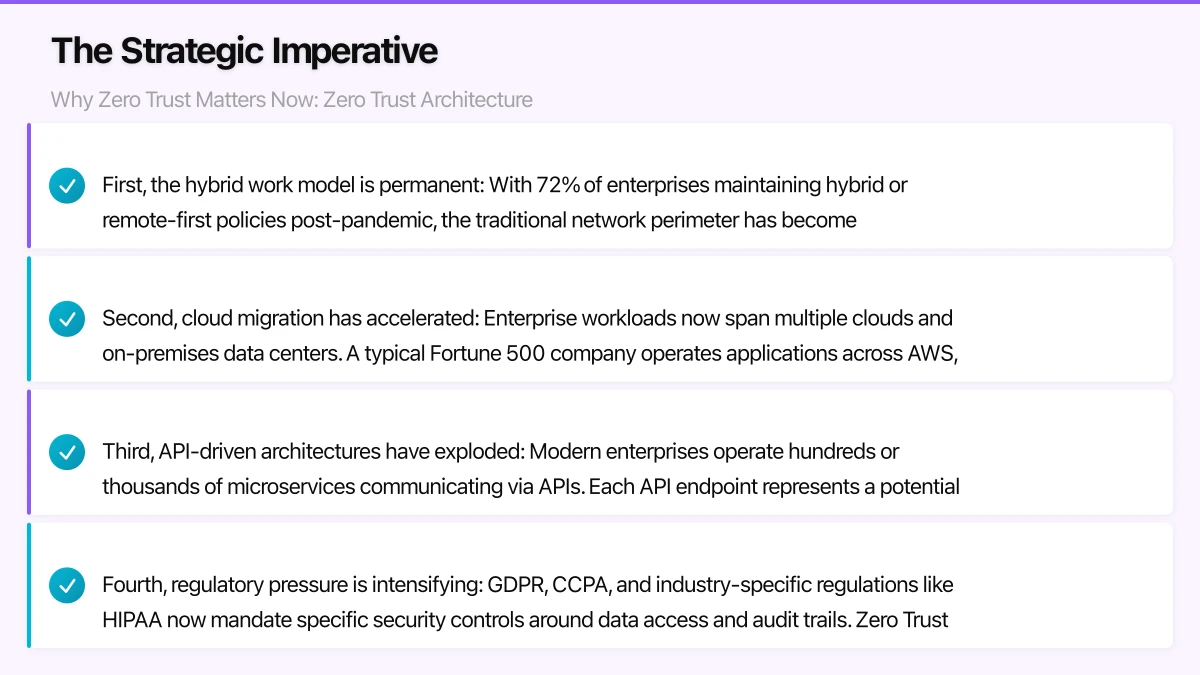
Third, API-driven architectures have exploded. Modern enterprises operate hundreds or thousands of microservices communicating via APIs. Each API endpoint represents a potential attack vector. Traditional network security tools lack the granularity to secure service-to-service communication at this scale.
Fourth, regulatory pressure is intensifying. GDPR, CCPA, and industry-specific regulations like HIPAA now mandate specific security controls around data access and audit trails. Zero Trust architecture provides the authentication, authorization, and logging infrastructure necessary to demonstrate compliance.
The business impact of inadequate security architecture is measurable and severe. IBM’s 2024 Cost of a Data Breach Report places the average enterprise breach cost at $4.88 million, with detection and containment taking an average of 277 days. Beyond direct costs, breaches damage customer trust, invite regulatory scrutiny, and create competitive disadvantage. For CTOs, Zero Trust represents both risk mitigation and strategic enablement—securing operations while enabling digital transformation initiatives.
Core Pillars: The Zero Trust Architecture Framework
Effective Zero Trust implementation rests on five interconnected pillars. Understanding each component and their interdependencies is critical before beginning the technical rollout.
Identity as the Primary Security Perimeter
In Zero Trust architecture, identity replaces network location as the primary security boundary. Every access request must be authenticated and authorized based on verified identity, regardless of whether it originates from inside or outside the traditional corporate network.
Enterprise-grade implementation requires moving beyond basic multi-factor authentication (MFA) to comprehensive identity and access management (IAM). This means deploying identity providers (IdPs) like Okta, Microsoft Entra ID (formerly Azure AD), or Ping Identity as the centralized authentication layer for all enterprise resources.
Key implementation considerations:
-
Single Sign-On (SSO) coverage: Achieve 95%+ application coverage with SAML 2.0 or OpenID Connect integration. Legacy applications requiring authentication modernization should be prioritized in the implementation roadmap.
-
Adaptive authentication policies: Implement risk-based authentication that considers user behavior, device posture, location, and access patterns. For example, a login from a new device in an unusual location should trigger step-up authentication even if initial credentials are valid.
-
Privileged access management (PAM): High-risk accounts—including administrators, developers with production access, and service accounts—require additional controls. Just-in-time (JIT) access provisioning limits standing privileges, while session recording provides audit trails for compliance.
Microsoft reports that enterprises with comprehensive MFA deployment block 99.9% of automated attacks targeting user accounts. However, MFA alone is insufficient—phishing-resistant authentication using FIDO2 security keys or biometrics is becoming necessary as attackers increasingly bypass SMS and app-based MFA.
Device Trust and Endpoint Security
Zero Trust requires validating not just who is accessing resources, but what device they’re using and its security posture. Every endpoint—whether corporate-managed laptop, personal mobile device, or IoT sensor—must be authenticated and assessed before being granted access.
Enterprise device trust strategies typically combine endpoint detection and response (EDR) platforms like CrowdStrike or Microsoft Defender with mobile device management (MDM) solutions like Jamf or Microsoft Intune. These platforms provide continuous posture assessment, checking for:
- Operating system patch levels: Devices running outdated OS versions with known vulnerabilities are denied access or restricted to non-sensitive resources.
- Security software status: Antivirus, endpoint protection, and disk encryption must be active and up-to-date.
- Jailbreak or root detection: Compromised mobile devices pose elevated risk and should be blocked from accessing sensitive data.
- Application control: Unauthorized or malicious applications trigger access restrictions.
For BYOD (bring your own device) scenarios, enterprise mobility management (EMM) solutions create containerized work environments on personal devices, isolating corporate data and applications from personal use. This balances employee privacy concerns with enterprise security requirements.
The device trust pillar becomes particularly critical when securing access to sensitive environments like production infrastructure or customer data systems. At Cloudflare, for example, all production access requires device certificate authentication in addition to user credentials—a “who and what” verification model.
Microsegmentation and Network Isolation
Traditional network security relies on flat topologies with perimeter firewalls—once attackers breach the perimeter, they can move laterally across the network with minimal resistance. Microsegmentation divides the network into isolated zones, with granular policies controlling traffic between segments.
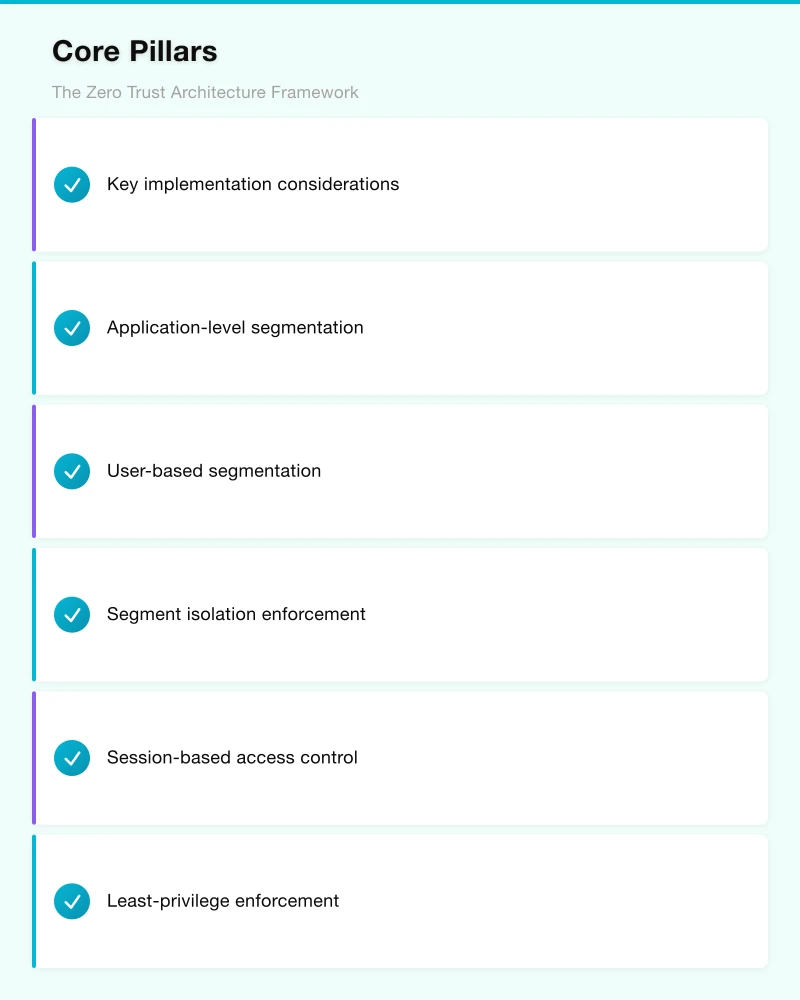
Enterprise microsegmentation operates at multiple layers:
Application-level segmentation groups workloads by function, environment, and sensitivity. Production databases live in isolated segments separate from application servers, with explicit allow-list policies controlling which services can communicate. This prevents attackers who compromise a web server from immediately accessing backend databases.
User-based segmentation restricts which network segments users can access based on role and context. Finance team members access financial systems; they cannot reach engineering development environments. Even with valid credentials, users are restricted to the minimal network access required for their role.
Segment isolation enforcement occurs through software-defined networking (SDN), next-generation firewalls (NGFW), or cloud-native security groups. In AWS environments, this means security groups and NACLs configured with deny-by-default policies. In on-premises data centers, it requires NGFW or SDN overlay networks like VMware NSX.
Google’s BeyondCorp implementation demonstrates microsegmentation at scale. Rather than granting VPN access to broad network segments, BeyondCorp grants per-application access based on device posture and user identity. An engineer accessing a development environment receives only the network connectivity necessary to reach that specific application—no lateral movement capability within the broader network.
Effective microsegmentation requires substantial network visibility to map application dependencies and data flows. Enterprises should expect 3-6 months of discovery and mapping before implementing enforcement policies, using network monitoring tools to understand legitimate traffic patterns and prevent operational disruption.
Continuous Verification and Least-Privilege Access
Zero Trust fundamentally rejects implicit trust. Authentication is not a one-time event at login—it’s a continuous process throughout the user’s session. Access decisions are dynamically evaluated based on changing risk factors.
Session-based access control treats each access request as an independent decision point. When a user attempts to open a sensitive document or query a database, the system re-evaluates their current authentication status, device posture, location, and behavior before granting access. If risk indicators change mid-session—such as a new device joining the network or anomalous access patterns—access can be revoked or step-up authentication required.
Least-privilege enforcement grants users the minimum permissions necessary to complete their tasks. Rather than broad role-based access control (RBAC) categories like “developer” or “analyst,” granular permissions specify exactly which resources each user can access and which actions they can perform.
Modern authorization platforms like Okta Workflows, AWS IAM, or Google Cloud IAM enable attribute-based access control (ABAC) policies that consider multiple contextual factors:
- User attributes (role, department, clearance level)
- Resource attributes (data classification, compliance requirements)
- Environmental attributes (time of day, location, network)
- Session attributes (authentication strength, device trust score)
For example, a developer might have read access to production logs from a corporate network during business hours using a managed device with MFA. The same developer attempting access from a personal device outside business hours triggers additional verification or access denial.
Time-bound access automatically expires permissions after a defined period. Engineers granted temporary production access for incident response lose those privileges when the maintenance window closes, eliminating standing privileges that create security risk.
Comprehensive Visibility and Analytics
Zero Trust generates enormous volumes of authentication, authorization, and access data. This telemetry is not just audit trail—it’s the foundation for continuous security improvement and threat detection.
Enterprise security information and event management (SIEM) platforms like Splunk, Chronicle, or Microsoft Sentinel aggregate logs from identity providers, network infrastructure, applications, and endpoints. Security operations centers (SOCs) use this data to detect anomalous patterns indicating potential breaches:
- Impossible travel scenarios where the same user authenticates from geographically distant locations within minutes
- Unusual access patterns like a finance employee suddenly accessing engineering repositories
- Privilege escalation attempts or repeated authorization failures
- Data exfiltration indicators like large-volume downloads or unusual API activity
Machine learning-based user and entity behavior analytics (UEBA) establish baselines for normal behavior, flagging deviations that may indicate compromised accounts. When an attacker gains access to legitimate credentials, their behavior typically differs from the actual user’s patterns—different applications accessed, unusual times of activity, or atypical data queries.
Zero Trust architecture provides the granular audit trails required for compliance with regulations like GDPR, HIPAA, and SOX. Every access attempt, granted or denied, creates an immutable record showing who accessed what data, when, from which device, and under which policies. This satisfies auditor requirements and enables forensic investigation when incidents occur.
Enterprise Implementation Roadmap
Transitioning to Zero Trust architecture is a multi-year transformation that requires careful planning to avoid operational disruption. Based on implementations at Fortune 500 enterprises, the following phased approach balances security improvement with business continuity.
Phase 1: Assessment and Foundation (3-6 months)
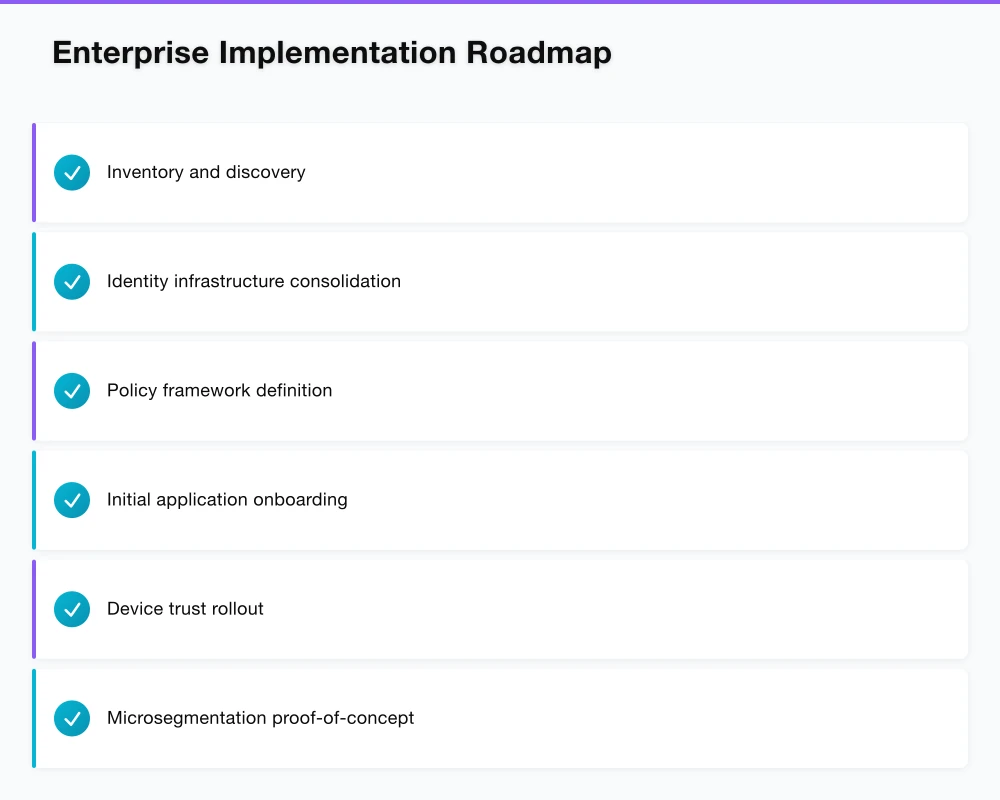
Inventory and discovery forms the critical first step. Most enterprises lack comprehensive understanding of their application portfolio, data flows, and access patterns. Discovery tools like Forescout, Armis, or cloud-native inventory services map:
- All applications and their authentication mechanisms
- Network topology and traffic patterns between applications
- User populations and their current access levels
- Data repositories and classification levels
- Legacy systems requiring authentication modernization
Identity infrastructure consolidation establishes the foundation for Zero Trust. Many enterprises operate multiple identity silos—Active Directory for on-premises, separate cloud IdPs, and application-specific user databases. Consolidation into a centralized identity provider enables consistent authentication policies and audit trails.
For organizations with Microsoft investments, migrating to Microsoft Entra ID provides integration with existing Active Directory, Azure services, and Microsoft 365. Organizations with multi-cloud architectures often choose vendor-neutral IdPs like Okta to avoid cloud platform lock-in.
Policy framework definition translates business requirements into technical access policies. This requires collaboration between security, IT, application owners, and business units to define:
- Role definitions and permission boundaries
- Data classification and handling requirements
- Risk-based authentication thresholds
- Acceptable use policies for personal devices
Phase 2: Pilot Implementation (4-6 months)
Initial application onboarding begins with non-critical applications to test policies and workflows without risking core business operations. SaaS applications like Salesforce or Slack typically integrate easily via SAML or OpenID Connect, providing quick wins that demonstrate value.
Device trust rollout starts with corporate-managed endpoints before expanding to BYOD scenarios. Deploy MDM agents and configure baseline security requirements—OS versions, encryption, security software. Test device-based access policies with a pilot user group before broad deployment.
Microsegmentation proof-of-concept isolates a single application tier—typically development environments—to validate segmentation policies. Map application dependencies, define security policies, and monitor traffic to ensure policies don’t break legitimate functionality. This phase identifies operational issues before implementing segmentation in production.
Phase 3: Production Rollout (12-18 months)
Phased application migration prioritizes based on risk and business impact:
- High-risk, low-complexity applications: Sensitive applications with straightforward authentication requirements
- Business-critical applications: Core systems requiring careful planning and validation
- Legacy applications: Systems requiring authentication modernization or proxy-based integration
Network segmentation enforcement progresses through environments—development, staging, then production. Begin with monitoring mode to validate policies, then transition to enforcement. Expect iterative refinement as edge cases emerge.
Continuous authentication rollout enables session-based verification and risk-adaptive policies. Start with low-risk scenarios, gradually increasing sensitivity thresholds as user experience impact is understood.
Phase 4: Optimization and Maturity (Ongoing)
Policy refinement based on operational data and security telemetry. Overly restrictive policies create friction and workarounds; insufficient controls create risk. Continuous adjustment balances security and usability.
Automated response capabilities enable systems to take action when threats are detected—revoking access, isolating devices, or triggering incident response workflows.
Third-party integration extends Zero Trust to partner and vendor access, supply chain systems, and B2B integrations.
Vendor Landscape and Technology Selection
Enterprise Zero Trust implementations typically combine platforms across multiple categories. No single vendor provides complete Zero Trust functionality—successful implementations require integration across identity, network, endpoint, and analytics tools.
Identity and access management: Microsoft Entra ID dominates organizations with Microsoft investments, offering tight integration with Azure, Microsoft 365, and on-premises Active Directory. Okta provides vendor-neutral alternative with extensive pre-built integrations. Ping Identity targets enterprises with complex identity federation requirements.
Secure access service edge (SASE): Platforms like Zscaler, Palo Alto Networks Prisma Access, and Cloudflare Access combine zero trust network access (ZTNA) with cloud-delivered security services. ZTNA replaces VPNs with application-level access controls, granting users direct access to specific applications rather than broad network segments.
Endpoint security: CrowdStrike Falcon, Microsoft Defender for Endpoint, and SentinelOne provide EDR capabilities with device trust integration. These platforms detect threats, assess device posture, and integrate with access control systems to enforce policies.
Network segmentation: Cloud-native security groups (AWS Security Groups, Azure NSGs, GCP Firewall Rules) provide microsegmentation for cloud workloads. On-premises segmentation requires SDN platforms like VMware NSX or next-generation firewalls from Palo Alto Networks or Cisco.
SIEM and analytics: Splunk, Microsoft Sentinel, and Google Chronicle aggregate security telemetry for threat detection and compliance. Choosing platforms with native integrations to your identity and network infrastructure reduces integration complexity.
Technology selection should prioritize integration over best-of-breed approaches. Zero Trust effectiveness depends on platforms sharing context and making coordinated access decisions. Organizations with Azure investments often choose Microsoft-centric stacks for seamless integration. Multi-cloud organizations typically combine Okta for identity with cloud-agnostic SASE and endpoint platforms.
Risk Mitigation and Common Implementation Challenges
Zero Trust implementations fail when they prioritize security theory over operational reality. Several patterns commonly derail enterprise rollouts.
User resistance and productivity impact: Overly aggressive authentication policies create friction that drives workarounds. Users who face repeated MFA prompts for routine tasks will find ways to circumvent controls. Implement smart authentication policies that balance security with user experience—risk-based authentication that steps up security for sensitive operations while minimizing friction for low-risk activities.
Legacy application constraints: Enterprises operate applications that cannot support modern authentication protocols. Mainframe systems, industrial control software, and vendor applications with proprietary authentication require alternative approaches. Identity-aware proxies can add modern authentication to legacy systems, and privileged access management solutions provide secure access to systems that cannot be directly modernized.
Operational complexity and tool sprawl: Enterprises that deploy too many point solutions create unmanageable complexity. Security teams overwhelmed by tool sprawl cannot effectively monitor and respond to threats. Prioritize integration and automation—platforms should share context and orchestrate responses without manual intervention.
Performance and latency concerns: Continuous authentication and verification introduce processing overhead. Applications with stringent performance requirements need careful architecture to avoid degrading user experience. Edge-deployed access control, caching strategies, and asynchronous verification can minimize latency impact.
Incomplete visibility: Zero Trust depends on comprehensive telemetry from all access points. Shadow IT, unmanaged devices, and legacy systems create blind spots that undermine security posture. Network monitoring and cloud access security brokers (CASB) help discover and manage unsanctioned resources.
Looking Forward: The Evolution of Zero Trust
Zero Trust is not a static architecture but an evolving approach that will adapt to emerging technologies and threats. Several trends are shaping the next phase of enterprise Zero Trust maturity.
AI-driven access decisions will move beyond rule-based policies to intelligent systems that understand normal behavior and detect subtle anomalies. Machine learning models trained on organizational access patterns will make real-time risk assessments more accurate than policy engines can achieve.
Passwordless authentication eliminates the weakest link in identity security. FIDO2 security keys, biometric authentication, and passkeys provide phishing-resistant authentication that’s more secure and user-friendly than passwords and traditional MFA. Microsoft announced plans to make passwordless authentication the default for consumer and enterprise accounts, signaling industry direction.
Zero Trust for operational technology (OT) extends security principles to industrial control systems, medical devices, and IoT environments. These systems traditionally relied on air-gapped networks, but increasing connectivity demands Zero Trust approaches adapted to resource-constrained devices and real-time operational requirements.
Decentralized identity using blockchain and verifiable credentials could transform how organizations manage identity federation and third-party access, reducing dependence on centralized identity providers while improving privacy.
For enterprise CTOs, Zero Trust represents both immediate security imperative and long-term strategic investment. The transition requires significant planning, investment, and organizational change—but the alternative is accepting unacceptable risk in an environment where perimeter security no longer provides adequate protection. Organizations that successfully implement Zero Trust architecture gain not just improved security posture, but the foundation for secure digital transformation and competitive advantage in an increasingly hostile threat landscape.
Ready to develop your enterprise Zero Trust strategy? Contact Ash Ganda for strategic advisory on security architecture and digital transformation.
Need to put cloud strategy into action? Cloud Geeks provides in-depth guides on AWS, Azure, and cybersecurity for Australian SMBs.
These insights are drawn from my work leading Ganda Tech Services — helping Australian businesses navigate digital transformation through cloud, web, and mobile.
About the Author
Ashish Ganda is the founder of Ganda Tech Services, a Sydney-based technology consultancy specialising in cloud infrastructure, web development, and mobile app solutions for Australian businesses.
Digital Transformation Roadmap 2026
A 12-month framework for Australian SMBs ready to modernise — phases, tools, and milestones.