Technology Risk Management: Enterprise Framework for CTOs
As enterprises accelerate digital transformation initiatives in 2024, technology risk has evolved from an IT concern to a board-level strategic imperative. The convergence of cloud adoption, AI integration, and increasingly sophisticated cyber threats has fundamentally changed the risk landscape. For CTOs, developing a comprehensive risk management framework isn’t just about protecting infrastructure—it’s about enabling sustainable innovation while maintaining stakeholder confidence.
The stakes have never been higher. Recent data shows that technology failures cost enterprises an average of $5.6 million per incident, while cybersecurity breaches now carry an average total cost of $4.45 million globally. Yet the greater risk lies in organizational paralysis: companies that fail to manage technology risk effectively struggle to execute strategic initiatives, losing competitive ground to more agile competitors.
Understanding the Modern Technology Risk Taxonomy
Technology risk in 2024 extends far beyond traditional IT security concerns. A comprehensive enterprise framework must address six interconnected risk domains, each requiring distinct governance approaches while maintaining strategic alignment.
Cybersecurity and Information Security Risk remains the most visible domain, encompassing threats from external actors, insider risks, and data protection failures. The shift to hybrid work environments and cloud-native architectures has expanded the attack surface exponentially. Zero-trust architecture has moved from emerging practice to enterprise standard, with 67% of large organizations now implementing zero-trust principles across their infrastructure.
Operational Technology Risk has gained prominence as operational technology and information technology converge. Manufacturing, energy, and logistics enterprises face unique challenges securing industrial control systems and IoT deployments. The Colonial Pipeline incident demonstrated how OT vulnerabilities can create systemic business continuity risks, driving renewed focus on air-gapped systems and segmented networks.
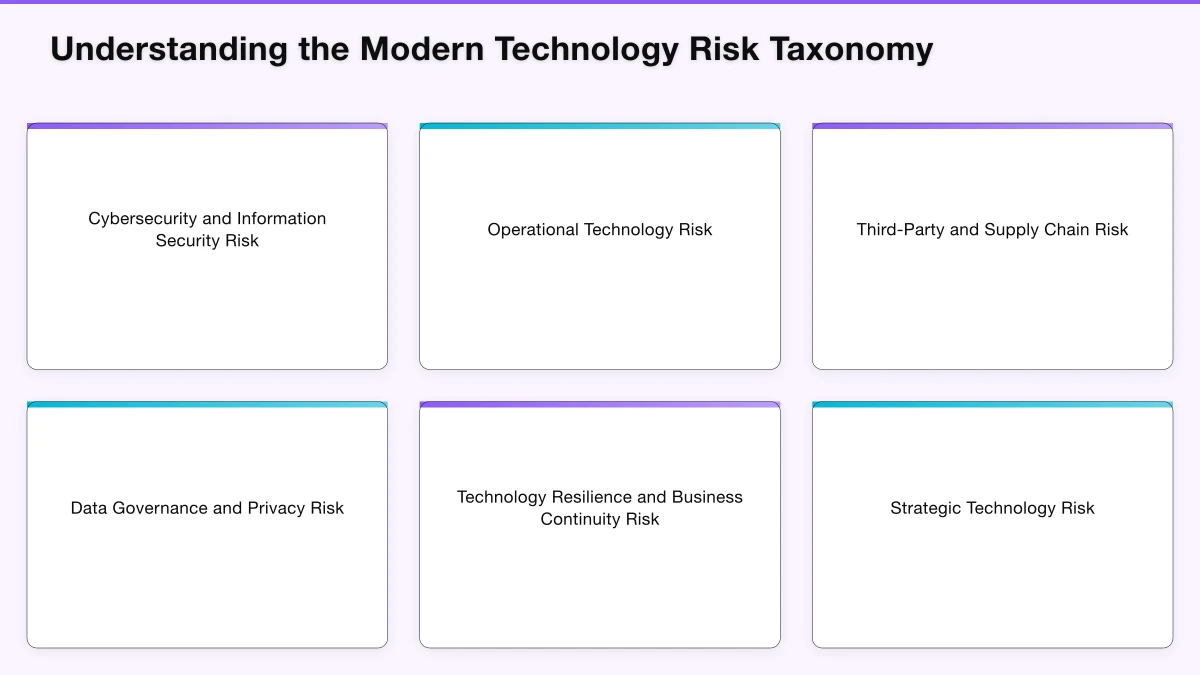
Third-Party and Supply Chain Risk represents perhaps the most complex challenge facing CTOs. Modern enterprises rely on ecosystems of SaaS providers, cloud platforms, managed service providers, and software supply chains. The SolarWinds attack exposed how vulnerabilities in trusted vendors can compromise thousands of downstream customers. Effective third-party risk management requires continuous monitoring, not annual vendor assessments.
Data Governance and Privacy Risk continues to evolve as regulatory frameworks expand globally. Beyond GDPR and CCPA, organizations now navigate Brazil’s LGPD, China’s PIPL, and dozens of industry-specific requirements. AI and machine learning initiatives introduce new data risks, particularly around algorithmic bias and model explainability. The challenge isn’t just compliance—it’s maintaining trust while extracting value from data assets.
Technology Resilience and Business Continuity Risk addresses the organization’s ability to maintain operations during disruptions. Cloud outages at major providers have demonstrated that even highly reliable platforms face availability challenges. Multi-cloud and hybrid strategies offer resilience but introduce architectural complexity. Recovery time objectives that seemed adequate for on-premises infrastructure may prove insufficient for real-time digital services.
Strategic Technology Risk encompasses the risks of technology decisions themselves. Selecting the wrong cloud platform, investing in obsolete architectures, or failing to adopt emerging capabilities can undermine competitive positioning. This domain also includes technical debt accumulation, talent retention challenges, and the risks inherent in transformation initiatives.
Risk Assessment Methodologies for Enterprise Scale
Effective risk assessment requires structured methodologies that scale across diverse technology portfolios while enabling consistent board-level reporting. Leading enterprises employ tiered approaches that balance rigor with operational efficiency.
Quantitative Risk Assessment provides the financial lens executives require for risk-informed decision making. The Factor Analysis of Information Risk (FAIR) framework has gained significant traction in enterprise environments, enabling CTOs to express technology risks in monetary terms. FAIR quantifies risk as probable loss magnitude over time, considering both threat event frequency and vulnerability magnitude.
Implementing quantitative assessment begins with asset valuation and threat cataloging. A financial services CTO might assess the risk of a customer database breach by estimating exposure (100 million customer records), asset value ($180 per record based on regulatory fines and remediation costs), threat event frequency (2.3 events per year based on industry data), and vulnerability (60% probability of successful exploitation given current controls). This yields an annualized loss expectancy of $248 million—a figure that immediately contextualizes security investment decisions.
The Monte Carlo simulation approach extends quantitative assessment by modeling probability distributions rather than point estimates. Using 10,000 simulation runs, organizations can express risk as a probability curve: “There is a 90% probability that annual losses from ransomware will not exceed $12 million, but a 5% probability they could reach $40 million.” This enables sophisticated risk appetite discussions and informs cyber insurance purchasing decisions.
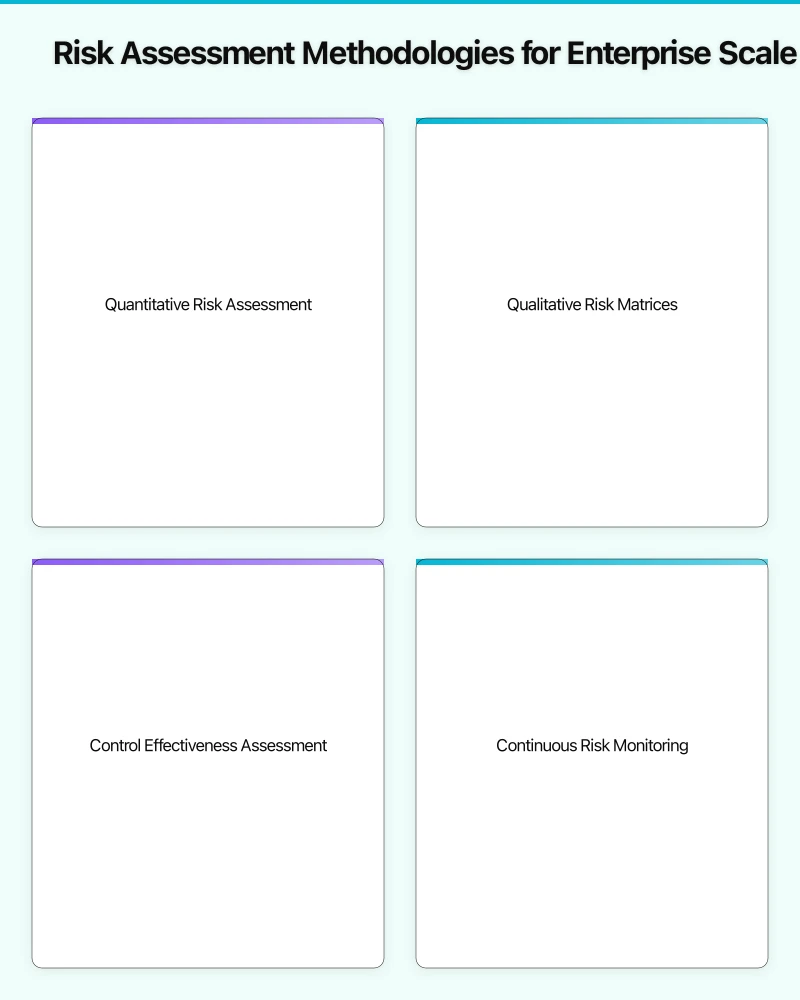
Qualitative Risk Matrices remain essential for rapid assessment and strategic communication. The NIST Cybersecurity Framework provides a widely adopted structure, categorizing risks across five functions: Identify, Protect, Detect, Respond, and Recover. Organizations typically employ a 5×5 matrix plotting likelihood against impact, with clear escalation thresholds for different risk scores.
The key to effective qualitative assessment lies in consistent calibration. A “high impact” security event must carry the same weight across different assessment teams. Leading organizations develop risk scoring rubrics with specific examples: “High impact: revenue loss exceeding $10M, regulatory penalties, or C-suite terminations. Medium impact: revenue loss of $1-10M, customer churn exceeding 5%, or significant media coverage.”
Control Effectiveness Assessment bridges the gap between identified risks and mitigation activities. The maturity model approach, popularized by CMMI and adapted for cybersecurity through frameworks like NIST’s Cybersecurity Maturity Model Certification (CMMC), enables organizations to assess control sophistication across five levels: Initial (ad-hoc), Managed (documented), Defined (standardized), Quantitatively Managed (measured), and Optimizing (continuously improving).
A practical control assessment examines three dimensions: design effectiveness (is the control theoretically capable of mitigating the risk?), implementation completeness (is it deployed consistently?), and operational effectiveness (does evidence demonstrate it functions as intended?). For example, multi-factor authentication might score high on design effectiveness but medium on implementation completeness if only 73% of user accounts have MFA enabled.
Continuous Risk Monitoring represents the evolution from point-in-time assessments to real-time risk posture management. Security information and event management (SIEM) platforms, extended detection and response (XDR) solutions, and continuous controls monitoring tools enable automated risk scoring based on actual environmental conditions.
Modern platforms aggregate data from vulnerability scanners, configuration management databases, threat intelligence feeds, and security controls to calculate dynamic risk scores. When a new critical vulnerability affecting the organization’s technology stack emerges, risk scores update automatically, triggering remediation workflows based on predefined thresholds. This shift from quarterly risk reviews to continuous monitoring fundamentally changes how organizations respond to emerging threats.
Strategic Mitigation and Control Frameworks
Once risks are assessed, CTOs must architect control environments that mitigate risks cost-effectively while enabling business objectives. The strategic challenge lies in avoiding both under-investment (leaving critical risks unaddressed) and over-investment (implementing controls that provide diminishing returns).
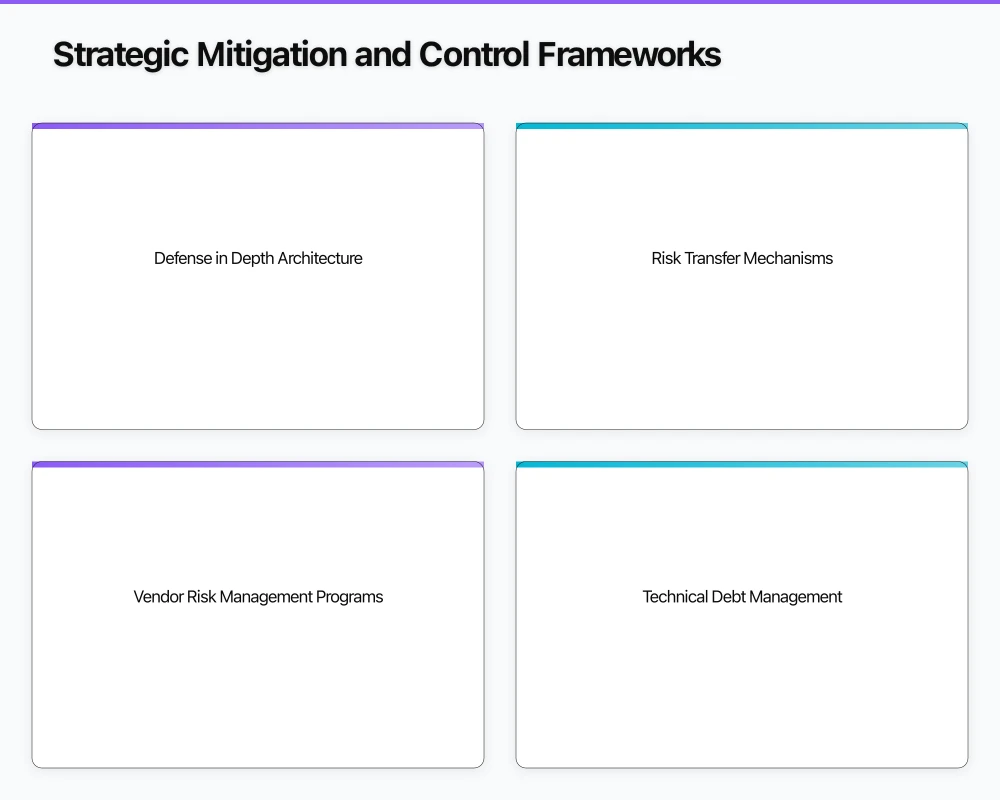
Defense in Depth Architecture remains the foundational principle for security control design. Rather than relying on perimeter defenses, layered controls ensure that compromising a single layer doesn’t result in complete system failure. A modern implementation includes endpoint detection and response, network segmentation, application-level security controls, data encryption, and privileged access management.
Consider cloud infrastructure security as a concrete example. AWS environments should implement controls at multiple layers: identity and access management with least-privilege policies enforced through service control policies, network security through VPC design with private subnets and security groups, compute security via instance hardening and patch management, application security through web application firewalls and API gateways, and data security via encryption at rest and in transit with AWS KMS. Each layer mitigates distinct attack vectors while creating overlapping protections.
Risk Transfer Mechanisms enable organizations to shift certain risks to third parties when direct mitigation proves cost-prohibitive. Cyber insurance has matured significantly, with global cyber insurance premiums reaching $11.9 billion in 2024. However, the market has tightened considerably, with insurers now requiring evidence of specific controls before offering coverage.
Modern cyber insurance policies typically require multi-factor authentication for all remote access, endpoint detection and response deployed to at least 95% of systems, regular backup testing with air-gapped copies, and documented incident response procedures with tabletop exercises conducted quarterly. Organizations failing to meet these requirements face significantly higher premiums or coverage exclusions. The strategic value extends beyond financial recovery—the underwriting process itself provides external validation of security posture.
Vendor Risk Management Programs must evolve beyond annual questionnaires to continuous assurance models. The tiered approach segments vendors based on risk exposure: critical vendors (those with access to sensitive data or critical systems) undergo comprehensive assessments including on-site audits, penetration test result reviews, and SOC 2 validation. Standard vendors receive automated security posture assessments through platforms like SecurityScorecard or BitSight, while low-risk vendors complete self-attestations.
The contractual dimension carries equal weight. Vendor agreements should mandate specific security requirements, define incident notification timelines (24 hours for breaches affecting customer data), establish audit rights, and allocate liability for security failures. Right-to-audit clauses prove particularly valuable, enabling organizations to validate vendor representations when risk profiles change.
Technical Debt Management represents a frequently overlooked mitigation strategy. Legacy systems, outdated frameworks, and accumulated architectural shortcuts create ongoing security and operational risks. A systematic technical debt reduction program treats debt as a quantifiable risk factor, allocating 15-20% of engineering capacity to debt remediation based on risk-weighted priorities.
Organizations can quantify technical debt using metrics like code complexity, dependency age, and test coverage, then correlate these with security vulnerability density and operational incident rates. This enables data-driven conversations: “Our payment processing system carries $2.3 million in annualized risk due to outdated dependencies and inadequate test coverage. A six-month modernization effort would reduce this to $400,000 while improving feature velocity by 35%.”
Board-Level Risk Reporting and Governance
Translating technical risk assessments into board-level insights requires a fundamental shift in communication approach. Directors need sufficient detail to exercise oversight responsibilities while maintaining focus on strategic risk questions rather than operational minutiae.
Risk Dashboard Design should prioritize trend visualization over point-in-time snapshots. Effective dashboards present risk posture changes over rolling 12-month periods, enabling boards to assess whether the overall risk trajectory is improving or deteriorating. Key metrics include aggregate risk score, critical vulnerability exposure, mean time to remediate high-severity findings, third-party risk concentration, and major incident frequency.
The traffic light approach, while simple, often proves most effective: green indicates risks within appetite, yellow indicates risks approaching thresholds requiring attention, and red indicates risks exceeding appetite requiring immediate action. Each indicator should link to a one-page deep-dive providing context, root cause analysis, and remediation plans.
Risk Appetite Statements formalize the organization’s willingness to accept specific risk levels in pursuit of strategic objectives. A well-crafted statement might read: “The organization maintains a low risk appetite for customer data protection, accepting no more than a 5% annual probability of material data breach. The organization maintains a moderate risk appetite for innovation initiatives, accepting elevated risks during pilot phases provided robust containment controls limit potential impact to defined test environments.”
These statements guide investment prioritization and provide objective criteria for escalation decisions. When a new AI initiative carries risks exceeding stated appetites, it triggers board-level review rather than proceeding at management discretion. This framework prevents both reckless innovation and excessive risk aversion.
Regulatory and Compliance Reporting increasingly demands board-level attention as regulatory frameworks expand expectations for director oversight. The SEC’s new cybersecurity disclosure rules, effective in 2024, require public companies to disclose material cybersecurity incidents within four business days and provide annual disclosures on cybersecurity risk management, strategy, and governance.
Board reporting should map enterprise risk management activities to regulatory requirements, demonstrating how the organization satisfies obligations under frameworks like SOX, GDPR, HIPAA, or sector-specific regulations. Audit committee materials might include a compliance matrix showing control status across all applicable frameworks, outstanding findings from regulatory examinations, and progress on remediation commitments.
Incident Response Integration ensures boards receive timely notification of material security events through predefined escalation criteria. Incidents meeting specific thresholds—affecting more than 100,000 customers, causing system outages exceeding four hours, resulting in unauthorized data access, or generating media coverage—trigger immediate board notification regardless of business hours.
Post-incident board reporting should follow a structured format: incident timeline and scope, root cause analysis, customer and regulatory impacts, remediation actions, and lessons learned for control improvement. The focus should extend beyond the specific incident to systemic questions: does this incident reveal broader control weaknesses? Are similar vulnerabilities present in other systems? Does it indicate inadequate investment in specific risk domains?
Building Resilient Risk Management Capabilities
Sustainable risk management requires embedded capabilities rather than episodic assessments. Leading organizations are investing in people, processes, and technology that make risk management a continuous competency rather than a periodic compliance exercise.
Risk-Aware Culture Development begins with tone from the top. When CEOs and CTOs consistently prioritize risk discussions in strategy sessions, acknowledge uncertainty transparently, and reward teams for identifying risks early, it creates psychological safety for risk escalation. Organizations with mature risk cultures celebrate near-miss incidents as learning opportunities rather than seeking to assign blame.
Practical mechanisms include incorporating risk management objectives into performance reviews for technical leaders, requiring architecture review boards to assess security implications before approving major initiatives, and establishing bug bounty programs that recognize security researchers who identify vulnerabilities responsibly. The metric that matters most: time from risk identification to executive awareness. Organizations with strong risk cultures average 2.3 days; those with weak cultures average 47 days.
Automation and Tooling Integration enables risk management to scale with technology portfolio complexity. Modern governance, risk, and compliance (GRC) platforms integrate with cloud providers, security tools, and IT service management systems to automate control evidence collection, risk scoring, and compliance reporting. This reduces manual effort while improving data accuracy and enabling real-time risk visibility.
Infrastructure as code scanning tools like Checkov or Terraform Sentinel enable shift-left security, identifying misconfigurations before deployment rather than discovering them through subsequent audits. When integrated into CI/CD pipelines, these tools prevent high-risk configurations from reaching production environments, reducing remediation costs by 90% compared to post-deployment fixes.
Metrics-Driven Continuous Improvement transforms risk management from a cost center to a performance optimization function. Leading indicators like vulnerability discovery rate, mean time to patch, security training completion rates, and phishing simulation click rates enable proactive risk reduction. Lagging indicators like actual incident frequency, regulatory findings, and audit deficiencies validate control effectiveness.
The key insight: risk management effectiveness should correlate with business outcomes. Organizations with mature risk management capabilities experience 38% faster cloud adoption, 42% reduction in unplanned outages, and 27% higher developer productivity due to reduced security remediation cycles. These operational benefits often exceed direct risk mitigation value.
Strategic Implications for Technology Leadership
Technology risk management has evolved from a defensive capability to a strategic enabler. Organizations that excel at identifying, assessing, and mitigating risks can pursue aggressive innovation strategies that competitors with immature risk capabilities cannot match. The CTO’s role encompasses not just managing current risks but architecting resilience into future capabilities.
The enterprises succeeding in 2024’s environment share common characteristics: they quantify risks in business terms, maintain transparent communication with boards and regulators, invest in automated risk monitoring, and treat risk management as a competitive advantage rather than a compliance burden. As technology continues to permeate every aspect of enterprise operations, these capabilities will increasingly separate market leaders from those struggling to manage complexity.
For CTOs, the imperative is clear: develop risk management frameworks that are comprehensive enough to address diverse threats, sophisticated enough to satisfy regulatory expectations, and pragmatic enough to avoid becoming obstacles to innovation. The organizations that achieve this balance will be positioned to capitalize on emerging technologies while maintaining the trust of customers, shareholders, and regulators.
Ash Ganda is a technology strategist advising enterprises on digital transformation, cloud architecture, and innovation acceleration. Connect on LinkedIn to discuss enterprise technology leadership.
For the practitioner’s view on web design and digital marketing, explore Cosmos Web Tech — where strategy meets execution.
These insights are drawn from my work leading Ganda Tech Services — helping Australian businesses navigate digital transformation through cloud, web, and mobile.
About the Author
Ashish Ganda is the founder of Ganda Tech Services, a Sydney-based technology consultancy specialising in cloud infrastructure, web development, and mobile app solutions for Australian businesses.
Digital Transformation Roadmap 2026
A 12-month framework for Australian SMBs ready to modernise — phases, tools, and milestones.
Almost done
Check your inbox and click the confirmation link to get your download.