The CTO's Guide to Sustainable Technology Investment
Technology investment decisions compound. A platform choice made this year shapes development velocity for the next five. A decision to defer maintenance creates debt that accrues interest in the form of slower delivery and increased incidents. An investment in developer experience pays dividends through improved retention and productivity for years.
Yet most organisations treat technology investment as an annual budget exercise — allocating funds to projects, measuring success by on-time delivery, and moving on to the next set of projects. This approach optimises for short-term execution while neglecting the long-term health of the technology estate. The result is a cycle of ambitious new initiatives built on a foundation of accumulated neglect.
Sustainable technology investment requires a fundamentally different approach: treating the technology estate as a portfolio, managing the balance between growth and maintenance, and making investment decisions based on long-term value creation rather than annual project delivery.
The Technology Investment Portfolio
Financial portfolio management provides a useful metaphor for technology investment. A well-managed financial portfolio balances growth assets (equities) with stability assets (bonds), diversifies across sectors, and rebalances periodically. Technology investment benefits from the same discipline.
Growth investments fund new capabilities: new products, new platforms, new market entries. These investments carry higher risk but create competitive advantage. In technology terms, growth investments include building new digital products, adopting new platforms (cloud migration, microservices adoption), and experimenting with emerging technologies.
Maintenance investments sustain existing capabilities: keeping systems running, patching security vulnerabilities, upgrading dependencies, and addressing technical debt. These investments are essential but often undervalued because they do not produce visible new features. In most enterprises, maintenance consumes sixty to eighty percent of the technology budget, though it rarely receives that level of strategic attention.
Efficiency investments improve the productivity of technology delivery itself: developer tools, CI/CD infrastructure, testing automation, observability platforms, and developer experience improvements. These investments reduce the cost and improve the speed of both growth and maintenance activities. They are the technology equivalent of compound interest — small improvements that accumulate into significant advantages over time.
The sustainable technology investment framework allocates budget across these three categories with explicit targets. A common starting point is sixty percent maintenance, twenty-five percent growth, and fifteen percent efficiency. The strategic goal over time is to shift the balance toward growth by making efficiency investments that reduce the cost of maintenance.
Managing Technical Debt as a Portfolio Risk
Technical debt is the most commonly discussed but least effectively managed aspect of technology investment. Every organisation accumulates technical debt — through expedient decisions, evolving requirements, and natural technology aging. The question is whether that debt is managed intentionally or ignored until it becomes a crisis.
I find it useful to categorise technical debt into four types:
Deliberate tactical debt: Conscious decisions to take shortcuts for time-to-market reasons, with a plan to remediate later. “We will hardcode these values now and build a configuration system in the next sprint.” This is the healthy form of technical debt, analogous to financial leverage used strategically.
Inadvertent debt: Debt created by decisions that seemed reasonable at the time but turned out to be suboptimal as understanding improved. “We chose a relational database for data that turned out to need a graph model.” This is the most common form and reflects the inherent uncertainty of technology decisions.
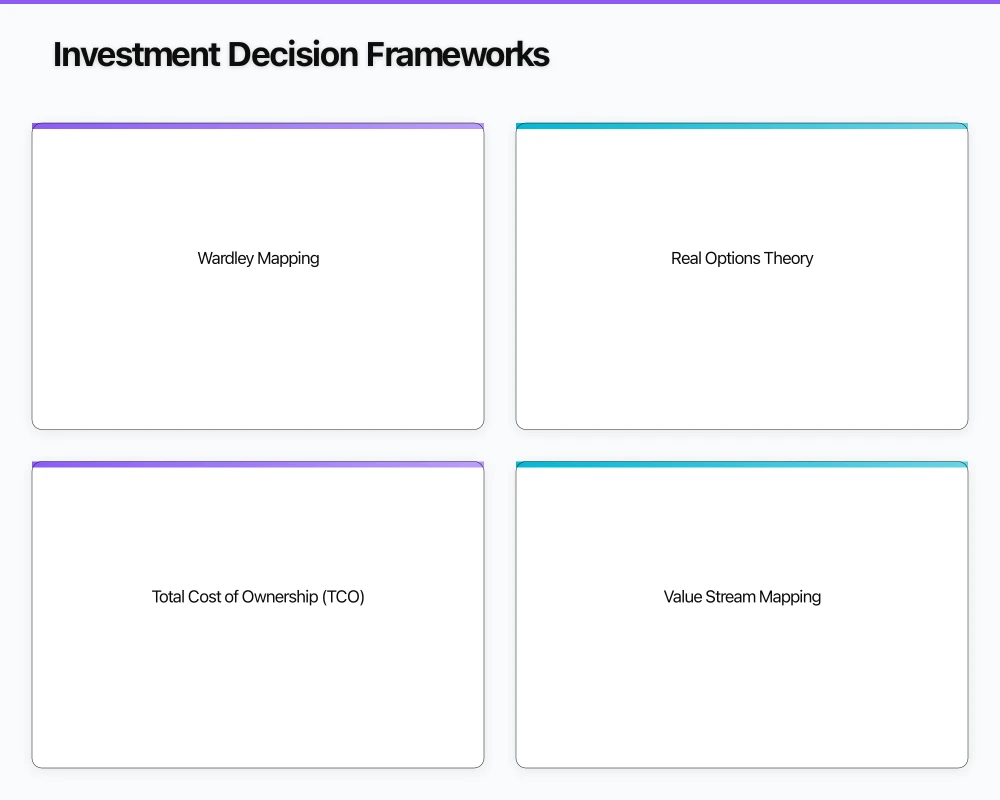
Environmental debt: Debt created by external changes rather than internal decisions. A dependency becomes unsupported. A security vulnerability requires architectural changes. A regulatory change demands data handling modifications. This debt is unavoidable and must be budgeted for.
Deliberate strategic debt: Debt accumulated by deliberately underinvesting in maintenance to fund growth initiatives. “We will not upgrade the platform this year because we are building the new product.” This is the most dangerous form because it appears rational in the short term while creating compounding costs.
Each type requires different management approaches. Tactical debt should be tracked in the backlog and addressed within a defined timeframe. Inadvertent debt should trigger a retrospective to improve future decision-making. Environmental debt should be budgeted as ongoing operational overhead. Strategic debt should be a conscious, time-bound decision with a clear remediation plan.
The CTO’s role is to make technical debt visible to business leadership. When the board asks why delivery velocity has slowed by thirty percent, the answer is often accumulated technical debt that was invisible in previous investment decisions. Quantifying debt in terms of its impact on delivery capacity — “this legacy system requires three additional engineers to maintain, which is equivalent to one full team not delivering new features” — makes the cost tangible.
Investment Decision Frameworks
Several frameworks help CTOs make better technology investment decisions:
Wardley Mapping: Simon Wardley’s mapping technique plots technology components on axes of visibility (to the user) and evolution (from genesis to commodity). This reveals where investment creates differentiation (custom-built components in the genesis or custom stages) versus where it should focus on efficiency (commodity components that should be outsourced or standardised). The map also reveals dependencies between components, helping identify where investment in one area enables or blocks progress in others.
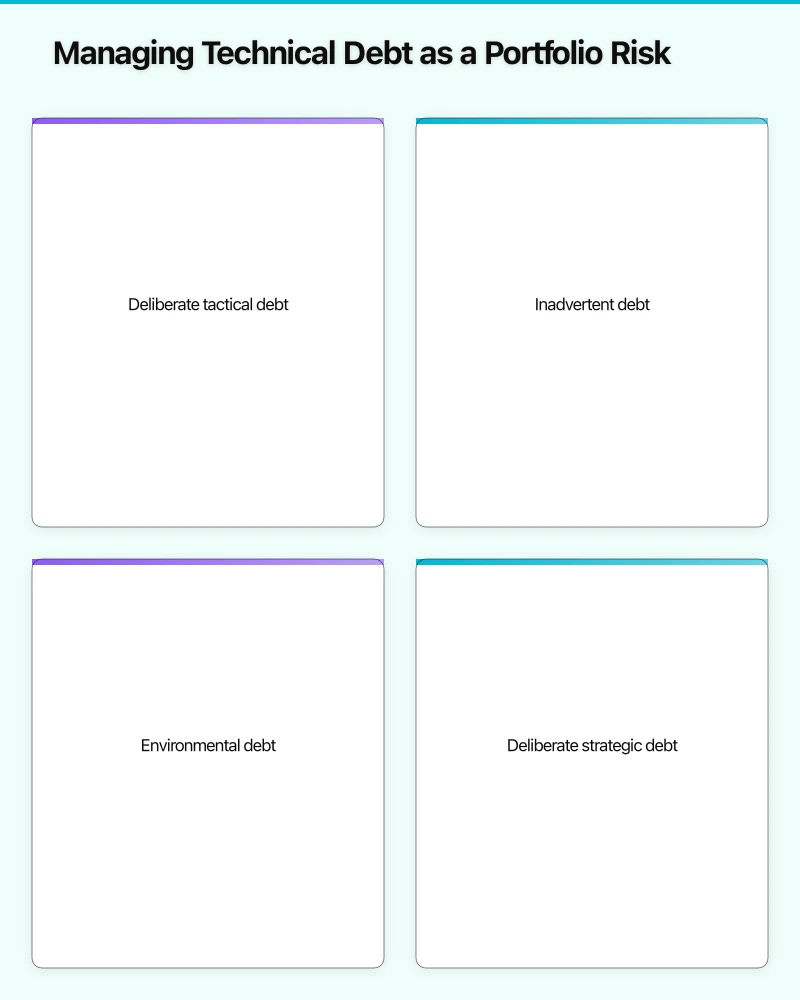
Real Options Theory: Traditional ROI analysis struggles with technology investments that create future optionality. A microservices migration may not have a clear ROI in terms of immediate feature delivery, but it creates the option to scale individual services, adopt new technologies incrementally, and enable independent team delivery. Real options theory values this flexibility, providing a more accurate assessment of investments that create strategic capability.
Total Cost of Ownership (TCO): Every technology investment has visible costs (licensing, development, infrastructure) and hidden costs (training, integration, maintenance, opportunity cost). TCO analysis that accounts for the full lifecycle of a technology investment — including the eventual cost of migration away from it — produces more accurate investment comparisons than focusing on acquisition cost alone.
Value Stream Mapping: Mapping the end-to-end flow of value delivery, from customer request to production deployment, reveals where investment will have the most impact. Bottlenecks in the value stream constrain the throughput of the entire system. Investing in areas downstream of a bottleneck adds capacity that cannot be utilised. Value stream mapping focuses investment where it produces the greatest system-level improvement.
Building a Sustainable Investment Culture
Sustainable technology investment is not just a planning exercise — it requires a cultural shift in how the organisation thinks about technology spending.
Treat infrastructure as product: Internal platforms, developer tools, and infrastructure deserve the same product management discipline as customer-facing products. This means understanding internal users, prioritising based on impact, measuring adoption and satisfaction, and continuously improving. Organisations that treat infrastructure as a cost centre to be minimised inevitably underinvest.
Make maintenance heroic, not invisible: In many organisations, the engineers who keep critical systems running and address technical debt receive less recognition than those who deliver new features. This creates perverse incentives that discourage maintenance work and accelerate debt accumulation. Celebrating maintenance achievements, measuring reliability improvements, and creating career paths that value operational excellence change the incentive structure.
Plan for technology lifecycle: Every technology has a lifecycle — adoption, maturity, decline. Investment decisions should account for where a technology sits in its lifecycle and plan for eventual migration. The organisation that adopts a platform without a plan for its eventual replacement will face an expensive, urgent migration when the platform reaches end of life.
Sustainable technology investment is ultimately about compounding advantage. Organisations that invest consistently in efficiency, manage technical debt intentionally, and make portfolio-level investment decisions build technology estates that become faster, more reliable, and more adaptable over time. Those that chase short-term project delivery at the expense of long-term health find themselves running faster while falling further behind. The CTO who builds a sustainable investment practice creates enduring value that outlasts any individual technology choice.
Need to put cloud strategy into action? Cloud Geeks provides in-depth guides on AWS, Azure, and cybersecurity for Australian SMBs.
Ganda Tech Services is my technology consultancy, bringing together cloud infrastructure, web development, and mobile expertise for Australian businesses.
Related reading: the real cost of good enough security.
About the Author
Ashish Ganda is the founder of Ganda Tech Services, a Sydney-based technology consultancy specialising in cloud infrastructure, web development, and mobile app solutions for Australian businesses.
Digital Transformation Roadmap 2026
A 12-month framework for Australian SMBs ready to modernise — phases, tools, and milestones.
Almost done
Check your inbox and click the confirmation link to get your download.