The CTO's Guide to Board Communication: Translating Technology Strategy
Introduction
The board room presents a unique challenge for technology leaders. The same skills that make someone an effective technologist—precision, nuance, technical depth—can undermine effectiveness when communicating with directors and executives whose expertise lies elsewhere.
Many CTOs approach board presentations with detailed technical explanations, comprehensive architecture diagrams, or exhaustive risk registers. The result is often glazed eyes, superficial questions, and ultimately, technology initiatives that lack the strategic support they need.
Effective board communication requires a fundamental shift in perspective. The goal is not to educate directors on technology, but to help them make informed decisions about business strategy where technology is a critical component.
This guide examines how CTOs can communicate technology strategy to boards effectively, building the understanding and trust that enables meaningful governance and appropriate investment.
Understanding the Board’s Perspective
What Boards Actually Care About
Board directors carry fiduciary responsibilities for the organisation’s performance and risk management. Their concerns centre on:
Strategic Alignment
Does technology strategy support business objectives? Are investments creating competitive advantage or merely keeping pace? How does the technology roadmap connect to revenue growth, cost efficiency, or market positioning?
Risk Management
What are the material technology risks? How are they being mitigated? What is the organisation’s exposure to cybersecurity incidents, system failures, or technology obsolescence?
Investment Efficiency
Is technology spending appropriate for the organisation’s size and industry? Are we getting adequate returns on technology investments? Where should incremental investment go?
Regulatory and Compliance
Are we meeting regulatory obligations around data protection, privacy, and industry-specific requirements? How is the organisation positioned for emerging regulations?
Talent and Capability
Do we have the technical talent needed to execute strategy? How does our technology capability compare to competitors?
Effective board communication addresses these concerns directly rather than expecting directors to translate technical details into business implications.
The Knowledge Gap Challenge
Most board directors lack deep technical expertise. This is not a weakness—boards need diverse perspectives, and technology is one domain among many. But it creates communication challenges:
Terminology barriers: Technical jargon obscures rather than illuminates Context gaps: Directors may not understand why certain decisions matter Risk calibration: Without technical background, assessing technology risk is difficult Investment evaluation: Hard to judge whether technology spending is appropriate
The CTO’s role is to bridge these gaps without oversimplifying to the point of meaninglessness. Directors need enough understanding to ask good questions and make informed decisions.
Time Constraints
Board meetings cover the entire organisation’s governance needs. Technology typically gets fifteen to thirty minutes in a packed agenda. This constraint demands:
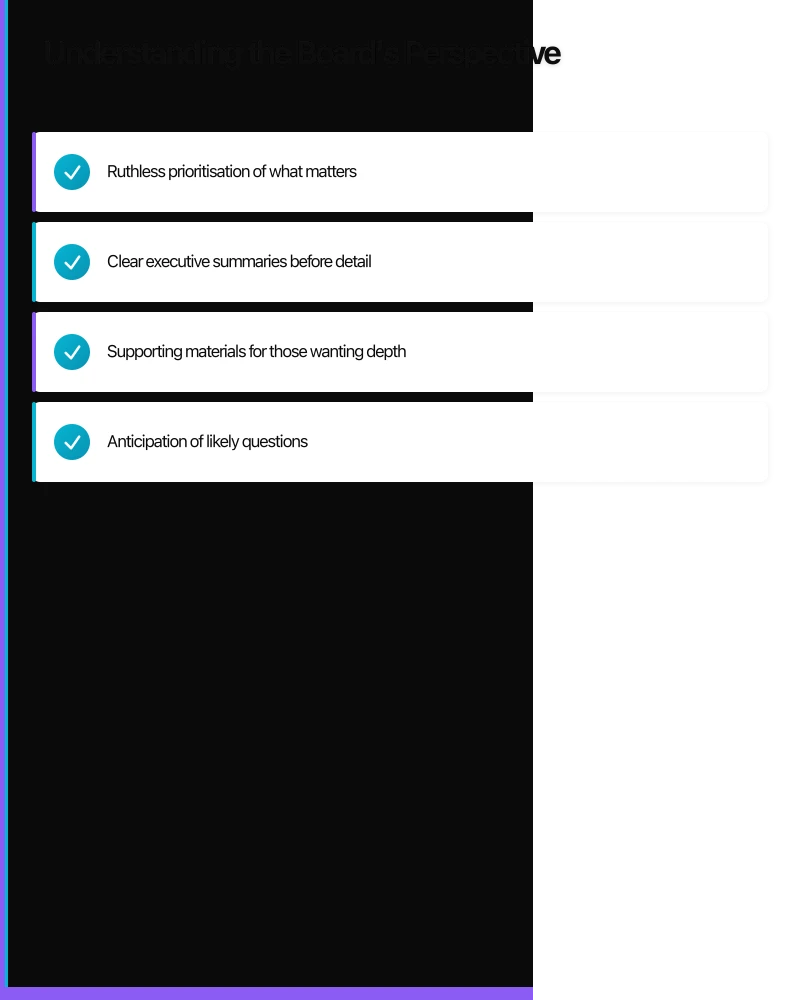
- Ruthless prioritisation of what matters
- Clear executive summaries before detail
- Supporting materials for those wanting depth
- Anticipation of likely questions
Every minute spent on unnecessary detail is a minute lost from strategic discussion.
Frameworks for Technology Communication
The Business Outcome Frame
Every technology initiative exists to enable business outcomes. Lead with those outcomes, not the technology itself.
Instead of: “We’re implementing a microservices architecture to improve system modularity and enable independent deployment of components.”
Try: “We’re restructuring our technology to release new features 5x faster than today. This supports our goal of outpacing competitors in product innovation. The approach mirrors how Netflix and Amazon achieve rapid delivery.”
The second framing answers the implicit board question: “Why should I care?”
The Risk-Reward Balance
Boards are comfortable with risk-reward trade-offs—this is the language of every investment decision. Frame technology initiatives in these terms:
Investment: What resources are required? Expected return: What business benefits will result? Risks: What could go wrong? Mitigation: How are risks being managed? Alternatives: What happens if we don’t proceed?
This framework applies equally to new initiatives and ongoing operations. Technical debt, for example, becomes understandable as accumulated risk that increases future costs—an analogy to financial debt that directors immediately grasp.
The Competitive Context
Boards think strategically about competitive positioning. Technology communication gains traction when connected to market dynamics:
- How does our technology capability compare to competitors?
- What are industry leaders doing that we should consider?
- Where can technology create differentiation?
- What technology shifts might disrupt our market?
Benchmark data from industry analysts like Gartner or Forrester helps calibrate whether technology spending and capability are appropriate for the competitive context.
The Maturity Model
Maturity models help boards understand where the organisation sits and where it needs to go. They transform complex capability assessments into simple frameworks:
Level 1 - Initial: Ad hoc processes, hero-dependent Level 2 - Developing: Basic processes, some automation Level 3 - Defined: Standardised processes, measured outcomes Level 4 - Managed: Data-driven optimisation, proactive management Level 5 - Optimising: Continuous improvement, industry-leading
Presenting current state and target state on a maturity model gives directors a clear picture of the journey without requiring technical depth.
Structuring Board Presentations
The Executive Summary
Every board presentation should start with a one-page executive summary answering:
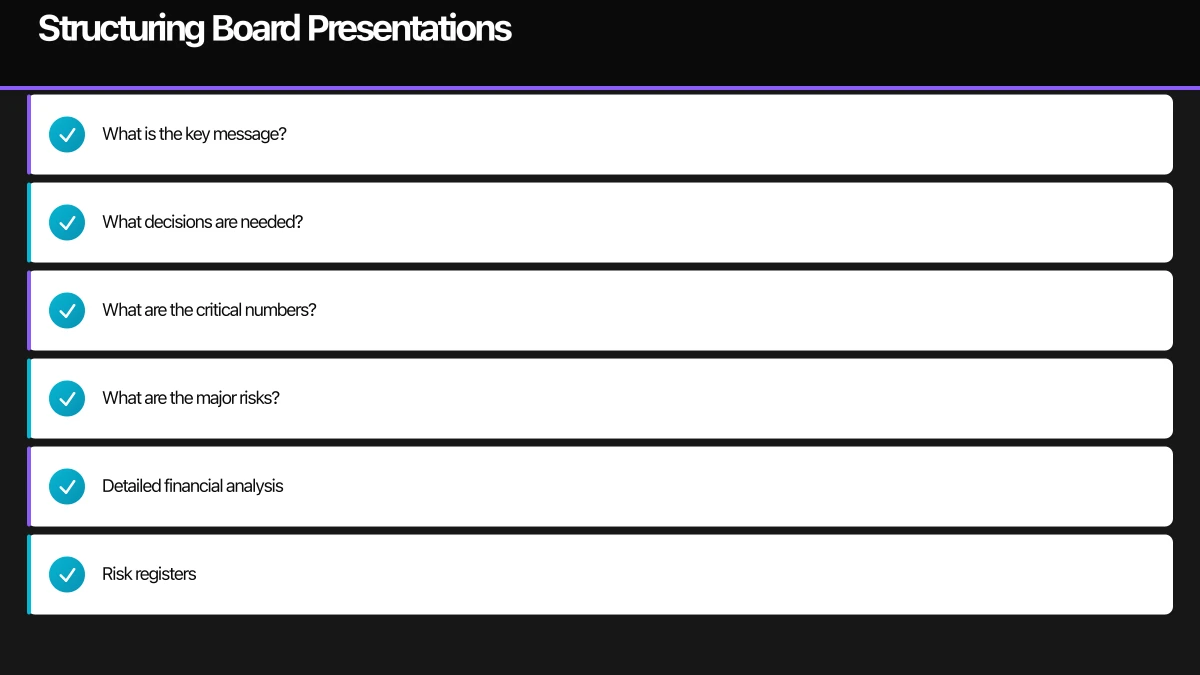
- What is the key message?
- What decisions are needed?
- What are the critical numbers?
- What are the major risks?
Directors may read only this page before the meeting. It should stand alone.
The Narrative Arc
Effective presentations tell a story:
Context: Where are we now? What’s happening in our market and industry? Challenge: What problem or opportunity demands attention? Approach: What are we proposing to do? Evidence: Why do we believe this approach will work? Ask: What do we need from the board?
This structure moves naturally from situation to solution to decision, carrying directors along rather than dumping information on them.
Visual Communication
Technology architectures can be incomprehensible to non-technical audiences. Visual communication helps:
Simplify diagrams: Three boxes and two arrows communicate better than detailed architecture diagrams Use analogies: “The firewall is like a building’s security desk—it checks who comes in and out” Show trends: Line graphs of key metrics over time tell stories numbers alone cannot Highlight key points: Visual emphasis guides attention to what matters
Avoid the temptation to include every detail. Board presentations should sacrifice completeness for clarity.
Supporting Materials
Some directors want more depth than presentations allow. Provide appendices with:
- Detailed financial analysis
- Risk registers
- Technical architecture for reference
- Industry benchmark data
- Glossary of key terms
Directors can review these before or after meetings. Their availability demonstrates thoroughness without cluttering the main presentation.
Key Topics for Board Communication
Cybersecurity
Cybersecurity has become a board-level concern across industries. Effective communication requires:
Current posture: How protected are we? Use frameworks like NIST or ISO 27001 to provide structure.
Key risks: What threats matter most? Focus on material risks—those that could significantly impact the organisation.
Recent activity: What incidents or near-misses have occurred? What did we learn?
Investment priorities: Where should additional resources go? Why?
Compliance status: Are we meeting regulatory requirements?
Avoid both complacency (“we’ve got this handled”) and fear-mongering (“threats are everywhere”). Directors need realistic assessment to make informed decisions.
Digital Transformation
Transformation initiatives require board support for sustained investment. Communication should address:
Business case: What outcomes are we pursuing? Revenue growth? Cost reduction? Customer experience?
Progress: Are we on track? Use simple metrics tied to business outcomes.
Risks and issues: What’s challenging? How are we addressing it?
Change management: Is the organisation adopting new ways of working?
Investment review: Is spending on plan? Are we getting expected returns?
The multi-year nature of transformation demands regular updates that demonstrate progress and maintain commitment.
Technical Debt and Infrastructure
Infrastructure and technical debt are challenging topics—necessary investments that don’t obviously create new value. Frame them in business terms:
Risk reduction: Technical debt increases the likelihood of incidents and outages. Addressing it reduces operational risk.
Velocity impact: Outdated systems slow development. Modernisation enables faster delivery.
Cost efficiency: Legacy systems often carry higher operating costs than modern alternatives.
Talent attraction: Top engineers don’t want to work with obsolete technology. Modernisation improves recruiting.
Use industry benchmarks to calibrate appropriate investment levels. “Industry leaders invest 15-20% of technology budgets in addressing technical debt. We’re currently at 8%.”
Emerging Technology
Boards increasingly ask about emerging technologies: AI, blockchain, quantum computing, and whatever else appears in mainstream media. Effective responses:
Separate hype from reality: What’s actually mature enough for production use? What’s still experimental?
Identify relevant applications: Where could this technology create value for our specific organisation?
Outline exploration approach: What small investments or pilots make sense?
Note industry adoption: What are competitors and peers doing?
Avoid dismissing emerging technology entirely (“that’s just hype”) or over-promising (“this will transform everything”). Balanced assessment builds credibility.
Building Board Relationships
Pre-Meeting Engagement
The most effective board communication happens before meetings:
Individual briefings: Meet with directors individually to understand their concerns and answer questions Pre-reads: Distribute materials in advance so directors arrive prepared Informal conversations: Build relationships outside formal board settings Responsive communication: Answer director questions promptly between meetings
Directors who understand technology issues before meetings can engage more substantively during them.
The Audit and Risk Committee
Many organisations have audit or risk committees with deeper technology oversight. CTOs should:
- Attend committee meetings regularly
- Provide more detailed updates than full board sessions allow
- Use committees to preview complex topics before board presentation
- Build relationships with committee members
Committees often shape how full boards think about technology issues.
Handling Difficult Questions
Boards sometimes ask challenging questions:
Questions you can’t answer: “I don’t have that specific data, but I’ll follow up by end of week” is better than guessing
Questions that reveal knowledge gaps: Treat these as opportunities to educate: “That’s a great question—let me explain why we think about it differently…”
Questions from crisis reports: When high-profile breaches make news, directors will ask “Could that happen to us?” Have prepared answers
Skeptical questions: If a director challenges your approach, engage rather than defend: “What concerns do you have? I want to make sure we’re addressing them.”
Handling difficult questions well builds more credibility than smooth presentations.
Board Education
Some organisations provide formal technology education for directors:
- Annual technology deep-dives (outside regular meetings)
- External speakers on important topics
- Site visits to technology operations
- Structured briefings on industry trends
Education investment pays dividends in more substantive board engagement.
Metrics That Matter to Boards
Outcome Metrics
Boards care about results, not activity. Focus on:
Customer impact: System availability, performance, digital experience metrics Business enablement: Time to market, feature delivery velocity Efficiency: Cost per transaction, automation rates Risk indicators: Incident frequency, vulnerability metrics, compliance status
Investment Metrics
Help boards evaluate technology investment:
Spending benchmarks: Technology spend as percentage of revenue, compared to industry Project delivery: On-time, on-budget rates for major initiatives Return on investment: Value delivered versus investment made Allocation: How spend divides across run, grow, and transform categories
Trend Over Time
Individual metrics matter less than trends. Show:
- How metrics have changed over the past year
- Whether trajectory is toward targets
- How the organisation compares to past performance
A metric slightly below target but improving tells a better story than one on target but declining.
Common Pitfalls to Avoid
Technical Depth Without Business Context
The most common failure mode: presenting technical detail without connecting it to business outcomes. Every technical point should answer “so what?” for a business audience.
Understating Risk
Technology leaders sometimes minimise risks to avoid difficult conversations. This backfires when incidents occur. Boards respect honest risk assessment more than false assurance.
Overpromising
Technology initiatives frequently take longer and cost more than planned. Building credibility requires realistic commitments. Better to under-promise and over-deliver.
Defensive Posture
When questioned, some CTOs become defensive. This damages relationships and suggests lack of confidence. Welcome scrutiny as helping ensure technology serves the organisation well.
Ignoring Board Feedback
Directors sometimes offer perspectives that seem uninformed. Before dismissing them, consider whether they’re identifying issues that technical proximity has obscured. Board questions often contain valuable insight.
Conclusion
Effective board communication is a skill distinct from technical leadership, but equally essential for technology executives. The CTO who can translate complex technology issues into business terms, build relationships with directors, and help boards make informed decisions becomes a strategic partner rather than a technical resource.
The fundamentals are straightforward: lead with business outcomes, frame issues in risk-reward terms, respect time constraints, and communicate with clarity rather than completeness. Execution requires practice and continuous refinement.
As technology becomes ever more central to business strategy, boards need CTOs who can help them govern effectively. Those who master board communication find their initiatives better supported, their risks better understood, and their organisations more likely to succeed with technology-enabled strategies.
The investment in communication skills pays compound returns over a technology leadership career.
Sources
- National Association of Corporate Directors. (2024). Director’s Handbook on Cyber-Risk Oversight. NACD.
- Gartner. (2025). CIO and Technology Executive Programs: Board-Level Technology Governance. Gartner Research.
- Westerman, G., Bonnet, D., & McAfee, A. (2014). Leading Digital: Turning Technology into Business Transformation. Harvard Business Review Press.
- McKinsey & Company. (2024). The Role of the CTO in Digital Strategy. McKinsey Digital.
- Deloitte. (2025). Technology and the Boardroom: Trends in Board Technology Oversight. Deloitte Insights.
Strategic guidance for technology leaders building effective board relationships.
The digital strategies I discuss here often start with a strong website. Cosmos Web Tech publishes practical guides on web design and online marketing.
As founder of Ganda Tech Services, I work with Australian businesses to align technology investments with business growth — across cloud, web, and mobile.
About the Author
Ashish Ganda is the founder of Ganda Tech Services, a Sydney-based technology consultancy specialising in cloud infrastructure, web development, and mobile app solutions for Australian businesses.
Digital Transformation Roadmap 2026
A 12-month framework for Australian SMBs ready to modernise — phases, tools, and milestones.
Almost done
Check your inbox and click the confirmation link to get your download.