Technology Portfolio Management: The Enterprise CTO's Strategic Guide
Every enterprise CTO manages a technology portfolio whether they explicitly acknowledge it or not. The applications, platforms, infrastructure, and technical capabilities accumulated over years of investment represent a portfolio requiring deliberate management. Without portfolio discipline, organizations drift toward fragmentation, duplication, and misalignment between technology investments and business priorities.
Effective technology portfolio management transforms reactive, project-driven technology decisions into strategic capability development. It provides frameworks for evaluating investments, retiring obsolete assets, and ensuring technology spending delivers maximum business value. For enterprise CTOs navigating constrained budgets and accelerating change, portfolio management is no longer optional.
The Portfolio Management Imperative
Technology portfolios in large enterprises typically grow organically, accumulating assets through project-by-project decisions without systematic oversight. The consequences compound over time.
Portfolio Fragmentation
Without portfolio governance, organizations accumulate redundant capabilities. Three different business units implement customer data platforms. Multiple integration approaches coexist. Each department selects its preferred analytics tools. This fragmentation increases costs, complicates integration, and diffuses expertise across too many technologies.
A financial services client recently discovered they maintained 47 different databases across the enterprise, many serving similar purposes. Consolidation to 12 strategic platforms reduced licensing costs by $4.2 million annually while improving operational efficiency and data governance.
Investment Misalignment
Project-driven funding allocates resources to the most compelling project proposals rather than the most strategic capabilities. Business units with better proposal skills or louder voices capture disproportionate investment. Strategic capabilities requiring sustained, multi-year investment struggle against flashier short-term projects.
Portfolio management shifts focus from project funding to capability investment, evaluating how individual projects contribute to strategic technology capabilities.
Technical Debt Accumulation
Without deliberate retirement and modernization, technical debt accumulates invisibly. Legacy systems remain in production because no project exists to replace them. Integration complexity grows as new systems connect to old. Development velocity decreases as teams navigate aging codebases.
Portfolio management makes technical debt visible and creates mechanisms for systematic reduction rather than indefinite deferral.
Portfolio Management Framework
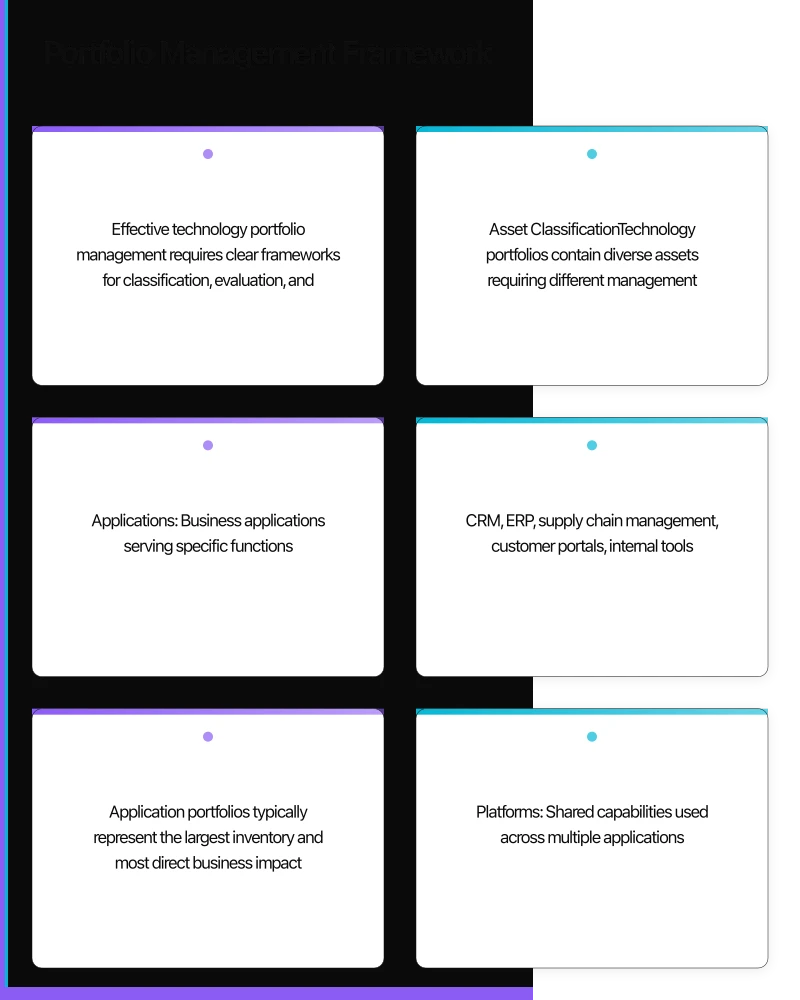
Effective technology portfolio management requires clear frameworks for classification, evaluation, and governance.
Asset Classification
Technology portfolios contain diverse assets requiring different management approaches.
Applications: Business applications serving specific functions. CRM, ERP, supply chain management, customer portals, internal tools. Application portfolios typically represent the largest inventory and most direct business impact.
Platforms: Shared capabilities used across multiple applications. Integration platforms, data platforms, identity management, API gateways. Platform investments create leverage but require coordination across consuming applications.
Infrastructure: Compute, storage, networking, and foundational services. Increasingly abstracted through cloud services but still requiring portfolio oversight for cost optimization and strategic direction.
Technical Capabilities: Cross-cutting capabilities like observability, security, DevOps tooling. Often overlooked in portfolio management but critical for organizational effectiveness.
Portfolio Dimensions
Each asset should be evaluated across multiple dimensions informing management decisions.
Business Value: Direct contribution to business outcomes. Revenue generation, cost reduction, risk mitigation, customer experience, operational efficiency. Value should be quantified where possible, though some benefits resist precise measurement.
Technical Health: Architecture quality, code maintainability, security posture, operational reliability. Healthy assets support business needs reliably. Unhealthy assets create risk and consume disproportionate maintenance effort.
Strategic Fit: Alignment with target architecture and technology direction. Assets may deliver value today while diverging from strategic direction, requiring migration planning.
Lifecycle Stage: Position in technology lifecycle. Emerging technologies under evaluation, strategic technologies for active investment, legacy technologies for managed decline.
Portfolio Visualization
Making portfolio status visible enables informed decision-making. Common visualization approaches include:
Application Rationalization Matrix: Maps applications by business value (y-axis) and technical health (x-axis). High value, high health applications represent strategic assets. Low value, low health assets are retirement candidates. The interesting quadrants require nuanced decisions: high value, low health needs modernization investment; low value, high health may be consolidation opportunities.
Technology Radar: Borrowed from ThoughtWorks, categorizes technologies as Adopt (strategic direction), Trial (selective experimentation), Assess (monitoring for potential), and Hold (no new investment). Provides clear guidance for technology selection decisions.
Capability Heat Maps: Visualize capability coverage and health across business domains. Reveals gaps, redundancies, and investment priorities.
Investment Portfolio Balancing
Technology investment portfolios require balancing across multiple dimensions.
Run, Grow, Transform
A foundational framework divides investment into three categories:
Run (typically 60-70%): Maintaining and operating existing capabilities. Infrastructure, support, licensing, necessary maintenance. Without adequate run investment, operational reliability suffers.
Grow (typically 20-30%): Enhancing existing capabilities. Feature development, performance improvement, integration expansion. Grow investment improves current state without fundamental change.
Transform (typically 10-20%): Creating new capabilities or fundamentally reimagining existing ones. Innovation, modernization, new technology adoption. Transform investment creates future competitive advantage.
Organizations often underinvest in transformation, consuming budget with run and grow activities. Portfolio discipline creates protected transformation capacity, ensuring continued evolution.
Time Horizon Balancing
Investment portfolios should balance across time horizons:
Horizon 1 (0-18 months): Immediate business needs, current capabilities, known requirements.
Horizon 2 (18-36 months): Emerging requirements, capability evolution, planned expansions.
Horizon 3 (3+ years): Future possibilities, disruptive technologies, long-term positioning.
Pressure for short-term results naturally emphasizes Horizon 1 at the expense of longer-term positioning. Portfolio management creates mechanisms for sustained Horizon 2 and 3 investment.
Risk Diversification
Technology portfolios require risk diversification similar to financial portfolios.
Technology Risk: Concentration in single vendors, platforms, or architectural approaches creates vulnerability. Diversification provides resilience.
Execution Risk: Large, complex programs carry higher delivery risk than smaller initiatives. Portfolio balance includes execution risk distribution.
Timing Risk: Technologies mature at different rates. Portfolios should include both proven technologies and strategic bets on emerging capabilities.
Rationalization and Retirement
Portfolio management includes deliberate asset retirement, often the most challenging aspect.
Identifying Retirement Candidates
Assets become retirement candidates through various paths:
Redundant Capabilities: Multiple systems serving similar purposes. Consolidation to strategic platforms reduces cost and complexity.
Declining Business Value: Systems serving declining business needs. As business evolves, previously valuable applications become irrelevant.
Unsustainable Technical Debt: Systems where maintenance cost exceeds value. Architecture limitations, security vulnerabilities, or skills scarcity make continued operation uneconomical.
Strategic Misalignment: Systems diverging from architectural direction. Continuing investment perpetuates fragmentation.
Rationalization Approaches
Common rationalization strategies include:
Retire: Complete decommissioning. Appropriate for truly obsolete systems with no ongoing value.
Replace: Migration to strategic alternative. Most common approach for consolidation.
Retain: Continued operation without significant investment. Appropriate for stable, low-maintenance systems with limited strategic importance.
Replatform: Moving to modern infrastructure (typically cloud) without significant application change. Addresses infrastructure concerns while deferring application modernization.
Refactor: Significant architectural improvement while maintaining functionality. Appropriate for high-value applications with technical debt.
Rehost: Simple migration (lift and shift) without change. Quick wins for infrastructure consolidation.
Managing Retirement Execution
Retirement projects face unique challenges:
Stakeholder Resistance: Users accustomed to familiar systems resist change. Early engagement, clear communication, and demonstrated benefits reduce resistance.
Data Migration Complexity: Legacy systems often contain irreplaceable data requiring careful migration. Data quality issues surface during migration, requiring remediation.
Integration Dependency: Other systems may depend on retiring systems. Dependency mapping and transition planning prevent disruption.
Resource Constraints: Retirement projects compete for resources against new capability development, often losing priority battles. Protected retirement capacity ensures progress.
Platform Strategy within Portfolios
Platforms deserve special attention within technology portfolios given their leverage effect and coordination requirements.
Platform Investment Logic
Platforms create value by enabling multiple applications:
Integration Platforms: Connect systems, manage data flows, enable ecosystem participation.
Data Platforms: Centralize data management, enable analytics and AI, support governance.
Developer Platforms: Provide development tools, CI/CD, environments, and shared services accelerating delivery.
Customer Platforms: Unified customer identity, experience orchestration, omnichannel capabilities.
Platform investment typically requires longer time horizons and sustained commitment. Benefits accrue as adoption increases across the application portfolio. Premature optimization or underinvestment both create problems.
Platform Governance
Platforms require governance mechanisms ensuring:
Adoption: Mandating platform usage where appropriate, preventing shadow alternatives.
Evolution: Incorporating consumer requirements into platform roadmaps, balancing standardization against flexibility.
Economics: Fair cost allocation to platform consumers, investment governance, value demonstration.
Quality: Platform reliability, performance, security appropriate for consumer requirements.
Governance and Decision Rights
Portfolio management requires clear governance structures and decision rights.
Portfolio Governance Bodies
Technology Investment Board: Senior leadership forum for significant investment decisions, portfolio balance review, and strategic direction setting. Typically meets quarterly.
Architecture Review Board: Technical governance ensuring alignment with target architecture and technology standards. Reviews significant technical decisions.
Domain Technology Committees: Business-technology partnership forums managing portfolios within specific business domains. Ensure business relevance of technology decisions.
Decision Frameworks
Clear decision frameworks prevent governance paralysis:
Investment Thresholds: Decisions below certain thresholds delegated to appropriate levels. Only significant decisions escalate to senior governance.
Decision Criteria: Explicit criteria for investment decisions: strategic alignment, business case quality, technical feasibility, resource availability, risk profile.
Fast-Track Processes: Expedited paths for time-sensitive decisions with appropriate risk acceptance.
Portfolio Reviews
Regular portfolio reviews maintain visibility and drive accountability:
Quarterly Portfolio Reviews: Comprehensive portfolio health assessment, investment performance review, adjustment decisions.
Annual Strategic Reviews: Technology strategy alignment, multi-year planning, significant portfolio restructuring decisions.
Continuous Monitoring: Real-time dashboards tracking portfolio metrics, flagging issues requiring attention.
Metrics and Measurement
Portfolio management requires metrics demonstrating value and guiding decisions.
Portfolio Health Metrics
Application Health Score: Composite metric combining technical quality, security posture, operational reliability, and support sustainability.
Portfolio Diversity: Vendor concentration, technology concentration, skills concentration measures.
Technical Debt Ratio: Proportion of effort consumed by debt-related work versus value-creating development.
Rationalization Progress: Retirement completions, consolidation achievements, portfolio size trends.
Investment Performance Metrics
Value Realization: Business benefits achieved versus projected, tracked over time.
Investment Efficiency: Cost per capability delivered, time to value, resource utilization.
Portfolio Balance: Actual allocation versus target across run/grow/transform and horizon categories.
Operational Metrics
Total Cost of Ownership: Complete cost visibility including hidden costs often missing from project budgets.
Support Burden: Incident volumes, support costs, time consumed by portfolio maintenance.
Change Velocity: Speed of portfolio evolution, time from strategy to execution.
Common Portfolio Management Challenges
Data Quality
Portfolio management depends on accurate, complete asset data. Most organizations lack comprehensive inventories, creating blind spots and undermining analysis quality. Initial portfolio establishment requires significant discovery effort.
Stakeholder Alignment
Business stakeholders often resist portfolio discipline that constrains their technology choices. Building shared understanding of portfolio benefits and appropriate flexibility within governance structures increases acceptance.
Sustained Commitment
Portfolio management delivers value over extended timeframes. Leadership transitions, budget pressures, and organizational changes threaten continuity. Embedding portfolio management into organizational culture rather than depending on individual champions improves sustainability.
Complexity Management
Large portfolios resist simple analysis. Tooling, automation, and analytical capabilities become essential for portfolio management at scale.
Technology Enablement
Modern portfolio management benefits from enabling technology:
Application Portfolio Management (APM) Tools: Dedicated platforms (ServiceNow APM, LeanIX, Ardoq) for portfolio inventory, analysis, and visualization.
Enterprise Architecture Tools: Broader architecture management capabilities including portfolio views.
Financial Management Tools: Technology business management (TBM) platforms like Apptio for investment tracking and cost allocation.
Integration Platforms: Connecting portfolio data from diverse sources: CMDBs, financial systems, project management tools.
Strategic Portfolio Positioning
Portfolio management ultimately serves strategic positioning. Different strategies imply different portfolio configurations.
Innovation Leadership: Higher transform investment, more emerging technology exploration, tolerance for controlled experimentation.
Operational Excellence: Strong run capabilities, reliability emphasis, lower tolerance for immature technologies.
Cost Leadership: Aggressive rationalization, standardization emphasis, efficiency prioritization over differentiation.
Customer Intimacy: Customer-facing capability investment, flexibility for customer-specific solutions, integration excellence.
Most organizations balance multiple strategic priorities, requiring nuanced portfolio strategies reflecting business context.
The Path Forward
Establishing effective technology portfolio management is itself a transformation requiring sustained commitment.
Start with Visibility: Comprehensive portfolio inventory is foundational. Discovery effort pays dividends across all subsequent portfolio activities.
Build Governance Incrementally: Implementing complete governance structures simultaneously overwhelms organizations. Start with critical decisions, expand as capability matures.
Demonstrate Value Early: Quick wins build organizational support. Rationalization savings, improved decision quality, and reduced complexity create visible benefits.
Embed in Culture: Portfolio management succeeds when it becomes how the organization operates, not an overlay on existing processes.
For enterprise CTOs, portfolio management transforms technology leadership from reactive problem-solving to proactive capability development. The discipline required is significant, but the strategic clarity and improved outcomes justify the investment.
References and Further Reading
- Weill, P., & Ross, J. (2004). “IT Governance: How Top Performers Manage IT Decision Rights for Superior Results.” Harvard Business Press.
- Gartner. (2025). “Technology Portfolio Management Best Practices.” Gartner Research.
- McKinsey & Company. (2024). “Technology Budgets: From Run to Transform.” McKinsey Digital.
- Forrester. (2025). “Application Portfolio Management Market Overview.” Forrester Research.
- Ross, J., Weill, P., & Robertson, D. (2006). “Enterprise Architecture as Strategy.” Harvard Business Press.
Strategy needs execution. Cloud Geeks publishes practical cloud computing and cybersecurity guides for Australian businesses ready to act.
I lead Ganda Tech Services, where we turn digital strategy into results through specialist cloud, web design, and mobile app teams across Sydney.
About the Author
Ashish Ganda is the founder of Ganda Tech Services, a Sydney-based technology consultancy specialising in cloud infrastructure, web development, and mobile app solutions for Australian businesses.
Digital Transformation Roadmap 2026
A 12-month framework for Australian SMBs ready to modernise — phases, tools, and milestones.
Almost done
Check your inbox and click the confirmation link to get your download.