The CTO's Guide to Privacy Engineering
Privacy has transitioned from a legal compliance checkbox to an architectural discipline. The regulatory landscape — GDPR in Europe, CCPA and its successor CPRA in California, LGPD in Brazil, and dozens of emerging privacy laws worldwide — creates a complex web of requirements that cannot be satisfied by policy documents alone. They require engineering.
Privacy engineering is the practice of building privacy protections into the architecture and implementation of technology systems, rather than layering them on after the fact. For CTOs, this represents a shift from treating privacy as a legal team’s responsibility to treating it as a core engineering requirement that influences architecture, data models, and system design.
Privacy by Design: From Principle to Practice
Ann Cavoukian’s Privacy by Design framework, developed in the 1990s and now embedded in GDPR’s Article 25, establishes seven foundational principles. The challenge for engineering organisations is translating these principles into concrete technical practices.
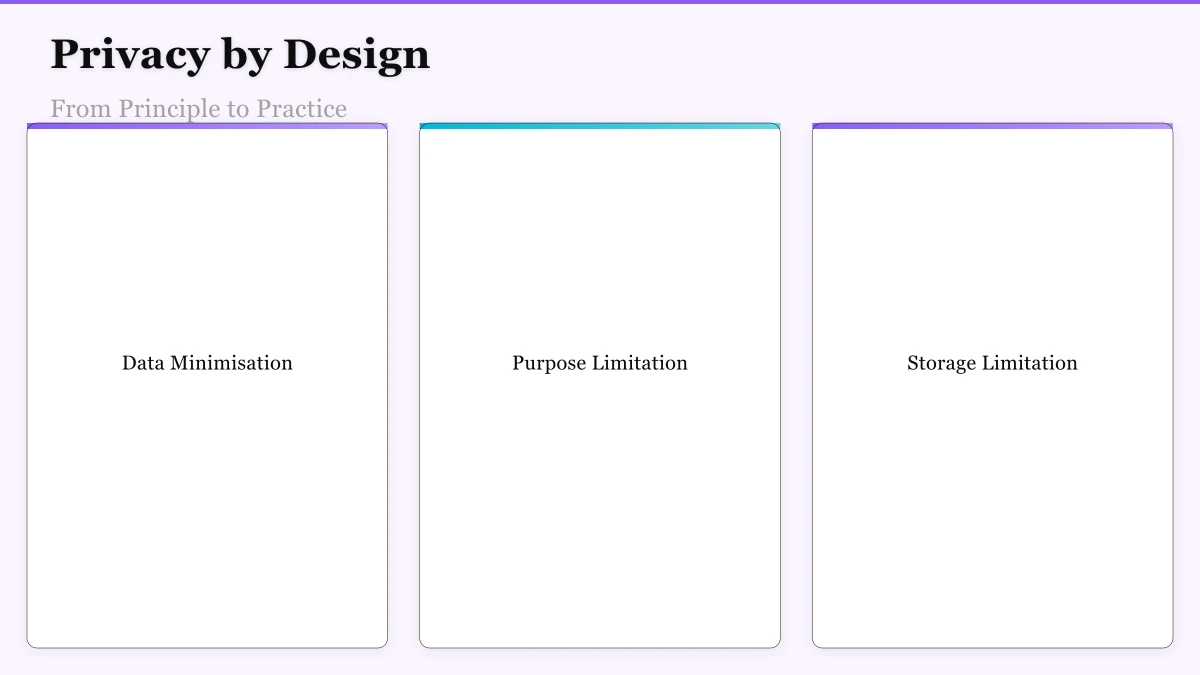
Data Minimisation: Collect only the data necessary for the stated purpose, and retain it only as long as necessary. This sounds simple but has profound architectural implications. It means designing APIs that request the minimum data needed, designing databases with retention policies enforced at the schema level, and designing analytics pipelines that aggregate data before storage rather than storing raw personal data.
In practice, data minimisation requires reversing the default assumption that has guided enterprise data architecture for decades: “collect everything because we might need it later.” This assumption creates privacy liability for data that provides no business value. The privacy-engineered approach starts from the opposite assumption: “collect nothing unless there is a specific, documented need.”
Purpose Limitation: Data collected for one purpose should not be repurposed without consent. Technically, this requires data lineage tracking that follows personal data from collection through all processing stages, ensuring that each use is consistent with the original purpose. This is not just a policy requirement — it is an architecture requirement that influences how data flows between systems.
Storage Limitation: Personal data should not be retained beyond the period necessary for the original purpose. Implementing this at enterprise scale requires automated data lifecycle management: classification of data by retention requirements, automated deletion or anonymisation when retention periods expire, and audit mechanisms that verify compliance.
Most enterprises have never implemented systematic data deletion. Legacy systems accumulate personal data indefinitely because deletion was never designed into the system. Retrofitting deletion capabilities into systems designed for perpetual retention is one of the most challenging aspects of privacy engineering.
Privacy-Enhancing Technologies
A growing category of technologies enables organisations to derive value from data while protecting individual privacy.
Differential Privacy: Differential privacy adds calibrated statistical noise to query results or datasets, providing mathematical guarantees about the maximum information that can be inferred about any individual. Google’s RAPPOR and Apple’s implementation for iOS telemetry demonstrate production use of differential privacy. For enterprise analytics, differential privacy enables aggregate insights without exposing individual records.
The practical challenge is that differential privacy reduces data utility — more noise means more privacy but less accurate results. Calibrating the privacy-utility trade-off requires understanding both the privacy risks and the analytical requirements, which demands collaboration between privacy engineers and data scientists.
Homomorphic Encryption: Fully homomorphic encryption enables computation on encrypted data without decrypting it. While still computationally expensive for general use, partial homomorphic encryption schemes are becoming practical for specific use cases: encrypted search, privacy-preserving machine learning, and secure multi-party computation. IBM and Microsoft are investing heavily in making homomorphic encryption practical for enterprise workloads.
Federated Learning: Rather than centralising data for machine learning, federated learning trains models on distributed data that remains at its source. Each participant trains a local model on their data and shares only model updates (gradients), not the underlying data. This enables collaborative model training across organisations or jurisdictions without data sharing. Google uses federated learning for keyboard prediction in Android, and the healthcare industry is exploring it for collaborative research without sharing patient data.
Synthetic Data: Generating artificial datasets that preserve the statistical properties of real data while containing no actual personal information enables testing, development, and analytics without privacy risk. Tools from companies like Mostly AI, Gretel, and Hazy generate synthetic data that data scientists can use for model development and testing.
Architecture Patterns for Privacy
Privacy requirements influence architecture decisions at every level, from data models to system integration patterns.
Data Vaulting: Centralise personal data in a dedicated, highly secured data vault with strong access controls, encryption, and audit logging. Other systems reference personal data through pseudonymous identifiers and request personal data from the vault only when needed. This pattern simplifies compliance by concentrating personal data management in a single system with purpose-built privacy controls.
Consent Management Architecture: Privacy regulations require managing granular consent: what data was collected, for what purpose, with what consent, and when that consent was given or withdrawn. This requires a consent management system that is integrated with all data collection points and all data processing systems. When consent is withdrawn, the system must propagate that withdrawal through all downstream systems and trigger data deletion or anonymisation.
The consent management architecture must handle consent at scale — millions of users with individual consent preferences across multiple purposes — and must provide real-time responses when systems query consent status before processing data.
Right to Erasure Implementation: GDPR’s right to erasure (Article 17) requires that organisations delete personal data upon request, with limited exceptions. Implementing this technically requires:
A comprehensive data inventory that identifies all systems containing personal data, including backups, logs, analytics systems, and third-party integrations.
Deletion orchestration that triggers data removal across all identified systems, including cascading deletions through data pipelines.
Verification mechanisms that confirm deletion was completed across all systems and that no residual personal data remains.
Exception handling for data that must be retained for legal or regulatory reasons (financial records, active contracts), with documentation of the legal basis for retention.
Building the Privacy Engineering Capability
Privacy engineering is an emerging discipline that requires a combination of software engineering, data architecture, security, and legal knowledge. Few organisations have established privacy engineering teams, but those that invest in this capability gain both compliance confidence and competitive advantage.
Organisational Structure: Privacy engineering works best when embedded within the engineering organisation, with a strong partnership with the legal and compliance teams. The privacy engineer’s role is to translate legal requirements into technical specifications and to advocate for privacy-protective design choices in architecture reviews and design discussions.
Privacy Impact Assessments: Automated or semi-automated privacy impact assessments (PIAs) for new systems and features ensure that privacy implications are considered during design rather than discovered during deployment. The PIA process should be lightweight enough to be completed for every significant feature and thorough enough to identify genuine privacy risks.
Testing and Validation: Privacy requirements should be tested with the same rigour as functional requirements. Automated tests that verify data minimisation (no unexpected personal data in responses), retention policy enforcement (data deleted on schedule), and access control (personal data inaccessible without authorisation) provide continuous assurance that privacy controls function as designed.
Privacy engineering is not a temporary response to regulatory pressure. It is a permanent shift in how technology systems are designed and operated. The organisations that build privacy engineering capabilities now will be better positioned for the expanding regulatory landscape, better protected against data breach consequences, and better trusted by customers who increasingly care about how their data is handled. For the CTO, privacy engineering is an investment in resilience that pays dividends across compliance, security, and customer trust.
For the practitioner’s view on cloud, IT, and cybersecurity, explore Cloud Geeks — where strategy meets infrastructure.
These insights are drawn from my work leading Ganda Tech Services — helping Australian businesses navigate digital transformation through cloud, web, and mobile.
About the Author
Ashish Ganda is the founder of Ganda Tech Services, a Sydney-based technology consultancy specialising in cloud infrastructure, web development, and mobile app solutions for Australian businesses.
Digital Transformation Roadmap 2026
A 12-month framework for Australian SMBs ready to modernise — phases, tools, and milestones.
Almost done
Check your inbox and click the confirmation link to get your download.