Technology Vendor Negotiation: A Strategic Framework for Enterprise CTOs
Enterprise technology procurement has evolved from a transactional purchasing function to a strategic discipline that directly impacts competitive advantage. The decisions made during vendor negotiations—contract terms, pricing structures, exit provisions, and service levels—reverberate through organizations for years, affecting everything from operational flexibility to financial performance.
Yet many technology leaders approach vendor negotiations without a systematic framework, relying on procurement departments unfamiliar with technology nuances or accepting vendor-proposed terms with minimal pushback. This approach leaves significant value on the table and creates lock-in risks that constrain future architectural decisions.
For CTOs tasked with balancing innovation velocity against cost optimization and risk management, mastering vendor negotiation is a fundamental competency. The stakes are substantial: enterprise software spending typically represents 15-25% of IT budgets, and poorly negotiated contracts can inflate costs by 30-40% while limiting operational flexibility.
The Changed Landscape of Technology Procurement
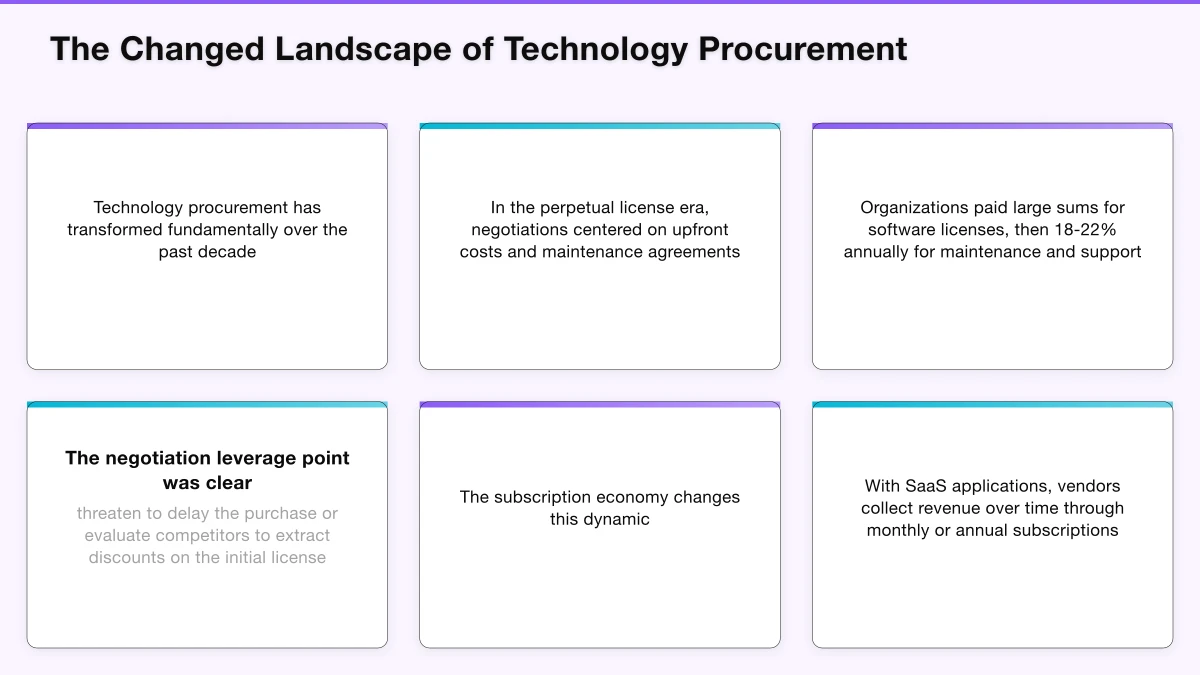
Technology procurement has transformed fundamentally over the past decade. The shift from perpetual licenses to subscription models, the proliferation of SaaS applications, and the emergence of cloud infrastructure have rewritten the rules of vendor relationships.
In the perpetual license era, negotiations centered on upfront costs and maintenance agreements. Organizations paid large sums for software licenses, then 18-22% annually for maintenance and support. The negotiation leverage point was clear: threaten to delay the purchase or evaluate competitors to extract discounts on the initial license.
The subscription economy changes this dynamic. With SaaS applications, vendors collect revenue over time through monthly or annual subscriptions. This recurring revenue model shifts vendor incentives: they’re incentivized to maximize long-term customer value rather than front-load revenue. The negotiation focus shifts accordingly—toward contract length, auto-renewal terms, price escalation caps, and service level commitments.
Cloud infrastructure introduces consumption-based pricing, adding another layer of complexity. AWS, Azure, and GCP offer hundreds of services with distinct pricing models—on-demand, reserved instances, spot pricing, committed use discounts. Effective negotiation requires understanding not just current usage patterns but projected growth trajectories and architectural evolution.
The vendor landscape has also fragmented. Where enterprises once dealt with a handful of major software vendors, the typical enterprise now uses over 100 SaaS applications across departments. Each vendor relationship requires management attention, creating procurement complexity that challenges traditional approaches.
Gartner’s research indicates that 68% of enterprises overpay for technology purchases due to inadequate negotiation preparation. The opportunity for improvement is significant: organizations that implement structured vendor management programs typically reduce technology spending by 15-25% while improving service levels and flexibility.
Pre-Negotiation Preparation Framework
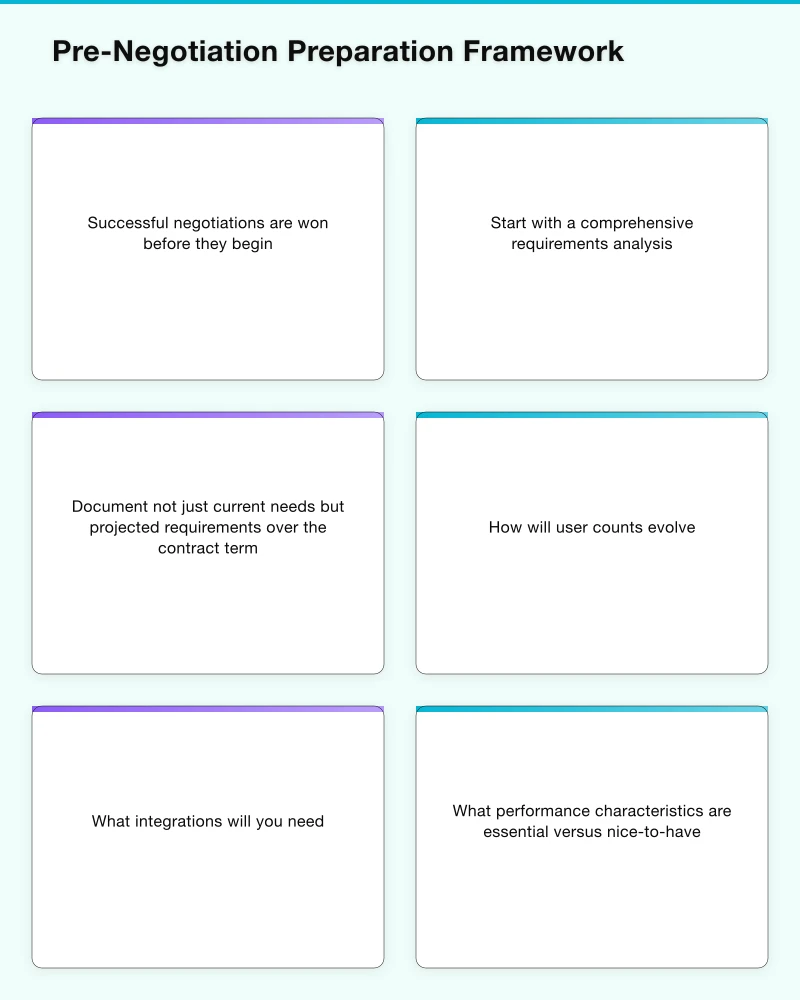
Successful negotiations are won before they begin. The preparation phase—understanding your leverage, documenting requirements, researching alternatives—determines negotiation outcomes more than tactics at the table.
Start with a comprehensive requirements analysis. Document not just current needs but projected requirements over the contract term. How will user counts evolve? What integrations will you need? What performance characteristics are essential versus nice-to-have? Vendors exploit ambiguity—unclear requirements lead to scope creep and change orders that inflate costs.
Build your alternative analysis rigorously. For every vendor under consideration, identify at least two credible alternatives. Document their capabilities, pricing models, and reference customers. This isn’t about bluffing—it’s about understanding your options. When you know you can walk away, your negotiating position strengthens automatically.
Calculate the vendor’s incentives. Enterprise sales representatives work on commission structures tied to quarterly and annual quotas. Understanding where you fall in a vendor’s fiscal calendar provides leverage—end-of-quarter deals often come with significant discounts as representatives push to hit targets. Similarly, vendors fighting to establish presence in your industry or displace an incumbent competitor may offer advantageous terms.
Develop your BATNA (Best Alternative to Negotiated Agreement) clearly. If negotiations fail, what will you do? A strong BATNA—a credible competitor ready to close, or an in-house solution that meets core needs—provides the foundation for confident negotiation. A weak BATNA—dependency on the vendor with no viable alternatives—undermines every request.
Document switching costs honestly. Vendors know that migrating data, retraining users, and rebuilding integrations creates inertia. Your negotiating leverage diminishes if switching costs are high and alternatives are limited. Conversely, if your architecture enables portability and alternatives are viable, communicate this positioning—it changes the power dynamic.
Understanding Vendor Pricing Models
Technology vendors employ diverse pricing models designed to optimize their revenue while appearing customer-friendly. Understanding these models—and their embedded assumptions—is essential for effective negotiation.
User-based licensing charges per named user, concurrent user, or active user. Named user licensing is simplest but often most expensive—you pay for every person who might use the system, regardless of actual usage. Concurrent user licensing charges for simultaneous users, better aligning cost with value for systems with variable usage. Active user licensing, increasingly common in SaaS, charges only for users who actually engage with the system.
The negotiation opportunity with user-based licensing lies in user definitions. How is a “user” defined? Can you share licenses across time zones? What happens when employees leave—is license release automatic? Poorly defined user terms inflate costs as organizations accumulate unused licenses.
Consumption-based pricing charges for actual resource usage—API calls, data storage, compute hours, transactions processed. This model aligns cost with value but introduces budgeting uncertainty. Negotiate committed use discounts: agree to minimum consumption levels in exchange for reduced per-unit pricing. For mature workloads with predictable usage, these discounts can reach 40-60%.
Tiered pricing offers volume discounts as usage increases. Understand tier boundaries and negotiate favorable breaks. If you’re just below a tier threshold, negotiate tier advancement. If you’re growing rapidly, negotiate pricing based on projected volumes rather than current usage.
Feature-based pricing bundles capabilities into editions—starter, professional, enterprise. Vendors use feature gating to drive upsells, placing desirable capabilities in higher-priced tiers. Negotiate for specific features rather than accepting bundle constraints—vendors often accommodate feature requests that don’t fit their standard packaging.
Platform fees add fixed charges regardless of usage—minimum commitments, base platform fees, implementation charges. These fees often survive scrutiny poorly; push back aggressively. Platform fees should reflect genuine value, not vendor revenue optimization.
Contract Structure and Key Terms
Enterprise technology contracts contain dozens of terms that affect operational flexibility and total cost. While legal review is essential, CTOs must understand the strategic implications of key provisions.
Contract length significantly impacts negotiation leverage. Vendors prefer longer commitments—they reduce customer acquisition costs and provide revenue predictability. Shorter contracts preserve your flexibility to renegotiate, switch vendors, or adapt to changing needs. The trade-off is clear: vendors offer better pricing for longer commitments.
Generally, three-year contracts provide a reasonable balance for established technologies with low switching costs. For emerging technologies or new vendor relationships, start with one-year contracts until the relationship is proven. Avoid contracts exceeding three years unless the technology is deeply embedded and switching costs are prohibitive—the technology landscape changes too rapidly for longer commitments.
Auto-renewal clauses deserve particular attention. Standard vendor contracts auto-renew at the end of the term, often at list price rather than negotiated rates. Require explicit opt-in renewal with price protection. At minimum, negotiate lengthy notice periods (90-180 days) for non-renewal to prevent inadvertent continuation.
Price escalation caps protect against cost increases during the contract term. Vendors typically propose annual increases tied to inflation indices or fixed percentages (3-5%). Negotiate caps rather than guarantees—a 3% cap means prices increase by 0-3%, not automatically 3%. For multi-year contracts, price protection is essential; uncapped escalation can significantly inflate total contract value.
Service level agreements (SLAs) define performance commitments. Standard SLAs often favor vendors—they specify uptime guarantees (99.9% is common) but provide minimal remediation for failures. Negotiate meaningful service credits—not just small rebates but credits that create genuine vendor accountability. Define measurement methodologies clearly; vendors often exclude scheduled maintenance, “acts of God,” and various other exceptions that dilute commitments.
Exit provisions are frequently overlooked during negotiation but become critical when relationships deteriorate. Ensure contracts include data portability requirements—vendors must provide your data in usable formats upon termination. Negotiate transition assistance provisions requiring vendor cooperation during migrations. Understand termination-for-convenience rights and associated penalties.
Negotiation Tactics and Execution
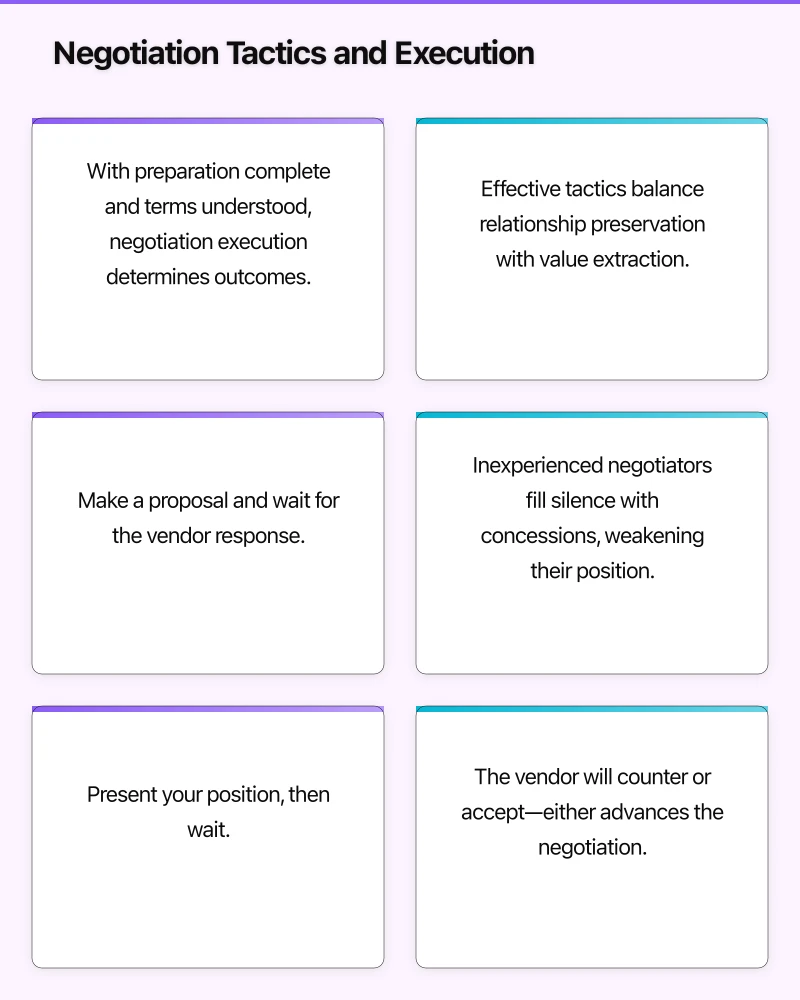
With preparation complete and terms understood, negotiation execution determines outcomes. Effective tactics balance relationship preservation with value extraction.
Never negotiate with yourself. Make a proposal and wait for the vendor response. Inexperienced negotiators fill silence with concessions, weakening their position. Present your position, then wait. The vendor will counter or accept—either advances the negotiation.
Separate the person from the problem. Sales representatives are professionals doing their jobs; adversarial relationships poison negotiations. Build rapport while maintaining firm positions. The best negotiations feel collaborative—you’re working together to find an agreement that works for both parties.
Use time strategically. Vendors face quarterly and annual pressure to close deals. Aligning major negotiations with vendor fiscal year-end creates leverage—representatives and their managers become flexible to avoid losing deals that affect compensation. Conversely, don’t create artificial urgency for yourself. “We need this system by Monday” eliminates your leverage.
Negotiate the entire package, not individual terms. Vendors trade concessions across dimensions—better pricing in exchange for longer commitments, enhanced SLAs in exchange for larger volumes. By negotiating holistically, you can optimize across the package rather than fighting term-by-term battles.
Document everything in writing. Verbal commitments from sales representatives are meaningless unless captured in contract language. “We’ll take care of that” and “Trust me, that won’t be a problem” reflect good intentions but create no obligation. If a commitment matters, it belongs in the contract.
Escalation should be strategic, not reactive. Engaging sales leadership or executives indicates deal importance and can unlock additional flexibility. But escalate purposefully—having “gone to the top” and failed eliminates future leverage in the current negotiation.
Cloud Infrastructure Negotiations
Cloud infrastructure negotiations differ from traditional software procurement. AWS, Azure, and GCP operate with relatively fixed pricing models, but significant savings opportunities exist for organizations that negotiate strategically.
Enterprise Discount Programs (EDPs) provide the primary negotiation vehicle. These programs commit organizations to minimum spend levels over multi-year terms in exchange for percentage discounts off list pricing. Discounts typically range from 5-25% depending on commitment level and growth trajectory.
The key negotiation variables are commitment level, contract term, and included services. Vendors want higher commitments for longer terms. You want lower commitments (to preserve flexibility) with broader service coverage (to maximize discount applicability). The negotiation seeks a balance that reflects realistic usage projections.
Avoid committing to usage you won’t consume. Unlike traditional software where unused licenses represent sunk cost, cloud EDPs with unmet commitments may carry penalties or, at minimum, represent committed spending that delivers no value. Model your cloud usage carefully before committing.
Reserved instances and savings plans offer additional discounts for committed capacity. These commitments are more granular than EDPs—you commit to specific instance types in specific regions. For stable, predictable workloads, reserved instances can reduce compute costs by 40-72% compared to on-demand pricing.
Private pricing addendums (PPAs) provide custom pricing for specific services beyond standard discount programs. If your usage pattern concentrates in particular services, negotiate PPAs that reduce pricing for those specific offerings.
Consider multi-cloud strategy as a negotiation tool. Credible plans to distribute workloads across providers create competitive pressure. AWS, Azure, and GCP all offer enhanced terms to prevent customer concentration on competitors. Even if multi-cloud isn’t your architectural preference, maintaining optionality improves negotiating position.
SaaS Contract Negotiation
SaaS agreements present distinct negotiation challenges. The subscription model, data custody arrangements, and integration dependencies create considerations beyond traditional software procurement.
Pricing transparency varies dramatically across SaaS vendors. Some publish pricing openly; others require sales engagement to receive quotes. For vendors with published pricing, the list price represents a starting point, not a ceiling. Discounts of 15-30% are common for annual commitments and reasonable volumes.
Volume commitments provide negotiation leverage. SaaS vendors prefer predictable subscription revenue to uncertain month-to-month arrangements. Committing to user counts or usage tiers over multi-year terms justifies discounted pricing. But avoid over-committing—paying for unused subscriptions eliminates the savings from volume discounts.
Data portability requirements are essential for SaaS agreements. Your data resides in vendor systems; you must be able to extract it. Require contractual commitments to data export in standard formats (CSV, JSON, standard APIs). Understand data retention after termination—how long will the vendor maintain your data for extraction?
Integration dependencies create switching costs that affect future negotiating position. SaaS applications that integrate deeply with other systems become difficult to replace. Consider integration architecture during vendor selection—APIs, webhooks, and standard data formats preserve flexibility better than proprietary connectors.
Security and compliance attestations protect organizational interests. For SaaS handling sensitive data, require current SOC 2 Type II reports, relevant compliance certifications (HIPAA, PCI-DSS, etc.), and right-to-audit provisions. Vendors resistant to transparency about security practices raise red flags.
Uptime and performance SLAs for SaaS applications should reflect business impact. A 99.9% uptime SLA allows approximately 8.7 hours of downtime annually—acceptable for some applications but not for business-critical systems. For mission-critical SaaS, negotiate enhanced SLAs with meaningful remediation.
Managing Ongoing Vendor Relationships
Contract signing isn’t the conclusion of vendor management—it’s the beginning of an ongoing relationship that requires active management.
Establish governance structures for significant vendor relationships. Quarterly business reviews (QBRs) provide forums for discussing performance, roadmaps, and issues. For strategic vendors, executive sponsorship from both organizations ensures appropriate attention and escalation paths.
Track contract performance systematically. SLA commitments, pricing terms, and service obligations should be monitored continuously. Vendors occasionally fail to deliver committed terms; without monitoring, you won’t know. Documented performance issues provide leverage for renewal negotiations.
Maintain competitive awareness throughout the contract term. The vendor landscape evolves—new entrants emerge, pricing models change, capabilities advance. Continuous market monitoring ensures you understand your options when renewal approaches. Vendors who believe you’re monitoring alternatives remain more attentive than those who perceive customer captivity.
Build relationships across the vendor organization. Your sales representative handles commercial matters, but technical contacts address implementation issues, and executive sponsors can resolve escalations. A network of relationships provides multiple channels for addressing issues and understanding vendor direction.
Plan for renewals well in advance. Start renewal discussions 6-9 months before contract expiration. This timeline provides adequate runway for negotiation, alternative evaluation, and transition planning if necessary. Last-minute renewals eliminate leverage and invite vendor opportunism.
Avoiding Common Negotiation Mistakes
Even experienced technology leaders make negotiation mistakes that inflate costs and constrain flexibility. Awareness of common pitfalls enables avoidance.
Accepting first offers signals willingness to overpay. Vendor initial proposals contain margin for negotiation. Accepting without pushback indicates price insensitivity—the vendor learns that this customer doesn’t negotiate, affecting current and future interactions.
Focusing exclusively on price neglects total cost of ownership. A low subscription price combined with expensive implementation services, integration costs, and training may exceed a higher-priced alternative with turnkey deployment. Evaluate total cost across the contract lifetime.
Undervaluing your leverage diminishes negotiating outcomes. Your organization represents potential revenue, references, and market position for vendors. Particularly for vendors seeking to establish presence in your industry or displace incumbents, your business carries value beyond revenue. Use this leverage.
Negotiating in silos fragments organizational buying power. When multiple departments negotiate separately with the same vendor, the organization pays higher prices and manages inconsistent terms. Centralize major vendor relationships to aggregate volume and standardize agreements.
Ignoring renewal economics until contract expiration eliminates options. Vendors price renewals assuming you’re captive—switching costs exceed price increases. By maintaining alternatives and starting renewal discussions early, you preserve leverage that expires as contract end approaches.
Over-committing to gain discounts trades flexibility for savings that may not materialize. Multi-year commitments at projected growth rates rarely match reality. Conservative commitments with good terms beat aggressive commitments that over-extend.
Building Organizational Negotiation Capability
Effective vendor negotiation isn’t an individual skill but an organizational capability. Building this capability requires process, tools, and talent investment.
Establish procurement processes that engage technology leadership early. Too often, procurement receives requirements after commitments are made, limiting negotiation flexibility. Technology leaders should participate in vendor selection and negotiation, not just requirements definition.
Create vendor management playbooks documenting negotiation frameworks, standard terms, and lessons learned. Each negotiation generates learning—capture it systematically so future negotiations benefit from organizational experience.
Invest in market intelligence. Understanding vendor financial health, competitive positioning, and pricing trends informs negotiation strategy. Services like Gartner, Forrester, and specialized procurement advisory firms provide intelligence that improves negotiating positions.
Consider procurement advisory services for major transactions. Specialized negotiators bring market intelligence, benchmark data, and negotiation experience that internal teams may lack. For contracts exceeding $500K annually, advisory fees often pay for themselves through improved terms.
Develop internal negotiation skills through training and mentorship. Procurement and technology team members benefit from formal negotiation training and experience working alongside skilled negotiators. This capability compounds over time as the organization completes more negotiations.
Strategic Implications for Technology Leaders
Vendor negotiation sits at the intersection of technology strategy, financial management, and risk mitigation. CTOs who master this discipline create competitive advantage through better economics, improved flexibility, and stronger vendor partnerships.
The immediate opportunity is substantial. Most enterprises overpay for technology by 20-30%—not through any single error but through accumulated suboptimal decisions across dozens of vendor relationships. Systematic improvement in negotiation practice captures significant value.
Beyond cost savings, effective vendor management preserves architectural flexibility. Poorly negotiated contracts create lock-in that constrains future decisions. Well-negotiated contracts include exit provisions, data portability, and reasonable terms that maintain optionality.
The skills developed through vendor negotiation extend throughout technology leadership. The preparation discipline, analytical frameworks, and negotiation tactics apply to budget discussions, partnership negotiations, and organizational change management.
Technology vendor relationships represent long-term partnerships, not transactional purchases. Approaching negotiations with this perspective—seeking fair agreements that work for both parties over time—creates sustainable relationships that deliver value beyond contract terms.
Preparing for a major technology negotiation? I advise enterprise leaders on vendor strategy and negotiation approach. Connect to discuss your specific situation.
For the practitioner’s view on web design and digital marketing, explore Cosmos Web Tech — where strategy meets execution.
My consultancy Ganda Tech Services operates three specialist divisions covering cloud infrastructure, web development, and mobile apps for Australian businesses.
About the Author
Ashish Ganda is the founder of Ganda Tech Services, a Sydney-based technology consultancy specialising in cloud infrastructure, web development, and mobile app solutions for Australian businesses.
Digital Transformation Roadmap 2026
A 12-month framework for Australian SMBs ready to modernise — phases, tools, and milestones.