Technology Due Diligence in M&A: A Framework for 2025
The Technology Factor in M&A
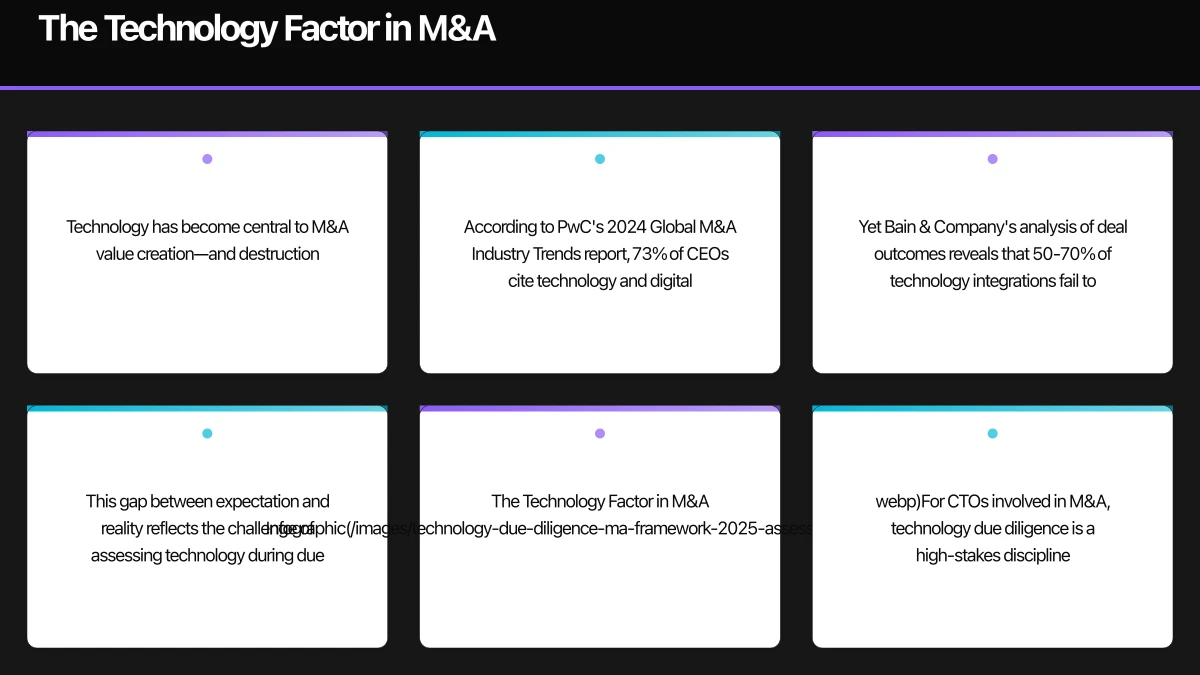
Technology has become central to M&A value creation—and destruction. According to PwC’s 2024 Global M&A Industry Trends report, 73% of CEOs cite technology and digital capabilities as a primary acquisition driver. Yet Bain & Company’s analysis of deal outcomes reveals that 50-70% of technology integrations fail to deliver expected synergies.
This gap between expectation and reality reflects the challenge of assessing technology during due diligence. Compressed timelines, limited access, and technical complexity create conditions where critical issues go undiscovered until integration begins—when addressing them is far more expensive.
For CTOs involved in M&A, technology due diligence is a high-stakes discipline. The assessment shapes deal valuation, identifies integration risks, and establishes the foundation for post-merger technology strategy. Getting it wrong can turn a strategic acquisition into an integration quagmire that destroys value and consumes years of executive attention.
This framework provides a structured approach to technology due diligence, drawing on patterns from successful assessments and lessons from deals that encountered unexpected technology challenges.
The Due Diligence Landscape
Why Technology Due Diligence Fails
Common failure patterns in technology due diligence:
Surface-level assessment: Reviewing documentation and architecture diagrams without technical depth. Organizations present their best face during due diligence—discovery requires probing beneath presentation materials.
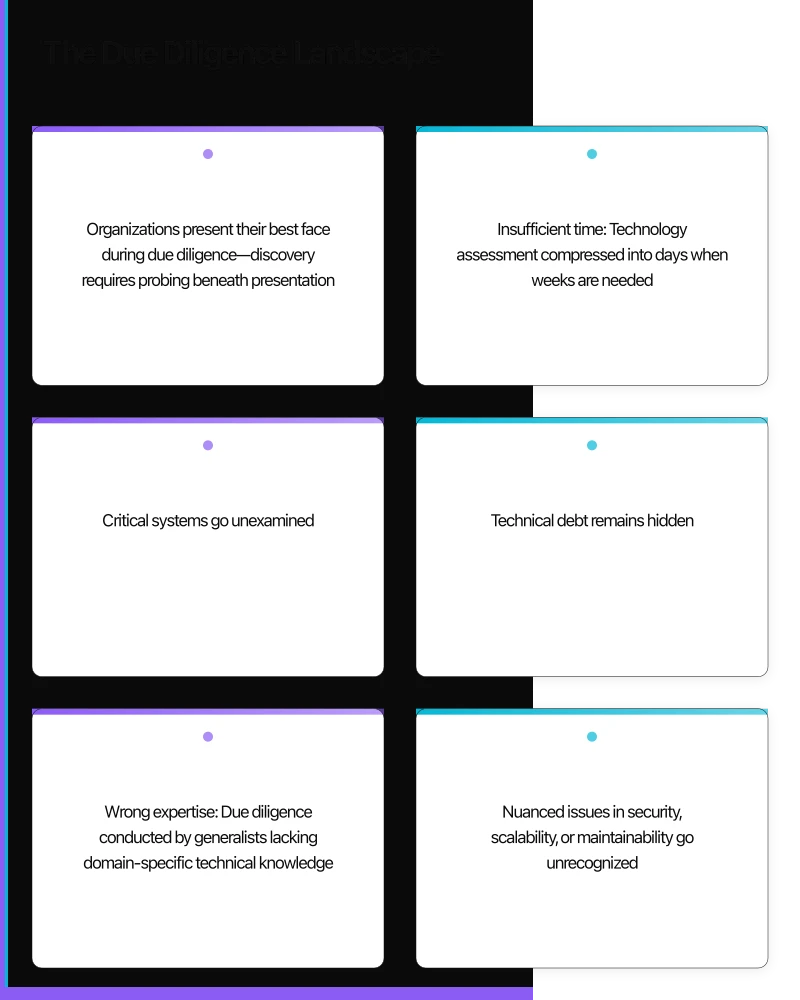
Insufficient time: Technology assessment compressed into days when weeks are needed. Critical systems go unexamined. Technical debt remains hidden.
Wrong expertise: Due diligence conducted by generalists lacking domain-specific technical knowledge. Nuanced issues in security, scalability, or maintainability go unrecognized.
Optimistic integration assumptions: Synergy models assuming rapid integration without accounting for actual technical complexity. “18-month integration” plans that actually require 36+ months.
Neglecting people: Focus on technology while ignoring the teams that build and maintain it. Key personnel departures post-acquisition can devastate technology value.
The Due Diligence Timeline
Technology due diligence typically occurs in phases:
Preliminary assessment (1-2 weeks): High-level review based on public information and initial data room materials. Go/no-go for deeper diligence.
Detailed technical diligence (2-4 weeks): Comprehensive technology assessment with data room access and management presentations. Core of the due diligence process.
Expert sessions (1-2 weeks): Deep-dive sessions with target technology leadership. Clarification of findings, exploration of specific concerns.
Integration planning (concurrent and post-signing): Detailed integration planning building on diligence findings. Often accelerates after signing with fuller access.
Timeline pressure is real but should not compromise thoroughness. Discoveries post-close are far more expensive than extending diligence.
Assessment Framework
Domain 1: Technology Assets and Architecture
Assess the target’s technology foundation:
Application portfolio:
- Inventory of applications (customer-facing, internal, infrastructure)
- Architecture patterns (monolithic, microservices, serverless)
- Technology stack (languages, frameworks, databases)
- Age and maintainability of key systems
- Documentation quality and currency
Infrastructure:
- Data center footprint (owned, collocated, cloud)
- Cloud adoption level and strategy
- Infrastructure as code maturity
- Disaster recovery and business continuity
- Capacity and scalability headroom
Data assets:
- Data architecture and data stores
- Data quality and governance maturity
- Analytics and ML capabilities
- Data privacy compliance
- Data portability and ownership
Intellectual property:
- Patents and proprietary algorithms
- Open source usage and compliance
- Third-party IP dependencies
- Trade secrets in technology
- What are the crown jewel technology assets?
- What is the technical debt burden?
- How maintainable are critical systems?
- Are there significant refactoring or replacement needs?
Domain 2: Security and Compliance
Assess security posture and regulatory compliance:
Security architecture:
- Security controls inventory
- Identity and access management
- Network security and segmentation
- Data encryption (at rest, in transit)
- Security monitoring and incident response
Vulnerability landscape:
- Recent penetration test results
- Vulnerability scan findings
- Security incident history
- Remediation velocity
Compliance status:
- Regulatory requirements (GDPR, CCPA, industry-specific)
- Compliance certifications (SOC 2, ISO 27001, PCI-DSS)
- Audit history and findings
- Privacy practices and consent management
Third-party risk:
- Vendor security assessment practices
- Critical vendor dependencies
- Supply chain security
Key questions:
- What is the security risk profile?
- Are there undisclosed breaches or incidents?
- What compliance gaps require remediation?
- What is the cost to achieve acceptable security posture?
Domain 3: Development and Operations
Assess technology delivery capabilities:
Development practices:
- Development methodology (agile, waterfall, hybrid)
- Code quality and testing practices
- Code review and quality gates
- DevOps and CI/CD maturity
- Release frequency and stability
Technical debt:
- Known technical debt inventory
- Code quality metrics
- Dependency currency (outdated libraries, frameworks)
- Documentation gaps
- Testing coverage
Operations:
- Incident management processes
- System reliability metrics (uptime, MTTR)
- Monitoring and alerting coverage
- Capacity management
- Change management
Key questions:
- How effective is technology delivery?
- What is the velocity and reliability of changes?
- How much technical debt requires remediation?
- What operational risks exist?
Domain 4: Technology Team
People are often the most valuable technology asset:
Organization structure:
- Technology organization chart
- Reporting relationships and decision authority
- Geographic distribution
- Contractor vs. employee mix
Capabilities:
- Skills inventory across teams
- Key person dependencies
- Institutional knowledge concentration
- Training and development investment
Culture and engagement:
- Employee turnover rates
- Engagement survey results (if available)
- Cultural indicators from interviews
- Relationship with business stakeholders
Compensation and retention:
- Compensation benchmarking
- Equity and retention arrangements
- Non-compete and IP assignment agreements
Key questions:
- Who are the critical individuals?
- What is the retention risk?
- What capability gaps exist?
- How will the team integrate culturally?
Domain 5: Vendor and Contract Landscape
Assess external dependencies:
Critical vendors:
- Tier-1 vendor inventory
- Contract terms and renewal dates
- Pricing and negotiability
- Termination provisions and change of control clauses
- Dependency risks
Licensing:
- Software licensing compliance
- License transferability in M&A
- Upcoming true-ups or renewals
- Open source license compliance
Outsourcing:
- Outsourced functions and providers
- Contract terms and performance
- Knowledge retention
- Transition considerations
Key questions:
- What contracts present integration challenges?
- Are there change-of-control provisions that affect the deal?
- What are the cost and operational risks from vendor dependencies?
- Are there licensing compliance issues?
Domain 6: Product and Roadmap
Assess technology products and future direction:
Product assessment:
- Product architecture and capabilities
- Competitive positioning
- Scalability and performance
- User experience quality
- Mobile and omnichannel capabilities
Roadmap alignment:
- Product roadmap and investment plans
- Strategic alignment with acquirer
- Development capacity for roadmap
- Technical feasibility of roadmap
Customer technology perspective:
- Customer satisfaction with technology
- Implementation and integration complexity
- Customer upgrade and migration needs
- Churn drivers related to technology
Key questions:
- What is the product’s competitive moat?
- Is the roadmap achievable with current capabilities?
- What technology investments are required to realize product vision?
Due Diligence Process
Pre-Diligence Preparation
Before formal diligence begins:
Assemble the team: Technical experts appropriate to target’s domain. Include security specialists, architects, and domain experts. Consider external advisors for specialized areas.
Define scope and priorities: What are the deal-critical technology questions? What risks would kill the deal? What findings would affect valuation?
Prepare request lists: Detailed data requests covering all assessment domains. Prioritize critical items for initial data room.
Establish hypotheses: What do you expect to find? What would concern you? Hypotheses focus investigation.
Data Room Review
Systematic review of available documentation:
Technology documentation:
- Architecture diagrams and technical specifications
- System inventories and configuration management data
- Development and operations documentation
- Security policies and procedures
Financial data:
- IT budget and spending history
- Capital expenditure plans
- Vendor contracts and pricing
- Headcount and compensation data
Compliance and legal:
- Security certifications and audit reports
- Regulatory correspondence
- Privacy policies and consent records
- IP documentation
Operational metrics:
- System availability and performance data
- Incident reports and trends
- Development velocity metrics
- Customer support data related to technology
Document gaps in available information. Prepare follow-up requests.
Management Presentations and Expert Sessions
Direct engagement with target technology leadership:
Presentation sessions:
- Technology strategy and vision
- Architecture overview
- Development and operations practices
- Security program
- Team and organization
Deep-dive sessions:
- Specific systems or concerns
- Technical demonstrations
- Code and infrastructure walkthroughs
- Security and compliance details
Interview targets:
- CTO/VP Engineering
- Security leadership
- Architecture leadership
- Key technical contributors
- Development and operations managers
Prepare specific questions based on data room findings. Probe areas of concern.
Technical Assessment
Where feasible, conduct direct technical evaluation:
Code review: Sample review of critical codebases. Assess quality, maintainability, security.
Architecture review: Validate documented architecture against reality. Assess scalability, resilience, technical debt.
Security assessment: Vulnerability scanning if permitted. Review of security controls. Assessment of security program maturity.
Infrastructure review: Assess infrastructure configuration, capacity, cost efficiency.
Access for technical assessment varies by deal stage and seller willingness. Push for maximum feasible access.
Integration Planning
Due diligence findings feed integration planning:
Integration Strategy Options
Absorption: Target technology absorbed into acquirer platforms. Appropriate when acquirer platforms are superior and target technology is not the deal rationale.
Preservation: Target technology operates independently. Appropriate for technology acquisitions where independence preserves value.
Convergence: Best-of-breed combination of acquirer and target capabilities. Complex but may capture more value.
Transformation: Deal creates opportunity for greenfield approach neither organization could execute alone.
Strategy selection depends on deal rationale, technology assessment findings, and integration capacity.
Day-1 Planning
Critical activities for Day 1:
Access management: Secure access to target systems. Implement acquirer security controls where required.
Communication: Communicate technology integration approach to target team. Address retention concerns.
Business continuity: Ensure no disruption to target technology operations. Establish incident escalation paths.
Compliance: Address immediate compliance requirements triggered by ownership change.
Integration Roadmap
Post-close integration typically spans 12-36 months:
Phase 1 (0-3 months): Stabilization and discovery
- Deeper technical assessment with full access
- Team integration and retention
- Quick wins and critical fixes
- Detailed integration planning
Phase 2 (3-12 months): Core integration
- System integrations and migrations
- Process harmonization
- Team restructuring
- Synergy capture
Phase 3 (12-36 months): Optimization
- Platform consolidation
- Organizational optimization
- Technical debt remediation
- Value capture completion
Synergy Realization
Technology synergies require active management:
Cost synergies:
- Infrastructure consolidation
- Application rationalization
- Vendor consolidation and renegotiation
- Headcount optimization (careful—often destroys capability)
Revenue synergies:
- Product integration enabling new offerings
- Cross-sell through technology integration
- Faster time-to-market from combined capabilities
Strategic synergies:
- Combined IP and capabilities
- Talent acquisition
- Market positioning
Track synergy realization against deal model. Adjust integration approach based on actual results.
Risk Assessment and Valuation Impact
Technology Risk Factors
Common findings that affect valuation:
Deferred investment: Years of underinvestment creating catch-up requirements. Assess magnitude and timeline.
Technical debt: Code quality, architectural, and infrastructure debt requiring remediation. Quantify remediation cost.
Security gaps: Security deficiencies requiring immediate or near-term investment. Factor into deal protection.
Scalability limitations: Architectural constraints limiting growth. May require significant rearchitecture.
Key person risk: Critical knowledge concentrated in few individuals with retention risk.
Compliance gaps: Regulatory compliance deficiencies requiring remediation. Potential for fines or enforcement.
Obsolete technology: End-of-life platforms requiring migration. Assess complexity and cost.
Quantifying Impact
Translate findings into financial impact:
One-time costs:
- Remediation investments
- Integration project costs
- Migration and consolidation
- Retention packages
Ongoing costs:
- Increased run-rate for capability gaps
- Elevated support costs for technical debt
- Compliance maintenance
Synergy adjustments:
- Delayed synergy realization timelines
- Reduced synergy magnitude
- Stranded costs from integration complexity
Risk provisions:
- Reserves for undiscovered issues
- Contingencies for integration overruns
Work with deal team to incorporate technology findings into valuation model.
Reporting and Communication
Due Diligence Report
Structure the final report for multiple audiences:
Executive summary: Key findings, deal-critical issues, overall technology assessment, valuation impact.
Detailed findings: Domain-by-domain assessment with supporting evidence.
Risk register: Identified risks with likelihood, impact, and mitigation approaches.
Integration considerations: Key integration planning factors, recommended approach.
Appendices: Detailed technical analysis, interview notes, supporting data.
Stakeholder Communication
Different stakeholders need different views:
Board/Investment Committee: Deal-critical issues, valuation impact, strategic technology assessment.
Deal team: Detailed findings for negotiation and deal structure.
Integration team: Actionable findings for integration planning.
Functional leaders: Domain-specific findings (security, infrastructure, development).
Tailor communication to audience needs and decision requirements.
The Human Element
Technology due diligence ultimately assesses human capability:
Engage authentically: Target technology teams are evaluating you as potential future leaders. Approach with respect and genuine interest.
Listen for signals: How do people talk about their systems, challenges, and leadership? Cultural indicators emerge in conversation.
Assess leadership: The CTO and technology leadership team are critical. Evaluate capability, vision, and cultural fit.
Consider retention early: Identify key individuals. Understand their motivations. Begin retention planning during diligence.
Remember the stakes: For target employees, acquisition creates uncertainty. Professional conduct and clear communication matter.
Strategic Recommendations
For CTOs leading technology due diligence:
-
Invest in thorough assessment. Time pressure is real but insufficient diligence creates larger problems. Push for adequate access and timeline.
-
Focus on deal-critical questions. What findings would kill the deal? What findings would significantly affect valuation? Prioritize these.
-
Bring appropriate expertise. Generalist diligence misses specialized issues. Security, scalability, and domain-specific concerns require domain expertise.
-
Quantify findings. Narrative findings have limited impact. Translate technology assessment into financial terms for deal team.
-
Plan integration during diligence. Don’t wait for close to think about integration. Diligence findings should directly inform integration strategy.
-
Remember the people. Technology value derives from teams. Assess capabilities, identify key individuals, and plan for retention.
Technology due diligence is challenging, time-pressured, and consequential. The organizations that approach it systematically—with clear frameworks, appropriate expertise, and sufficient investment—make better acquisition decisions and capture more value from deals they complete.
For guidance on technology due diligence and M&A integration planning, connect with me to discuss approaches tailored to your specific transaction context.
Turning mobile strategy into a shipped app? Awesome Apps covers Flutter, React Native, and native development for Australian businesses.
I lead Ganda Tech Services, where we turn digital strategy into results through specialist cloud, web design, and mobile app teams across Sydney.
About the Author
Ashish Ganda is the founder of Ganda Tech Services, a Sydney-based technology consultancy specialising in cloud infrastructure, web development, and mobile app solutions for Australian businesses.
Digital Transformation Roadmap 2026
A 12-month framework for Australian SMBs ready to modernise — phases, tools, and milestones.
Almost done
Check your inbox and click the confirmation link to get your download.