Strategic Decision-Making Framework: Using 3D Decision Matrix for Cloud Architecture
The Architecture Decision Problem
Every enterprise architect has been there: a steering committee meeting where stakeholders argue past each other about cloud strategy. The CTO wants multi-cloud flexibility. Finance demands cost optimisation. Security insists on private cloud controls. Operations pushes for managed services that reduce toil.
Everyone brings legitimate concerns. No one brings a structured framework for weighing them. The meeting ends with vague consensus and deferred decisions—a pattern that repeats until deadline pressure forces a rushed choice.
This happens because cloud architecture decisions are genuinely difficult. They involve multiple dimensions, conflicting priorities, uncertain futures, and irreversible commitments. Traditional decision-making tools—pro/con lists, weighted scorecards, gut instinct—fail to capture this complexity.
The 3D Decision Matrix offers a better approach.
Understanding the 3D Decision Matrix
The 3D Decision Matrix evaluates architectural choices across three orthogonal dimensions:
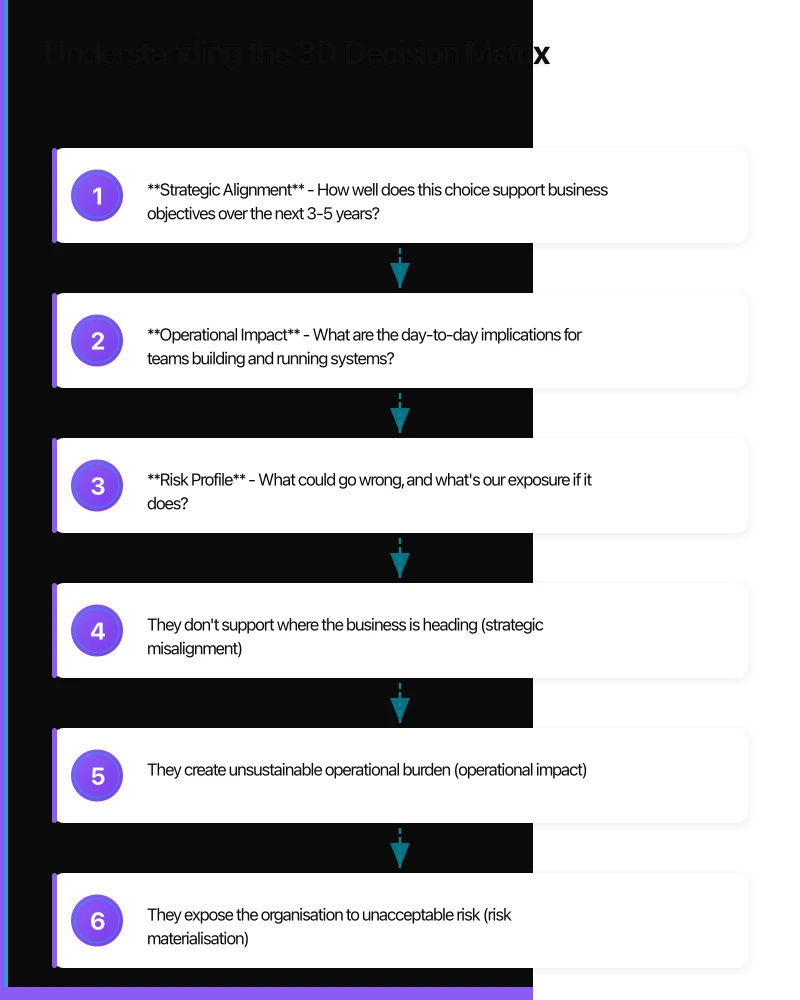
- Strategic Alignment - How well does this choice support business objectives over the next 3-5 years?
- Operational Impact - What are the day-to-day implications for teams building and running systems?
- Risk Profile - What could go wrong, and what’s our exposure if it does?
Unlike two-dimensional matrices that collapse complexity into oversimplified quadrants, the 3D approach preserves the genuine tensions inherent in architectural trade-offs. It doesn’t pretend there’s an obvious “right answer”—it makes the trade-offs visible so stakeholders can make informed choices.
Why Three Dimensions?
Architectural decisions fail for one of three reasons:
- They don’t support where the business is heading (strategic misalignment)
- They create unsustainable operational burden (operational impact)
- They expose the organisation to unacceptable risk (risk materialisation)
Two-dimensional frameworks typically capture only two of these concerns, leaving the third to blindside you post-implementation. The 3D Matrix ensures all three receive explicit consideration.
Constructing Your Decision Matrix
Let’s work through the framework using a common enterprise challenge: selecting a cloud database strategy for a growing SaaS platform.
Step 1: Define the Decision Space
Before evaluating options, clearly articulate:
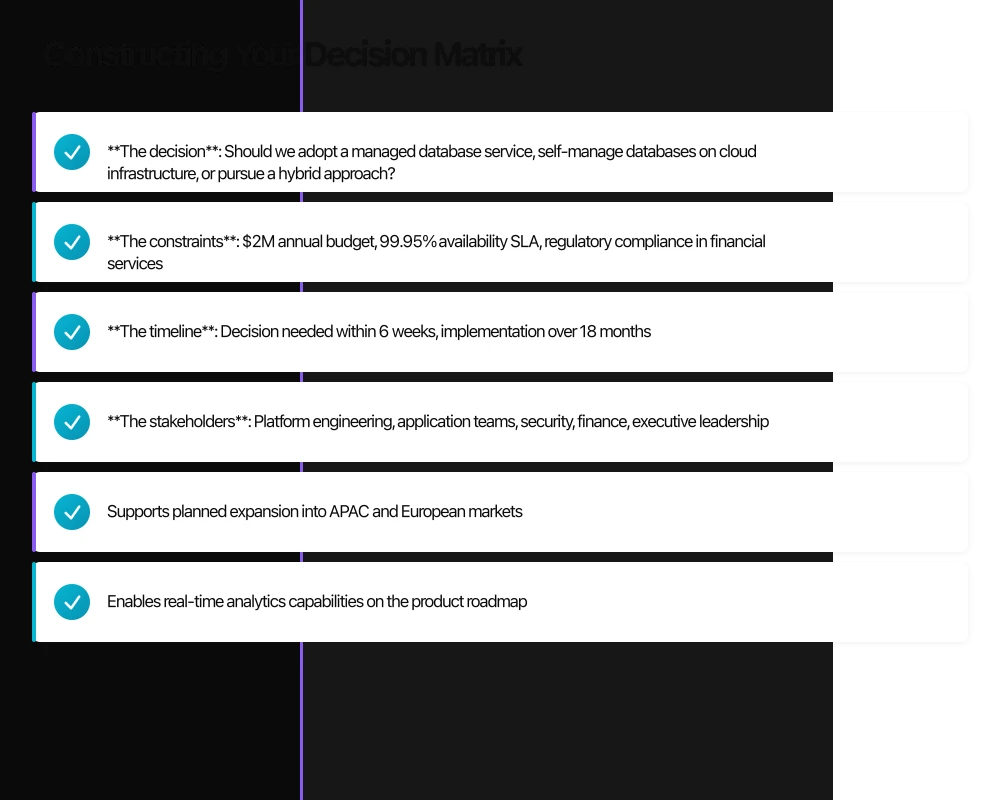
- The decision: Should we adopt a managed database service, self-manage databases on cloud infrastructure, or pursue a hybrid approach?
- The constraints: $2M annual budget, 99.95% availability SLA, regulatory compliance in financial services
- The timeline: Decision needed within 6 weeks, implementation over 18 months
- The stakeholders: Platform engineering, application teams, security, finance, executive leadership
Document these explicitly. Unstated constraints derail more architecture decisions than technical limitations.
Step 2: Establish Evaluation Criteria
For each dimension, define 3-5 measurable criteria:
Strategic Alignment:
- Supports planned expansion into APAC and European markets
- Enables real-time analytics capabilities on the product roadmap
- Preserves optionality for future M&A integration scenarios
- Aligns with the 5-year cloud cost reduction initiative
Operational Impact:
- Skills availability in current and future engineering workforce
- Incident response and recovery complexity
- Development team velocity and deployment frequency
- On-call burden and sustainable operations
Risk Profile:
- Vendor lock-in and exit cost
- Data sovereignty and compliance exposure
- Security attack surface
- Business continuity under various failure scenarios
Step 3: Score Each Option
For each criterion, score options on a 1-5 scale:
- 1: Significant concern
- 2: Below acceptable
- 3: Acceptable
- 4: Good fit
- 5: Excellent fit
Example scoring for managed database service:
| Criterion | Score | Rationale |
|---|---|---|
| APAC/EU expansion | 5 | Regional availability built-in |
| Real-time analytics | 4 | Streaming integrations available |
| M&A flexibility | 2 | Proprietary features create integration friction |
| Cost reduction | 3 | Higher unit cost, lower operational overhead |
| Skills availability | 4 | Common platform, good hiring pool |
| Incident complexity | 5 | Vendor handles most operational concerns |
| Developer velocity | 4 | Fast provisioning, good tooling |
| On-call burden | 5 | Minimal operational toil |
| Vendor lock-in | 2 | Significant migration cost to exit |
| Data sovereignty | 3 | Available regions may require negotiation |
| Security surface | 4 | Shared responsibility, but vendor investment high |
| Business continuity | 4 | Strong SLAs, proven track record |
Step 4: Visualise the Trade-offs
Plot each option in three-dimensional space using the average scores for each dimension:
                     Strategic Alignment (High)
                              |
                              |
           Managed -----+     |
                        |     |
                        |     +---- Hybrid
                        |    /
        Risk (Low) -----+---/------------ Operational Impact (Low)
                       /   |
                      /    |
               Self-Managed
This visualisation immediately reveals the fundamental trade-off: managed services score well on operational impact but raise strategic concerns about lock-in. Self-managed approaches preserve flexibility but increase operational burden.
Applying the Framework to Cloud Migration
Cloud migration decisions benefit particularly from 3D analysis because they involve all three dimensions acutely.
Migration Strategy Selection
Consider the classic “6 Rs” migration strategies: Rehost, Replatform, Repurchase, Refactor, Retain, Retire. Each represents different trade-offs:
Rehost (Lift-and-Shift):
- Strategic Alignment: Low—preserves technical debt, limits cloud-native benefits
- Operational Impact: Medium—similar ops model, new infrastructure
- Risk Profile: Low—minimal change, predictable outcomes
Refactor (Re-architect):
- Strategic Alignment: High—enables cloud-native capabilities
- Operational Impact: High initial burden, low long-term
- Risk Profile: High—significant change, uncertain timelines
Replatform (Lift-and-Optimise):
- Strategic Alignment: Medium—some modernisation benefits
- Operational Impact: Medium—moderate learning curve
- Risk Profile: Medium—balanced change scope
The 3D Matrix reveals that migration strategy isn’t a one-size-fits-all decision. Different applications warrant different approaches based on their strategic importance, operational criticality, and acceptable risk levels.
Portfolio-Level Decision Making
For enterprise portfolios with hundreds of applications, use the 3D Matrix to create migration cohorts:
Cohort A: Strategic Refactor (15% of portfolio) Applications central to competitive differentiation. Accept high operational impact and risk in exchange for strategic alignment.
Cohort B: Tactical Replatform (45% of portfolio) Important but not differentiating applications. Balance all three dimensions for sustainable migration pace.
Cohort C: Efficient Rehost (30% of portfolio) Utility applications with low strategic value. Minimise operational burden and risk; accept limited cloud benefits.
Cohort D: Retire/Retain (10% of portfolio) Applications approaching end-of-life or with prohibitive migration complexity. Don’t migrate—retire or keep on-premises.
This cohort approach enables parallel workstreams with different velocity and risk profiles, accelerating overall migration without overwhelming operational capacity.
Common Pitfalls and How to Avoid Them
Pitfall 1: Scoring Without Context
A “3” for vendor lock-in means nothing without understanding your organisation’s actual lock-in tolerance. Some organisations accept significant lock-in in exchange for development velocity. Others require exit strategies with maximum 6-month transition periods.
Solution: Establish explicit scoring rubrics before evaluation. Define what constitutes a “1” vs. a “5” for each criterion in your specific context.
Pitfall 2: Equal Weighting
Not all criteria matter equally. If data sovereignty is a regulatory requirement, it’s not negotiable—it’s a constraint. Treating it as one criterion among many masks its true importance.
Solution: Identify non-negotiable constraints separately from preference criteria. Only score criteria that represent genuine trade-offs.
Pitfall 3: Point-in-Time Thinking
Scores change over time. Today’s vendor lock-in concern may be irrelevant if you’re acquiring that vendor next year. Current skills gaps close with training investment.
Solution: Score for multiple time horizons. Where will each option stand in 6 months? 2 years? 5 years? Decisions that score well across time horizons are more robust.
Pitfall 4: Consensus Bias
Groups naturally gravitate toward options that no one strongly opposes, even when a controversial option is objectively better.
Solution: Have stakeholders score independently before group discussion. Use the variance in scores—high variance indicates genuine disagreement that deserves explicit debate.
Case Study: Financial Services Cloud Platform
A mid-sized Australian bank faced a common challenge: their core banking system needed modernisation, but regulatory constraints complicated cloud adoption.
The Decision: How to architect their next-generation payments platform across cloud and on-premises infrastructure.
The Options:
- Full public cloud with regulatory exemption pursuit
- Hybrid with sensitive workloads on-premises
- Private cloud within existing data centres
- Multi-cloud with workload distribution
3D Matrix Results:
| Option | Strategic | Operational | Risk | Overall Position |
|---|---|---|---|---|
| Full Public Cloud | 5 | 4 | 2 | High reward, high risk |
| Hybrid | 4 | 3 | 4 | Balanced trade-offs |
| Private Cloud | 2 | 2 | 5 | Conservative, limited upside |
| Multi-Cloud | 3 | 1 | 3 | Complexity without proportional benefit |
The visualisation revealed that multi-cloud—initially favoured for its apparent flexibility—actually delivered the worst operational profile without meaningfully reducing risk or improving strategic alignment.
The bank chose the hybrid approach, accepting modest strategic constraints in exchange for manageable operational burden and acceptable risk. They established a 3-year roadmap to evaluate regulatory changes that might enable fuller public cloud adoption.
Outcome: The hybrid architecture launched 4 months ahead of schedule with 99.98% availability in its first year. The structured decision process enabled faster executive approval by making trade-offs explicit rather than hiding them behind technical jargon.
Integrating with Architecture Review Boards
Enterprise Architecture Review Boards (ARBs) often struggle with consistent decision-making. Different reviewers apply different mental models, leading to unpredictable outcomes that frustrate delivery teams.
The 3D Decision Matrix brings structure to ARB processes:
Pre-Review Preparation Require teams to complete 3D analysis before ARB submission. Provide templates and scoring rubrics aligned with enterprise principles.
Review Discussion Focus ARB time on areas of scoring disagreement rather than relitigating well-understood trade-offs. If the team scored vendor lock-in as “3” and reviewers see it as “1,” that’s a specific, discussable disagreement.
Decision Documentation Record not just the decision but the 3D analysis that supported it. This creates an organisational knowledge base of architectural reasoning that informs future decisions.
Pattern Recognition Over time, ARB decisions accumulate into patterns. “When strategic alignment exceeds 4 and operational impact is below 3, we typically approve despite moderate risk.” These patterns become codified guidance that accelerates routine decisions.
Beyond Cloud: Broader Applications
While I’ve focused on cloud architecture, the 3D Decision Matrix applies to any significant technical decision:
- Build vs. Buy: Strategic (differentiation), Operational (maintenance burden), Risk (vendor viability)
- Technology Selection: Strategic (talent market alignment), Operational (learning curve), Risk (technology maturity)
- Outsourcing: Strategic (core competency focus), Operational (coordination overhead), Risk (knowledge loss)
- Technical Debt Remediation: Strategic (future optionality), Operational (current productivity), Risk (system brittleness)
The framework succeeds because it forces explicit consideration of dimensions that are often implicit—dimensions that cause decisions to fail when they’re finally acknowledged too late.
Making Better Decisions Faster
Structured frameworks might seem like they slow down decision-making. In practice, they accelerate it.
Unstructured discussions meander through tangentially related concerns, revisit settled points, and stall on unstated disagreements. Structured frameworks channel discussion toward genuine decision points—the places where reasonable people disagree based on different priorities.
The 3D Decision Matrix doesn’t make decisions for you. It clarifies what you’re actually deciding: which dimension matters most when you can’t optimise all three simultaneously.
That clarity is what enables confident architectural choices even under uncertainty. And in enterprise technology, uncertainty is the only certainty.
Next Steps for Enterprise Architects
-
Adopt the framework for your next significant decision. Start with something consequential but not critical—a technology selection for a non-production system, perhaps.
-
Develop organisation-specific scoring rubrics. What does a “5” for strategic alignment mean in your context? Document it explicitly.
-
Build a decision library. Record 3D analyses for major decisions. Reference them when similar decisions arise.
-
Train your ARB on the methodology. Consistent frameworks require consistent application. Invest in reviewer calibration.
-
Iterate based on outcomes. Track whether your predictions materialised. Refine your scoring rubrics based on what you learn.
Architecture decisions shape technology organisations for years. They deserve decision-making processes commensurate with their importance. The 3D Decision Matrix provides that process—structured enough to ensure rigour, flexible enough to accommodate context, clear enough to align stakeholders around trade-offs rather than positions.
Ash Ganda advises enterprise technology leaders on cloud architecture, developer experience, and digital transformation strategy. Connect on LinkedIn for ongoing insights.
If this strategic perspective has you considering a mobile channel, Awesome Apps provides actionable app development and ASO guidance.
My consultancy Ganda Tech Services operates three specialist divisions covering cloud infrastructure, web development, and mobile apps for Australian businesses.
About the Author
Ashish Ganda is the founder of Ganda Tech Services, a Sydney-based technology consultancy specialising in cloud infrastructure, web development, and mobile app solutions for Australian businesses.
Digital Transformation Roadmap 2026
A 12-month framework for Australian SMBs ready to modernise — phases, tools, and milestones.