Enterprise Low-Code/No-Code Strategy
Introduction
The enterprise application development landscape is experiencing a fundamental shift. Traditional software development—with its lengthy timelines, specialized talent requirements, and substantial budgets—struggles to meet the accelerating pace of business change. The past year has demonstrated conclusively that organizations need faster ways to digitize processes, build customer experiences, and respond to market disruption.
Low-code and no-code platforms promise to address this challenge by enabling faster application development with less specialized expertise. Gartner predicts that by 2024, low-code application development will account for more than 65% of all application development activity. Forrester estimates the low-code market will reach $21.2 billion by 2022.
Yet for enterprise CTOs, the strategic questions extend beyond market trends. How do low-code platforms fit within existing technology architecture? What governance models ensure quality and security? Where does low-code accelerate and where does it constrain? This article provides a comprehensive framework for enterprise low-code strategy.
Defining the Landscape
Before developing strategy, we must establish clear definitions. The terms “low-code” and “no-code” are often used interchangeably but represent distinct approaches with different enterprise implications.
Low-Code Platforms
Low-code platforms provide visual development environments with pre-built components while retaining the ability to write custom code when needed. Target users include professional developers seeking productivity gains and technical business users comfortable with logic but not traditional programming.
Key Characteristics:
- Visual development interfaces with drag-and-drop functionality
- Pre-built connectors to common enterprise systems
- Ability to extend with custom code (JavaScript, Java, C#)
- Application lifecycle management capabilities
- Enterprise-grade security and scalability
Leading Platforms: OutSystems, Mendix, Appian, ServiceNow App Engine
No-Code Platforms
No-code platforms eliminate coding entirely, enabling business users without technical backgrounds to create applications. These platforms trade flexibility for accessibility.
Key Characteristics:
- Purely visual development with no code required
- Template-based application patterns
- Limited customization options
- Simplified deployment and hosting
- Department-level rather than enterprise-wide scope
Leading Platforms: Microsoft Power Apps, Salesforce Lightning, Airtable, Bubble
The Convergence Trend
The distinction between low-code and no-code is blurring. Platforms that started as no-code are adding coding capabilities. Low-code platforms are simplifying interfaces for business users. The most significant trend is Microsoft Power Platform, which combines no-code simplicity with enterprise integration depth through its Microsoft ecosystem connectivity.
The Strategic Case for Low-Code
Enterprise adoption of low-code must be driven by clear strategic objectives, not technology enthusiasm. The following business cases justify low-code investment.
Development Capacity Expansion
The global shortage of software developers constrains digital transformation initiatives. The U.S. Bureau of Labor Statistics projects 22% growth in software developer employment through 2029, but supply growth cannot match demand. Low-code expands effective development capacity by:
- Accelerating professional developers: 10x productivity improvements for appropriate use cases
- Enabling citizen developers: Business users build departmental applications without IT bottlenecks
- Reducing maintenance burden: Platform handles infrastructure, freeing developers for business logic
Time-to-Market Acceleration
Traditional enterprise applications require 6-18 months from conception to production. Low-code platforms compress this timeline dramatically. OutSystems reports average time-to-production of 2-3 months for enterprise applications. This speed enables:
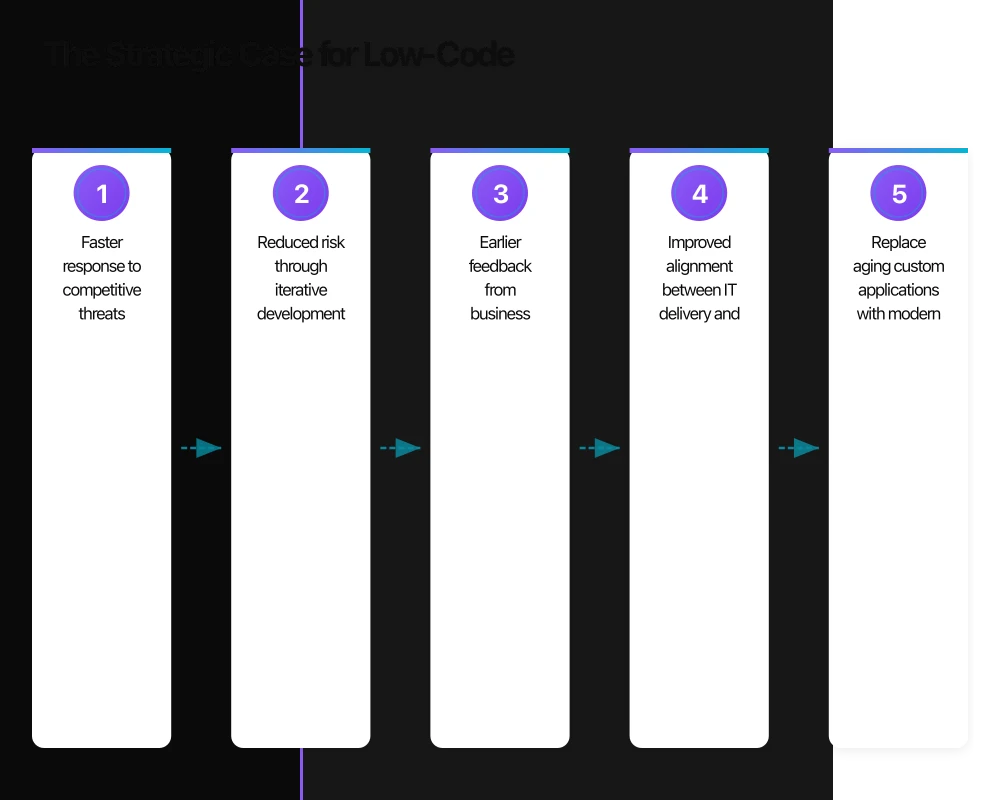
- Faster response to competitive threats
- Reduced risk through iterative development
- Earlier feedback from business stakeholders
- Improved alignment between IT delivery and business needs
Technical Debt Reduction
Legacy application portfolios accumulate technical debt that consumes maintenance budgets and resists modernization. Low-code provides a path to retire legacy systems:
- Replace aging custom applications with modern platforms
- Standardize on consistent technology stack
- Transfer maintenance burden to platform vendor
- Enable incremental modernization rather than risky rewrites
Business-IT Alignment
The historic tension between IT and business units often stems from capacity constraints and communication gaps. Citizen development—business users building applications on approved platforms—can transform this relationship:
- Business users solve their own problems for appropriate use cases
- IT focuses on complex, strategic initiatives
- Collaboration replaces contention
- Innovation emerges from those closest to problems
Use Case Assessment Framework
Not every application benefits from low-code development. CTOs need clear criteria for determining where low-code delivers value and where traditional development remains superior.
Ideal Low-Code Use Cases
Process Automation Applications
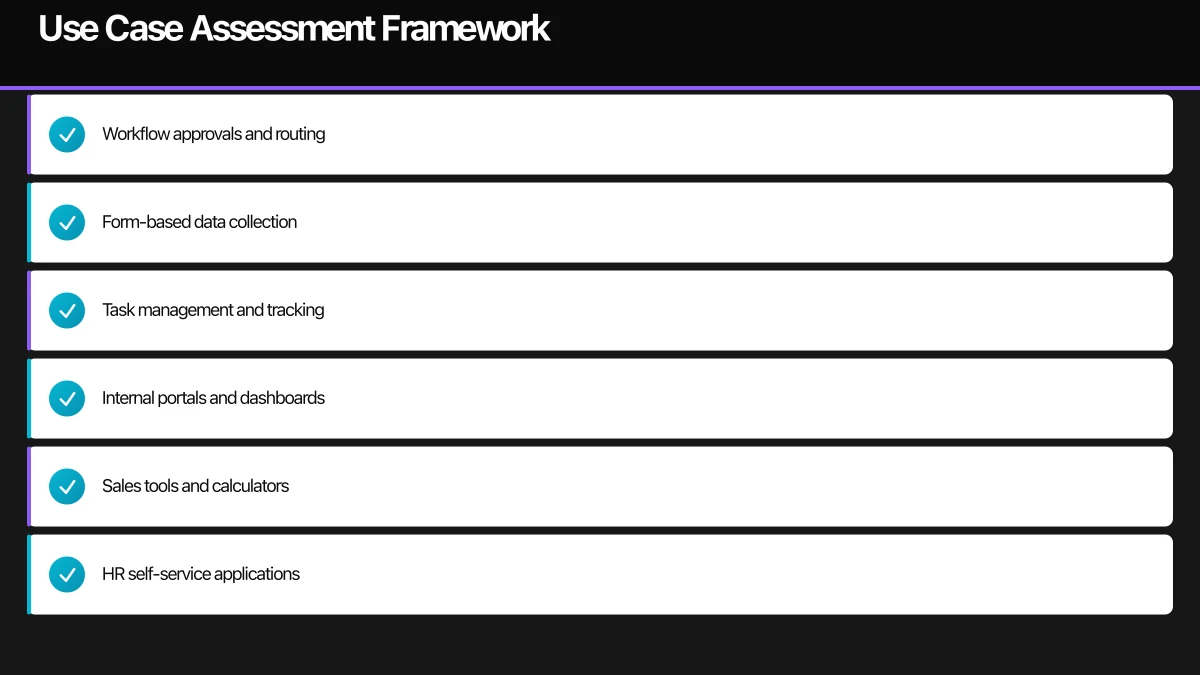
- Workflow approvals and routing
- Form-based data collection
- Task management and tracking
- Internal portals and dashboards
Characteristics: Standard UI patterns, moderate complexity, frequent change requirements, internal users
Departmental Applications
- Sales tools and calculators
- HR self-service applications
- Operations tracking systems
- Customer service utilities
Characteristics: Limited integration requirements, departmental scope, business-defined requirements
Customer-Facing Applications (with caveats)
- Customer portals
- Self-service capabilities
- Partner collaboration tools
- Simple e-commerce extensions
Characteristics: Standard experiences acceptable, platform scalability sufficient, brand flexibility adequate
Challenging Low-Code Use Cases
Real-Time Systems Applications requiring sub-second response times or complex event processing typically exceed low-code platform capabilities. Trading systems, real-time analytics, and streaming applications need traditional development.
Complex Integration Scenarios While low-code platforms offer standard connectors, complex integration patterns—transformation logic, error handling, exactly-once delivery—often require custom middleware.
Highly Differentiated Experiences Applications where user experience provides competitive differentiation may need the flexibility of traditional development. Unique interactions, custom animations, and innovative interfaces strain low-code constraints.
Algorithm-Intensive Applications Machine learning models, optimization algorithms, and complex calculations typically require traditional programming languages and specialized libraries.
Assessment Matrix
| Factor | Favors Low-Code | Favors Traditional |
|---|---|---|
| Time pressure | High | Low |
| Change frequency | High | Low |
| Integration complexity | Low-Medium | High |
| UI differentiation | Standard | Unique |
| User base | Internal/Limited | Broad public |
| Performance requirements | Moderate | Extreme |
| Regulatory complexity | Low-Medium | High |
Platform Selection Criteria
The enterprise low-code market includes dozens of platforms with varying capabilities. Selection requires systematic evaluation across multiple dimensions.
Technical Capabilities
Development Experience
- Visual modeling completeness
- Code extensibility options
- Debugging and testing tools
- Version control integration
- IDE quality and productivity
Platform Architecture
- Deployment options (cloud, on-premises, hybrid)
- Scalability characteristics
- Performance benchmarks
- Multi-tenancy support
- Geographic availability
Integration Capabilities
- Pre-built connectors catalog
- API management features
- Event-driven integration support
- Legacy system connectivity
- Data transformation capabilities
Enterprise Requirements
Security
- Authentication options (SAML, OAuth, LDAP)
- Authorization granularity
- Data encryption (transit, rest)
- Security certifications (SOC 2, ISO 27001)
- Vulnerability management processes
Governance
- Environment management (dev, test, prod)
- Change management workflows
- Audit logging completeness
- Compliance reporting
- Data residency controls
Operations
- Monitoring and alerting
- Backup and recovery
- Disaster recovery capabilities
- SLA commitments
- Support quality and responsiveness
Strategic Factors
Vendor Viability
- Financial stability
- Market position
- Investment trajectory
- Customer reference quality
- Partnership ecosystem
Lock-in Considerations
- Application portability
- Data export capabilities
- Standard compliance
- Exit strategy viability
- Skills transferability
Total Cost of Ownership
- Licensing models and costs
- Implementation expenses
- Training requirements
- Ongoing operational costs
- Hidden costs (connectors, users, storage)
Governance Models for Citizen Development
Enabling citizen development requires governance that balances empowerment with control. Without governance, citizen development creates shadow IT problems—security gaps, data silos, and support nightmares. With excessive governance, the agility benefits disappear.
The Federated Governance Model
We recommend a federated approach that distributes authority while maintaining standards.
Central IT Responsibilities:
- Platform selection and procurement
- Security policy definition
- Integration architecture standards
- Production deployment approval
- Platform administration and monitoring
- Training program development
- Center of excellence support
Business Unit Responsibilities:
- Application ideation and prioritization
- Requirements definition
- Development within approved platforms
- User acceptance testing
- Business process ownership
- Change request management
Shared Responsibilities:
- Application portfolio management
- Quality standards compliance
- Documentation maintenance
- Knowledge sharing
Citizen Developer Enablement
Successful citizen development requires more than platform access. Organizations must invest in enablement:
Training Programs
- Platform fundamentals courses
- Best practice workshops
- Security and compliance training
- Ongoing skill development
Support Structures
- Center of excellence staffing
- Office hours with professional developers
- Community forums and knowledge bases
- Mentorship programs
Guardrails
- Approved data source catalog
- Integration pattern templates
- UI component libraries
- Automated quality checks
Quality Assurance
Citizen-developed applications require quality assurance appropriate to their risk profile.
Risk-Based Testing:
| Risk Level | Testing Requirements |
|---|---|
| Low (department tool) | User acceptance testing |
| Medium (cross-department) | UAT + security scan |
| High (customer-facing) | UAT + security + performance |
| Critical (regulated) | Full enterprise testing |
Automated Quality Gates:
- Static analysis for common errors
- Security vulnerability scanning
- Performance baseline validation
- Accessibility compliance checking
Architecture Integration Patterns
Low-code platforms must integrate with existing enterprise architecture. Isolated low-code silos create technical debt rather than reducing it.
API-First Integration
The most sustainable integration pattern treats low-code platforms as API consumers. Enterprise systems expose capabilities through well-defined APIs that low-code platforms consume.
Benefits:
- Loose coupling between systems
- Consistent integration patterns
- Security at the API layer
- Reusable integrations across platforms
Implementation:
- Expose enterprise capabilities through API gateway
- Define standard API patterns for common operations
- Configure low-code platforms to consume APIs
- Monitor API usage and performance
Event-Driven Integration
For real-time integration scenarios, event-driven patterns complement API integration.
Architecture:
- Enterprise systems publish events to message broker (Kafka, Azure Event Hubs)
- Low-code platforms subscribe to relevant event streams
- Platform triggers workflows based on events
- Platform publishes events for other systems to consume
Use Cases:
- Order processing workflows
- Approval notifications
- Data synchronization
- Alert and escalation systems
Data Integration Considerations
Low-code platforms require data access strategies that balance functionality with governance.
Pattern Options:
Direct Database Access: Platform connects directly to enterprise databases. Simple but creates tight coupling and security exposure.
Data Virtualization: Abstraction layer presents unified view of data to platforms. Adds complexity but improves governance.
Data Replication: Subset of enterprise data replicated to platform data store. Reduces load on source systems but creates synchronization challenges.
API-Only Access: All data access through APIs. Most governance-friendly but may limit platform capabilities.
Measuring Low-Code Success
Enterprise low-code initiatives require clear success metrics tied to strategic objectives.
Development Velocity Metrics
Application Delivery Time
- Time from approved requirement to production deployment
- Compare low-code vs traditional development timelines
- Track trend over time as organization matures
Developer Productivity
- Features delivered per developer-month
- Lines of configuration vs custom code
- Reuse rate for components and integrations
Change Cycle Time
- Time from change request to production
- Frequency of production deployments
- Rollback rate and recovery time
Business Value Metrics
Process Efficiency
- Manual process time eliminated
- Error rate reduction
- Cycle time improvements for automated processes
Capacity Creation
- IT capacity redirected to strategic initiatives
- Business problems solved without IT queuing
- Backlog reduction rate
User Satisfaction
- Business stakeholder satisfaction scores
- End-user adoption rates
- Support ticket volumes
Risk and Quality Metrics
Security Posture
- Vulnerability scan findings
- Security incident rate
- Compliance audit results
Application Quality
- Production incident rate
- Mean time to resolution
- Technical debt accumulation
Platform Health
- Platform availability
- Performance degradation trends
- Vendor relationship health
Common Pitfalls and Mitigation
Enterprise low-code initiatives fail for predictable reasons. Understanding these pitfalls enables proactive mitigation.
Pitfall: Shadow Low-Code
Problem: Business units adopt low-code platforms without IT involvement, recreating shadow IT problems.
Mitigation: Establish clear platform standards. Communicate approved options widely. Make approved platforms easier to use than alternatives.
Pitfall: Over-Customization
Problem: Developers treat low-code as traditional development, writing excessive custom code that negates platform benefits.
Mitigation: Establish customization guidelines. Review applications for unnecessary complexity. Train developers on platform-native approaches.
Pitfall: Governance Paralysis
Problem: Excessive approval processes eliminate agility benefits that motivated low-code adoption.
Mitigation: Risk-based governance tiers. Streamlined approval for low-risk applications. Regular governance process review.
Pitfall: Skills Gap
Problem: Organization lacks skills to effectively use selected platforms.
Mitigation: Comprehensive training programs. Vendor professional services for initial implementations. Internal center of excellence development.
Pitfall: Integration Complexity
Problem: Low-code platforms cannot integrate with enterprise systems, limiting usefulness.
Mitigation: API-first architecture. Platform selection emphasizing integration capabilities. Middleware investment for complex integrations.
Looking Forward
The low-code market is evolving rapidly. Several trends will shape enterprise strategy in coming years.
AI-Assisted Development: Platforms are incorporating AI to suggest components, auto-generate integrations, and identify optimization opportunities. These capabilities will accelerate development further.
Process Mining Integration: Combining process mining insights with low-code development creates powerful automation opportunities. Identify process inefficiencies automatically, then build solutions rapidly.
Industry Solutions: Vertical-specific accelerators and templates will reduce development time for common industry patterns. Healthcare, financial services, and manufacturing solutions are emerging.
Consolidation: The crowded low-code market will consolidate. Strategic platform selection should consider vendor acquisition scenarios and migration paths.
Conclusion
Low-code and no-code platforms represent a genuine shift in enterprise application development. The organizations that harness this shift effectively will outpace competitors constrained by traditional development limitations.
Success requires strategic clarity:
- Define clear objectives for low-code adoption
- Assess use cases systematically to identify appropriate applications
- Select platforms that meet enterprise requirements
- Implement governance that balances empowerment with control
- Integrate architecturally with existing enterprise systems
- Measure success against strategic objectives
- Learn from pitfalls that undermine other organizations
The CTO’s role is not to adopt low-code universally or resist it categorically. It is to integrate low-code strategically within a portfolio approach to application development—using the right tool for each job while building organizational capability for the future.
Enterprise technology strategy requires balancing innovation adoption with practical governance. Low-code platforms offer genuine value when deployed thoughtfully within clear strategic frameworks.
Mobile execution is where many digital strategies come to life. Awesome Apps publishes practical guides on app development and mobile UX.
Ash Ganda is the founder of Ganda Tech Services, a Sydney-based technology consultancy delivering cloud, web, and mobile solutions for Australian businesses.
About the Author
Ashish Ganda is the founder of Ganda Tech Services, a Sydney-based technology consultancy specialising in cloud infrastructure, web development, and mobile app solutions for Australian businesses.
Digital Transformation Roadmap 2026
A 12-month framework for Australian SMBs ready to modernise — phases, tools, and milestones.
Almost done
Check your inbox and click the confirmation link to get your download.