Tech M&A: What CTOs Need to Know About Post-Acquisition Integration
Introduction
Technology due diligence during M&A often focuses on obvious questions: What’s the tech stack? How much technical debt exists? What will it cost to integrate?
These questions matter, but they miss the harder truths that determine integration success or failure. The real challenges are organisational, not technical: conflicting cultures, duplicated capabilities, retention of key talent, and the brutal reality that integration always takes longer and costs more than projected.
Having participated in technology integration efforts across multiple acquisitions, patterns emerge that separate successful integrations from expensive failures.
The Integration Reality Check
Why Technology Integration Fails
Underestimated Complexity
Acquirers consistently underestimate integration difficulty:
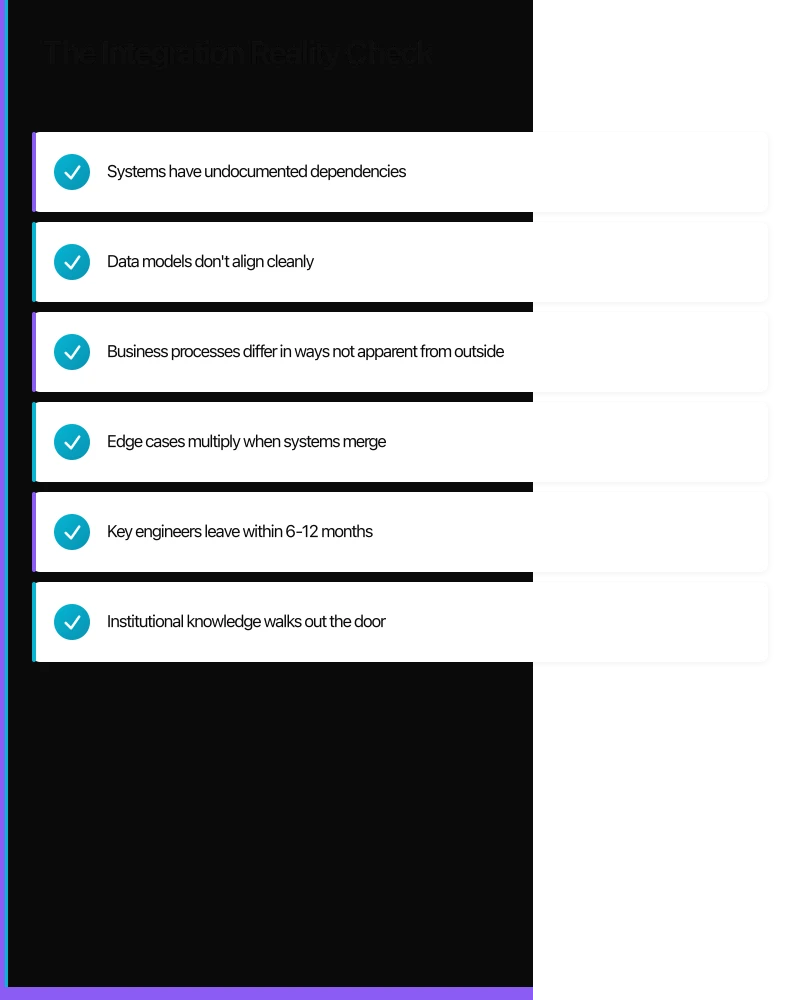
- Systems have undocumented dependencies
- Data models don’t align cleanly
- Business processes differ in ways not apparent from outside
- Edge cases multiply when systems merge
A “simple” customer data merge becomes a year-long project when you discover different definitions of “customer,” multiple ID schemes, conflicting addresses, and merged records that create downstream failures.
Talent Exodus
Acquisitions create uncertainty. Uncertainty drives departures:
- Key engineers leave within 6-12 months
- Institutional knowledge walks out the door
- Remaining staff are overwhelmed
- Hiring replacements is difficult during integration chaos
The technology being acquired is often only as valuable as the people who understand it.
Culture Clash
Technical cultures differ:
- Startup “move fast” meets enterprise “change control”
- Agile practices meet waterfall expectations
- Cloud-native meets on-premises assumptions
- Open source meets vendor-first preferences
When cultures collide without deliberate management, passive resistance and departures follow.
Competing Priorities
Integration competes with business continuity:
- Teams maintaining existing systems can’t also integrate
- New development stalls during integration focus
- Customer commitments conflict with migration timelines
- Leadership attention is divided
Pre-Acquisition: Technology Due Diligence
Beyond the Obvious
Standard technical due diligence covers:
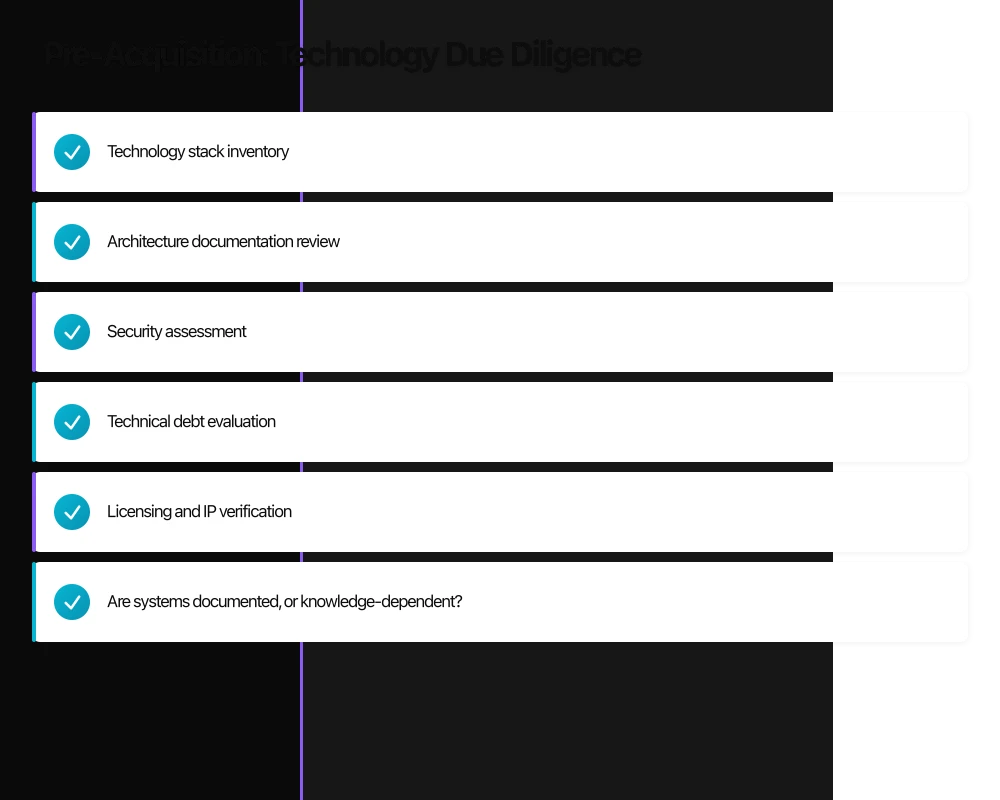
- Technology stack inventory
- Architecture documentation review
- Security assessment
- Technical debt evaluation
- Licensing and IP verification
Go deeper on questions that predict integration difficulty:
Talent Assessment
Who actually knows how things work?
- Are systems documented, or knowledge-dependent?
- How concentrated is critical knowledge?
- What’s the retention risk for key people?
- What are their likely motivations post-acquisition?
Integration Surface Area
How deeply entangled are systems?
- How many external integrations exist?
- How many internal system dependencies?
- What data flows between systems?
- What shared services or platforms exist?
Organisational Complexity
How does work actually get done?
- What processes cross team boundaries?
- What approval workflows exist?
- How are changes released to production?
- What tribal knowledge guides operations?
Red Flags
Watch for signals that integration will be painful:
Hero-Dependent Systems
- “Only Sarah really understands that system”
- Limited documentation, concentrated knowledge
- Single points of failure in people, not just systems
Undocumented Integration
- Point-to-point connections between systems
- No clear integration architecture
- Data synchronised through scripts and cron jobs
Deferred Maintenance
- Known bugs never fixed
- Security patches not applied
- Outdated dependencies everywhere
Process Gaps
- No clear incident response
- Ad-hoc change management
- Missing monitoring or alerting
These issues aren’t disqualifying—but they affect timeline and cost projections significantly.
Integration Strategy
Integration Models
Absorption
Target fully absorbed into acquirer systems:
- Target systems eventually retired
- Data migrated to acquirer platforms
- Processes aligned to acquirer standards
Highest synergy potential, highest risk, longest timeline.
Preservation
Target operates independently:
- Minimal system integration
- Separate technology stacks continue
- Limited process alignment
Fastest to execute, lowest synergy, missed opportunities.
Best of Both
Selective integration of superior components:
- Evaluate capabilities from both organisations
- Choose best-in-class for combined entity
- May involve migrating acquirer to target systems
Potentially optimal outcomes, requires objective evaluation (rare in practice).
Transformation
Acquisition triggers broader modernisation:
- Neither system preserved as-is
- New platforms built for combined entity
- Opportunity for fresh start
Highest investment, potentially highest returns, significant execution risk.
Choosing Your Model
Factors influencing choice:
| Factor | Absorption | Preservation | Best of Both | Transformation |
|---|---|---|---|---|
| Speed priority | No | Yes | Moderate | No |
| Synergy priority | Yes | No | Yes | Yes |
| Target systems superior | No | Yes | Yes | Maybe |
| Major modernisation needed | No | No | Maybe | Yes |
| Retention critical | No | Yes | Yes | Depends |
Most acquisitions combine models: absorption for some systems, preservation for others, best of both where clear winners exist.
Integration Execution
Day One Readiness
Before close, prepare for immediate needs:
Access and Identity
- How will acquired employees access systems?
- Email and communication integration
- Single sign-on or separate identity?
- Temporary vs. permanent solutions
Communication
- How will teams communicate across organisations?
- Shared channels or separate instances?
- Video conferencing interoperability
- Document sharing capabilities
Critical Business Continuity
- What systems must work on day one?
- Who provides support?
- Escalation paths for issues
- Backup plans if integration fails
Day one isn’t about full integration—it’s about basic operational capability.
First 90 Days
Focus on understanding and planning:
Deep Discovery
- Document actual system state (often differs from due diligence)
- Map dependencies and data flows
- Identify undocumented tribal knowledge
- Assess talent retention risk
Integration Roadmap
- Define target state architecture
- Sequence integration activities
- Identify dependencies between workstreams
- Create realistic timelines (then add contingency)
Quick Wins
- Consolidate obvious duplicates (tools, subscriptions)
- Address urgent security issues
- Enable basic collaboration
- Build relationships across teams
Talent Retention
- Identify critical individuals
- Have direct conversations about future
- Address compensation concerns
- Provide clarity on roles
Long-Term Integration
Systematic execution over 12-36 months:
Data Integration
Often the hardest part:
- Define master data strategy
- Reconcile conflicting data models
- Build data migration pipelines
- Plan cutover carefully (data cutover is risky)
Application Integration
Consolidate and integrate applications:
- Prioritise based on business impact
- Consider interim integration (APIs) vs. full consolidation
- Plan for parallel operation during transition
- Define clear deprecation timelines
Infrastructure Consolidation
Reduce operational complexity:
- Consolidate cloud accounts/subscriptions
- Standardise on common platforms
- Migrate workloads to target infrastructure
- Decommission redundant systems
Process Alignment
Harmonise how work gets done:
- Development methodologies
- Release management
- Incident response
- Change control
People Challenges
Retention Strategy
Key talent retention requires proactive effort:
Identify Critical People Not just titles—who actually makes things work?
- System experts
- Integration points between teams
- Cultural leaders
- Customer relationship holders
Direct Engagement Don’t communicate through email—have conversations:
- Individual meetings with critical staff
- Honest discussion about future
- Listen to concerns
- Address uncertainty directly
Retention Incentives Financial tools for retention:
- Stay bonuses tied to integration milestones
- Equity in combined entity
- Enhanced severance if not retained
- Promotion or role expansion opportunities
Clear Futures Remove uncertainty where possible:
- Define organisation structure quickly
- Communicate role decisions
- Provide transition timelines
- Be honest about positions at risk
Culture Integration
Technology culture manifests in daily decisions:
- How are code reviews conducted?
- Who can deploy to production?
- How are incidents handled?
- How is technical debt prioritised?
Explicit Conversation Surface differences through direct discussion:
- Document each organisation’s practices
- Discuss rationale behind approaches
- Identify where alignment is needed
- Allow diversity where alignment isn’t required
Bridge People Identify individuals who can work across cultures:
- Respect in both organisations
- Communication skills
- Patience with differences
- Problem-solving orientation
Invest in these people as integration leaders.
Common Pitfalls
The “Rip and Replace” Mistake
Assuming acquirer systems are automatically better:
- Target systems may be superior in some areas
- Imposed change creates resentment
- Valuable capabilities may be lost
- Due diligence bias (acquirers see what they expect)
Evaluate systems objectively before deciding.
The “Integration Project” Mistake
Treating integration as a discrete project:
- “We’ll integrate by Q4 and be done”
- Underestimates ongoing effort
- Leads to premature declaration of completion
- Misses the continuous nature of integration
Integration is a multi-year journey, not a project with an end date.
The “Technical Only” Mistake
Focusing exclusively on systems:
- Ignoring process alignment
- Underestimating cultural factors
- Treating people as interchangeable
- Missing the human cost of change
Technical integration without organisational integration fails.
The “Boil the Ocean” Mistake
Trying to integrate everything at once:
- Overwhelming teams
- Spreading attention too thin
- Creating excessive risk
- Delaying any value realisation
Sequence and prioritise ruthlessly.
Measuring Integration Success
Leading Indicators
Early signals of integration health:
Talent Metrics
- Key person retention rates
- Employee sentiment scores
- Voluntary turnover rates
- Internal mobility across organisations
Collaboration Metrics
- Cross-organisational communication
- Joint project progress
- Issue escalation patterns
- Decision-making velocity
Operational Metrics
- System stability during transition
- Customer impact incidents
- Support ticket volume
- Security finding remediation
Lagging Indicators
Long-term success measures:
Synergy Realisation
- Cost savings achieved vs. projected
- Revenue synergies captured
- Capability enhancements delivered
Technology State
- Systems successfully consolidated
- Technical debt addressed
- Platform standardisation achieved
Organisational Health
- Unified culture indicators
- Retention of key talent long-term
- Innovation velocity post-integration
Conclusion
Technology M&A integration succeeds or fails based on clarity, realism, and people.
Clarity: Know what you’re trying to achieve and why. Different integration models suit different situations—absorption isn’t always right.
Realism: Integration takes longer and costs more than projected. Plan for reality, not optimistic scenarios. Build contingency into timelines and budgets.
People: Technology is ultimately about people. Retention of key talent, cultural integration, and clear communication determine outcomes more than technical decisions.
The organisations that excel at technology M&A treat integration as strategic discipline, not a necessary evil to be delegated and forgotten. They plan thoroughly, execute patiently, and maintain focus over years, not months.
For CTOs facing acquisition integration, the advice is straightforward: go slow to go fast, invest in people as much as systems, and accept that perfect integration is a journey without a destination.
Sources
- McKinsey & Company. (2023). The Keys to Technology Integration in M&A. McKinsey Digital. https://www.mckinsey.com/capabilities/strategy-and-corporate-finance/our-insights/technology-integration-ma
- Deloitte. (2023). M&A Technology Integration Playbook. Deloitte Consulting. https://www2.deloitte.com/global/en/pages/mergers-and-acquisitions/articles/technology-integration.html
- Harvard Business Review. (2023). Why Most M&A Technology Integrations Fail. HBR. https://hbr.org/technology-integration-mergers
- Gartner. (2023). Post-Merger Technology Integration Best Practices. Gartner Research. https://www.gartner.com/en/information-technology/insights/postmerger-integration
- Bain & Company. (2023). M&A Integration: The Technology Challenge. Bain Insights. https://www.bain.com/insights/ma-integration-technology/
Strategic guidance for technology leaders navigating major organisational change.
Need to put cloud strategy into action? Cloud Geeks provides in-depth guides on AWS, Azure, and cybersecurity for Australian SMBs.
Ganda Tech Services is my technology consultancy, bringing together cloud infrastructure, web development, and mobile expertise for Australian businesses.
About the Author
Ashish Ganda is the founder of Ganda Tech Services, a Sydney-based technology consultancy specialising in cloud infrastructure, web development, and mobile app solutions for Australian businesses.
Digital Transformation Roadmap 2026
A 12-month framework for Australian SMBs ready to modernise — phases, tools, and milestones.
Almost done
Check your inbox and click the confirmation link to get your download.