The Strategic CTO: Balancing Innovation and Operations
The modern CTO operates under a dual mandate that creates a persistent, productive tension. On one side, the board and business leadership expect technology innovation that creates competitive advantage — new capabilities, faster delivery, adoption of emerging technologies that enable new business models. On the other side, the same stakeholders expect flawless operational execution — reliable systems, secure infrastructure, compliant data handling, and predictable cost management.
These two mandates are not inherently contradictory, but they compete for the same finite resources: engineering talent, budget, and leadership attention. Every hour an engineer spends modernising a legacy system is an hour not spent building a new feature. Every dollar invested in operational resilience is a dollar not invested in emerging technology exploration. Every hour the CTO spends in an incident war room is an hour not spent in a strategy session.
The CTOs who navigate this tension successfully do not resolve it — they manage it. They build organisational structures that pursue both mandates simultaneously, establish allocation frameworks that distribute investment deliberately, and develop communication practices that set appropriate expectations with each stakeholder group.
The Portfolio Allocation Model
The most effective framework I have observed for managing the innovation-operations balance is a portfolio allocation model that explicitly divides engineering investment across defined categories.
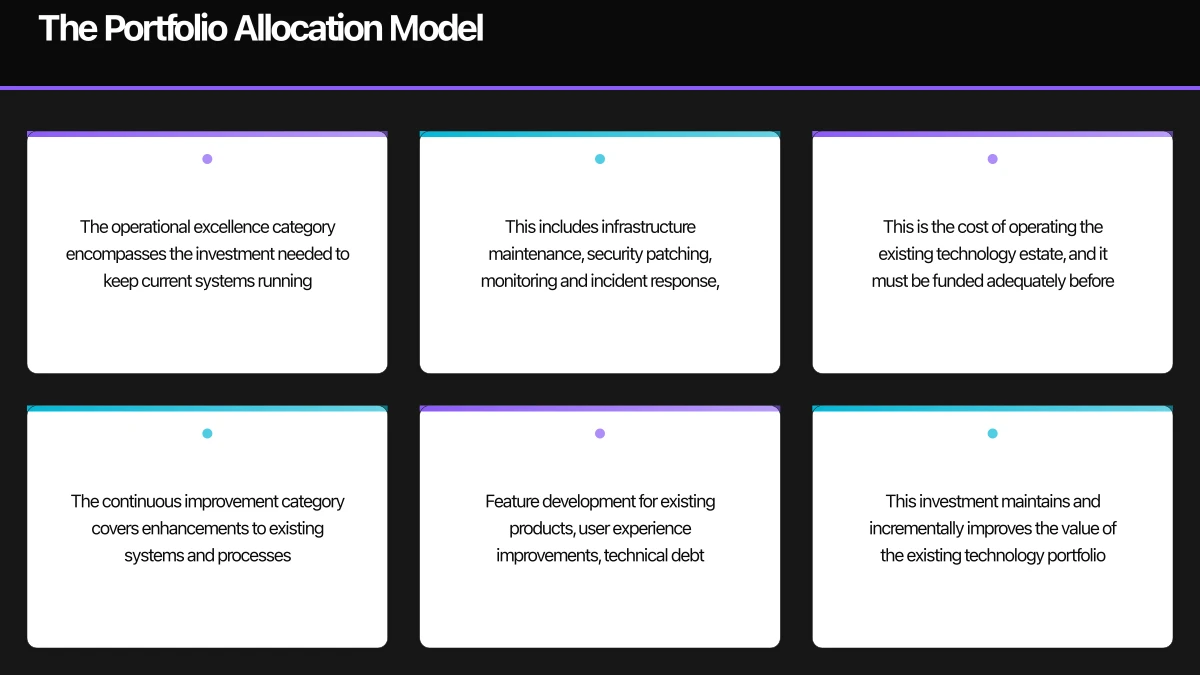
The operational excellence category encompasses the investment needed to keep current systems running reliably, securely, and efficiently. This includes infrastructure maintenance, security patching, monitoring and incident response, compliance maintenance, and performance optimisation. This is the cost of operating the existing technology estate, and it must be funded adequately before other investments are considered.
The continuous improvement category covers enhancements to existing systems and processes. Feature development for existing products, user experience improvements, technical debt remediation, and process automation fall here. This investment maintains and incrementally improves the value of the existing technology portfolio.
The strategic innovation category funds new capabilities, technology platform modernisation, and emerging technology exploration. Cloud migration, microservices architecture adoption, AI/ML capability building, and experimental projects fall here. This investment creates the future technology landscape.
The typical allocation for a mature enterprise is roughly forty percent operational excellence, forty percent continuous improvement, and twenty percent strategic innovation. The specific percentages vary by industry, competitive pressure, and the state of the existing technology estate, but the framework provides a deliberate structure for investment decisions.
The power of this model is transparency. When a business stakeholder requests a new feature, the CTO can show where it fits in the portfolio and what trade-offs are involved. When the security team identifies a critical remediation need, the CTO can allocate from the operational excellence budget without disrupting innovation commitments. When the board asks about innovation investment, the CTO can provide a specific percentage with associated initiatives.
Organisational Design for Dual Mandate
The organisational structure should enable rather than impede the dual mandate. Several structural patterns support this balance.
The two-speed model creates organisational separation between innovation-focused teams and operations-focused teams. Innovation teams work with agile methodologies, short cycle times, and high tolerance for experimentation. Operations teams focus on stability, reliability, and incremental improvement. This model provides clarity but risks creating silos — innovation teams that build systems they do not operate, and operations teams that maintain systems they did not design.
The integrated model embeds both mandates within every team. Product teams own their services end-to-end, from feature development through production operation. This model provides strong feedback loops — teams that operate their own code are motivated to build it well — but risks overwhelming teams with competing priorities.
The platform-plus-product model, which I advocate for most enterprises, provides a structural resolution. Platform teams focus on operational excellence and foundational capabilities, creating the stable, reliable infrastructure that product teams build upon. Product teams focus on continuous improvement and innovation, delivering business value on the platform foundation. Strategic innovation is funded through dedicated initiatives that draw from both organisational streams.
This model works because it aligns each team’s primary mandate with a clear accountability. Platform teams are measured on reliability, developer experience, and security posture. Product teams are measured on delivery velocity, feature adoption, and business outcomes. Neither team is asked to optimise for competing objectives simultaneously.
Strategic Time Management
The CTO’s personal time allocation reflects and reinforces the organisational balance. How the CTO spends their time signals what the organisation values.
A common anti-pattern is the CTO who spends the majority of their time in operational activities — incident response, vendor management, infrastructure decisions — leaving insufficient time for strategic thinking, stakeholder communication, and organisational development. This is understandable (operational issues are urgent and visible) but unsustainable (strategic neglect compounds over time).
A deliberate time allocation framework helps. The CTO should aim to spend roughly thirty percent of time on strategic activities (technology strategy, board communication, industry engagement, innovation oversight), thirty percent on people and organisational development (hiring, coaching, culture building, team structure), twenty percent on operational oversight (incident review, security posture, operational metrics), and twenty percent on cross-functional collaboration (product strategy alignment, business partnership, vendor relationships).
This allocation will be disrupted by major incidents, critical deadlines, and organisational changes. The framework’s value is as a guide for the steady state and a tool for identifying when temporary disruptions have become permanent imbalances.
Delegation is essential. The CTO who cannot delegate operational decision-making to trusted engineering leaders will be consumed by operational demands. Building a leadership team that can handle operational complexity independently — and trusting them to do so — frees the CTO to focus on the strategic activities that only the CTO can perform.
Communication Across Stakeholders
The CTO communicates with stakeholders who have fundamentally different perspectives on technology investment, and the ability to translate between these perspectives is a core leadership skill.
Board communication should focus on strategic technology direction, competitive positioning, risk management, and investment returns. The board does not need to understand Kubernetes versus Docker Swarm. It needs to understand whether the organisation’s technology investments are creating competitive advantage, whether technology risks are managed appropriately, and whether the technology organisation is operating efficiently.
Executive peer communication should focus on alignment between technology capabilities and business strategy. The CTO’s relationship with the CEO, CFO, and business unit leaders determines whether technology investment is seen as a strategic enabler or a cost centre. Regular strategic alignment sessions — not operational status updates — maintain this relationship.
Engineering team communication should focus on vision, values, and recognition. The engineering organisation needs to understand the strategic direction, feel confident in the CTO’s leadership, and see that their contributions to both innovation and operational excellence are valued.
The CTO who masters this multi-directional communication builds the trust and alignment that makes the dual mandate manageable. Innovation investment is supported because the board understands its strategic value. Operational investment is funded because business leaders understand the risk of underinvestment. And the engineering team is motivated because they see how their work connects to both mandates.
The balance between innovation and operations is not a problem to be solved — it is a tension to be managed with deliberate structure, clear allocation, and transparent communication. The CTO who embraces this tension as a defining feature of the role, rather than resenting it as a constraint, builds an organisation that is simultaneously reliable and innovative — the combination that creates lasting competitive advantage.
Your digital strategy starts with being found online. Cosmos Web Tech covers SEO, WordPress, and web performance for Australian businesses.
I lead Ganda Tech Services, where we turn digital strategy into results through specialist cloud, web design, and mobile app teams across Sydney.
About the Author
Ashish Ganda is the founder of Ganda Tech Services, a Sydney-based technology consultancy specialising in cloud infrastructure, web development, and mobile app solutions for Australian businesses.
Digital Transformation Roadmap 2026
A 12-month framework for Australian SMBs ready to modernise — phases, tools, and milestones.