Year in Review: Enterprise Technology Trends That Defined 2021
As 2021 draws to a close, enterprise technology leaders are in a fundamentally different position than they were twelve months ago. The emergency-mode technology decisions of 2020 — rapid cloud migration, hastily deployed remote work infrastructure, accelerated digital transformation timelines — have matured into deliberate strategy. The question has shifted from “how do we survive?” to “how do we build on what we have done?”
This year has been defined not by any single breakthrough technology but by the maturation and convergence of several trends that collectively reshape how enterprise technology organisations operate. Cloud-native architecture has moved from aspiration to expectation. Security has been transformed by supply chain attacks and zero trust adoption. The way engineering teams are organised and operate has evolved significantly. And the infrastructure supporting distributed work has shifted from temporary to permanent.
Here is my assessment of the technology trends that mattered most for enterprise CTOs in 2021.
Cloud-Native Architecture Reached Enterprise Maturity
2021 was the year that cloud-native architecture crossed from early adoption to mainstream enterprise practice. Kubernetes adoption has expanded beyond technology companies into financial services, healthcare, government, and traditional industries. The CNCF ecosystem has matured, with projects like Envoy, Prometheus, and Argo reaching the kind of production stability that enterprise adoption requires.
More importantly, the organisational practices around cloud-native architecture have matured. Platform engineering has emerged as a recognised discipline, with dedicated teams building internal developer platforms that abstract Kubernetes complexity and provide self-service capabilities. GitOps — using Git as the single source of truth for declarative infrastructure and application configuration — has moved from emerging practice to standard approach. Service mesh adoption, while still in early stages for most enterprises, has gained enough traction to validate the pattern’s value for complex microservices environments.
The maturation signal is that the conversation has shifted from “should we adopt cloud-native?” to “how do we operate cloud-native at enterprise scale?” The focus is on operational excellence, developer experience, and organisational design — signs that the technology itself is no longer the primary challenge.
Supply Chain Security Became a Board-Level Concern
The SolarWinds attack, disclosed in December 2020, dominated security conversations throughout 2021. The attack demonstrated that compromising a trusted vendor’s build process could provide access to thousands of organisations simultaneously. The subsequent Codecov breach and the Kaseya ransomware attack reinforced the message: supply chain security is a critical vulnerability that traditional perimeter-based security models do not address.
The enterprise response has been multifaceted. Software bill of materials (SBOM) — machine-readable inventories of all components in a software product — have moved from niche practice to expected deliverable, accelerated by the Biden Administration’s Executive Order on Improving the Nation’s Cybersecurity issued in May 2021. Dependency scanning and vulnerability management have been elevated from developer tooling to enterprise security requirements. Container image signing and verification are becoming standard practices in CI/CD pipelines.
Zero trust architecture has gained significant adoption momentum, driven in part by the supply chain security concerns but also by the continued dissolution of network perimeters due to remote work. The NIST Zero Trust Architecture framework (SP 800-207) has provided enterprises with a reference model, and identity-centric security — authenticating every access request regardless of network location — is becoming the default architecture for new systems.
Platform Engineering Emerged as a Discipline
The recognition that developer experience is a strategic concern — not a nicety — has driven the formalisation of platform engineering as a discipline. Enterprises have observed that the cognitive load on product teams in a cloud-native environment is unsustainable: developers cannot be experts in application development, Kubernetes, CI/CD, monitoring, security, and compliance simultaneously.
Platform engineering teams address this by building internal developer platforms that provide self-service capabilities, standardised tooling, and abstracted infrastructure. The platform team operates as a product team, with product management practices applied to internal tooling. Backstage, Spotify’s open-source developer portal, has gained significant adoption as a framework for building developer portals that provide service catalogues, documentation, and scaffolding.
Team Topologies, the organisational design framework by Matthew Skelton and Manuel Pais, has influenced how enterprises structure their engineering organisations. The concept of stream-aligned teams (focused on business value delivery), platform teams (focused on internal infrastructure), enabling teams (focused on capability building), and complicated subsystem teams (focused on complex technical components) provides a vocabulary and model that many organisations have adopted or adapted.
Distributed Work Infrastructure Became Permanent
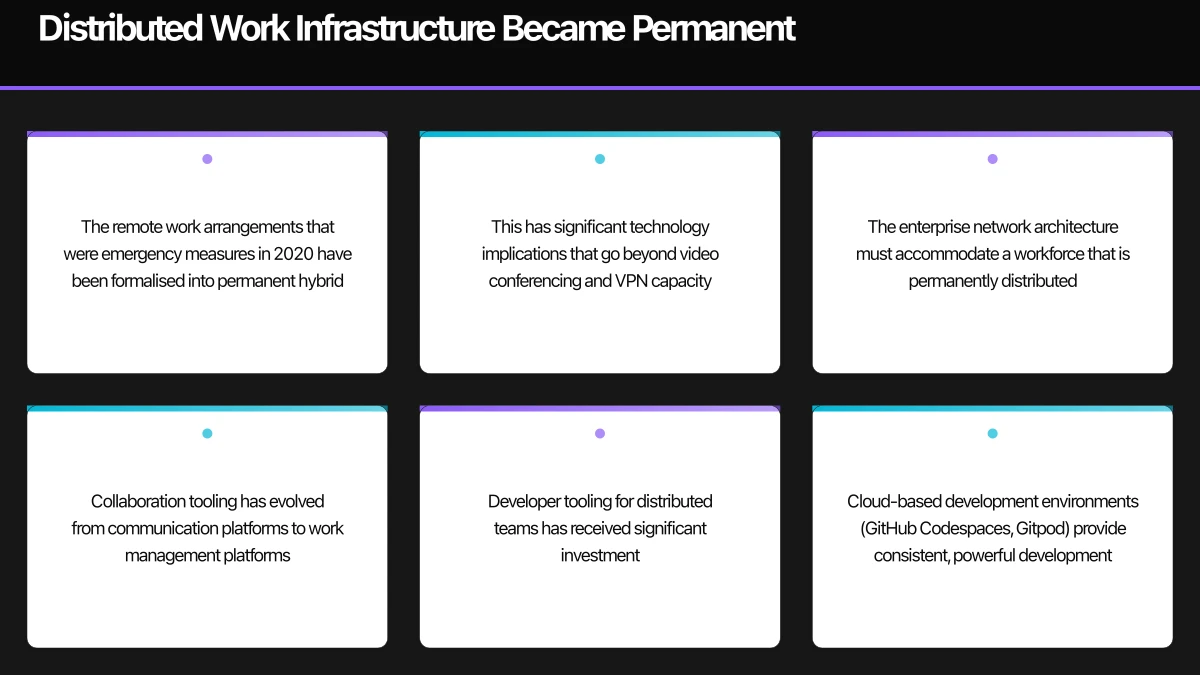
The remote work arrangements that were emergency measures in 2020 have been formalised into permanent hybrid work models in 2021. This has significant technology implications that go beyond video conferencing and VPN capacity.
The enterprise network architecture must accommodate a workforce that is permanently distributed. Software-defined WAN (SD-WAN) and Secure Access Service Edge (SASE) architectures are replacing traditional hub-and-spoke network designs, providing secure, performant connectivity for users regardless of their location. Cloud-delivered security services — web gateways, CASB, DLP — apply security policies at the edge rather than routing traffic through corporate data centres.
Collaboration tooling has evolved from communication platforms to work management platforms. The integration between communication (Slack, Teams), documentation (Confluence, Notion), and project management (Jira, Linear, Asana) creates a digital work environment that supports asynchronous collaboration across time zones.
Developer tooling for distributed teams has received significant investment. Cloud-based development environments (GitHub Codespaces, Gitpod) provide consistent, powerful development environments accessible from any device. Pair programming tools integrated with IDEs enable real-time collaboration. The infrastructure supporting engineering productivity in a distributed model has matured significantly.
Observability Became Non-Negotiable
The complexity of distributed systems — microservices, event-driven architectures, multi-cloud deployments — has made observability a non-negotiable capability rather than an operational luxury. The OpenTelemetry project, merging the OpenTracing and OpenCensus projects, has established itself as the standard for instrumentation, providing vendor-neutral APIs and SDKs for metrics, logs, and traces.
The shift from monitoring to observability — from checking known conditions to exploring unknown system behaviour — reflects the reality that distributed system failure modes cannot be anticipated in advance. SRE practices, inspired by Google’s model and codified in the SRE books, have been widely adopted, with error budgets and service level objectives providing the framework for balancing reliability with delivery velocity.
Data Architecture Rethought
Data mesh, the paradigm introduced by Zhamak Dehghani, has generated enormous interest in 2021 as enterprises grapple with the limitations of centralised data architectures. The principles — domain-oriented data ownership, data as a product, self-serve data infrastructure, and federated governance — challenge the centralised data team model that most enterprises have followed.
While full data mesh implementations remain rare, the influence on enterprise data thinking is significant. More organisations are questioning whether centralised data teams are the right model, exploring domain-oriented data ownership, and investing in self-serve data infrastructure. The conversation has shifted the enterprise data architecture discourse in a direction that aligns data ownership with business accountability.
Looking Ahead
The trends that defined 2021 share a common theme: maturation. Cloud-native, zero trust, platform engineering, distributed work, and observability are not new concepts in 2021 — they are concepts that have matured to the point of mainstream enterprise adoption. The organisations that invested early are now operating at scale. The organisations that are adopting now have a clearer path because of the lessons learned by early adopters.
For the CTO, the strategic implication is that these are no longer optional investments. They are the baseline expectations for a modern enterprise technology organisation. The competitive advantage now lies not in adopting these practices but in executing them excellently — with operational maturity, organisational alignment, and the disciplined governance that turns technology capability into business value.
2021 has been a year of building on foundations laid in crisis. The structures erected on those foundations are now solid enough to support the next phase of enterprise technology evolution. The CTO’s task is to ensure that their organisation is among those building upward, not still laying foundations.
Turning strategy into infrastructure? Cloud Geeks covers managed cloud, DevOps, and IT security for businesses putting digital plans into action.
Ash Ganda is the founder of Ganda Tech Services, a Sydney-based technology consultancy delivering cloud, web, and mobile solutions for Australian businesses.
About the Author
Ashish Ganda is the founder of Ganda Tech Services, a Sydney-based technology consultancy specialising in cloud infrastructure, web development, and mobile app solutions for Australian businesses.
Digital Transformation Roadmap 2026
A 12-month framework for Australian SMBs ready to modernise — phases, tools, and milestones.