Technical Debt Management: A Strategic Approach for Enterprise CTOs
Introduction
Every software system accumulates technical debt. Shortcuts taken under deadline pressure. Design decisions that made sense then but constrain now. Dependencies that haven’t been updated in years. Code that no one wants to touch because no one fully understands it.
The question isn’t whether you have technical debt—you do. The question is whether you’re managing it strategically or letting it compound until it cripples your ability to deliver.
Understanding Technical Debt
What Technical Debt Actually Is
Ward Cunningham coined the term “technical debt” as a financial metaphor: sometimes you borrow against the future to deliver faster today, accepting that you’ll pay interest on that borrowing until you pay it down.
This metaphor is useful but incomplete. Some technical debt is deliberate and strategic—conscious trade-offs made with full understanding. Much technical debt is accidental—the result of decisions that seemed reasonable but aged poorly, or gaps in knowledge that only became apparent later.
Types of Technical Debt
Deliberate-Prudent “We know this isn’t ideal, but we need to ship for the market window. We’ll refactor next quarter.”
This is strategic debt—consciously incurred with a repayment plan. The key is actually following through on repayment.
Deliberate-Reckless “We don’t have time to do it right. Ship it and hope for the best.”
This is dangerous debt—incurred without considering consequences or planning for repayment.
Accidental-Prudent “Now that we’ve learned more about the domain, we realise this design doesn’t fit. We should restructure.”
This is learning debt—the natural result of gaining knowledge through building. It’s not a failure; it’s how software development works.
Accidental-Reckless “What were they thinking when they built this? This doesn’t make any sense.”
This is often judging past decisions without understanding past context—or genuine mistakes that created lasting problems.
The Cost of Technical Debt
Technical debt compounds like financial debt:
Direct Costs
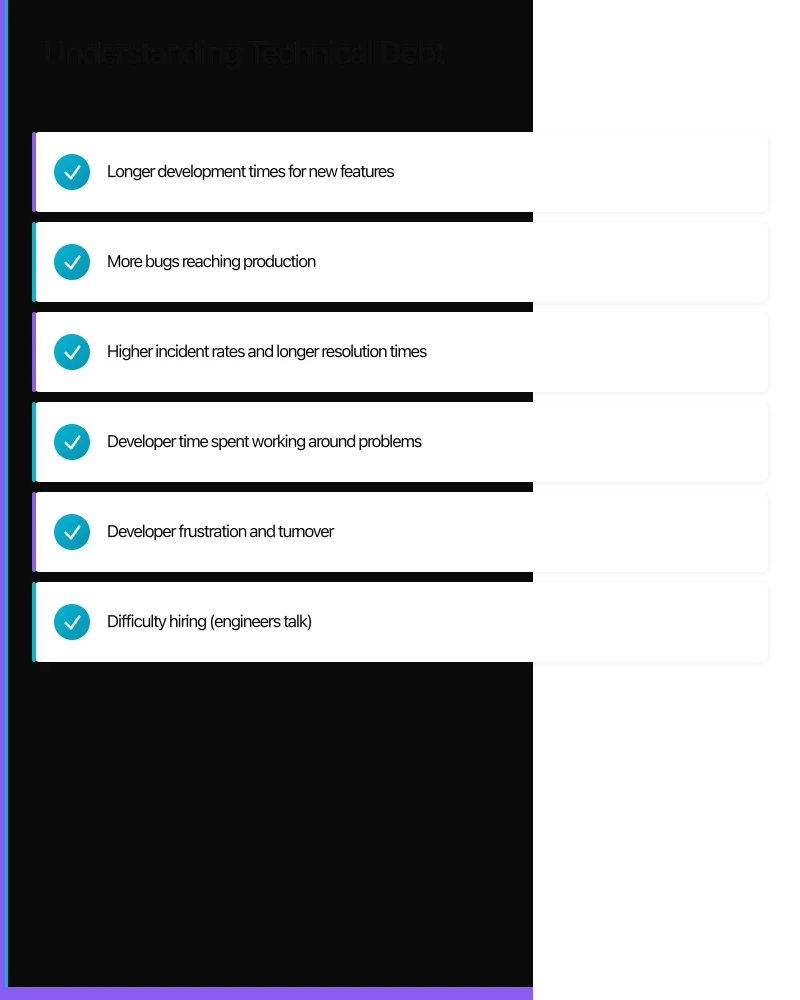
- Longer development times for new features
- More bugs reaching production
- Higher incident rates and longer resolution times
- Developer time spent working around problems
Indirect Costs
- Developer frustration and turnover
- Difficulty hiring (engineers talk)
- Slower response to market changes
- Increased risk of security vulnerabilities
Hidden Costs
- Features not built because they’re “too hard”
- Opportunities not pursued because systems can’t adapt
- Business decisions constrained by technical limitations
Quantifying Technical Debt
Why Quantification Matters
“We have technical debt” doesn’t drive action. Executives hear this constantly. What drives action:
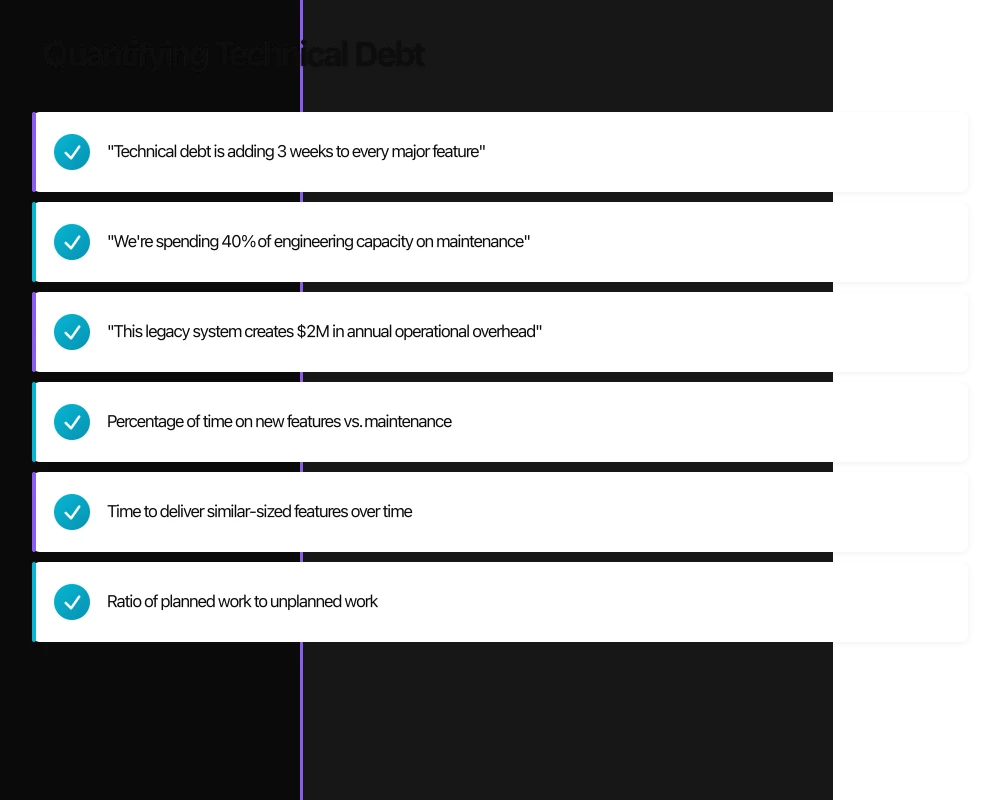
- “Technical debt is adding 3 weeks to every major feature”
- “We’re spending 40% of engineering capacity on maintenance”
- “This legacy system creates $2M in annual operational overhead”
Quantification enables prioritisation and business cases for investment.
Measurement Approaches
Time-Based Metrics
Track engineering time allocation:
- Percentage of time on new features vs. maintenance
- Time to deliver similar-sized features over time
- Ratio of planned work to unplanned work
If teams are spending increasing time on maintenance and unplanned work, debt is growing.
Quality Metrics
Measure symptoms of debt:
- Defect density trends
- Escaped defect rates
- Mean time to recovery from incidents
- Change failure rate
Worsening trends indicate debt accumulation.
Developer Experience Metrics
Survey engineering teams:
- Ease of making changes to different systems
- Confidence in deploying changes
- Satisfaction with codebase quality
- Time spent on frustrating workarounds
Engineers know where the bodies are buried.
Architecture Metrics
Assess structural health:
- Dependency complexity
- Component coupling
- Test coverage
- Documentation currency
Tools like SonarQube, CodeClimate, or architecture analysis tools provide automated insights.
Creating a Technical Debt Register
Maintain an inventory of significant debt items:
| Item | Impact | Effort | Risk | Business Area | Owner |
|---|---|---|---|---|---|
| Legacy payment system | High | Large | High | Revenue | Team A |
| Outdated authentication | Medium | Medium | High | Security | Team B |
| Monolith service X | High | Extra-Large | Medium | Core Platform | Team C |
This register enables:
- Visibility across the organisation
- Prioritisation discussions
- Progress tracking over time
- Investment planning
Prioritisation Framework
Not All Debt Is Equal
Prioritise based on:
- Which debt constrains business-critical functions?
- Which affects customer experience?
- Which limits revenue opportunities?
Risk
- Which creates security vulnerabilities?
- Which could cause major incidents?
- Which has compliance implications?
Leverage
- Which improvements unlock multiple benefits?
- Which enable other teams or initiatives?
- Which reduce ongoing maintenance burden?
Effort
- What’s the realistic effort to address?
- What dependencies exist?
- What expertise is required?
Prioritisation Matrix
Plot debt items on impact vs. effort:
High Impact, Low Effort: Do these first. Quick wins that demonstrate progress.
High Impact, High Effort: Plan these carefully. Major initiatives requiring investment.
Low Impact, Low Effort: Fill in opportunistically. Good for learning or morale.
Low Impact, High Effort: Avoid these. Don’t invest significant effort for minimal return.
The “Interest Rate” Concept
Some debt has high interest—it costs you significantly every sprint:
- Every feature is harder because of it
- Every incident traces back to it
- Every new team member stumbles on it
Other debt has low interest—it’s suboptimal but not actively harmful:
- Old code that works and doesn’t need changes
- Suboptimal architecture in stable, low-change areas
- Technical decisions you’d make differently today but don’t affect current work
Focus on high-interest debt first.
Repayment Strategies
Dedicated Capacity
Reserve engineering capacity for debt reduction:
- 20% of each sprint for tech debt
- Dedicated “gardening” sprints quarterly
- Specific team allocation for platform/debt work
Pros: Guaranteed investment, visible progress Cons: Feels like tax on delivery, can be raided under pressure
Opportunistic Refactoring
Address debt when working in affected areas:
- “Leave the campsite cleaner than you found it”
- Boy Scout rule for code
- Refactor as part of feature work
Pros: Low overhead, integrated into delivery Cons: Only addresses active areas, easy to skip under pressure
Strategic Initiatives
Major projects to address significant debt:
- Legacy system replacement
- Architecture modernisation
- Platform migration
Pros: Can address large-scale issues Cons: Expensive, risky, competes with feature delivery
Hybrid Approach
Most organisations need a combination:
- Dedicated capacity for medium items and ongoing maintenance
- Opportunistic refactoring as standard practice
- Strategic initiatives for major debt requiring focused investment
Execution Principles
Incremental Progress
Large rewrites rarely succeed. Incremental improvement works:
- Strangler fig pattern for legacy replacement
- Gradual migration with traffic shifting
- Feature flags for parallel implementations
- Continuous small improvements
Measurement and Visibility
Track progress transparently:
- Dashboard showing debt reduction over time
- Regular reporting to leadership
- Celebration of meaningful improvements
- Honest acknowledgment of remaining work
Preventing New Debt
Reduction means little if you’re accumulating faster than repaying:
- Definition of done includes quality criteria
- Architecture review for significant changes
- Automated quality gates in CI/CD
- Time allocated for doing things right
Stakeholder Management
Technical debt investment competes with features:
- Translate debt into business impact language
- Connect debt reduction to business outcomes
- Set realistic expectations about timeline
- Demonstrate value through incremental delivery
Organisational Approaches
Engineering Culture
Culture shapes debt accumulation:
High-Debt Cultures
- “Ship it, we’ll fix it later” (never later)
- Velocity metrics that reward shortcuts
- No time allocated for quality
- Technical decisions made without engineers
Low-Debt Cultures
- Quality is non-negotiable
- Time allocated for sustainable delivery
- Technical excellence is valued
- Engineers empowered in technical decisions
Culture change is slow but essential for long-term debt management.
Team Structure
Structure affects debt patterns:
Feature Teams Own features end-to-end, including technical quality. Can address debt in their area but may not see cross-cutting issues.
Platform Teams Own shared infrastructure and can address platform-level debt. Risk of being distant from business context.
Hybrid Feature teams with platform support. Can balance delivery pressure with platform health.
Incentives
Align incentives with quality:
- Recognise technical excellence, not just feature delivery
- Include quality metrics in team objectives
- Career progression for engineers who improve systems
- Avoid pure velocity metrics that encourage shortcuts
Special Cases
Acquired Systems
M&A brings technical debt:
- Assessment during due diligence
- Realistic integration timelines
- Budget for modernisation
- Talent retention for knowledge
Don’t assume you can quickly “fix” acquired systems. Plan for the reality of what you’re acquiring.
Legacy Systems
Systems that have run for decades:
- Often critical to business operations
- Knowledge concentrated in few individuals
- Risky to change, expensive to maintain
- May require strategic replacement
Balance operational risk against strategic investment.
Vendor Dependencies
Technical debt isn’t just your code:
- Outdated vendor platforms
- End-of-life dependencies
- Vendor lock-in constraining options
- Integration complexity
Include vendor roadmaps in debt assessment.
Communicating with Leadership
The Business Case
Frame technical debt in business terms:
- “This will enable us to deliver features 30% faster”
- “This reduces our security exposure by eliminating X vulnerability”
- “This will reduce operational costs by $Y annually”
- “This is required for compliance with Z regulation”
Avoid:
- “This code is ugly”
- “We should have done it right the first time”
- “Good engineers don’t leave debt”
Setting Expectations
Be honest about timelines and trade-offs:
- Debt reduction takes sustained investment
- Some quick wins exist, but major items take time
- Continued feature delivery is possible alongside debt work
- Progress should be visible and measurable
Regular Reporting
Keep leadership informed:
- Quarterly debt status updates
- Progress against reduction goals
- Impact of reduction on delivery metrics
- Risks from remaining debt
Conclusion
Technical debt is inevitable in long-lived software systems. The question is whether you manage it strategically or let it manage you.
Effective debt management requires:
- Quantification that enables prioritisation
- Prioritisation that focuses on highest-impact items
- Strategies that balance reduction with delivery
- Culture that prevents excessive accumulation
- Communication that secures ongoing investment
The goal isn’t zero debt—that’s neither achievable nor desirable. The goal is debt at levels that don’t constrain your business, systematically managed as part of normal engineering practice.
Start by understanding what you have. Prioritise ruthlessly. Address incrementally. Prevent accumulation. Over time, you’ll build systems that enable rather than constrain your business.
Sources
- Cunningham, W. (1992). The WyCash Portfolio Management System. OOPSLA. http://c2.com/doc/oopsla92.html
- Fowler, M. (2019). Technical Debt. martinfowler.com. https://martinfowler.com/bliki/TechnicalDebt.html
- Forsgren, N., Humble, J., & Kim, G. (2018). Accelerate: Building and Scaling High Performing Technology Organizations. IT Revolution Press.
- Tornhill, A. (2022). Software Design X-Rays. Pragmatic Bookshelf.
- SEI. (2023). Managing Technical Debt. Software Engineering Institute. https://www.sei.cmu.edu/our-work/technical-debt/
Strategic guidance for technology leaders building sustainable engineering organisations.
Need to put cloud strategy into action? Cloud Geeks provides in-depth guides on AWS, Azure, and cybersecurity for Australian SMBs.
These insights are drawn from my work leading Ganda Tech Services — helping Australian businesses navigate digital transformation through cloud, web, and mobile.
About the Author
Ashish Ganda is the founder of Ganda Tech Services, a Sydney-based technology consultancy specialising in cloud infrastructure, web development, and mobile app solutions for Australian businesses.
Tech Stack Selection Guide 2026
Choose the right tools for your Australian business — without the vendor hype or overlapping spend.
Almost done
Check your inbox and click the confirmation link to get your download.