Serverless Architecture Maturity: Beyond Simple Functions
The serverless conversation in enterprise technology has evolved considerably since AWS Lambda’s introduction in 2014. Early adoption focused on simple use cases — image thumbnailing, webhook processing, cron job replacement — that demonstrated the model’s appeal but barely scratched the surface of its strategic potential. Today, organisations like Liberty Mutual, Capital One, and iRobot run substantial production workloads on serverless infrastructure, proving that the model scales far beyond toy examples.
Yet many enterprises remain stuck at the first rung of the serverless maturity ladder, deploying isolated functions without the architectural thinking needed to build coherent serverless systems. The gap between deploying a Lambda function and architecting a serverless enterprise system is substantial, and bridging it requires a strategic approach to serverless adoption that addresses architecture, operations, organisation, and economics simultaneously.
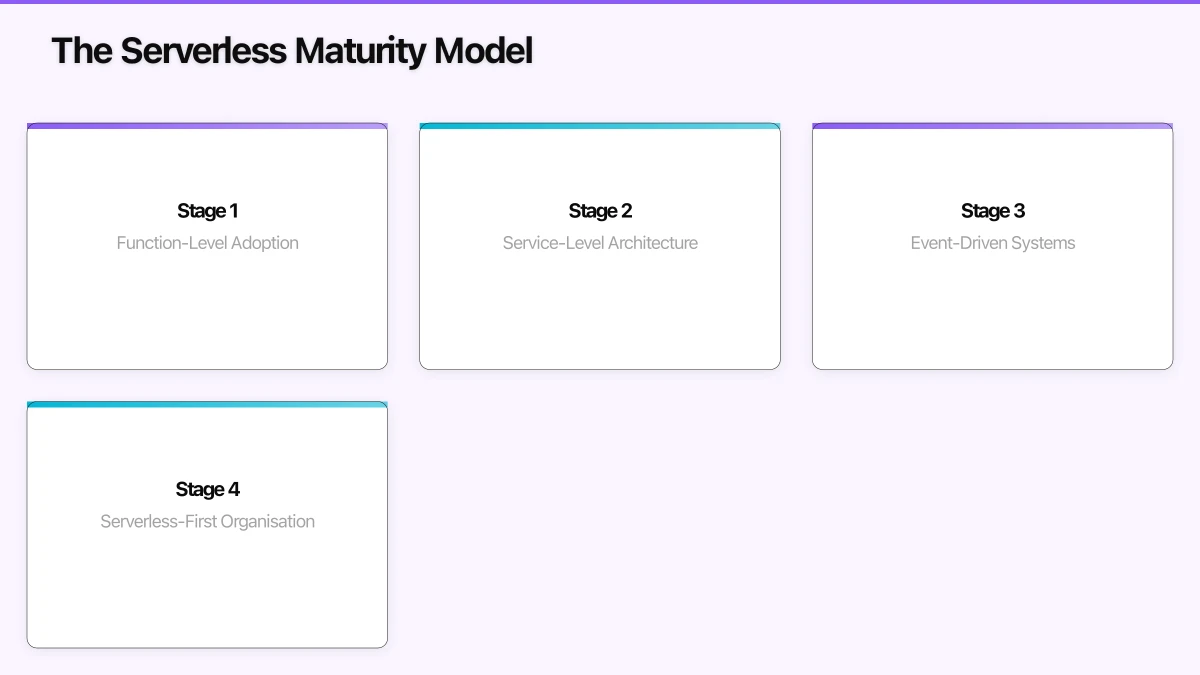
The Serverless Maturity Model
Enterprise serverless adoption typically progresses through four stages, each building on the capabilities and organisational learnings of the previous stage.
Stage 1: Function-Level Adoption is where most organisations begin. Individual teams deploy Lambda functions (or equivalent services on Azure Functions or Google Cloud Functions) for isolated use cases. API endpoints, event handlers, scheduled tasks, and data transformation pipelines are common starting points. The value proposition is clear: no servers to manage, automatic scaling, and pay-per-invocation pricing. But functions are deployed ad hoc, without consistent patterns for error handling, observability, or deployment automation.
Stage 2: Service-Level Architecture represents the first meaningful maturity leap. Rather than isolated functions, teams build coherent services from compositions of functions, event sources, and managed services. A serverless API is not a single function behind an API Gateway — it is a collection of functions handling different endpoints, backed by DynamoDB or Aurora Serverless for data persistence, using SQS or EventBridge for asynchronous processing, and fronted by CloudFront for caching and edge distribution. The key shift is thinking in terms of services rather than functions.
Stage 3: Event-Driven Systems extends the service model to entire systems. Multiple serverless services communicate through events, creating loosely coupled architectures that scale independently and evolve autonomously. Amazon EventBridge (or equivalent event buses) becomes the backbone for inter-service communication. Choreography replaces orchestration for many workflows. The system exhibits emergent behaviour as services react to events produced by other services, enabling capabilities that were not explicitly designed.
Stage 4: Serverless-First Organisation represents full maturity. Serverless is the default compute model, used unless there is a specific reason to choose containers or virtual machines. The organisation has developed serverless-native patterns for testing, deployment, observability, and security. Architecture review processes evaluate designs through a serverless lens. The operational model has shifted from capacity management to event management.
Most enterprises in 2022 are between stages 1 and 2, with leading organisations reaching stage 3. Stage 4 remains rare and may not be appropriate for all organisations, but understanding the full maturity spectrum helps CTOs set directional strategy.
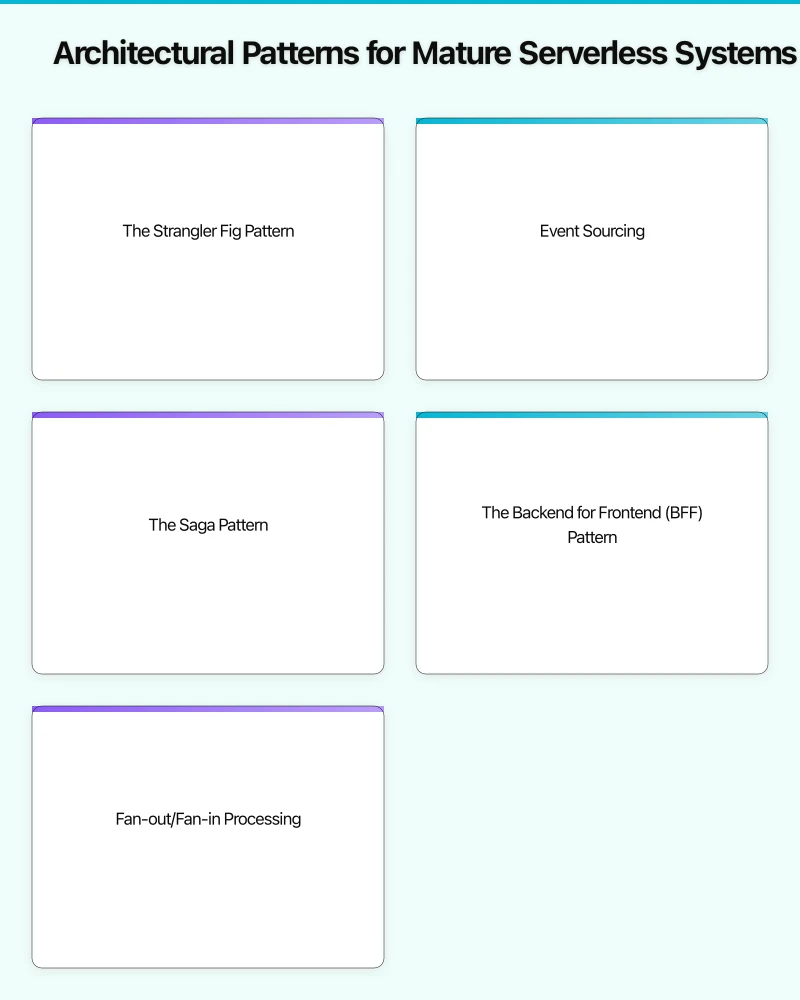
Architectural Patterns for Mature Serverless Systems
Moving beyond simple functions requires adopting architectural patterns that address the unique characteristics of serverless environments.
The Strangler Fig Pattern enables incremental migration of existing applications to serverless. Rather than rewriting an application wholesale, individual capabilities are extracted and reimplemented as serverless services. An API Gateway routes requests to either the legacy application or the new serverless implementation, gradually shifting traffic as confidence grows. This pattern reduces migration risk and allows teams to learn serverless patterns incrementally.
Event Sourcing is particularly well-suited to serverless architectures. Rather than storing current state, events that represent state changes are persisted and the current state is derived by replaying events. In a serverless context, events naturally flow through services like EventBridge, SQS, or Kinesis, making event capture a natural byproduct of the architecture. DynamoDB Streams provide change data capture for database operations, feeding downstream processing pipelines.
The Saga Pattern addresses distributed transactions in serverless systems. When a business process spans multiple services, each with its own data store, traditional ACID transactions are not available. Sagas implement distributed transactions as a sequence of local transactions, with compensating actions to undo previous steps if later steps fail. AWS Step Functions provides a natural orchestration mechanism for sagas, managing the state machine that coordinates the distributed transaction.
The Backend for Frontend (BFF) Pattern creates dedicated API layers for each frontend application. In a serverless context, each BFF is a collection of Lambda functions behind its own API Gateway, tailored to the specific data requirements and interaction patterns of its frontend. This eliminates the coupling that occurs when multiple frontends share a generic API, allowing each frontend team to evolve its API layer independently.
Fan-out/Fan-in Processing leverages serverless scaling for parallel processing of large datasets. An orchestrator function distributes work across hundreds or thousands of concurrent Lambda invocations, each processing a partition of the data, and a reducer function aggregates the results. This pattern, sometimes called “serverless MapReduce,” enables processing at enormous scale without managing any infrastructure.
Operational Maturity: The Hidden Challenge
The operational model for serverless systems differs fundamentally from traditional operations, and many enterprises underestimate the maturity required for production-grade serverless systems.
Observability in serverless environments requires different approaches than traditional monitoring. There are no servers to monitor, no CPU utilisation trends to track, and no disk space alerts to configure. Instead, observability focuses on function-level metrics (invocation count, duration, error rate, throttling), service-level metrics (end-to-end latency, business transaction success rates), and distributed tracing across function chains.
AWS X-Ray provides distributed tracing for serverless applications, and third-party tools like Lumigo, Epsagon, and Thundra offer serverless-specific observability platforms. The key challenge is correlating events across asynchronous, event-driven architectures where a single business transaction may traverse dozens of functions and services.
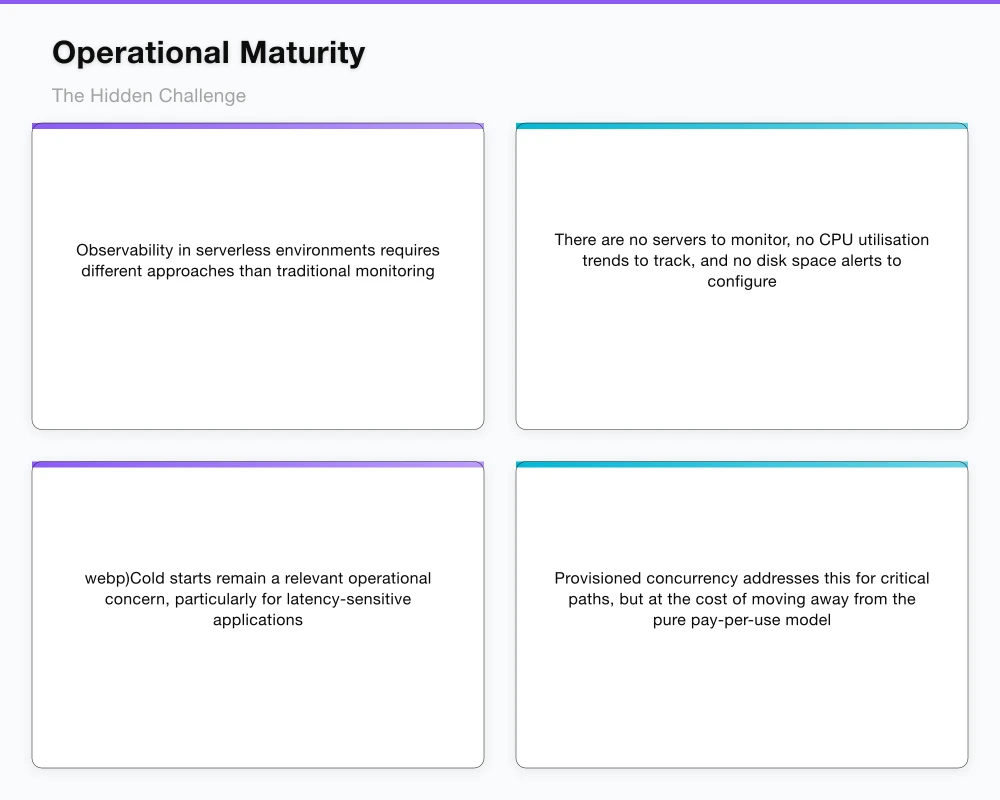
Cold starts remain a relevant operational concern, particularly for latency-sensitive applications. A Lambda function that has not been invoked recently requires initialization — downloading the deployment package, starting the runtime, and executing initialization code — which adds hundreds of milliseconds to seconds of latency for the first invocation. Provisioned concurrency addresses this for critical paths, but at the cost of moving away from the pure pay-per-use model.
Testing serverless applications requires rethinking testing strategies. Unit testing individual function handlers is straightforward, but integration testing — validating that functions interact correctly with managed services, event sources, and other functions — is more challenging. Tools like LocalStack provide local emulations of AWS services, and the AWS SAM CLI enables local invocation of Lambda functions, but the fidelity of local testing versus actual cloud behaviour remains imperfect.
Security in serverless environments shifts from infrastructure hardening to function-level security. Each function should have its own IAM role with least-privilege permissions — a significant departure from applications running on shared infrastructure with broad permissions. Dependency security is critical because each function’s deployment package includes its dependencies, and vulnerabilities in those dependencies are the primary attack surface.
Economic Analysis and Strategic Positioning
The economic model of serverless is one of its most compelling attributes, but the analysis is more nuanced than the simple “pay only for what you use” narrative suggests.
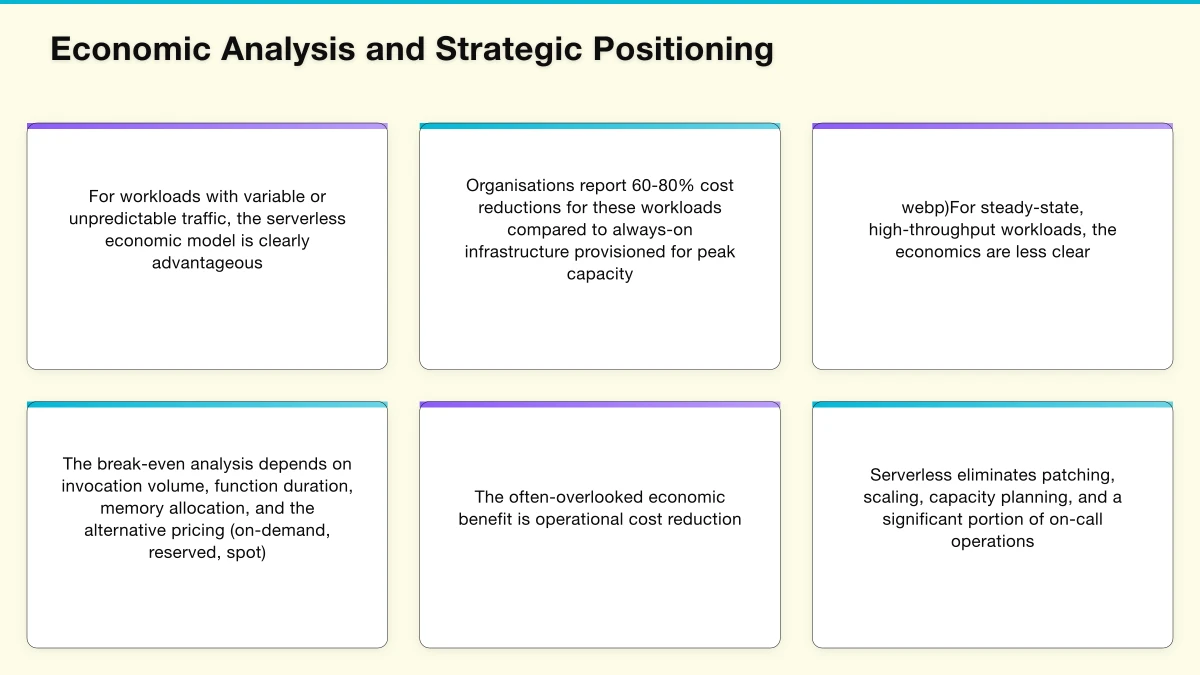
For workloads with variable or unpredictable traffic, the serverless economic model is clearly advantageous. Functions that handle webhook events, process file uploads, or respond to user interactions have traffic patterns that are inherently bursty, and serverless pricing perfectly matches cost to demand. Organisations report 60-80% cost reductions for these workloads compared to always-on infrastructure provisioned for peak capacity.
For steady-state, high-throughput workloads, the economics are less clear. A Lambda function processing millions of invocations per hour at consistent volume may cost more than equivalent compute on reserved EC2 instances or Fargate containers. The break-even analysis depends on invocation volume, function duration, memory allocation, and the alternative pricing (on-demand, reserved, spot).
The often-overlooked economic benefit is operational cost reduction. Serverless eliminates patching, scaling, capacity planning, and a significant portion of on-call operations. The cost of an operations team managing infrastructure is real and substantial, and serverless significantly reduces this burden. When fully-loaded operational costs are included in the analysis, the economic case for serverless strengthens considerably.
Strategic positioning is perhaps the most important consideration. Serverless enables organisations to allocate engineering resources to business logic rather than infrastructure management. For technology organisations competing on feature delivery speed and innovation, this reallocation is a competitive advantage that transcends the per-invocation cost comparison.
Conclusion
Serverless architecture has matured from a curiosity to a legitimate enterprise compute model. The organisations extracting the most value are those that have progressed beyond isolated function deployment to architecting coherent serverless systems built on event-driven patterns, leveraging the full ecosystem of managed services.
For CTOs charting serverless strategy in 2022, the path forward is progressive maturity. Start with well-suited use cases that build team capabilities and demonstrate value. Invest in the operational practices — observability, testing, security, deployment automation — that enable production-grade serverless systems. And architect for the event-driven, loosely coupled systems that represent serverless at its most powerful.
The serverless model is not appropriate for every workload, and mature organisations maintain container and server-based infrastructure alongside serverless capabilities. The strategic skill is matching the compute model to the workload characteristics, and ensuring that the organisation has the capabilities to execute effectively across the spectrum.
For technical deep-dives on the cloud and IT topics I cover strategically, visit Cloud Geeks — our specialist IT infrastructure blog.
Ganda Tech Services is my technology consultancy, bringing together cloud infrastructure, web development, and mobile expertise for Australian businesses.
About the Author
Ashish Ganda is the founder of Ganda Tech Services, a Sydney-based technology consultancy specialising in cloud infrastructure, web development, and mobile app solutions for Australian businesses.
Digital Transformation Roadmap 2026
A 12-month framework for Australian SMBs ready to modernise — phases, tools, and milestones.
Almost done
Check your inbox and click the confirmation link to get your download.