Multi-Cloud Governance: Managing Complexity Without Compromise
The multi-cloud reality has arrived, and for most enterprises, it was not entirely by design. Mergers and acquisitions brought AWS accounts alongside existing Azure subscriptions. A specific team adopted Google Cloud Platform for its machine learning capabilities. A SaaS vendor runs on a different cloud than the organisation’s primary provider. Shadow IT projects created cloud accounts that are now production dependencies.
According to Flexera’s 2021 State of the Cloud Report, 92% of enterprises have a multi-cloud strategy, and the average enterprise uses 2.6 public clouds and 2.7 private clouds. But having multiple clouds is not the same as having a multi-cloud strategy. The former is an accident of organisational growth. The latter is a deliberate governance framework that manages complexity while capturing the benefits that multiple clouds can provide.
The benefits are real. Multi-cloud provides leverage in vendor negotiations, access to best-of-breed services (Google’s AI/ML, AWS’s breadth, Azure’s enterprise integration), geographic coverage for data sovereignty, and reduced concentration risk. But these benefits come with equally real costs: operational complexity, skill fragmentation, security inconsistency, and the risk of building to a lowest-common-denominator architecture that captures the disadvantages of every cloud while capturing the advantages of none.
The CTO’s challenge is to establish governance that captures the benefits while managing the costs. This requires clear principles, consistent operating practices, and the organisational discipline to make deliberate decisions about what runs where and why.
Governance Principles
Effective multi-cloud governance starts with a clear set of principles that guide workload placement, technology selection, and operational practices.
The strategic placement principle determines which workloads run on which cloud and why. This is not a decision that should be left to individual teams. The organisation needs a workload placement policy that considers factors including the workload’s primary technology requirements, data sovereignty constraints, integration dependencies with other workloads, the team’s existing skill profile, and total cost of ownership including operational overhead.
Not every workload needs to be cloud-portable. The lowest-common-denominator trap occurs when organisations insist on abstracting away all cloud-specific capabilities, resulting in architectures that use only the features common across all providers. This negates the primary benefit of multi-cloud — access to best-of-breed capabilities. A more pragmatic approach distinguishes between workloads that benefit from cloud-specific services (and accept the corresponding lock-in) and workloads that should be portable (using cloud-agnostic technologies like Kubernetes, PostgreSQL, and standard APIs).
The consistent security principle mandates that security standards are uniform across all cloud environments, regardless of provider. An attacker does not care which cloud hosts a misconfigured storage bucket. Security policies, identity management, network segmentation, encryption standards, and vulnerability management must be applied consistently. This is one area where abstraction is valuable — a unified security framework that translates organisational policies into provider-specific configurations.
The unified financial governance principle ensures that cloud spending is visible, allocated, and optimised across all providers. When costs are managed separately by cloud, the organisation loses visibility into total technology spending and cannot make informed trade-off decisions.
Operational Standardisation
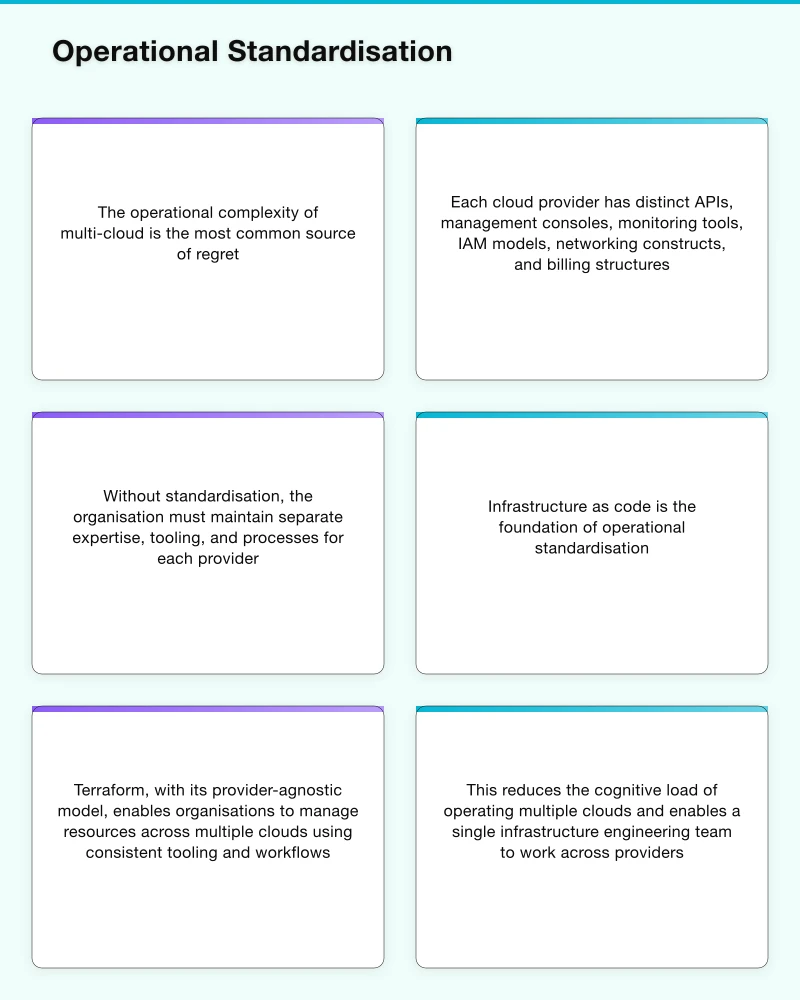
The operational complexity of multi-cloud is the most common source of regret. Each cloud provider has distinct APIs, management consoles, monitoring tools, IAM models, networking constructs, and billing structures. Without standardisation, the organisation must maintain separate expertise, tooling, and processes for each provider.
Infrastructure as code is the foundation of operational standardisation. Terraform, with its provider-agnostic model, enables organisations to manage resources across multiple clouds using consistent tooling and workflows. While the resource definitions are necessarily provider-specific, the workflow — version control, peer review, plan/apply, state management — is consistent. This reduces the cognitive load of operating multiple clouds and enables a single infrastructure engineering team to work across providers.
Identity and access management standardisation is both critical and challenging. Each cloud provider has its own IAM model, and the concepts do not map cleanly between providers. Azure Active Directory, AWS IAM, and Google Cloud IAM use different terminology, different permission models, and different integration mechanisms. The governance solution is to establish a single identity provider (typically Azure AD or Okta) as the authoritative source and federate it to each cloud provider through SAML or OIDC. This ensures consistent identity lifecycle management and enables centralised access review.
Networking across multiple clouds adds another layer of complexity. Inter-cloud connectivity — connecting workloads across providers — can be achieved through VPN tunnels, dedicated interconnects, or third-party networking solutions like Aviatrix. The governance framework must define networking standards for inter-cloud communication including encryption requirements, latency expectations, and bandwidth provisioning.
Monitoring and observability should be consolidated onto a provider-neutral platform. While each cloud offers native monitoring (CloudWatch, Azure Monitor, Cloud Operations), relying exclusively on native tools creates fragmented visibility. A unified observability platform — Datadog, New Relic, Splunk, or a self-managed stack based on Prometheus and Grafana — provides consistent dashboards, alerting, and incident response across all environments.
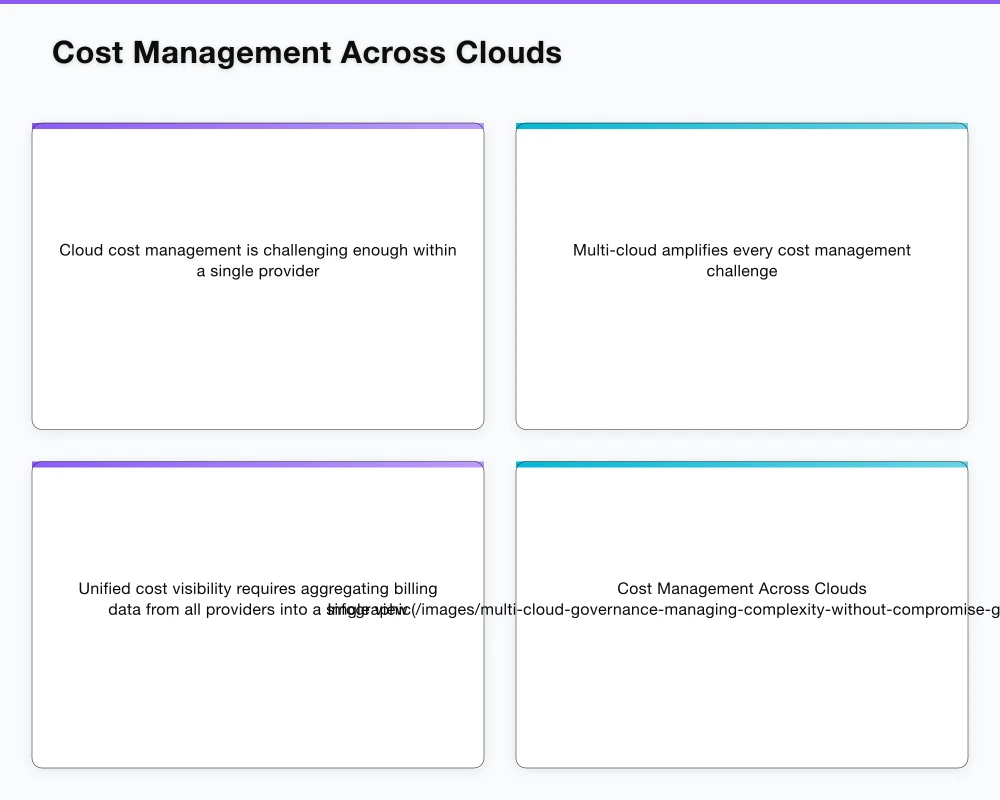
Cost Management Across Clouds
Cloud cost management is challenging enough within a single provider. Multi-cloud amplifies every cost management challenge.
Unified cost visibility requires aggregating billing data from all providers into a single view. Cloud management platforms like CloudHealth, Cloudability, and Apptio provide this aggregation, normalising cost data across providers and enabling consistent reporting, allocation, and optimisation.
Cost allocation in a multi-cloud environment must use consistent tagging across all providers. Every resource across all clouds should be tagged with a consistent taxonomy — cost centre, application, environment, team. Tag compliance must be monitored and enforced, as untagged resources create allocation gaps that undermine financial governance.
Optimisation strategies differ by provider but the governance framework should ensure that common techniques are applied everywhere: right-sizing instances based on actual utilisation, leveraging reserved capacity and savings plans for predictable workloads, automating the shutdown of non-production resources outside business hours, and reviewing storage tiering to ensure data is stored at the appropriate cost point.
FinOps — the practice of bringing financial accountability to cloud spending — is essential for multi-cloud organisations. The FinOps framework, developed by the FinOps Foundation, provides a structured approach to managing cloud financial operations with clear roles, processes, and metrics. Implementing FinOps across multiple clouds requires additional tooling and governance but provides the visibility and accountability needed to control spending.
Avoiding Common Pitfalls
Several patterns consistently undermine multi-cloud governance.
Accidental multi-cloud occurs when the organisation drifts into multiple providers without deliberate strategy. Each new cloud adopted without governance creates operational overhead, security risk, and cost opacity. The governance response is a cloud adoption policy that requires business justification and architectural review before new cloud providers are introduced.
Skills dilution happens when the organisation attempts to maintain deep expertise across all providers. Enterprise engineering teams have finite capacity, and spreading expertise too thin results in mediocrity across all platforms rather than excellence on any. The governance response is to identify primary and secondary providers, investing deeply in primary provider skills while maintaining functional competency for secondary providers.
Tool sprawl occurs when each cloud environment uses different tools for the same function — different CI/CD platforms, different monitoring tools, different security scanners. This multiplies the operational burden and creates inconsistency. The governance response is a standardised tool portfolio that works across all cloud environments, complemented by cloud-native tools only where they provide capabilities not available in the standard portfolio.
Multi-cloud is not inherently good or bad — it is a reality that must be governed deliberately. The CTO who establishes clear principles, invests in operational standardisation, maintains unified financial visibility, and resists the temptation to optimise for every cloud simultaneously will manage multi-cloud complexity without sacrificing the benefits that led to multi-cloud adoption in the first place.
Turning strategy into infrastructure? Cloud Geeks covers managed cloud, DevOps, and IT security for businesses putting digital plans into action.
Ash Ganda is the founder of Ganda Tech Services, a Sydney-based technology consultancy delivering cloud, web, and mobile solutions for Australian businesses.
About the Author
Ashish Ganda is the founder of Ganda Tech Services, a Sydney-based technology consultancy specialising in cloud infrastructure, web development, and mobile app solutions for Australian businesses.
Digital Transformation Roadmap 2026
A 12-month framework for Australian SMBs ready to modernise — phases, tools, and milestones.
Almost done
Check your inbox and click the confirmation link to get your download.