Enterprise Workflow Automation: BPM in the Cloud Era
Business process management (BPM) has been a staple of enterprise technology for decades. Traditional BPM platforms from vendors like IBM, Oracle, and Pegasystems provided the tools to model, automate, and optimise business processes across large organisations. These platforms delivered genuine value — automating approval workflows, orchestrating multi-system processes, and enforcing business rules consistently. But they also accumulated significant limitations: monolithic architectures, proprietary modelling languages, expensive licensing, and deployment complexity that made them resistant to change.
The cloud era is reshaping enterprise workflow automation in fundamental ways. Cloud-native orchestration engines, event-driven architectures, low-code platforms, and API-first integration patterns are providing alternatives that challenge the traditional BPM paradigm. For CTOs managing enterprise process automation strategy, understanding these shifts is essential for making investment decisions that serve the organisation for the next decade.
The Limitations of Traditional BPM
Traditional enterprise BPM platforms were designed for a world of on-premises deployment, synchronous communication, and centralised process ownership. Several of their foundational assumptions no longer hold in modern enterprise environments.
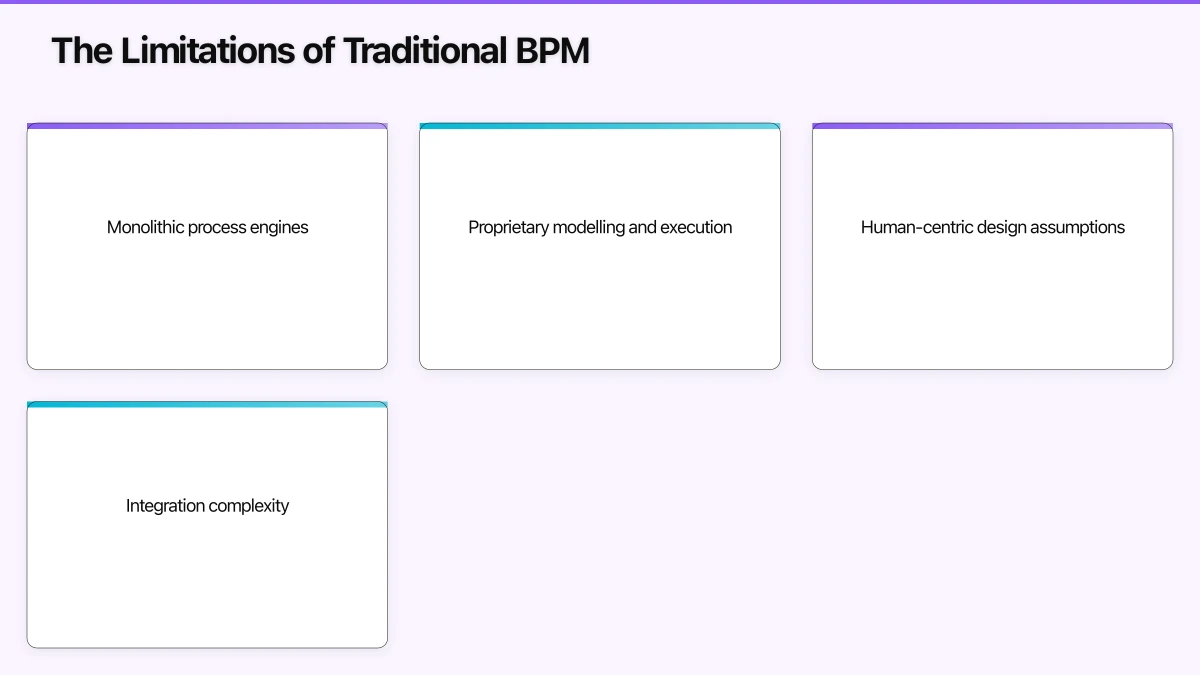
Monolithic process engines concentrate all workflow execution in a single platform. Every business process, regardless of its complexity, latency requirements, or change frequency, runs on the same engine. This creates single points of failure, scaling limitations, and deployment coupling — a change to one process requires redeployment of the entire platform. In environments with hundreds of automated processes, this coupling makes change management slow and risky.
Proprietary modelling and execution languages lock organisations into specific vendor ecosystems. BPMN 2.0 provides a standard modelling notation, but the execution semantics differ between platforms, and most platforms extend the standard with proprietary features that become dependencies. Migrating from one BPM platform to another is typically a multi-year, multi-million dollar effort, giving vendors significant pricing power in renewal negotiations.
Human-centric design assumptions reflect BPM’s origins in document routing and approval workflows. Traditional platforms excel at processes that involve human tasks — review, approve, escalate — with system integration playing a supporting role. Modern enterprise processes are increasingly system-to-system, event-driven, and real-time, with human involvement as the exception rather than the rule. The human-centric design of traditional BPM platforms introduces unnecessary overhead for system-driven processes.
Integration complexity has compounded as enterprise technology landscapes have diversified. Traditional BPM platforms assume integration through enterprise service buses (ESBs) and SOAP web services. Modern integration patterns — REST APIs, GraphQL, webhooks, event streams, serverless functions — are often supported as afterthoughts rather than first-class citizens.
Cloud-Native Workflow Orchestration
A new generation of workflow orchestration technologies addresses the limitations of traditional BPM while embracing cloud-native architecture principles.
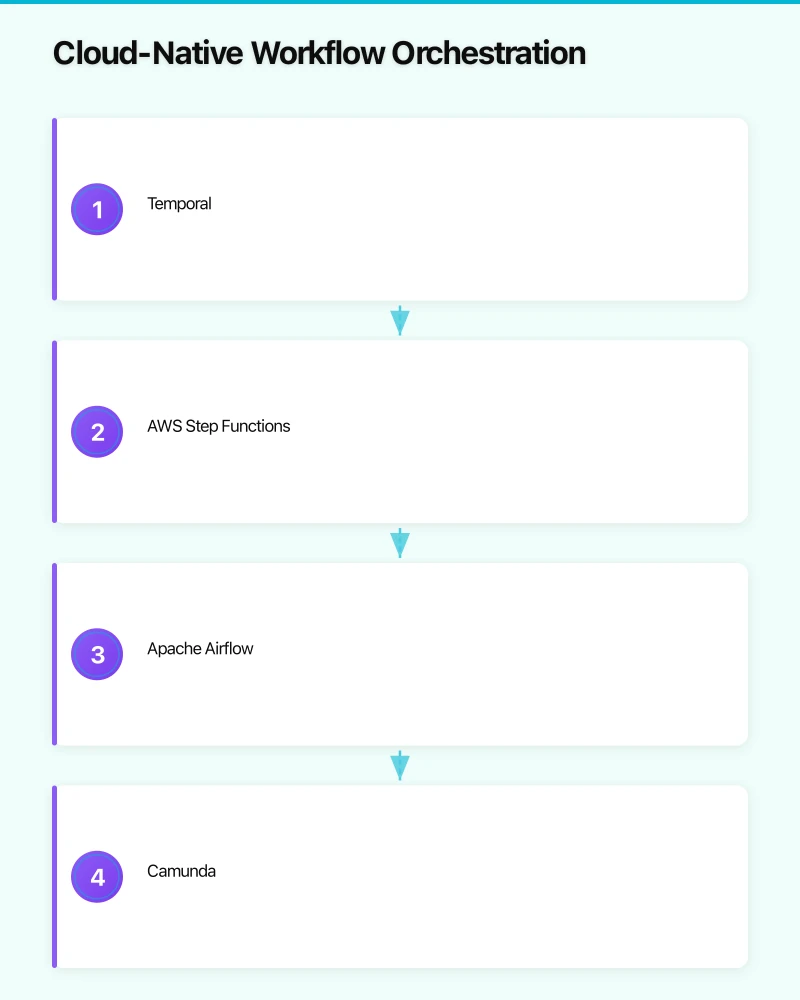
Temporal (originally developed at Uber as Cadence) has emerged as a compelling platform for durable workflow execution. Temporal provides a code-first approach to workflow definition — workflows are written in standard programming languages (Go, Java, TypeScript, PHP) rather than visual modelling tools or XML-based definitions. This enables workflows to leverage the full power of the programming language, including libraries, testing frameworks, and IDE support.
Temporal’s durability model guarantees that workflows survive infrastructure failures, ensuring that long-running business processes (which may take hours, days, or months to complete) execute reliably without the developer writing explicit error handling or state persistence code. For enterprises running critical business processes, this reliability guarantee is strategically significant.
AWS Step Functions provides serverless workflow orchestration tightly integrated with the AWS ecosystem. Step Functions defines workflows as state machines (using Amazon States Language), with each state invoking an AWS service — Lambda functions, ECS tasks, DynamoDB operations, SQS messages, and more. The serverless model means no infrastructure to manage, automatic scaling, and pay-per-state-transition pricing.
Step Functions excels for AWS-native workloads where workflow steps are AWS service invocations. Its visual designer provides accessibility for non-developers, and its integration with CloudWatch and X-Ray provides observability. The limitation is AWS lock-in — workflows are defined in terms of AWS services and cannot be portably executed elsewhere.
Apache Airflow has become the standard for data pipeline orchestration, with strong adoption in data engineering teams. Its directed acyclic graph (DAG) model, Python-based workflow definitions, and extensive operator library make it well-suited for extract-transform-load (ETL) pipelines, machine learning workflows, and data processing orchestration. Managed offerings from AWS (MWAA), Google Cloud (Cloud Composer), and Astronomer reduce the operational burden.
Camunda bridges the gap between traditional BPM and cloud-native orchestration. Its workflow engine supports both BPMN 2.0 visual models and code-first approaches, runs as a lightweight Java application or cloud service, and provides the process modelling capabilities that business stakeholders expect alongside the developer experience that engineering teams demand.
Event-Driven Process Architecture
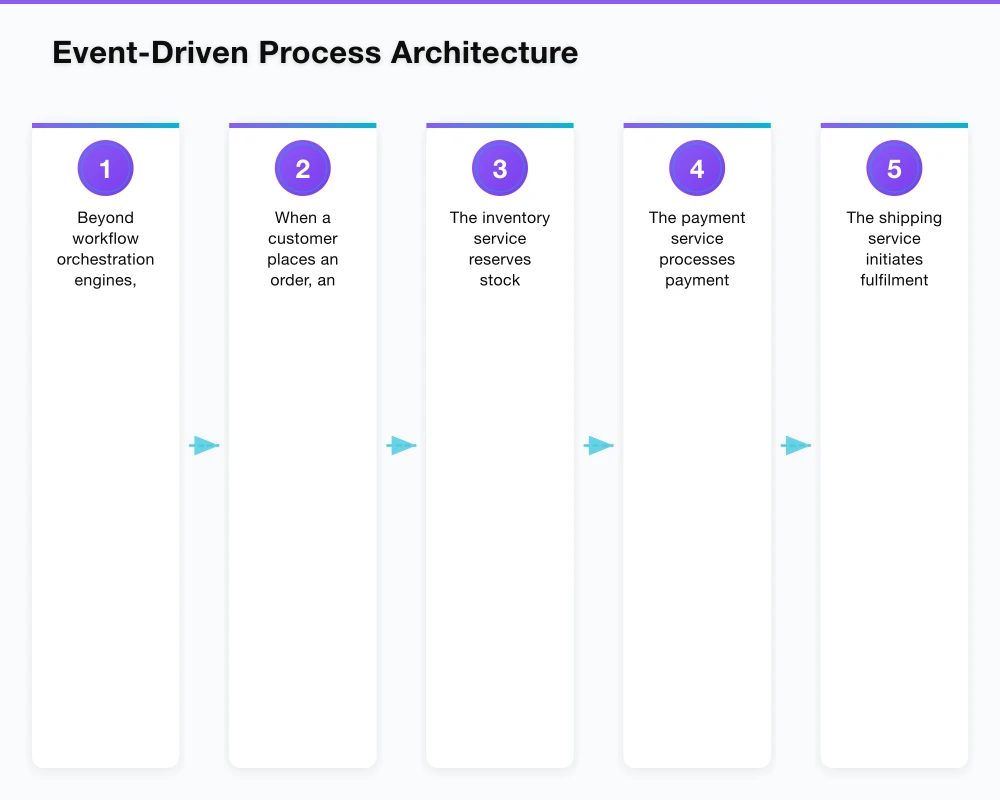
Beyond workflow orchestration engines, event-driven architecture patterns are transforming how enterprises approach process automation.
In event-driven process architecture, business processes are not centrally orchestrated but emerge from the choreography of independent services reacting to business events. When a customer places an order, an event is published. The inventory service reserves stock. The payment service processes payment. The shipping service initiates fulfilment. Each service acts independently based on events, without a central orchestrator coordinating the sequence.
This choreography model offers several advantages for enterprise process automation. Services are loosely coupled — they can be deployed, scaled, and evolved independently. The process is resilient to individual service failures because there is no central coordinator that represents a single point of failure. And the architecture naturally supports the addition of new process steps — adding a fraud check or a loyalty points calculation simply requires deploying a new service that subscribes to the relevant events.
The challenge is visibility and governance. When processes are distributed across choreographed services, understanding the end-to-end process flow requires aggregating information from multiple systems. Distributed tracing (using tools like Jaeger or Zipkin) provides technical visibility, but business-level process monitoring requires additional tooling — event-sourced process views, saga monitoring dashboards, and business activity monitoring capabilities.
For most enterprises, the optimal approach combines orchestration and choreography. Complex business processes with strict ordering requirements, exception handling, and compensation logic benefit from explicit orchestration (using Temporal, Step Functions, or similar). Simple event reactions and loosely coupled integrations benefit from choreography through event buses like Apache Kafka or Amazon EventBridge.
Strategic Recommendations for Enterprise Workflow Modernisation
Modernising enterprise workflow automation is a multi-year journey that should be guided by strategic principles rather than technology preferences.
Assess the process portfolio before selecting technology. Map the organisation’s automated and manually executed processes, categorising them by complexity, change frequency, latency requirements, and business criticality. This assessment reveals the diversity of requirements that the automation strategy must serve and prevents the common mistake of selecting a single tool for all scenarios.
Adopt a polyglot orchestration strategy that matches technologies to process characteristics. Use cloud-native orchestration engines (Temporal, Step Functions) for complex system-to-system workflows. Use event-driven choreography for loosely coupled integrations. Use low-code platforms for business-user-configurable workflows where non-technical stakeholders need direct control. Use robotic process automation (RPA) for legacy system integration where APIs are not available.
Invest in process observability as a first-class capability. Regardless of the orchestration technology, the ability to monitor process execution, identify bottlenecks, detect failures, and measure performance is essential for operational excellence. This requires standardised logging, distributed tracing, and business-level dashboards that aggregate information across orchestration technologies.
Plan for incremental migration from traditional BPM platforms. Wholesale replacement of an established BPM platform is high-risk and rarely necessary. Instead, route new processes to modern orchestration technologies while maintaining existing processes on the legacy platform. Over time, the most valuable legacy processes can be migrated individually, with the legacy platform eventually reaching end-of-life through attrition rather than big-bang replacement.
Conclusion
Enterprise workflow automation is undergoing a transformation as significant as any in its history. Cloud-native orchestration engines, event-driven architectures, and modern integration patterns provide capabilities that traditional BPM platforms cannot match in terms of scalability, developer experience, and architectural flexibility.
For CTOs, the strategic imperative is to develop a workflow automation strategy that serves the full spectrum of process requirements — from complex, long-running business processes to simple event reactions — using technologies that align with the organisation’s cloud strategy and engineering capabilities. The organisations that modernise their process automation infrastructure will be better positioned to adapt, automate, and optimise as business requirements evolve.
Turning strategy into infrastructure? Cloud Geeks covers managed cloud, DevOps, and IT security for businesses putting digital plans into action.
I lead Ganda Tech Services, where we turn digital strategy into results through specialist cloud, web design, and mobile app teams across Sydney.
About the Author
Ashish Ganda is the founder of Ganda Tech Services, a Sydney-based technology consultancy specialising in cloud infrastructure, web development, and mobile app solutions for Australian businesses.
Digital Transformation Roadmap 2026
A 12-month framework for Australian SMBs ready to modernise — phases, tools, and milestones.
Almost done
Check your inbox and click the confirmation link to get your download.