IT Operating Model Transformation: From Cost Centre to Business Partner
Introduction
Too many IT organisations remain trapped in a service provider role—taking orders, delivering projects, maintaining systems, and perpetually defending budgets. Business units view IT as a necessary cost, not a strategic enabler. Strategic technology decisions happen without IT involvement, then IT inherits the complexity.
The CTOs who escape this trap transform their IT operating model. They evolve from order-takers to strategic partners, from project factories to product organisations, from cost centres to value creators. This transformation requires deliberate redesign of how IT operates.
The Operating Model Challenge
The Traditional IT Model
Classic IT operating model characteristics:
Project-Based Delivery
Work organised as projects:
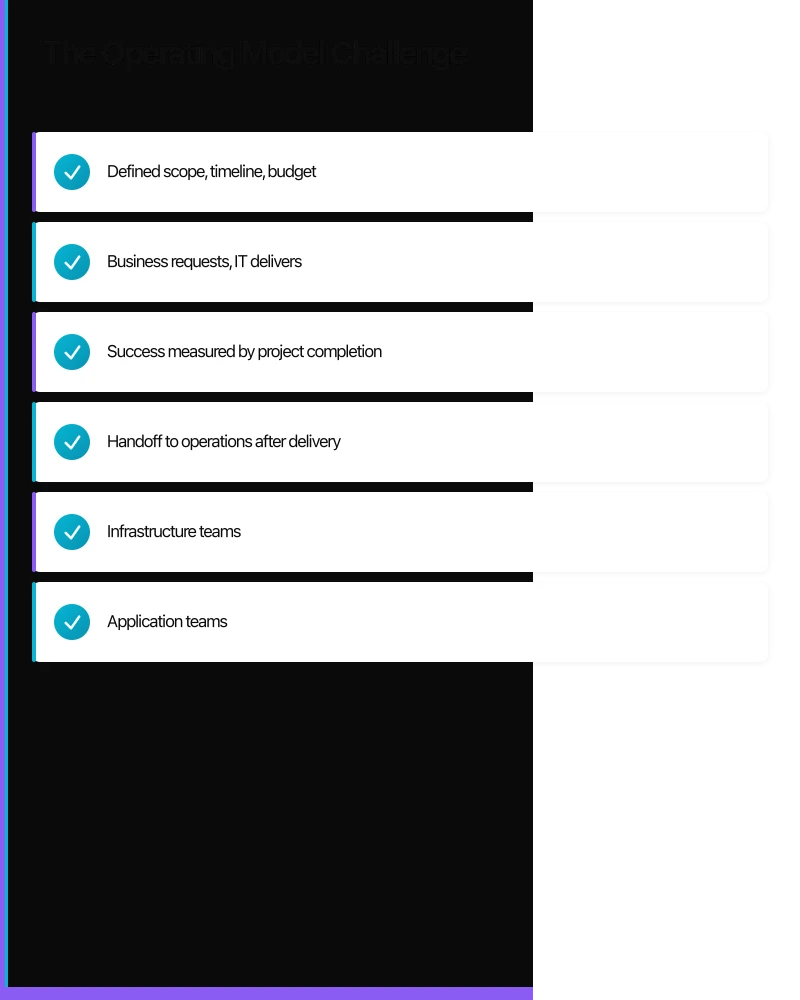
- Defined scope, timeline, budget
- Business requests, IT delivers
- Success measured by project completion
- Handoff to operations after delivery
Functional Silos
Organised by technical specialty:
- Infrastructure teams
- Application teams
- Security teams
- Operations teams
Work flows between silos, creating handoffs and delays.
Cost Centre Orientation
IT as overhead:
- Budget allocated top-down
- Cost reduction pressure constant
- Value difficult to demonstrate
- Investment viewed as expense
Reactive Posture
Responding to business requests:
- Business defines requirements
- IT estimates and delivers
- Little input on strategic direction
- Perpetually behind demand
Why This Model Fails
Slow Delivery
Handoffs between silos add time:
- Project approval cycles
- Resource allocation delays
- Integration challenges
- Deployment bottlenecks
Disconnection from Business
Distance from business outcomes:
- Requirements lost in translation
- Solutions don’t fit real needs
- Iteration is expensive
- Feedback loops are long
Innovation Deficit
No capacity for innovation:
- All resources committed to projects
- Risk aversion dominates
- New ideas lack funding paths
- Technical debt accumulates
Talent Challenges
Difficulty attracting top talent:
- Order-taking not appealing
- Limited autonomy and ownership
- Technology choices constrained
- Career development limited
Target Operating Model
Product-Oriented Structure
Reorganise around business outcomes:
Cross-functional teams owning products:
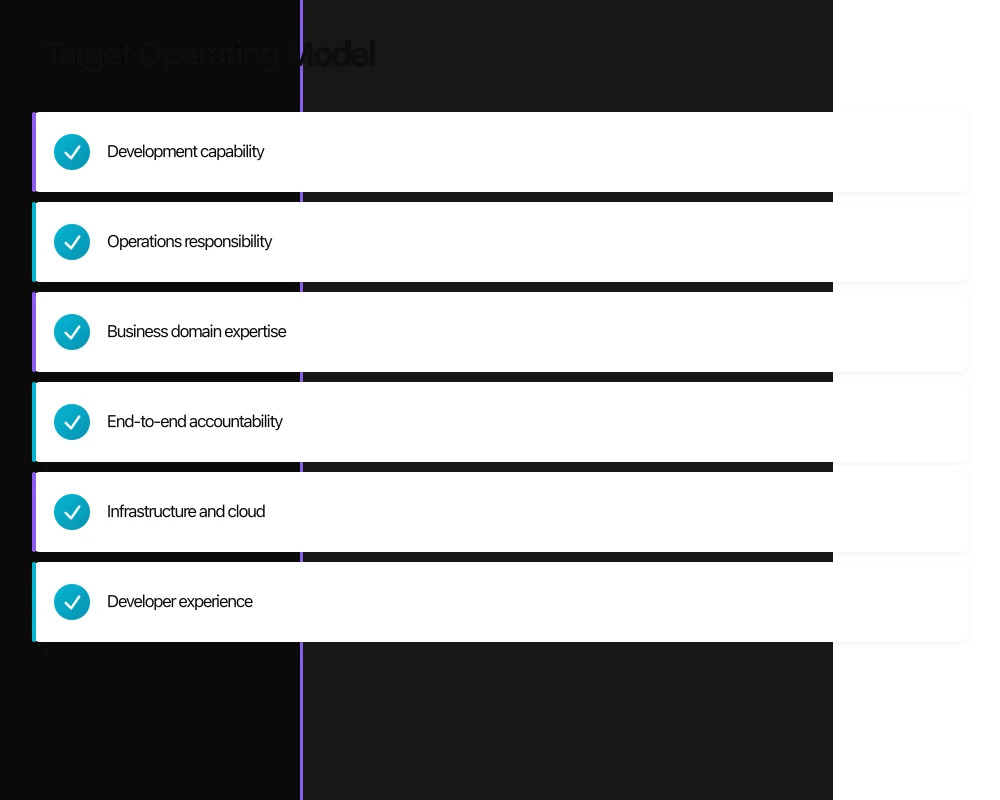
- Development capability
- Operations responsibility
- Business domain expertise
- End-to-end accountability
Teams own outcomes, not just outputs.
Enabling capabilities for product teams:
- Infrastructure and cloud
- Developer experience
- Security services
- Data platforms
Platform teams enable product teams to move faster.
Business Alignment
Teams aligned to business domains:
- Customer-facing products
- Internal business capabilities
- Shared services
- Innovation initiatives
Structure mirrors business structure.
Agile Delivery
Move from projects to continuous delivery:
Continuous Flow
Work as continuous stream:
- Prioritised backlogs, not project scopes
- Frequent small releases
- Continuous feedback and adjustment
- No “projects” that end
Cross-Functional Teams
Teams have all capabilities needed:
- Development, testing, operations
- Security and compliance
- Business analysis
- UX and design
Reduce handoffs, increase speed.
Iterative Approach
Embrace iteration:
- Start small, learn, expand
- Minimum viable products
- Data-driven decisions
- Pivot when needed
Strategic Partnership
Elevate IT role in business:
Business Engagement
Active participation in business strategy:
- IT at strategy table
- Technology-enabled business opportunities
- Digital business models
- Competitive technology analysis
Demand Management
Shape demand, don’t just fulfill it:
- Portfolio prioritisation
- Trade-off discussions
- Opportunity identification
- Constraint communication
Value Demonstration
Articulate IT contribution:
- Business outcomes achieved
- Revenue enabled
- Costs avoided
- Risk mitigated
Transformation Approach
Phase 1: Vision and Strategy
Define the future state:
Operating Model Design
Specify target model:
- Organisational structure
- Roles and responsibilities
- Processes and practices
- Technology and tools
- Metrics and governance
Gap Assessment
Understand current state gaps:
- Structural misalignment
- Capability gaps
- Process inefficiencies
- Cultural barriers
Transformation Roadmap
Plan the journey:
- Phased approach
- Quick wins and longer initiatives
- Dependencies and sequencing
- Investment requirements
Phase 2: Foundation Building
Create conditions for success:
Leadership Alignment
Executive commitment:
- CTO conviction and sponsorship
- Business leadership support
- Clear mandate for change
- Sustained attention
Pilot Selection
Start with demonstrable success:
- Willing business partners
- Suitable scope
- Visible outcomes
- Learning opportunity
Capability Investment
Build needed capabilities:
- Skills development
- Process design
- Tool deployment
- Cultural change
Phase 3: Structural Change
Implement new operating model:
Organisational Redesign
Restructure deliberately:
- Team formation
- Reporting changes
- Role redefinition
- Transition support
Process Transformation
Change how work flows:
- Agile practices
- DevOps implementation
- Portfolio management
- Service management evolution
Technology Enablement
Deploy supporting technology:
- Modern infrastructure
- Automation and CI/CD
- Collaboration tools
- Measurement systems
Phase 4: Culture and Sustainability
Embed the transformation:
Cultural Shift
Change mindsets and behaviours:
- Outcome orientation
- Continuous improvement
- Collaboration across boundaries
- Experimentation and learning
Governance Evolution
Adapt management systems:
- New metrics and KPIs
- Funding model changes
- Decision rights clarity
- Accountability frameworks
Continuous Improvement
Build improvement capability:
- Regular retrospectives
- Performance monitoring
- Feedback incorporation
- Ongoing optimisation
Key Transformation Elements
Funding Model Change
Move beyond project funding:
From Project to Product
Allocate to products, not projects:
- Stable product funding
- Team continuity
- Long-term investment
- Outcome accountability
Capacity-Based Funding
Fund team capacity:
- Predictable resource allocation
- Reduced approval overhead
- Team autonomy on priorities
- Business partnership on direction
Value-Based Allocation
Connect funding to value:
- Business case for capacity
- Outcome measurement
- Portfolio prioritisation
- Investment returns
Metrics Evolution
Measure what matters:
From Activity to Outcomes
Shift measurement focus:
Traditional Metrics (Limited Value)
- Projects completed
- Tickets resolved
- Uptime percentage
- Budget variance
Outcome Metrics (Higher Value)
- Business value delivered
- Customer satisfaction
- Time to market
- Innovation contribution
Flow Metrics
Measure delivery effectiveness:
- Lead time (idea to production)
- Deployment frequency
- Change failure rate
- Mean time to recover
Value Metrics
Measure business impact:
- Revenue enabled
- Cost efficiency
- Risk reduction
- Customer experience
Governance Redesign
Adapt governance for agility:
Lightweight Governance
Reduce bureaucracy while maintaining control:
- Principles over rules
- Exception-based oversight
- Automated compliance
- Trust with verification
Portfolio Management
Strategic alignment:
- Clear prioritisation criteria
- Regular portfolio reviews
- Trade-off visibility
- Business partnership in decisions
Risk Management
Appropriate risk governance:
- Risk-based controls
- Proportionate oversight
- Automated monitoring
- Continuous compliance
Business Relationship Model
Transform engagement:
Embedded Partnership
IT as business partner:
- Technology leaders in business units
- Business representation in IT
- Joint accountability for outcomes
- Shared success metrics
Demand Shaping
Active demand management:
- Opportunity identification
- Feasibility guidance
- Priority recommendations
- Constraint transparency
Strategic Dialogue
Elevate conversations:
- Technology strategy input
- Digital opportunity surfacing
- Competitive analysis
- Industry trend briefings
Common Challenges
Resistance to Change
People protect status quo:
- Uncertainty about roles
- Skill concerns
- Power dynamics
- Comfort with current state
Mitigation:
- Clear communication
- Involvement in design
- Skill development support
- Patience and persistence
Business Skepticism
Business doesn’t believe IT can change:
- Historical disappointments
- Promise fatigue
- Competing priorities
- Relationship damage
Mitigation:
- Demonstrate early results
- Rebuild trust incrementally
- Own past failures
- Deliver consistently
Transformation Fatigue
Organisational change exhaustion:
- Too many initiatives
- Insufficient results
- Cynicism develops
- Energy depletes
Mitigation:
- Pace change appropriately
- Celebrate progress
- Maintain focus
- Avoid initiative overload
Sustainability Pressure
Maintaining transformation momentum:
- Initial enthusiasm fades
- Old patterns resurface
- Attention moves elsewhere
- Regression occurs
Mitigation:
- Embed in operating rhythm
- Measure and monitor
- Reinforce continuously
- Leadership commitment
Conclusion
IT operating model transformation is challenging but essential. The traditional model—project-based, siloed, reactive, and cost-focused—cannot deliver what digital business requires. The enterprises that transform IT into strategic partners gain sustained competitive advantage.
Start with clear vision of the target operating model. Build foundations carefully. Implement structural changes deliberately. Invest in cultural transformation as much as organisational change.
The transformation takes years, not months. But the destination—IT as genuine business partner, delivering continuous value through modern practices and engaged teams—is worth the journey.
Sources
- McKinsey. (2023). The IT Operating Model of the Future. McKinsey Digital.
- Gartner. (2022). Building a Modern IT Operating Model. Gartner Research.
- Deloitte. (2023). Tech Trends: IT Operating Model Evolution. Deloitte Insights.
- Thoughtworks. (2022). Digital Transformation: From Projects to Products. Thoughtworks.
Strategic guidance for technology leaders transforming IT delivery.
For hands-on web development and SEO advice, visit Cosmos Web Tech — our specialist web design and digital marketing blog.
Ganda Tech Services is my technology consultancy, bringing together cloud infrastructure, web development, and mobile expertise for Australian businesses.
About the Author
Ashish Ganda is the founder of Ganda Tech Services, a Sydney-based technology consultancy specialising in cloud infrastructure, web development, and mobile app solutions for Australian businesses.
Digital Transformation Roadmap 2026
A 12-month framework for Australian SMBs ready to modernise — phases, tools, and milestones.
Almost done
Check your inbox and click the confirmation link to get your download.