Enterprise Low-Code Platform Strategy: A CTO's Guide for 2025
Low-code and no-code platforms have matured from departmental tools into enterprise capabilities that CTOs cannot ignore. The promise is compelling: accelerate application delivery, reduce professional developer bottlenecks, and empower business users to build solutions addressing their own needs. The reality is more nuanced, requiring strategic thinking about where low-code creates value and where it creates risk.
For enterprise CTOs, low-code strategy involves balancing genuine productivity gains against governance complexity, integration challenges, and the risk of creating new forms of shadow IT. Organizations succeeding with low-code at scale are those approaching it as a strategic capability requiring deliberate architecture, governance, and operating models.
The Low-Code Landscape in 2025
The low-code market has evolved significantly, with platforms spanning a spectrum from simple workflow automation to full enterprise application development.
Platform Categories
Application Development Platforms: Full-featured platforms for building complete applications including data models, business logic, user interfaces, and integrations. Microsoft Power Platform, OutSystems, Mendix, and ServiceNow App Engine represent this category.
Workflow Automation: Focused on automating business processes and connecting systems. Platforms like Zapier, Power Automate, and Workato enable process automation without traditional development.
Form and Database Builders: Tools for creating data collection applications quickly. Airtable, AppSheet, and Quickbase enable rapid creation of structured data applications.
Website and Portal Builders: Platforms for creating web experiences without coding. Webflow, Wix, and similar platforms serve marketing and content use cases.
Integration Platforms: Low-code approaches to system integration. MuleSoft, Boomi, and Workato provide visual integration development.
Market Dynamics
The low-code market continues rapid growth, with Gartner projecting it to exceed $30 billion globally by 2026. Several factors drive adoption:
Developer Scarcity: Competition for software development talent remains intense. Low-code extends development capacity without proportional headcount growth.
Time-to-Value Pressure: Business units demand faster delivery. Low-code can reduce development timelines from months to weeks.
Democratization Expectations: Business users accustomed to consumer technology expect self-service capabilities for business applications.
AI Augmentation: Generative AI integration in low-code platforms further accelerates development through code suggestion, natural language specification, and automated testing.
Strategic Value Proposition
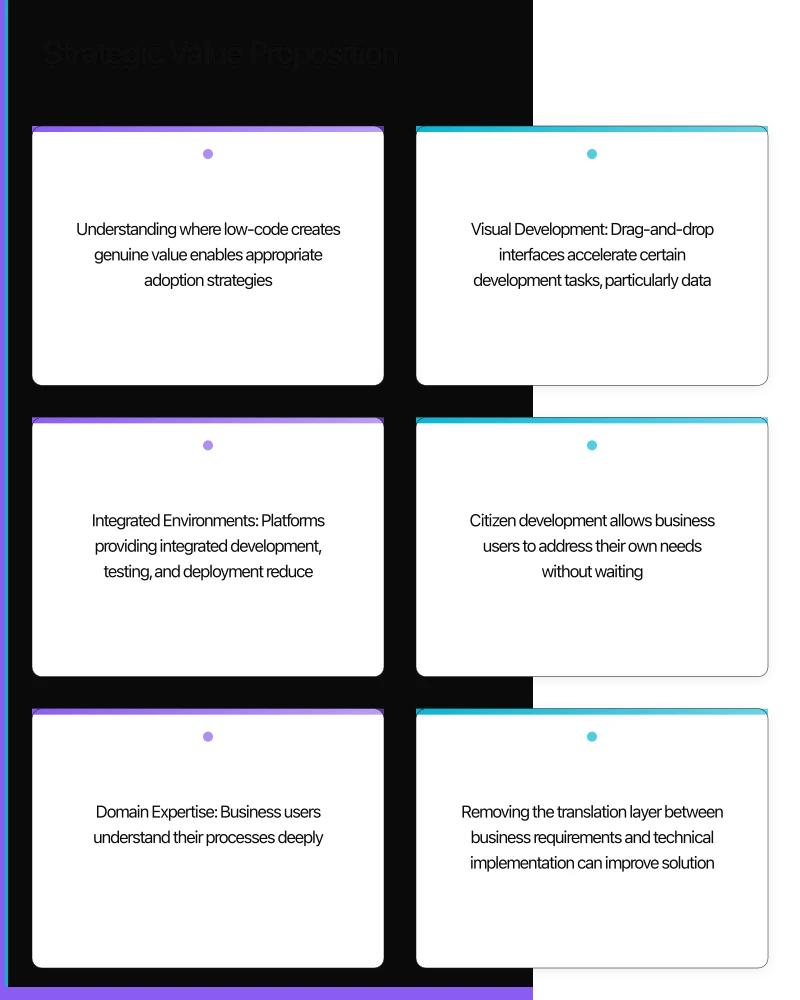
Understanding where low-code creates genuine value enables appropriate adoption strategies.
Developer Productivity
Professional developers using low-code platforms often achieve significant productivity improvements:
Reduced Boilerplate: Low-code platforms handle common functionality (authentication, data access, UI components) that would otherwise require manual implementation.
Visual Development: Drag-and-drop interfaces accelerate certain development tasks, particularly data modeling, workflow definition, and form creation.
Integrated Environments: Platforms providing integrated development, testing, and deployment reduce toolchain complexity.
Organizations report 3-10x development speed improvements for suitable use cases, though productivity varies significantly based on application type and developer experience.
Citizen Development
Enabling business users to build applications addresses two persistent challenges:
Backlog Reduction: IT backlogs typically extend months or years. Citizen development allows business users to address their own needs without waiting.
Domain Expertise: Business users understand their processes deeply. Removing the translation layer between business requirements and technical implementation can improve solution quality.
Innovation Enablement: Lowering the barrier to experimentation encourages innovation that might not justify formal development investment.
However, citizen development requires governance frameworks preventing the creation of ungoverned, unsupported application sprawl.
Use Case Fit
Low-code excels in specific application categories:
Internal Applications: Tools serving internal users where consumer-grade polish is less critical than rapid delivery.
Data Collection and Workflow: Applications primarily capturing structured data and routing it through approval or processing workflows.
Dashboards and Reporting: Visual presentation of data from existing systems.
System Integration: Connecting existing systems and automating data flows between them.
Process Automation: Automating manual business processes, particularly those involving approvals, notifications, and conditional routing.
Low-code struggles with:
Complex Business Logic: Applications with intricate algorithms or unusual processing requirements may exceed platform capabilities.
Performance-Critical Applications: High-throughput, low-latency applications often require optimization beyond low-code platform control.
Unique User Experiences: Applications requiring distinctive interfaces or innovative interaction patterns face platform constraints.
Deep System Integration: Complex integrations with legacy systems or proprietary protocols may require traditional development.
Governance Frameworks
Enterprise low-code requires governance balancing enablement against risk.
Platform Governance
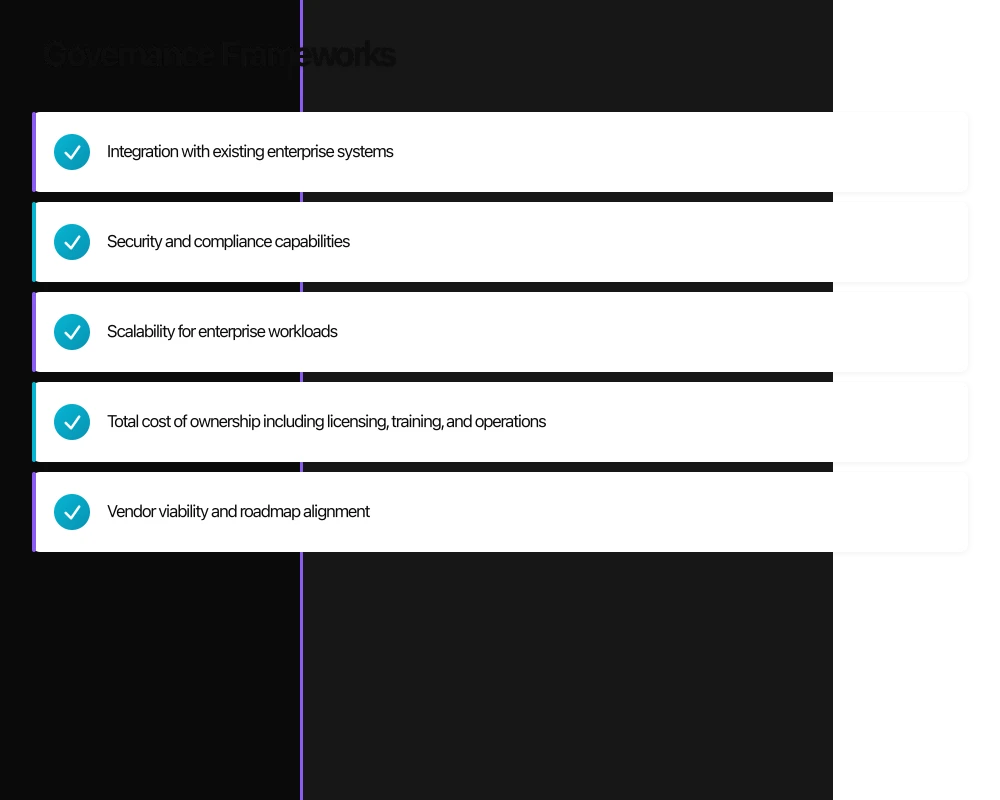
Platform Selection: Enterprises typically standardize on a limited number of platforms to manage complexity. Selection criteria include:
- Integration with existing enterprise systems
- Security and compliance capabilities
- Scalability for enterprise workloads
- Total cost of ownership including licensing, training, and operations
- Vendor viability and roadmap alignment
Environment Standards: Defining how low-code platforms are provisioned, configured, and managed. Ensuring consistent security controls and compliance across environments.
Capacity Management: Low-code platforms have capacity limits. Planning for growth and managing resource allocation across applications.
Application Governance
Application Classification: Risk-based classification determining governance requirements. A prototype for exploring an idea requires less governance than an application automating financial processes.
Review and Approval: Processes for reviewing applications before production deployment. Review intensity based on risk classification.
Change Management: How changes to low-code applications are tested, approved, and deployed. Particularly important when citizen developers make changes.
Documentation Requirements: Ensuring applications are documented sufficiently for ongoing support and troubleshooting.
Citizen Developer Governance
Authorization: Who can develop and what can they build? Role-based permissions limiting citizen developer capabilities to appropriate scope.
Training Requirements: Mandatory training before granting development access. Covering both platform skills and governance requirements.
Support Models: How citizen developer applications receive support. Self-support, peer support, or IT support with different expectations.
Application Retirement: Processes for handling applications when their creators leave or move roles.
Architecture Considerations
Low-code platforms must integrate into enterprise architecture coherently.
Integration Architecture
API-First Approach: Low-code applications should consume and produce APIs following enterprise standards. Preventing point-to-point integrations that create fragility.
Integration Patterns: Defining how low-code applications connect to enterprise systems. Typically through enterprise integration platforms rather than direct connections.
Data Access Governance: Controlling what data low-code applications can access. Ensuring compliance with data classification and access policies.
Data Architecture
Data Ownership: Clarifying whether data created in low-code applications belongs to the platform or can be exported. Avoiding vendor lock-in on critical data.
Master Data Alignment: Ensuring low-code applications use enterprise master data rather than creating redundant data stores.
Data Quality: Maintaining data quality standards for information entering enterprise systems through low-code applications.
Security Architecture
Authentication Integration: Low-code platforms must integrate with enterprise identity management. Single sign-on, MFA, and role-based access control.
Network Security: How low-code platforms, particularly cloud-hosted ones, access internal systems securely.
Application Security: Security scanning and vulnerability management for low-code applications.
Operating Model
Successful low-code programs require appropriate operating models.
Center of Excellence
Many organizations establish low-code Centers of Excellence (CoE) providing:
Standards and Governance: Defining and maintaining low-code standards, patterns, and governance frameworks.
Training and Enablement: Building organizational capability through training programs and enablement resources.
Best Practice Sharing: Documenting and disseminating successful patterns across the organization.
Application Review: Reviewing applications for quality, security, and architectural alignment.
Platform Administration: Managing platform configuration, capacity, and operations.
Development Models
Fusion Teams: Combining professional developers with business users. Professionals handle complex components while business users build simpler elements.
Professional Low-Code: Professional developers using low-code for accelerated delivery of full applications.
Supported Citizen Development: Citizen developers building applications with professional developer support available.
Self-Service Citizen Development: Citizen developers building and supporting their own applications with minimal IT involvement.
Most enterprises operate multiple models simultaneously for different use cases and risk levels.
Support Models
Tiered Support: Citizen developer applications typically receive lower support priority than professional-built applications. Clear tier definitions set expectations.
Peer Support Networks: Enabling citizen developers to help each other through communities of practice.
Office Hours: Scheduled time when professional developers assist citizen developers.
Escalation Paths: Clear processes for escalating issues beyond citizen developer capability.
Cost Considerations
Low-code economics differ from traditional development.
Cost Categories
Platform Licensing: Per-user, per-application, or capacity-based licensing. Often significant expense at enterprise scale.
Professional Services: Implementation assistance, training, and consulting from platform vendors or partners.
Internal Resources: Staff time for governance, training, support, and platform administration.
Integration Development: Connecting low-code platforms to enterprise systems often requires professional development.
Ongoing Operations: Platform management, monitoring, and maintenance.
Total Cost of Ownership
Evaluating low-code TCO requires comparing:
- Platform costs versus developer salary/contractor costs for equivalent traditional development
- Speed to delivery differences
- Ongoing maintenance costs
- Technical debt implications
- Vendor lock-in costs if switching platforms later
Low-code often delivers favorable TCO for suitable use cases but may cost more than traditional development for complex applications that strain platform capabilities.
Hidden Costs
Customization Limits: When applications require capabilities beyond platform features, workarounds become expensive.
Scalability Surprises: Applications that grow beyond initial expectations may require migration to traditional development.
Integration Complexity: Connecting to enterprise systems often requires more effort than anticipated.
Technical Debt: Poorly governed low-code can accumulate technical debt as rapidly as traditional development.
Risk Management
Enterprise low-code introduces specific risks requiring mitigation.
Shadow IT Risk
Ungoverned citizen development can recreate shadow IT problems:
- Applications processing sensitive data without security review
- Critical processes dependent on unknown applications
- Duplicate functionality across departments
- Applications abandoned when creators leave
Mitigation requires discovery capabilities, governance frameworks, and appropriate citizen developer permissions.
Vendor Lock-in
Low-code platforms create significant lock-in:
- Application logic expressed in platform-specific formats
- Data stored in platform databases
- Integrations using platform-specific connectors
- Skills invested in platform-specific knowledge
Mitigation strategies include data portability requirements, API-based integration, and acceptance of strategic platform commitments.
Quality and Technical Debt
Citizen-developed applications may lack quality practices professional developers follow:
- Inadequate testing
- Poor error handling
- Security vulnerabilities
- Unmaintainable designs
Mitigation requires review processes, quality standards, and training on development practices.
Compliance Risk
Low-code applications may process data subject to regulatory requirements:
- Privacy regulations requiring data handling controls
- Financial regulations requiring audit trails
- Industry regulations requiring specific controls
Governance must ensure low-code applications comply with applicable regulations.
AI Integration in Low-Code
Generative AI integration is transforming low-code platforms in 2025:
AI-Assisted Development
Natural Language to Application: Describing desired functionality in natural language, with AI generating application components.
Code Suggestion: AI suggesting logic, formulas, and configurations based on context.
Automated Testing: AI generating test cases and identifying potential issues.
Documentation Generation: AI creating documentation from application definitions.
AI-Powered Applications
Intelligent Automation: Low-code workflows incorporating AI services for classification, extraction, and decision support.
Conversational Interfaces: Building chatbots and conversational applications within low-code platforms.
Predictive Features: Embedding ML predictions in low-code applications without ML expertise.
Implications
AI augmentation further accelerates low-code development and extends citizen developer capabilities. Governance frameworks must evolve to address AI-specific risks including bias, hallucination, and appropriate use of AI capabilities.
Implementation Roadmap
For organizations establishing or scaling low-code capabilities:
Phase 1: Foundation
Platform Selection: Evaluate and select platforms aligned with enterprise requirements and use cases.
Governance Framework: Establish initial governance covering platform standards, development authorization, and application review.
Pilot Programs: Controlled pilots demonstrating value and refining operating model.
Phase 2: Expansion
Citizen Developer Program: Launch structured citizen development with training, certification, and support.
Integration Development: Build connectors and patterns for enterprise system integration.
Center of Excellence: Establish CoE providing governance, enablement, and platform management.
Phase 3: Optimization
Operating Model Refinement: Adjust governance and support based on operational experience.
Portfolio Management: Rationalize low-code application portfolio, addressing technical debt and redundancy.
Advanced Capabilities: Adopt AI augmentation and advanced platform features.
Success Metrics
Measuring low-code program effectiveness:
Delivery Metrics
- Cycle Time: Time from requirement to production deployment
- Throughput: Applications or features delivered per period
- Backlog Reduction: Impact on IT backlog
Adoption Metrics
- Active Developers: Citizen and professional developers using platforms
- Application Portfolio: Active applications in production
- Usage Metrics: Application usage and engagement
Quality Metrics
- Defect Rates: Production issues per application
- Security Incidents: Security-related issues in low-code applications
- Compliance: Audit findings related to low-code
Business Metrics
- Cost Efficiency: Cost per application compared to traditional development
- Business Value: Business outcomes enabled by low-code applications
- Satisfaction: User satisfaction with low-code-built solutions
Conclusion
Low-code platforms have earned a place in enterprise technology strategy. The question is not whether to adopt low-code but how to adopt it effectively: selecting appropriate platforms, establishing governance enabling value creation while managing risk, and building operating models supporting sustainable scale.
Organizations that approach low-code strategically will accelerate delivery, extend development capacity, and empower business users while maintaining architectural coherence and governance control. Those that adopt low-code reactively or without governance will create new challenges while missing the strategic benefits.
For enterprise CTOs, low-code strategy requires the same rigor applied to other strategic technology decisions: clear understanding of business value, appropriate architecture integration, sound governance frameworks, and operational models supporting long-term success.
References and Further Reading
- Gartner. (2025). “Magic Quadrant for Enterprise Low-Code Application Platforms.” Gartner Research.
- Forrester. (2025). “The Forrester Wave: Low-Code Development Platforms for Professional Developers.” Forrester Research.
- Microsoft. (2025). “Power Platform Adoption Best Practices.” Microsoft Documentation.
- OutSystems. (2025). “Low-Code Governance Framework.” OutSystems Resources.
- McKinsey & Company. (2024). “Low-Code Development: Creating Business Value Through Speed.” McKinsey Digital.
- Deloitte. (2025). “Enterprise Low-Code: Strategies for Scale.” Deloitte Insights.
Strategy without a web presence is invisible. Cosmos Web Tech publishes practical guides on building websites that attract and convert Australian customers.
Ash Ganda is the founder of Ganda Tech Services, a Sydney-based technology consultancy delivering cloud, web, and mobile solutions for Australian businesses.
About the Author
Ashish Ganda is the founder of Ganda Tech Services, a Sydney-based technology consultancy specialising in cloud infrastructure, web development, and mobile app solutions for Australian businesses.
Tech Stack Selection Guide 2026
Choose the right tools for your Australian business — without the vendor hype or overlapping spend.
Almost done
Check your inbox and click the confirmation link to get your download.