A CTO's Guide to Enterprise Architecture Frameworks: TOGAF, Zachman, and Beyond
Enterprise architecture remains one of the most debated disciplines in technology leadership. When done well, it provides strategic alignment between business and technology, manages complexity across large organizations, and enables coherent transformation. When done poorly, it becomes bureaucratic overhead producing documentation no one reads, approvals that slow delivery, and frameworks followed for their own sake.
For enterprise CTOs, the challenge is extracting value from architecture discipline without falling into framework worship. Understanding available frameworks, their strengths and limitations, and practical application approaches enables informed decisions about architecture practice maturity.
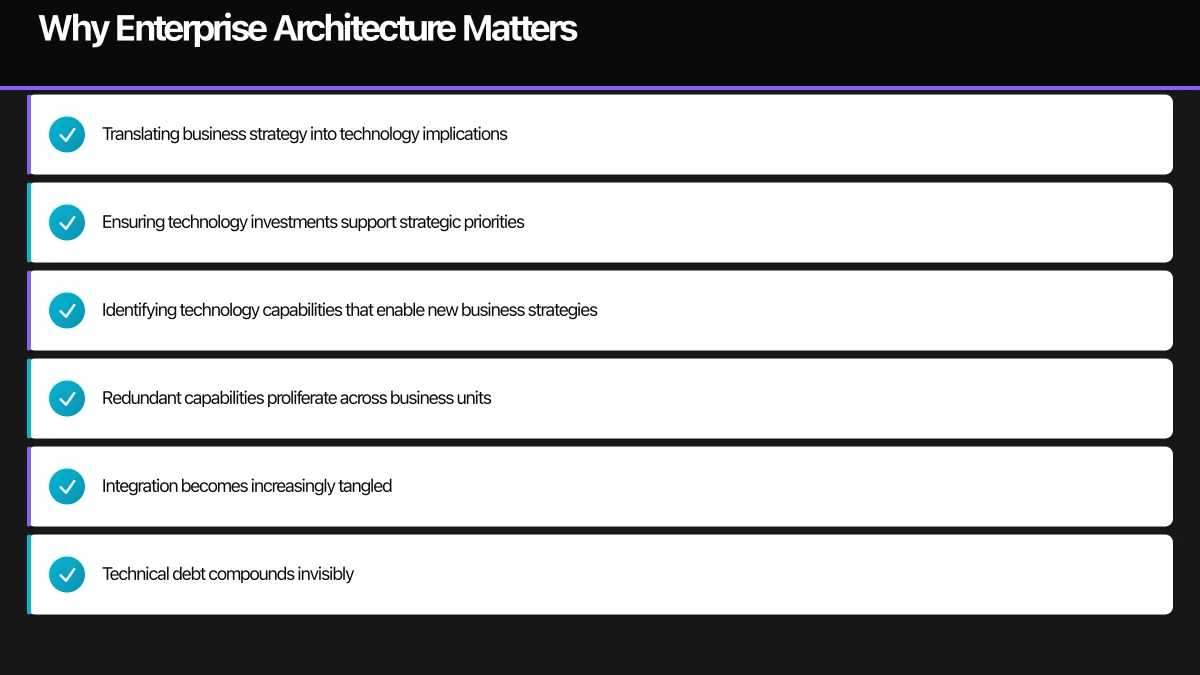
Why Enterprise Architecture Matters
Before examining frameworks, understanding the problems they address clarifies their value proposition.
Strategic Alignment
Large organizations struggle maintaining alignment between business strategy and technology investments. Business units pursue local optimization. Technology teams build what’s requested without broader context. The result is technology landscapes that don’t support strategic direction and business strategies constrained by legacy technology limitations.
Enterprise architecture provides mechanisms for:
- Translating business strategy into technology implications
- Ensuring technology investments support strategic priorities
- Identifying technology capabilities that enable new business strategies
Complexity Management
Enterprise technology estates accumulate complexity over decades. Without architectural oversight:
- Redundant capabilities proliferate across business units
- Integration becomes increasingly tangled
- Technical debt compounds invisibly
- Knowledge fragments across teams
Architecture discipline provides visibility into complexity and frameworks for managing it systematically.
Transformation Enablement
Digital transformation requires coordinated change across business and technology. Architecture defines:
- Target states to transform toward
- Migration paths from current to target state
- Dependencies and sequencing requirements
- Standards enabling interoperability
Without architectural vision, transformation becomes disconnected projects failing to achieve coherent outcomes.
The Framework Landscape
Multiple enterprise architecture frameworks have emerged over decades. Understanding the major options informs selection and adaptation.
TOGAF (The Open Group Architecture Framework)
TOGAF has become the dominant enterprise architecture framework, with over 150,000 certified practitioners globally.
Core Components:
Architecture Development Method (ADM): TOGAF’s process framework defines phases for architecture development:
- Preliminary Phase: Establishing architecture capability
- Phase A: Architecture Vision
- Phase B: Business Architecture
- Phase C: Information Systems Architecture (Data and Application)
- Phase D: Technology Architecture
- Phase E: Opportunities and Solutions
- Phase F: Migration Planning
- Phase G: Implementation Governance
- Phase H: Architecture Change Management
The ADM is explicitly iterative, with each phase potentially triggering returns to earlier phases as understanding deepens.
Architecture Content Framework: Defines deliverables, artifacts, and building blocks produced through the ADM.
Enterprise Continuum: Conceptual model for categorizing architecture assets from generic (industry-wide) to specific (organization-specific).
Architecture Repository: Organizing structure for architecture artifacts enabling reuse and governance.
TOGAF Strengths:
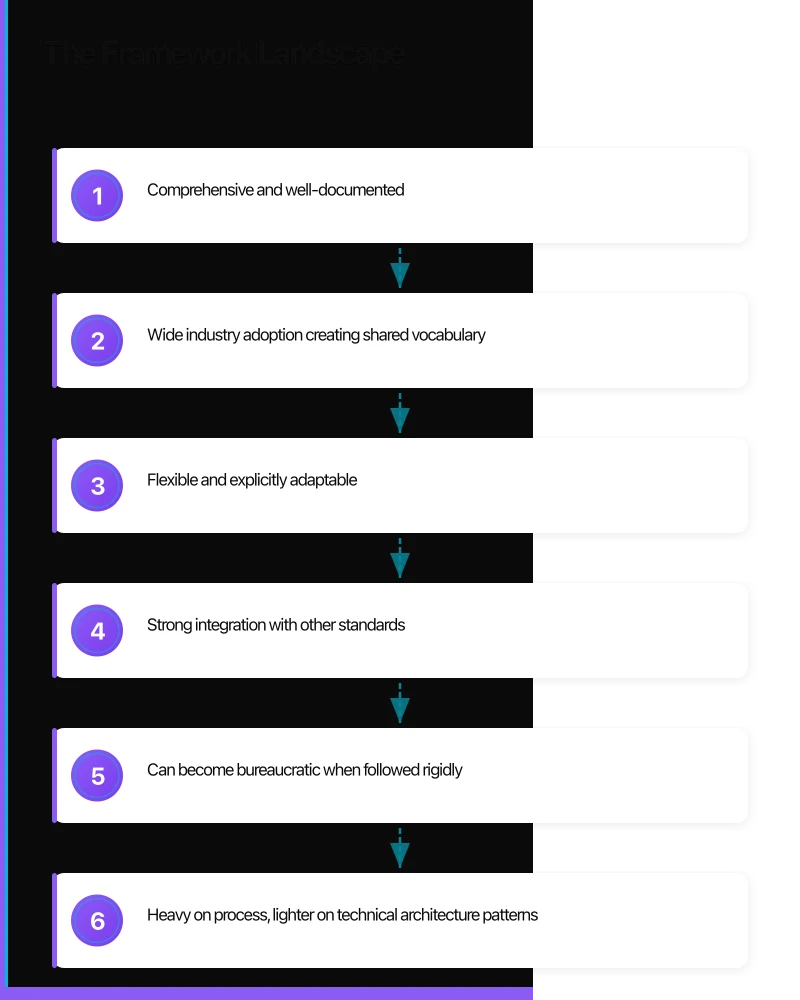
- Comprehensive and well-documented
- Wide industry adoption creating shared vocabulary
- Flexible and explicitly adaptable
- Strong integration with other standards
TOGAF Limitations:
- Can become bureaucratic when followed rigidly
- Heavy on process, lighter on technical architecture patterns
- Certification focus sometimes emphasizes knowledge over practical skill
- Full implementation requires significant organizational commitment
Zachman Framework
The Zachman Framework, originating in 1987, takes a fundamentally different approach: a classification scheme rather than a methodology.
The Framework Structure:
The Zachman Framework is a 6x6 matrix:
Rows (Perspectives):
- Scope (Planner): Contextual/boundary definitions
- Business Model (Owner): Conceptual/business requirements
- System Model (Designer): Logical/system specifications
- Technology Model (Builder): Physical/technology implementation
- Detailed Representation (Subcontractor): Component specifications
- Functioning System (User): Operational instances
Columns (Interrogatives):
- What (Data): Inventory/data models
- How (Function): Process/function models
- Where (Network): Distribution/location models
- Who (People): Organization/role models
- When (Time): Timing/scheduling models
- Why (Motivation): Strategy/motivation models
Each cell represents a specific type of architectural artifact from a specific perspective.
Zachman Strengths:
- Rigorous classification ensuring completeness
- Perspective-neutral: each stakeholder view has equal importance
- Technology-independent: applicable across eras
- Clarifies what architecture work produces
Zachman Limitations:
- Doesn’t prescribe process or methodology
- 36 cells can seem overwhelming
- Lacks guidance on prioritization and sequencing
- May encourage documentation for its own sake
FEAF (Federal Enterprise Architecture Framework)
Developed for US federal agencies, FEAF provides reference models for government-specific architecture.
Reference Models:
- Performance Reference Model (PRM)
- Business Reference Model (BRM)
- Data Reference Model (DRM)
- Application Reference Model (ARM)
- Infrastructure Reference Model (IRM)
- Security Reference Model (SRM)
FEAF’s standardized reference models enable comparison and interoperability across agencies. Its applicability outside government contexts is limited, though the reference model concept transfers.
DODAF (Department of Defense Architecture Framework)
DODAF addresses defense-specific requirements for complex systems of systems. Its rigor around interoperability, capability views, and operational scenarios influences architecture in defense-adjacent industries.
Gartner’s Enterprise Architecture Framework
Gartner promotes a more pragmatic, business-outcome-focused approach emphasizing:
- Business outcome orientation over documentation completeness
- Continuous architecture over big-design-up-front
- Enabling agility rather than constraining it
- Architecture as enabling function rather than control function
Gartner’s approach lacks the detailed methodology of TOGAF but provides principles more aligned with agile and digital-native organizations.
Practical Framework Selection
Framework selection should reflect organizational context rather than framework popularity.
Factors Influencing Selection
Organizational Size and Complexity: Large, complex organizations benefit from comprehensive frameworks. Smaller organizations may find lighter approaches sufficient.
Industry Context: Regulated industries often require formal architecture documentation. Government organizations may mandate specific frameworks. Industries without such requirements have more flexibility.
Existing Capabilities: Organizations with established architecture practices can adopt sophisticated frameworks. Organizations building architecture capability for the first time may start simpler.
Strategic Objectives: Transformation programs benefit from roadmap-oriented frameworks. Steady-state optimization may emphasize classification and governance.
Cultural Fit: Organizations valuing formality and process adopt comprehensive frameworks more readily. Agile-oriented cultures may resist heavyweight approaches.
Hybrid Approaches
Most organizations adopt hybrid approaches rather than pure framework implementations:
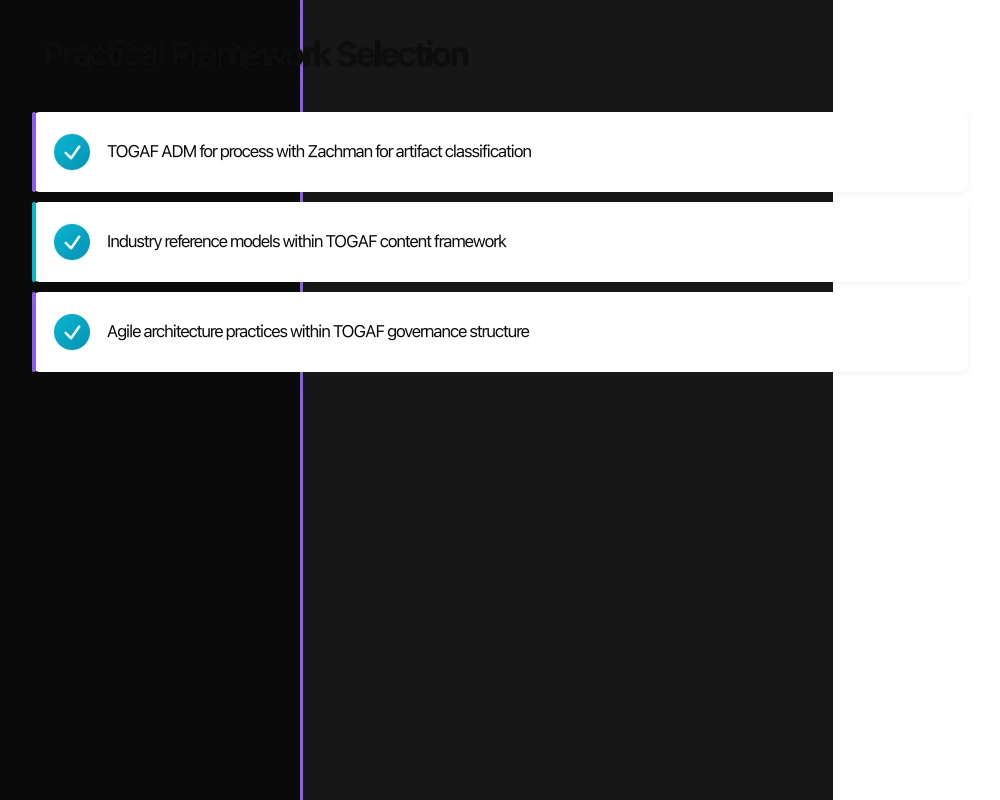
- TOGAF ADM for process with Zachman for artifact classification
- Industry reference models within TOGAF content framework
- Agile architecture practices within TOGAF governance structure
Framework authors explicitly encourage adaptation. TOGAF’s documentation emphasizes tailoring to organizational context.
Architecture Domains
Regardless of framework selection, enterprise architecture spans multiple domains requiring distinct expertise.
Business Architecture
Business architecture describes business strategy, governance, organization, and key business processes. It provides the “why” driving technology architecture decisions.
Key Artifacts:
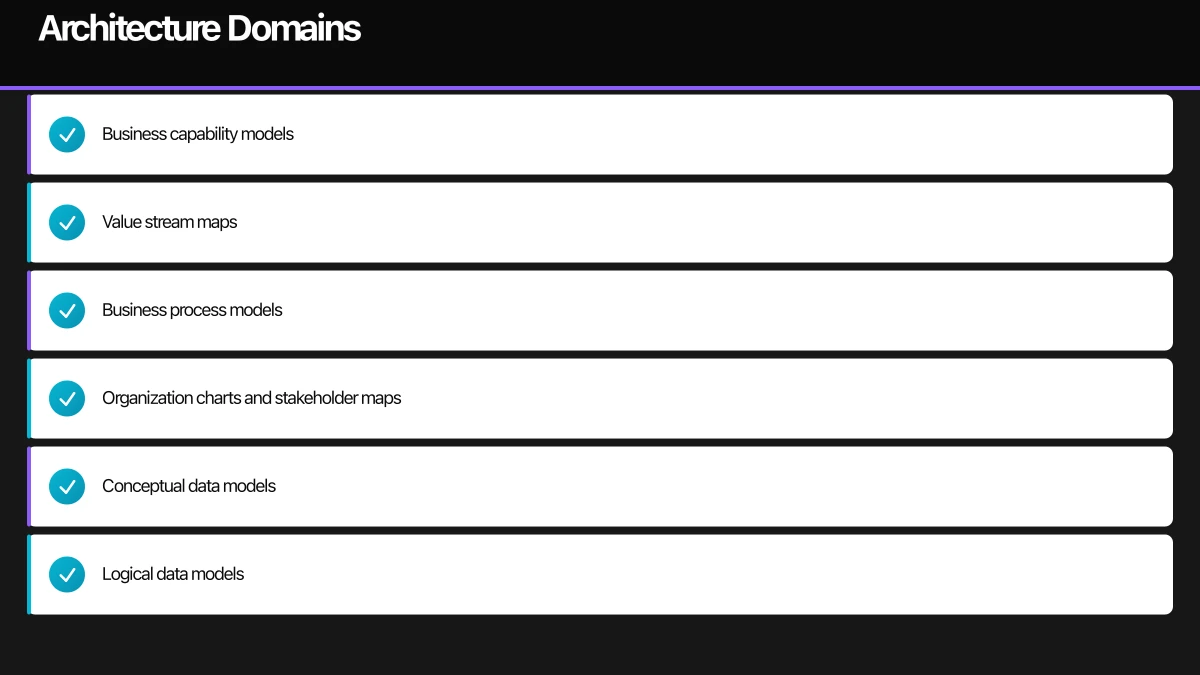
- Business capability models
- Value stream maps
- Business process models
- Organization charts and stakeholder maps
Business architecture connects technology decisions to business outcomes. Without it, technology architecture operates without strategic context.
Data Architecture
Data architecture describes the structure of logical and physical data assets and data management resources.
Key Artifacts:
- Conceptual data models
- Logical data models
- Data flow diagrams
- Data governance frameworks
In the AI era, data architecture has become increasingly strategic, with AI/ML initiatives depending critically on data quality, accessibility, and governance.
Application Architecture
Application architecture describes individual applications, their interactions, and their relationships to core business processes.
Key Artifacts:
- Application portfolios
- Application integration diagrams
- Interface specifications
- Application roadmaps
Application rationalization and modernization depend on clear application architecture visibility.
Technology Architecture
Technology architecture describes the logical software and hardware capabilities required to support business, data, and application services.
Key Artifacts:
- Infrastructure topology diagrams
- Technology standards
- Platform architectures
- Security architectures
Cloud migration and infrastructure modernization require sound technology architecture foundations.
Integration Architecture
Increasingly recognized as a distinct domain, integration architecture addresses how systems connect and communicate.
Key Artifacts:
- Integration patterns
- API specifications
- Event schemas
- Integration platform architecture
As organizations adopt microservices, APIs, and event-driven architectures, integration architecture complexity demands dedicated attention.
Architecture Governance
Frameworks provide structure; governance provides enforcement and evolution.
Governance Mechanisms
Architecture Review Boards: Forums for reviewing significant architectural decisions, ensuring alignment with standards and strategy.
Architecture Principles: Guiding statements informing decisions. Examples: “Buy before build,” “Cloud-first,” “API-enabled by default.”
Standards and Patterns: Specific technical standards and approved patterns guiding implementation.
Waivers and Exceptions: Processes for approved deviations from standards when justified by business needs.
Compliance Assessment: Mechanisms for evaluating adherence to architecture decisions.
Governance Balance
Governance must balance standardization benefits against agility costs:
Too Little Governance: Fragmentation, duplication, technical debt accumulation, strategic misalignment.
Too Much Governance: Slow delivery, innovation stifling, shadow IT proliferation, architect-developer antagonism.
Effective governance focuses on high-impact decisions while allowing appropriate autonomy for lower-impact choices.
Architecture in Agile Contexts
Traditional architecture practice emerged in waterfall contexts with big-design-up-front assumptions. Reconciling architecture with agile delivery requires adaptation.
Continuous Architecture
Rather than completing architecture before development begins, continuous architecture evolves alongside delivery:
- Architecture vision provides direction without detailed specification
- Just-in-time architecture decisions made when needed, not before
- Architecture emerges from delivered work, informed by guiding principles
- Feedback loops incorporate learning into architecture evolution
Architectural Runway
The SAFe concept of architectural runway describes infrastructure and enablers ready to support near-term feature development. Architecture work stays ahead of feature delivery, providing the foundations needed without specifying features themselves.
Architecture Enabling Teams
Team Topologies describes architecture teams as enabling teams: providing expertise, guidance, and platforms that empower delivery teams rather than constraining them.
Fitness Functions
Evolutionary architecture uses fitness functions: automated assessments verifying architectural characteristics remain within acceptable bounds as systems evolve. This enables architectural governance without manual approval bottlenecks.
Common Anti-Patterns
Recognizing anti-patterns helps avoid common architecture practice failures.
Ivory Tower Architecture
Architects isolated from delivery teams, producing documents that don’t reflect reality or influence implementation. Architecture becomes theoretical rather than practical.
Mitigation: Embed architects with delivery teams. Ensure architecture artifacts emerge from and influence actual development.
Analysis Paralysis
Endless architecture analysis delaying delivery while pursuing completeness. Perfect architecture understanding never arrives; value comes from building.
Mitigation: Time-box architecture work. Accept uncertainty. Make decisions with available information and adjust based on learning.
Framework Worship
Following framework prescriptions regardless of organizational fit. Producing artifacts because the framework defines them rather than because they provide value.
Mitigation: Treat frameworks as toolboxes, not prescriptions. Adopt what helps; adapt or ignore what doesn’t.
PowerPoint Architecture
Beautiful diagrams disconnected from implementation reality. Architecture artifacts that don’t influence development or reflect actual systems.
Mitigation: Validate architecture against implementation. Generate diagrams from code where possible. Close feedback loops between architecture and delivery.
Big Bang Architecture
Attempting to define complete target architecture before starting. Underestimating change during implementation. Architecture becomes outdated before delivery completes.
Mitigation: Iterative architecture development. Smaller architectural increments. Regular architecture refresh cycles.
Building Architecture Capability
For organizations establishing or improving architecture practice:
Capability Assessment
Evaluate current state:
- What architecture artifacts exist?
- How is architecture governance performed?
- How do architects engage with delivery?
- What skills exist in the architecture team?
- How is architecture perceived by stakeholders?
Maturity Progression
Architecture capability matures through stages:
Initial: Ad-hoc architecture work, project-focused, inconsistent practices.
Managed: Defined architecture processes, governance structures, artifact standards.
Defined: Consistent practices across the organization, architecture repository, reusable assets.
Quantitatively Managed: Architecture effectiveness measured, data-driven improvement.
Optimizing: Continuous improvement, architecture enabling innovation.
Organizations should progress gradually rather than attempting immediate sophistication.
Skill Development
Architecture requires diverse skills:
- Technical depth in relevant domains
- Business acumen and strategic thinking
- Communication and stakeholder management
- Analysis and problem-solving
- Change leadership
Developing these skills takes years. Organizations must invest in architect development rather than expecting instant capability.
Measuring Architecture Value
Demonstrating architecture value justifies continued investment.
Leading Indicators
Standards Adoption: Percentage of projects adhering to architecture standards.
Technical Debt Trends: Is technical debt increasing or decreasing?
Architecture Artifact Currency: Are architecture artifacts current and accurate?
Stakeholder Satisfaction: Do stakeholders find architecture work valuable?
Lagging Indicators
Delivery Velocity: Are projects delivering faster with architectural foundations?
Integration Effort: Is system integration becoming easier or harder?
Change Impact: How extensive are changes required for new requirements?
Incident Reduction: Are architecture-related incidents decreasing?
Business Outcome Attribution
Ultimately, architecture enables business outcomes:
- Faster time-to-market for new capabilities
- Lower total cost of ownership
- Improved agility responding to change
- Reduced risk from technology decisions
Attributing specific business outcomes to architecture work is challenging but essential for demonstrating value.
The Path Forward
Enterprise architecture practice continues evolving:
AI-Assisted Architecture: Large language models increasingly assist architecture work: generating diagrams, analyzing codebases, suggesting patterns. Architects leverage AI while providing judgment AI cannot.
Architecture as Code: Defining architecture in machine-readable formats enabling automated validation, generation, and enforcement.
Platform Engineering: Architecture enabling through internal developer platforms rather than document-based standards.
Composable Architecture: Modular, interchangeable business capabilities enabling rapid reconfiguration.
For CTOs, architecture frameworks provide valuable structure while demanding pragmatic adaptation. The goal is not framework compliance but business-technology alignment enabling strategic success.
References and Further Reading
- The Open Group. (2022). “TOGAF Standard, 10th Edition.” The Open Group.
- Zachman, J. (2008). “The Concise Definition of the Zachman Framework.” Zachman International.
- Ford, N., Parsons, R., & Kua, P. (2017). “Building Evolutionary Architectures.” O’Reilly Media.
- Skelton, M., & Pais, M. (2019). “Team Topologies.” IT Revolution Press.
- Richards, M., & Ford, N. (2020). “Fundamentals of Software Architecture.” O’Reilly Media.
- Gartner. (2025). “Enterprise Architecture Trends and Best Practices.” Gartner Research.
If this strategic perspective has you thinking about your online presence, Cosmos Web Tech provides actionable web design and SEO guidance.
These insights are drawn from my work leading Ganda Tech Services — helping Australian businesses navigate digital transformation through cloud, web, and mobile.
About the Author
Ashish Ganda is the founder of Ganda Tech Services, a Sydney-based technology consultancy specialising in cloud infrastructure, web development, and mobile app solutions for Australian businesses.
Digital Transformation Roadmap 2026
A 12-month framework for Australian SMBs ready to modernise — phases, tools, and milestones.
Almost done
Check your inbox and click the confirmation link to get your download.