Enterprise Architecture Modernisation: From Legacy Constraints to Strategic Agility
Introduction
Every enterprise of sufficient age carries architectural baggage. Systems built for yesterday’s requirements struggle with today’s demands. Technologies that were cutting-edge a decade ago are now maintenance burdens. Integration patterns that made sense for batch processing fail in a real-time world.
The temptation is the grand rewrite—replace everything with modern architecture. History is littered with failed rewrites that consumed years and budgets without delivering value. The alternative—living with legacy forever—eventually makes the business uncompetitive.
The answer lies in strategic modernisation: deliberate, incremental transformation that delivers value continuously while progressively building toward a better future state.
The Modernisation Imperative
Why Now
Several forces are accelerating modernisation urgency:
Digital Business Requirements
Customers expect:
- Real-time interactions
- Seamless omnichannel experiences
- Personalisation at scale
- Always-available services
Legacy architectures struggle to deliver these capabilities.
Talent Challenges
Engineers increasingly refuse to work with:
- Obsolete technologies
- Poor development experiences
- Slow, risky deployments
- Systems they can’t understand
The best talent goes elsewhere.
Cost Pressures
Legacy systems often have:
- Expensive maintenance contracts
- Scarce, expensive expertise
- Inefficient resource utilisation
- Hidden costs in workarounds
Modernisation can reduce ongoing costs.
Security and Compliance
Older systems frequently have:
- Unpatched vulnerabilities
- Inadequate audit capabilities
- Compliance gaps
- Security architectures that pre-date modern threats
Risk exposure grows over time.
The Danger of Inaction
Doing nothing has costs:
- Competitors move faster
- Technical debt compounds
- Talent leaves
- Security risks accumulate
- Integration becomes harder
- Innovation capacity shrinks
The question isn’t whether to modernise, but how and when.
Modernisation Patterns
The Big Rewrite (Usually Avoid)
The Pattern
Replace the entire system with a new implementation.
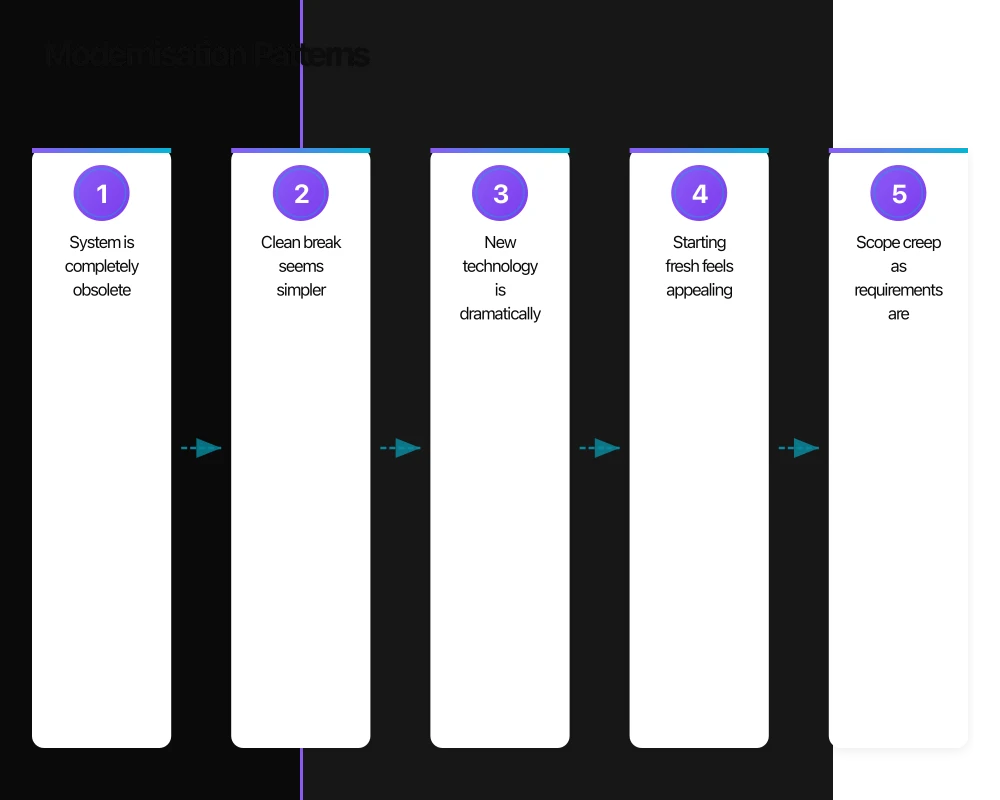
When Attempted
- System is completely obsolete
- Clean break seems simpler
- New technology is dramatically better
- Starting fresh feels appealing
Why It Usually Fails
- Scope creep as requirements are re-discovered
- Business can’t wait for completion
- Second system effect (over-engineering)
- Knowledge loss from original system
- Risk concentrated in single cutover
When It Might Work
- Very small, isolated systems
- Complete business model change
- Acquisition scenarios with replacement mandate
- Truly unsalvageable systems
Proceed with extreme caution.
Strangler Fig Pattern
The Pattern
Incrementally replace components while the old system continues running. New functionality goes to new system. Old functionality migrates gradually.
- Identify component boundaries
- Build new implementation for one component
- Route traffic to new component
- Repeat for next component
- Eventually, old system is empty
Advantages
- Continuous value delivery
- Reduced risk per change
- Learning incorporated along the way
- Rollback possible at each step
- Business continuity maintained
Challenges
- Requires clean component boundaries
- Integration between old and new adds complexity
- Discipline needed to complete migration
- Temptation to stop mid-way
This is often the right approach for significant systems.
Encapsulation Pattern
The Pattern
Wrap legacy system with modern interfaces. Hide complexity behind APIs or facades.
How It Works
- Define clean interface for legacy capabilities
- Build API layer in front of legacy
- New consumers use API, not legacy directly
- Legacy becomes implementation detail
- Optionally replace implementation later
Advantages
- Minimal changes to legacy system
- New capabilities can be added at API layer
- Decouples consumers from implementation
- Enables future replacement
Challenges
- Legacy limitations still exist
- API layer adds latency
- Mapping can be complex
- Doesn’t address legacy maintenance
Good for buying time and creating flexibility.
Parallel Running
The Pattern
Run new and old systems simultaneously. Compare results. Gradually shift traffic.
How It Works
- Build new implementation
- Run both systems on same inputs
- Compare outputs for correctness
- Gradually shift production traffic
- Decommission old system
Advantages
- High confidence in correctness
- Smooth transition
- Immediate rollback capability
- Performance comparison possible
Challenges
- Running two systems is expensive
- Comparison logic can be complex
- Data synchronisation challenges
- Extended transition period
Good for high-risk, high-value systems.
Planning Modernisation
Assessment
Before modernising, understand what you have:
Application Portfolio
Inventory all applications:
- Business capability supported
- Technology stack
- Age and health
- Maintenance cost
- Strategic importance
Dependencies
Map relationships:
- What integrates with what
- Data flows between systems
- Shared components
- External dependencies
Business Value
Assess importance:
- Revenue dependency
- Operational criticality
- Regulatory requirements
- Customer impact
Prioritisation
Not everything needs modernisation. Prioritise based on:
Strategic Value
Focus modernisation on systems that:
- Enable competitive advantage
- Support growth initiatives
- Require frequent changes
- Face capability gaps
Risk
Address systems with:
- Security vulnerabilities
- Compliance gaps
- Stability issues
- Single points of failure
Cost
Consider systems with:
- High maintenance costs
- Expensive licensing
- Scarce skills required
- Inefficient operations
Target Architecture
Define where you’re heading:
Architecture Principles
Establish guiding principles:
- API-first design
- Cloud-native where appropriate
- Loosely coupled components
- Data as a product
- Security by design
Reference Patterns
Define standard approaches:
- How services communicate
- How data is managed
- How security is implemented
- How operations work
Technology Standards
Specify approved technologies:
- Languages and frameworks
- Data stores
- Integration patterns
- Infrastructure platforms
Roadmap
Plan the journey:
Phases
Break into manageable phases:
- Foundation (platforms, standards, skills)
- Quick wins (low-risk, high-value)
- Core transformation (major systems)
- Completion (remaining systems, decommissioning)
Dependencies
Sequence based on:
- Technical dependencies
- Business priorities
- Resource availability
- Risk tolerance
Milestones
Define measurable checkpoints:
- Capabilities delivered
- Systems migrated
- Costs reduced
- Risks mitigated
Execution Considerations
Team Structure
Dedicated Modernisation Teams
Pros:
- Focused attention
- Specialised skills
- Faster progress
Cons:
- Knowledge silos
- Handoff to operations
- Disconnected from business
Embedded in Product Teams
Pros:
- Business context
- Continuous ownership
- Balanced priorities
Cons:
- Slower progress
- Competing priorities
- Skill gaps
Hybrid Approach
Often best:
- Platform team for shared infrastructure
- Product teams for application modernisation
- Architecture guidance from centre
- Flexible resource allocation
Managing Risk
Incremental Delivery
Never go long periods without delivering value:
- Frequent releases
- Feature flags for incomplete work
- Canary deployments
- Immediate feedback
Comprehensive Testing
Ensure quality at every step:
- Automated regression testing
- Performance testing
- Security testing
- Chaos engineering
Rollback Capability
Always have an exit:
- Database migration reversibility
- Traffic routing controls
- Data synchronisation
- Documented rollback procedures
Monitoring
Know what’s happening:
- Business metrics comparison
- Technical health indicators
- User experience metrics
- Anomaly detection
Data Migration
Data is often the hardest part:
Data Quality
Legacy data often has issues:
- Inconsistencies
- Missing values
- Invalid formats
- Duplicate records
Clean during migration or accept carrying problems forward.
Data Mapping
Schema evolution requires:
- Field mapping between old and new
- Transformation logic
- Default handling
- Validation rules
Migration Strategies
Options include:
- Big bang migration (risky)
- Trickle migration (complex sync)
- Dual-write during transition
- Event sourcing for audit
Testing Data
Verify thoroughly:
- Row counts match
- Key fields verified
- Business rules validated
- Edge cases tested
Organisational Change
Modernisation is a people challenge:
Skills Development
Teams need new capabilities:
- Modern technologies
- Cloud platforms
- DevOps practices
- Architecture patterns
Invest in training and learning time.
Change Management
People resist change:
- Communicate the why
- Involve teams in decisions
- Address concerns honestly
- Celebrate progress
Knowledge Transfer
Legacy knowledge must transfer:
- Documentation before decommissioning
- Pairing on migration work
- Capture business rules
- Record decisions and rationale
Common Failure Modes
Scope Creep
Starting to “also improve” other things. Modernisation becomes transformation becomes rewrite.
Prevention:
- Clear scope boundaries
- Separate backlogs for improvements
- Discipline to defer
- Regular scope review
Incomplete Migration
Getting 80% done then moving on. Old and new systems both running, neither well.
Prevention:
- Decommissioning as explicit milestone
- Tracked to completion
- Incentives aligned
- Resources maintained until done
Over-Engineering
Building for imagined future requirements. Creating complexity that isn’t needed.
Prevention:
- YAGNI principle (You Aren’t Gonna Need It)
- Iterative design
- Real requirements only
- Architecture review
Underestimating Integration
Assuming integration is simple. Discovering complex dependencies late.
Prevention:
- Thorough dependency mapping
- Integration testing early
- Experts on legacy systems involved
- Time buffer for surprises
Measuring Success
Technical Metrics
- Deployment frequency improvement
- Lead time reduction
- Defect rates
- System availability
- Performance improvements
Business Metrics
- Time to market for features
- Operational cost reduction
- Revenue enabled
- Customer satisfaction
Risk Metrics
- Security vulnerability reduction
- Compliance gap closure
- Single point of failure elimination
- Disaster recovery capability
Organisational Metrics
- Developer satisfaction
- Talent retention
- Skills development
- Knowledge documentation
Conclusion
Enterprise architecture modernisation is a journey, not a destination. The goal isn’t a perfect architecture—it’s sustainable evolution that enables business agility while managing risk.
Avoid the extremes: the risky big rewrite and the comfortable do-nothing. Instead, pursue deliberate, incremental transformation that delivers value continuously.
Start with clear understanding of current state. Prioritise based on business value and risk. Execute with discipline and risk management. Measure progress against meaningful outcomes.
The organisations that master continuous modernisation build lasting competitive advantage. Those that don’t eventually face crisis-driven transformation under much worse conditions.
Sources
- Ford, N., Parsons, R., & Kua, P. (2017). Building Evolutionary Architectures. O’Reilly Media.
- Newman, S. (2019). Monolith to Microservices. O’Reilly Media.
- Richards, M., & Ford, N. (2020). Fundamentals of Software Architecture. O’Reilly Media.
- Fowler, M. (2004). Strangler Fig Application. martinfowler.com.
Strategic guidance for technology leaders navigating enterprise transformation.
The strategic frameworks I discuss here come to life through execution. Cloud Geeks covers the practical side of cloud infrastructure and IT management.
As founder of Ganda Tech Services, I work with Australian businesses to align technology investments with business growth — across cloud, web, and mobile.
About the Author
Ashish Ganda is the founder of Ganda Tech Services, a Sydney-based technology consultancy specialising in cloud infrastructure, web development, and mobile app solutions for Australian businesses.
Tech Stack Selection Guide 2026
Choose the right tools for your Australian business — without the vendor hype or overlapping spend.
Almost done
Check your inbox and click the confirmation link to get your download.