Google Cloud Vertex AI: Multimodal Capabilities for Enterprise Applications
Introduction
Google’s Vertex AI platform has evolved into one of the most comprehensive enterprise AI offerings available, particularly with the integration of Gemini models. What distinguishes Vertex AI in the current landscape is its native multimodal capabilities—the ability to process and reason across text, images, video, and code within unified models.
For enterprises, this multimodal capability opens application categories that were previously either impossible or required complex orchestration of multiple specialised models.
The Multimodal Advantage
Understanding Multimodal AI
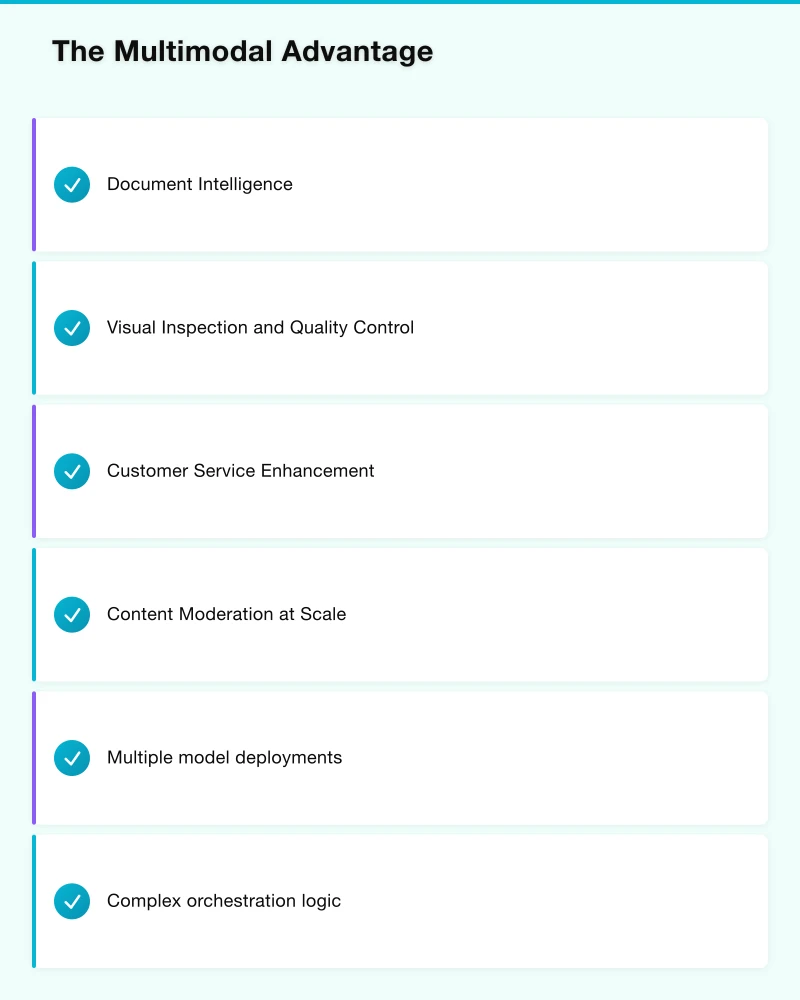
Traditional AI models process single modalities: text models handle text, image models handle images, video models handle video. Building applications that understand multiple formats required:
- Multiple model deployments
- Complex orchestration logic
- Translation layers between modalities
- Accumulated latency and errors
Gemini models process multiple modalities natively. A single model can:
- Analyse an image and answer questions about it in natural language
- Process a video and extract insights or generate summaries
- Understand diagrams, charts, and documents with mixed content
- Reason across combinations of text, images, and structured data
This native multimodality simplifies architecture and enables new application patterns.
Enterprise Use Cases Enabled
Document Intelligence
Enterprise documents rarely contain only text. Reports include charts. Manuals include diagrams. Contracts include signatures and stamps. Invoices combine structured data with scanned images.
Multimodal AI can:
- Extract information from documents regardless of format
- Understand relationships between text and visual elements
- Process handwritten annotations alongside printed text
- Analyse charts and graphs alongside textual analysis
Visual Inspection and Quality Control
Manufacturing and logistics organisations can deploy AI that:
- Identifies defects by analysing product images
- Compares items against specification documents
- Generates natural language reports from visual inspection
- Learns from combined image and text feedback
Customer Service Enhancement
Support interactions often involve screenshots, photos of problems, or video demonstrations. Multimodal AI enables:
- Understanding customer-submitted images alongside text descriptions
- Providing visual guidance with annotated instructions
- Analysing video recordings of issues
- Generating documentation from visual and textual inputs
Content Moderation at Scale
Platforms with user-generated content need to moderate text, images, and video together. Multimodal capabilities allow:
- Understanding context across content types
- Identifying policy violations that span modalities
- Reducing false positives through comprehensive understanding
- Scaling moderation without proportional human review increases
Vertex AI Platform Capabilities
Model Garden
Vertex AI’s Model Garden provides access to:
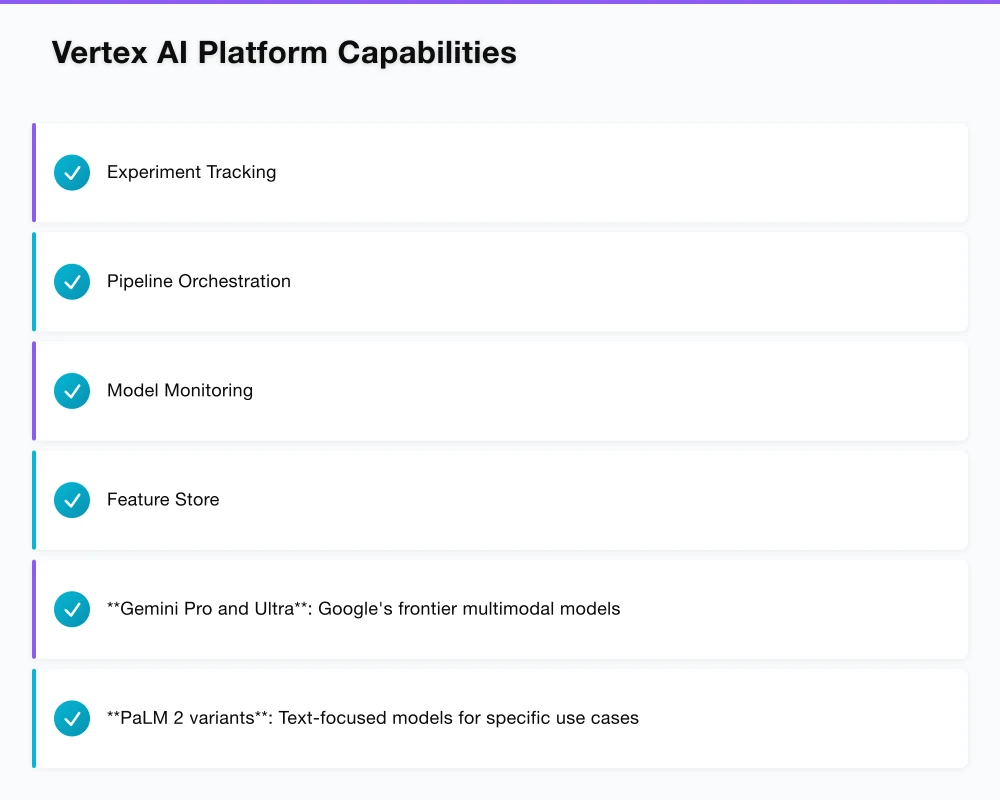
- Gemini Pro and Ultra: Google’s frontier multimodal models
- PaLM 2 variants: Text-focused models for specific use cases
- Imagen: Image generation capabilities
- Codey: Code generation and understanding
- Chirp: Speech-to-text capabilities
- Third-party models: Access to models from partners
This model diversity allows enterprises to select optimal models for specific tasks while maintaining unified infrastructure.
Managed Infrastructure
Like competing offerings, Vertex AI abstracts infrastructure complexity:
- Automatic scaling based on demand
- Regional deployment options for latency and compliance
- Integrated security and access controls
- No GPU cluster management required
The operational simplicity enables teams to focus on application development rather than infrastructure operations.
MLOps Integration
Vertex AI provides comprehensive MLOps capabilities for production AI:
Experiment Tracking
- Version prompts and compare results
- Track model performance across iterations
- Manage A/B testing of different approaches
Pipeline Orchestration
- Build complex AI workflows
- Schedule and automate processing
- Handle dependencies between steps
Model Monitoring
- Track model performance in production
- Detect drift and degradation
- Alert on quality issues
Feature Store
- Centralised feature management
- Consistent features across training and serving
- Feature versioning and lineage
Implementation Architecture
Foundation Pattern
Build a foundation that supports multimodal applications:
[Client Applications]
        ↓
[API Gateway / Load Balancer]
        ↓
[Application Services Layer]
    ├── Request Processing
    ├── Content Preparation
    ├── Response Formatting
    └── Caching
        ↓
[Vertex AI Integration Layer]
    ├── Model Selection Logic
    ├── Prompt Management
    ├── Rate Limiting
    └── Error Handling
        ↓
[Vertex AI APIs]
    ├── Gemini Pro/Ultra
    ├── Imagen
    └── Specialised Models
Content Processing Pipeline
Multimodal applications require robust content handling:
Input Processing
- Validate and sanitise incoming content
- Convert formats as needed (image resizing, video transcoding)
- Extract metadata for processing decisions
- Apply content filtering before model calls
Model Invocation
- Select appropriate model based on content type and task
- Construct prompts with proper multimodal formatting
- Handle streaming responses where appropriate
- Implement retry logic for transient failures
Output Processing
- Validate model outputs against business rules
- Format responses for client consumption
- Cache results where appropriate
- Log for monitoring and improvement
Security Implementation
Authentication and Authorisation
Vertex AI integrates with Google Cloud IAM:
- Service accounts for application authentication
- IAM roles for access control
- VPC Service Controls for network isolation
- Customer-managed encryption keys
Data Protection
Configure for enterprise data requirements:
- Data residency through regional deployment
- Encryption in transit and at rest
- Audit logging for compliance
- Data retention policies aligned with requirements
Cost Optimisation
Pricing Structure
Vertex AI pricing varies by model and input type:
Gemini Pro
- Text input: ~$0.00025 per 1K characters
- Image input: ~$0.0025 per image
- Video input: ~$0.002 per second
Gemini Ultra (where available)
- Higher pricing for more capable model
- Reserved for complex tasks requiring maximum capability
Optimisation Strategies
Input Optimisation
Multimodal inputs can be expensive. Optimise by:
- Resizing images to minimum required resolution
- Trimming videos to relevant segments
- Compressing content where quality permits
- Batching multiple items in single requests where supported
Model Selection
Not every task needs the most capable model:
- Use Gemini Pro for most applications
- Reserve Ultra for tasks requiring maximum reasoning
- Consider specialised models for single-modality tasks
- Build routing logic based on task complexity
Caching and Reuse
Multimodal processing results are often reusable:
- Cache analysis results for repeated content
- Store extracted features for downstream use
- Implement semantic caching for similar queries
- Pre-process static content during off-peak hours
Batch Processing
For non-real-time workloads:
- Accumulate requests for batch processing
- Take advantage of batch pricing where available
- Schedule processing during lower-cost periods
- Optimise throughput over latency
Building Multimodal Applications
Document Analysis Application
A practical example: intelligent document processing.
Requirements
- Accept documents in various formats (PDF, images, scanned)
- Extract key information regardless of format
- Answer questions about document content
- Generate summaries and insights
Architecture
-
Document Ingestion
- Convert PDFs to images
- Apply OCR where needed for searchability
- Store original and processed versions
-
Initial Analysis
- Send document pages to Gemini for understanding
- Extract document type, structure, key elements
- Store analysis results for fast retrieval
-
Query Interface
- Accept natural language questions
- Retrieve relevant document sections
- Combine text and images in Gemini queries
- Return answers with source references
-
Summary Generation
- Generate executive summaries on demand
- Create structured extracts (dates, amounts, parties)
- Produce comparison analyses across documents
Key Considerations
- Handle documents of varying quality
- Implement confidence scoring for extractions
- Provide human review workflows for low-confidence results
- Build feedback loops for continuous improvement
Visual Quality Inspection
Manufacturing quality control application:
Requirements
- Inspect products on production line
- Compare against specifications
- Identify defects and categorise severity
- Generate reports for quality management
Architecture
-
Image Capture Integration
- Connect to production line cameras
- Capture images at specified intervals
- Ensure consistent lighting and positioning
-
Specification Management
- Store reference images and specifications
- Version control for specification changes
- Link specifications to product variants
-
Inspection Processing
- Send product images with relevant specifications
- Request defect identification and classification
- Compare against reference standards
- Generate pass/fail decisions with explanations
-
Reporting and Analytics
- Track defect rates over time
- Identify patterns in quality issues
- Generate shift and line reports
- Feed insights to process improvement
Organisational Considerations
Skills Required
Successful Vertex AI deployment requires:
Google Cloud Platform Expertise
- GCP networking and security
- IAM and access management
- Monitoring and operations
- Cost management
AI/ML Knowledge
- Prompt engineering for multimodal inputs
- Understanding model capabilities and limitations
- Evaluation methodology for AI systems
- Responsible AI practices
Application Development
- Building production AI applications
- Handling AI uncertainty in applications
- Designing human-in-the-loop workflows
- Performance optimisation
Governance Framework
Establish governance appropriate for multimodal AI:
Content Policies
- What content types can be processed
- Handling of sensitive or personal data
- Retention and deletion requirements
- Compliance with relevant regulations
Quality Standards
- Accuracy requirements for different use cases
- Confidence thresholds for automated decisions
- Review processes for edge cases
- Continuous monitoring and improvement
Risk Management
- Identify risks specific to multimodal AI
- Implement appropriate mitigations
- Establish incident response procedures
- Regular review and updates
Conclusion
Google Cloud’s Vertex AI, particularly with Gemini multimodal capabilities, offers enterprises powerful tools for building applications that understand and process diverse content types. The platform’s combination of frontier model capabilities, enterprise infrastructure, and comprehensive MLOps support creates a foundation for serious AI deployment.
Success requires:
- Clear understanding of multimodal capabilities and limitations
- Architecture designed for the unique requirements of multimodal processing
- Active cost management given the expense of multimodal inputs
- Appropriate governance for AI systems processing diverse content
The organisations that master multimodal AI will unlock application categories impossible with text-only models—from intelligent document processing to visual quality control to comprehensive content understanding.
Sources
- Google Cloud. (2024). Vertex AI Documentation. Google Cloud. https://cloud.google.com/vertex-ai/docs
- Google DeepMind. (2024). Gemini: A Family of Highly Capable Multimodal Models. Google DeepMind. https://deepmind.google/technologies/gemini/
- Google Cloud. (2024). Vertex AI Pricing. Google Cloud. https://cloud.google.com/vertex-ai/pricing
- Google Cloud. (2024). Responsible AI Practices. Google Cloud. https://cloud.google.com/responsible-ai
- Gartner. (2024). Competitive Landscape: Cloud AI Developer Services. Gartner Research. https://www.gartner.com/en/documents/cloud-ai-developer-services
Strategic guidance for enterprises building AI capabilities on cloud platforms.
Turning strategy into infrastructure? Cloud Geeks covers managed cloud, DevOps, and IT security for businesses putting digital plans into action.
Ash Ganda is the founder of Ganda Tech Services, a Sydney-based technology consultancy delivering cloud, web, and mobile solutions for Australian businesses.
About the Author
Ashish Ganda is the founder of Ganda Tech Services, a Sydney-based technology consultancy specialising in cloud infrastructure, web development, and mobile app solutions for Australian businesses.
AI Strategy Primer for Australian Business Leaders
A practical framework for AI adoption in 2026 — cut through the hype and start with what matters.