Enterprise Cloud Migration: Strategic Approaches to Modernization in 2025
The Modernization Imperative
Cloud migration has evolved from a technology initiative to a business transformation. The organizations still debating whether to move to cloud are increasingly rare—according to Flexera’s 2025 State of the Cloud Report, 95% of enterprises have adopted cloud in some form. The question now is not if but how: how to migrate remaining workloads, how to modernize applications for cloud-native operations, and how to extract maximum value from cloud investments.
Yet migration results vary dramatically. McKinsey’s 2024 cloud value research found that while cloud leaders achieve 20-30% productivity improvements and 10-15% cost reductions, the average enterprise realizes less than half the anticipated benefits. The difference lies not in technology selection but in strategy, execution, and organizational transformation.
This analysis provides a strategic framework for CTOs leading cloud migration and modernization initiatives in 2025, drawing on patterns from successful transformations and lessons from those that struggled.
Understanding Your Starting Point
The Application Portfolio Reality
Every enterprise application portfolio contains:
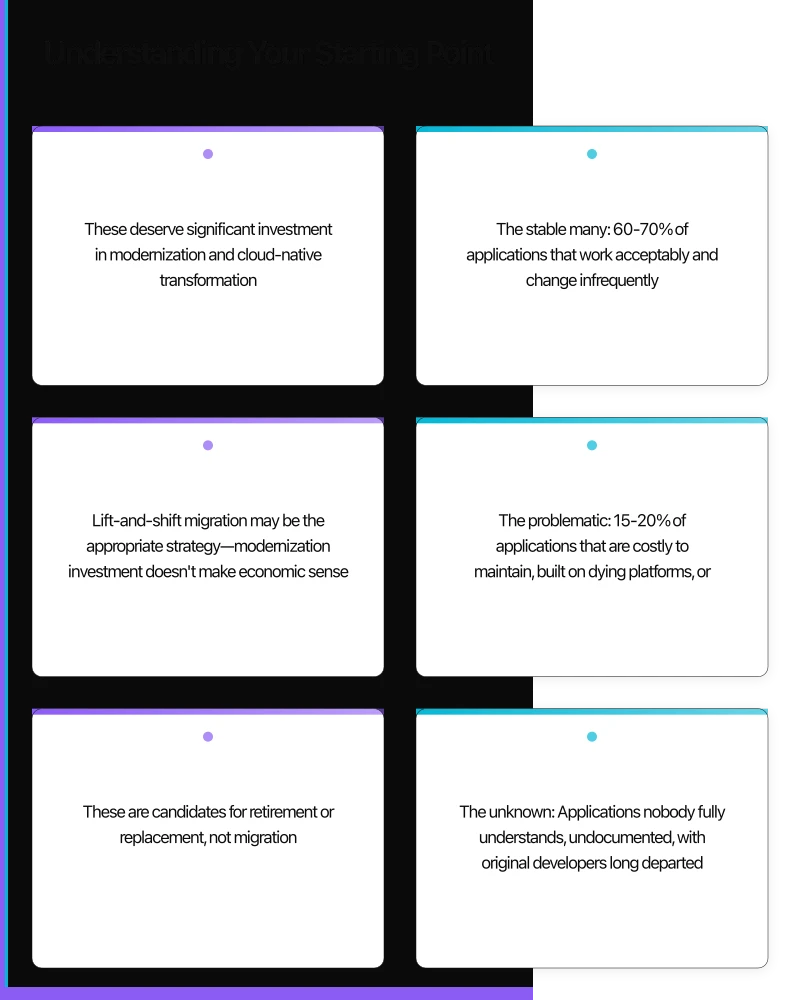
The critical few: 10-15% of applications that drive the majority of business value. These deserve significant investment in modernization and cloud-native transformation.
The stable many: 60-70% of applications that work acceptably and change infrequently. Lift-and-shift migration may be the appropriate strategy—modernization investment doesn’t make economic sense.
The problematic: 15-20% of applications that are costly to maintain, built on dying platforms, or no longer aligned with business needs. These are candidates for retirement or replacement, not migration.
The unknown: Applications nobody fully understands, undocumented, with original developers long departed. These require discovery before any migration decision.
Effective migration strategy begins with honest portfolio assessment. Organizations that skip this step—attempting to modernize everything or migrating without understanding what they have—waste resources and extend timelines.
Technical Debt Accounting
Cloud migration exposes technical debt that on-premises operations can obscure. Before migration, assess:
Architectural debt: Monolithic applications, tight coupling, hard-coded configurations, state stored in local filesystems.
Operational debt: Manual deployment processes, absent monitoring, undocumented runbooks, missing disaster recovery.
Security debt: Outdated dependencies, exposed credentials, missing encryption, inadequate access controls.
Data debt: Inconsistent schemas, missing documentation, unclear ownership, questionable quality.
This assessment informs modernization scope and migration sequencing. Some debt must be addressed before migration; some can be addressed during; some can wait until after.
The Migration Strategy Framework
The 7 Rs of Migration
AWS popularized the “6 Rs” framework; the industry has since expanded it. Each application should be assigned a strategy:
Retain: Keep on-premises. Valid for applications with hard regulatory requirements, those near retirement, or those where migration ROI doesn’t justify investment.
Retire: Decommission. Applications no longer needed or replaceable by existing cloud services.
Rehost (Lift-and-Shift): Move to cloud VMs with minimal changes. Fast migration, minimal immediate benefit, but establishes cloud foundation for future optimization.
Relocate: Move to cloud with hypervisor-level migration (VMware Cloud on AWS, Azure VMware Solution). Useful for VMware estates with significant investment.
Replatform (Lift-and-Reshape): Minor changes to leverage cloud services—managed databases instead of self-managed, managed containers instead of raw VMs.
Repurchase: Replace with SaaS. CRM to Salesforce, email to Microsoft 365, HR to Workday. Often the right answer for commodity functions.
Refactor/Re-architect: Redesign for cloud-native. Microservices, serverless, managed services. Highest investment, highest potential benefit.
Strategy Selection Matrix
Match strategy to application characteristics:
| Characteristic | Suggested Strategy |
|---|---|
| High business value, high change rate | Refactor |
| High business value, low change rate | Replatform |
| Low business value, any change rate | Rehost or Retire |
| Commodity function | Repurchase |
| Regulatory constraints | Retain or Replatform |
| Near end-of-life | Retire |
| Mainframe-based | Refactor or Retain |
The Wave Model
Large-scale migrations benefit from a wave approach:
Wave 0: Foundation (2-3 months)
- Landing zone architecture
- Network connectivity (Direct Connect, ExpressRoute, Interconnect)
- Identity federation
- Security baseline
- Initial operational tooling
Wave 1: Quick Wins (2-4 months)
- Low-complexity applications
- Development/test environments
- Non-critical workloads
- Establish migration factory processes
- Build organizational capability
Wave 2: Core Business (6-12 months)
- Mission-critical applications
- Complex integrations
- Data-intensive workloads
- Parallel operations as needed
Wave 3: Difficult Last Mile (6-12 months)
- Mainframe integrations
- Legacy databases
- Applications with complex dependencies
- Final decommissioning of on-premises
Total timeline varies by portfolio size—major enterprises often measure migration in years, not months.
Cloud Platform Selection
The Multi-Cloud Reality
Most enterprises end up multi-cloud, whether by strategy or acquisition. The question is whether multi-cloud is deliberate (workload-appropriate placement) or accidental (governance failure).
Deliberate multi-cloud rationales:
- Specific service advantages (Google’s AI/ML, Azure’s enterprise integration, AWS’s breadth)
- Customer requirements (government, regulated industries)
- Acquisition integration
- Negotiating leverage
Multi-cloud costs:
- Skills and training across platforms
- Tool and process duplication
- Cross-cloud data transfer
- Management complexity
For most enterprises, a primary cloud strategy with selective secondary use optimizes benefits while managing complexity. Attempt true workload portability only where specific business requirements demand it.
AWS vs. Azure vs. GCP in 2025
Each platform has evolved distinct strengths:
AWS: Broadest service catalog, most mature enterprise features, largest partner ecosystem. Strong for organizations prioritizing service breadth and operational maturity.
Azure: Deepest Microsoft integration, strong enterprise sales relationships, comprehensive hybrid capabilities. Natural fit for Microsoft-centric enterprises.
GCP: Leading AI/ML capabilities, strongest data analytics, best Kubernetes experience. Attractive for data-intensive and AI-focused workloads.
All three are viable for most enterprise workloads. Selection typically reflects existing relationships, specific service requirements, and strategic alignment rather than technical differentiation.
Landing Zone Architecture
The landing zone—the foundational cloud environment—shapes everything that follows. Key decisions:
Account/Subscription Structure
Multi-account strategy (AWS, GCP) or multi-subscription strategy (Azure) provides:
- Blast radius containment
- Cost allocation clarity
- Security boundary enforcement
- Environment isolation (dev/test/prod)
Common patterns:
- Organizational Unit hierarchy matching business structure
- Separate accounts for shared services, security, networking
- Workload accounts scoped to applications or teams
- Sandbox accounts for experimentation
Network Architecture
Hub-and-spoke topology: Centralized networking services (firewalls, DNS, connectivity) in hub; workloads in spokes. Balances security control with workload isolation.
Transit connectivity: AWS Transit Gateway, Azure Virtual WAN, GCP Cloud Interconnect for cross-account/cross-region connectivity without meshed peering.
Hybrid connectivity: Direct Connect, ExpressRoute, or Dedicated Interconnect for on-premises links. Consider redundancy and bandwidth requirements.
DNS strategy: Hybrid DNS resolution between on-premises and cloud. Plan for split-horizon DNS during migration.
Identity and Access
Federate identity: Integrate cloud IAM with enterprise identity provider (Azure AD, Okta, Ping). Avoid proliferating cloud-only identities.
Privileged access: Implement just-in-time access for administrative actions. Use cloud-native privileged access management.
Service accounts: Principle of least privilege. Prefer instance profiles/managed identities over long-lived credentials.
Security Baseline
Establish guardrails before workloads arrive:
- Encryption requirements (in-transit, at-rest)
- Logging and monitoring standards
- Approved services and regions
- Network security rules
- Compliance controls
Use landing zone accelerators (AWS Control Tower, Azure Landing Zones, GCP Cloud Foundation Toolkit) to codify these decisions.
Migration Execution
The Migration Factory Model
At scale, migration becomes a repeatable process. The factory model:
Discovery: Automated inventory, dependency mapping, utilization analysis. Tools like AWS Migration Hub, Azure Migrate, or third-party solutions.
Assessment: Strategy assignment, complexity scoring, prioritization.
Design: Target architecture, migration approach, rollback plan.
Build: Infrastructure provisioning, configuration management, testing.
Migration: Data synchronization, cutover, validation.
Optimization: Right-sizing, cost optimization, operational handoff.
Teams specialize in factory roles—discovery analysts, migration engineers, validation testers. Throughput increases as processes mature.
Data Migration Strategies
Data migration often determines migration timeline. Approaches:
Offline migration: Export, transfer, import. Simple but requires downtime. Acceptable for smaller datasets or systems that tolerate maintenance windows.
Online migration: Continuous replication with cutover. AWS Database Migration Service, Azure Database Migration Service, or application-level replication. Essential for large datasets or low-downtime requirements.
Hybrid operation: Cloud reads from synchronized replica; writes to on-premises until cutover. Reduces cutover risk.
Snowball/physical transfer: For very large datasets (petabytes), physical transfer may be faster than network. AWS Snowball, Azure Data Box, Google Transfer Appliance.
Testing and Validation
Migration testing should include:
Functional testing: Application behavior unchanged after migration.
Performance testing: Response times and throughput meet requirements. Cloud performance characteristics differ from on-premises.
Integration testing: Upstream and downstream systems communicate correctly.
Disaster recovery testing: Backup, restore, and failover procedures work in cloud.
Security testing: Controls implemented correctly; no new vulnerabilities introduced.
Automate testing where possible—migrations at scale require repeatable validation.
Organizational Transformation
The Cloud Operating Model
Cloud changes how IT operates. Key shifts:
From projects to products: Move from project-based delivery to product teams with ongoing ownership.
From tickets to self-service: Enable teams to provision infrastructure through automation, not request queues.
From ITIL to SRE: Adopt site reliability engineering practices—error budgets, SLOs, blameless postmortems.
From specialized silos to cross-functional teams: Break down walls between development, operations, and security.
Skills Transformation
Cloud requires new capabilities:
Infrastructure as Code: Terraform, CloudFormation, Pulumi, Bicep. Infrastructure defined in version-controlled code, not console clicks.
Container orchestration: Kubernetes operations for containerized workloads.
Serverless development: Event-driven architecture, function design, managed service integration.
Cloud security: IAM, network security groups, encryption, compliance automation.
FinOps: Cloud cost management, showback/chargeback, optimization.
Training investment should precede major migration waves. Certifications provide structured learning; hands-on labs provide practical experience.
The Cloud Center of Excellence
A Cloud Center of Excellence (CCoE) accelerates transformation:
Responsibilities:
- Define cloud standards and guardrails
- Maintain landing zone and shared services
- Provide training and enablement
- Support migration teams
- Drive continuous improvement
Structure options:
- Embedded model: CCoE members distributed across teams
- Centralized model: Dedicated CCoE team
- Hybrid: Core team plus embedded liaisons
The CCoE should enable, not gatekeep. If teams work around the CCoE rather than with it, something is wrong.
Cost Management from Day One
Cloud cost surprises are common. Prevent them with:
Architecture for Cost
Right-sizing: Start smaller than you think necessary. Cloud makes scaling up easy; motivation to scale down is weaker.
Managed services: Often cheaper than self-managed infrastructure when operational costs are included.
Spot/preemptible instances: Use for fault-tolerant workloads (batch, development, stateless services).
Reserved capacity: Commit to 1-3 year reservations for stable baseline. Savings plans provide flexibility.
Storage tiering: Match storage class to access patterns. Automatic tiering reduces manual optimization.
Operational Cost Control
Tagging strategy: Mandatory tags for cost allocation. Enforce through policy.
Budgets and alerts: Set budgets with alerts at thresholds (50%, 80%, 100%).
Regular optimization: Monthly reviews of spending. Tools like AWS Cost Explorer, Azure Cost Management, GCP Billing Reports.
Showback/chargeback: Make teams aware of their cloud consumption. Financial accountability drives optimization.
The FinOps Function
FinOps—cloud financial operations—is an emerging discipline:
Inform: Accurate, timely visibility into cloud spending.
Optimize: Continuous identification of efficiency opportunities.
Operate: Governance and accountability for cloud costs.
Organizations with mature FinOps practices report 20-30% lower cloud costs than those without.
Measuring Migration Success
Define success metrics before starting:
Migration progress:
- Applications migrated vs. planned
- Data volume migrated
- On-premises capacity decommissioned
Business outcomes:
- Time-to-market for new features
- System availability and reliability
- Customer experience metrics
Operational improvements:
- Deployment frequency
- Mean time to recovery
- Incident rates
Financial results:
- Cloud spending vs. budget
- On-premises cost reduction
- Total cost of ownership comparison
Track and report metrics throughout migration. Course-correct when metrics diverge from expectations.
The Path Forward
Cloud migration in 2025 is both simpler and more complex than five years ago. Simpler because tooling has matured, patterns are established, and talent is more available. More complex because expectations are higher, integration requirements are deeper, and the competitive stakes have increased.
For CTOs leading migration initiatives:
-
Invest in assessment. Understand your portfolio before making migration decisions. Skip this step at your peril.
-
Choose strategies pragmatically. Not everything warrants refactoring. Lift-and-shift is a valid strategy for many applications.
-
Build the foundation right. Landing zone decisions are difficult to change. Invest in architecture before application migration.
-
Transform the organization. Cloud is an operating model change, not just a hosting change. Skills, processes, and culture must evolve.
-
Manage costs actively. Cloud cost management requires ongoing attention. Build FinOps capabilities from day one.
The organizations that succeed treat migration as business transformation enabled by technology, not technology change with business implications. That distinction shapes every decision and determines whether cloud investment delivers promised value.
For strategic guidance on enterprise cloud migration and modernization initiatives, connect with me to discuss approaches tailored to your organization’s context and objectives.
Turning strategy into infrastructure? Cloud Geeks covers managed cloud, DevOps, and IT security for businesses putting digital plans into action.
I lead Ganda Tech Services, where we turn digital strategy into results through specialist cloud, web design, and mobile app teams across Sydney.
About the Author
Ashish Ganda is the founder of Ganda Tech Services, a Sydney-based technology consultancy specialising in cloud infrastructure, web development, and mobile app solutions for Australian businesses.
Digital Transformation Roadmap 2026
A 12-month framework for Australian SMBs ready to modernise — phases, tools, and milestones.
Almost done
Check your inbox and click the confirmation link to get your download.