The Future of Enterprise Middleware: Integration Platform Strategy
Enterprise middleware — the software layer that connects disparate applications, data sources, and services — is undergoing its most significant transformation since the emergence of the enterprise service bus (ESB) two decades ago. The centralised, heavyweight middleware platforms that defined enterprise integration for a generation are giving way to distributed, cloud-native integration patterns that better serve the realities of modern enterprise architecture.
This transformation is driven by convergent forces: the proliferation of SaaS applications (the average enterprise uses over 100 SaaS products), the shift to microservice architectures that multiply integration points, the adoption of cloud infrastructure that demands cloud-native integration capabilities, and the growing expectation that data and events flow in real-time rather than batch intervals. The middleware strategy that served the on-premises, SOA-era enterprise is insufficient for today’s integration landscape.
The Decline of Traditional ESB Architecture
The enterprise service bus emerged as the answer to point-to-point integration chaos. Rather than connecting every application directly to every other application (creating an exponentially growing web of integrations), the ESB provided a centralised bus through which all communication flowed. The bus handled message routing, transformation, protocol mediation, and orchestration — a compelling centralisation of integration complexity.
Products like IBM WebSphere Message Broker, Oracle Service Bus, MuleSoft (pre-Anypoint), and TIBCO BusinessWorks became staples of enterprise integration architecture. They delivered genuine value for organisations integrating dozens of on-premises applications through standardised middleware.
The limitations became apparent as enterprise architecture evolved. Centralised bottleneck: all integration traffic flowing through a single platform creates performance, availability, and change management bottlenecks. A change to one integration flow requires redeployment of the entire bus, and an ESB outage affects all integrations simultaneously. Operational complexity: ESB platforms are complex to operate, requiring specialised skills for configuration, monitoring, and troubleshooting. Impedance mismatch with cloud: ESB platforms designed for on-premises deployment do not translate naturally to cloud-native environments. Developer experience: ESB development typically uses proprietary tooling, visual flow designers, and XML-heavy configuration that is at odds with modern development practices.
These limitations do not mean that ESBs failed — they served their era well. But the architectural context has changed fundamentally, and integration strategy must evolve accordingly.
Modern Integration Architecture Patterns
Three architectural patterns are reshaping enterprise integration: API-led connectivity, event-driven integration, and integration platform as a service (iPaaS).
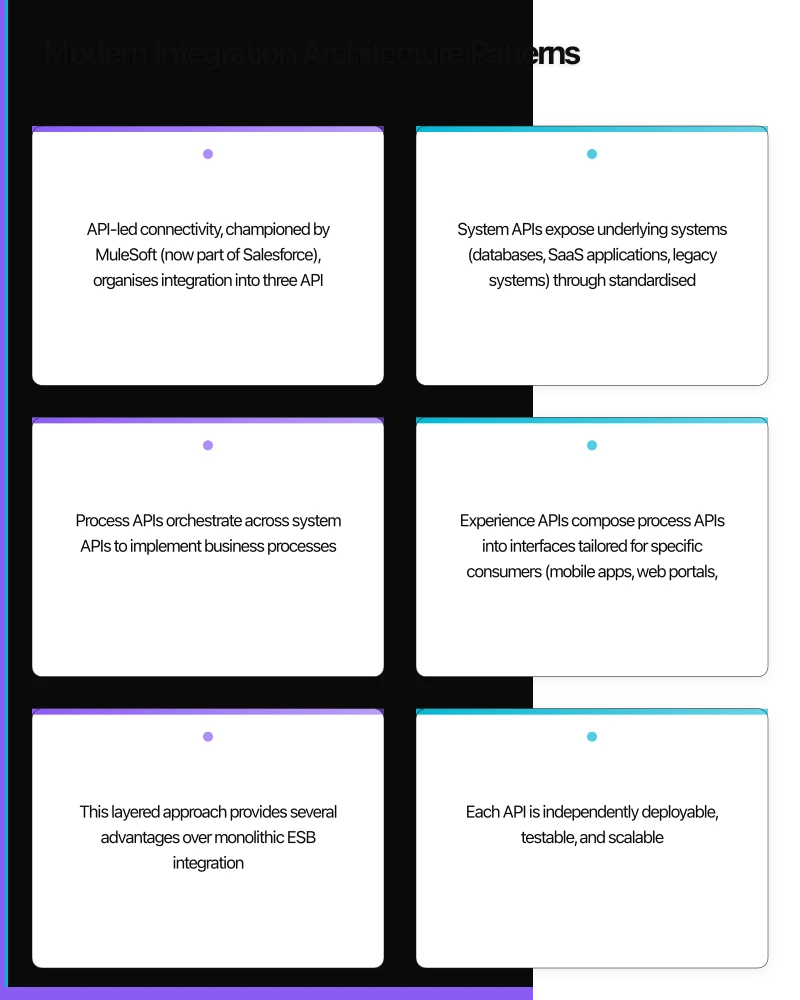
API-led connectivity, championed by MuleSoft (now part of Salesforce), organises integration into three API layers. System APIs expose underlying systems (databases, SaaS applications, legacy systems) through standardised interfaces. Process APIs orchestrate across system APIs to implement business processes. Experience APIs compose process APIs into interfaces tailored for specific consumers (mobile apps, web portals, partner integrations).
This layered approach provides several advantages over monolithic ESB integration. Each API is independently deployable, testable, and scalable. The layering promotes reuse — a system API for the customer database serves multiple process APIs. And the API-first approach means that integrations are discoverable, documented, and consumable through standard protocols, rather than buried in ESB flow configurations.
Event-driven integration replaces synchronous, request-response communication with asynchronous event streams. When a business event occurs — a customer places an order, a payment is processed, an inventory level changes — an event is published to a broker (Apache Kafka, Amazon EventBridge, Azure Event Grid) and consumed by any interested service. This pattern decouples producers from consumers, enables real-time data propagation, and supports complex event processing.
Event-driven integration is particularly powerful for keeping distributed systems consistent without tight coupling. When the CRM system publishes a “customer updated” event, the billing system, marketing platform, and analytics warehouse can each consume that event and update their own records — without the CRM system needing to know about or integrate directly with any of them.
The combination of API-led and event-driven patterns creates a comprehensive integration architecture: APIs for synchronous, request-response interactions (querying data, triggering actions) and events for asynchronous, publication-based communication (state changes, notifications, data propagation).
Integration Platform as a Service (iPaaS) provides cloud-hosted integration capabilities without the infrastructure management burden of on-premises middleware. Platforms like MuleSoft Anypoint, Boomi (now part of Francisco Partners), Informatica Cloud, and Workato provide visual integration design, pre-built connectors for popular SaaS applications, and managed runtime environments.
iPaaS is particularly well-suited for SaaS-to-SaaS integration, where the integration challenge is connecting cloud applications rather than on-premises systems. The pre-built connector libraries (Salesforce, Workday, SAP, ServiceNow, Slack, and hundreds more) dramatically reduce integration development time for common SaaS connectivity patterns.
Strategic Assessment: Choosing the Right Integration Model
Enterprise integration strategy should match integration patterns to the characteristics of each integration requirement rather than adopting a single universal approach.
SaaS-to-SaaS integration is best served by iPaaS platforms. The combination of pre-built connectors, visual design tools, and managed runtime provides the fastest path to connecting cloud applications. Business process automation that spans multiple SaaS applications — synchronising customer data between CRM and marketing platforms, routing support tickets based on business rules, automating employee onboarding across HR and IT systems — is the sweet spot.
Microservice-to-microservice integration is best served by direct API communication and event-driven patterns. Microservices within the same domain communicate through APIs; microservices across domains communicate through events. The integration logic is embedded in the services themselves, not in a separate middleware layer. Service meshes (Istio, Linkerd) provide infrastructure-level concerns (service discovery, load balancing, security) without application-level middleware.
Legacy system integration often requires the mediation capabilities that middleware provides: protocol translation, data format transformation, and orchestration. Modern integration platforms like MuleSoft and TIBCO Cloud Integration provide these capabilities with cloud-native deployment models. For organisations with significant legacy estates, these platforms bridge the gap between legacy and modern integration patterns.
Data integration and ETL — moving data between systems for analytics, reporting, and data warehousing — is served by specialised data integration platforms (Fivetran, Airbyte, Talend, Informatica) rather than general-purpose middleware. The separation of data integration from application integration enables each to be optimised for its specific requirements.
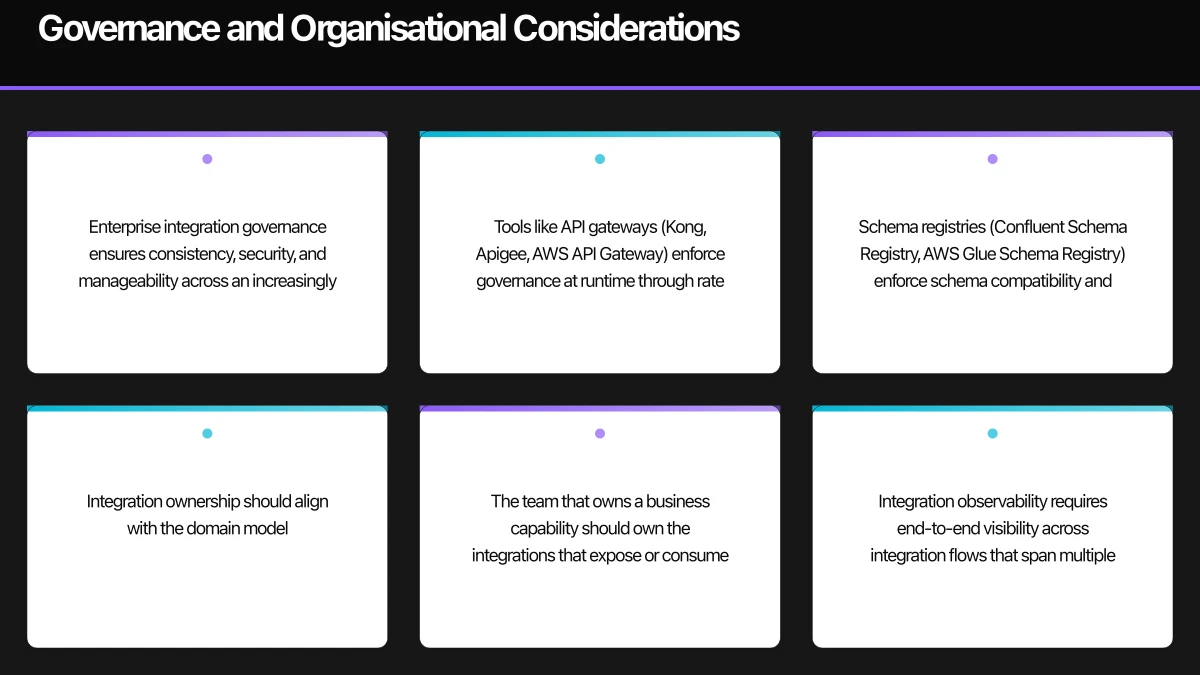
Governance and Organisational Considerations
Enterprise integration governance ensures consistency, security, and manageability across an increasingly distributed integration landscape.
API governance establishes standards for API design (naming conventions, versioning strategies, security requirements), API documentation (OpenAPI specifications, developer portals), and API lifecycle management (deprecation policies, consumer notification). Tools like API gateways (Kong, Apigee, AWS API Gateway) enforce governance at runtime through rate limiting, authentication, and usage tracking.
Event governance establishes standards for event schemas (Avro, JSON Schema), event naming conventions, event catalogue management, and event retention policies. Schema registries (Confluent Schema Registry, AWS Glue Schema Registry) enforce schema compatibility and evolution rules.
Integration ownership should align with the domain model. The team that owns a business capability should own the integrations that expose or consume that capability. Centralised integration teams that own all integrations create bottlenecks; distributed ownership with centralised governance provides scalability with consistency.
Integration observability requires end-to-end visibility across integration flows that span multiple technologies and services. Distributed tracing (OpenTelemetry, Jaeger) provides the correlation needed to debug issues that traverse API calls, event processing, and data pipelines. Integration-level dashboards should track success rates, latency, error rates, and business-level metrics for each integration flow.
Conclusion
Enterprise middleware is not disappearing — it is disaggregating. The monolithic ESB that handled all integration through a single platform is being replaced by a portfolio of specialised capabilities: API gateways for synchronous communication, event brokers for asynchronous communication, iPaaS for SaaS connectivity, and data integration platforms for analytical data flows.
For CTOs defining integration strategy in 2022, the opportunity is to build an integration architecture that matches the diversity of modern enterprise technology landscapes. API-led connectivity for structured interactions, event-driven integration for real-time data flow, iPaaS for SaaS connectivity, and specialised tools for data integration — each pattern serving the scenarios for which it is best suited.
The organisations that architect integration deliberately will move data and events fluidly across their technology estates, enabling the agility and real-time responsiveness that modern business demands. Those that cling to monolithic middleware or neglect integration architecture will face growing friction as their technology landscapes diversify.
For hands-on mobile development advice, visit Awesome Apps — our specialist app development blog for Australian businesses.
My consultancy Ganda Tech Services operates three specialist divisions covering cloud infrastructure, web development, and mobile apps for Australian businesses.
About the Author
Ashish Ganda is the founder of Ganda Tech Services, a Sydney-based technology consultancy specialising in cloud infrastructure, web development, and mobile app solutions for Australian businesses.
Digital Transformation Roadmap 2026
A 12-month framework for Australian SMBs ready to modernise — phases, tools, and milestones.
Almost done
Check your inbox and click the confirmation link to get your download.