Enterprise Integration Patterns: API Gateway Strategy for Modern Architectures
The Integration Imperative
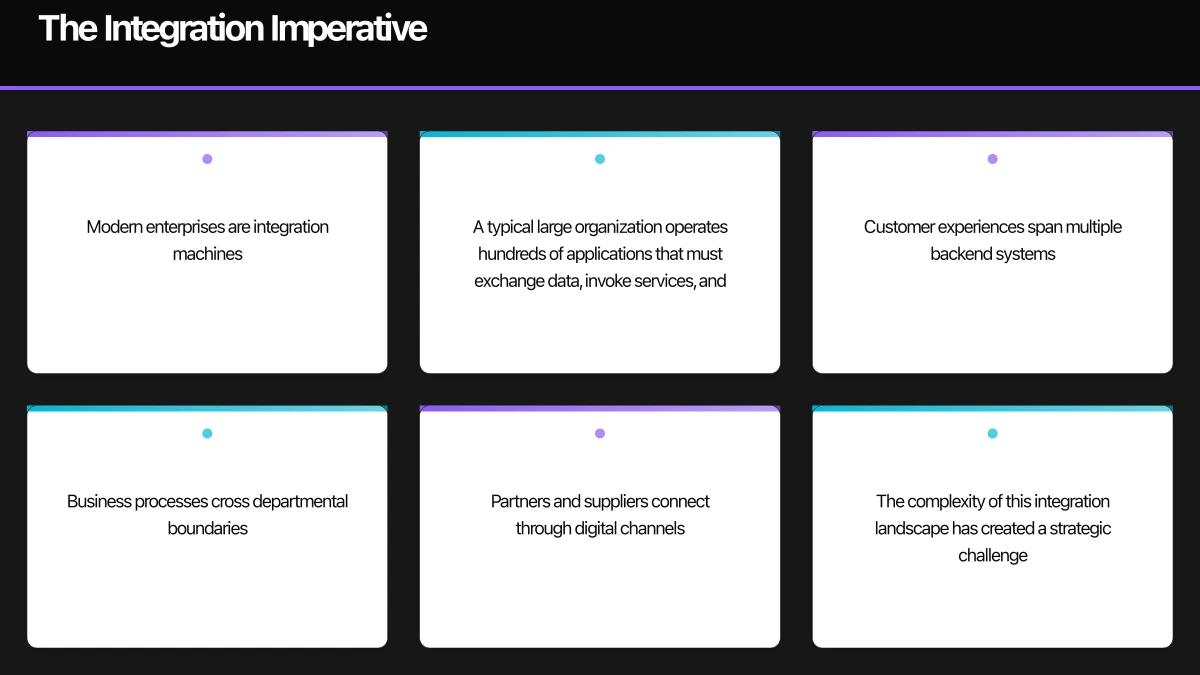
Modern enterprises are integration machines. A typical large organization operates hundreds of applications that must exchange data, invoke services, and coordinate processes. Customer experiences span multiple backend systems. Business processes cross departmental boundaries. Partners and suppliers connect through digital channels.
The complexity of this integration landscape has created a strategic challenge. Point-to-point integrations create brittle, unmanageable webs of dependencies. Legacy middleware accumulates technical debt. Shadow integrations emerge when official channels are too slow or cumbersome.
API gateways have emerged as the architectural centerpiece for managing this complexity. According to Gartner’s 2024 API Management Market Guide, 95% of enterprises now use API management platforms, up from 75% in 2021. Yet many organizations struggle to realize the full potential of these investments.
This analysis provides strategic guidance for CTOs on API gateway architecture and enterprise integration patterns, drawing on implementation experiences from organizations that have built successful integration platforms.
Understanding the Integration Landscape
The Evolution of Enterprise Integration
Enterprise integration has evolved through distinct eras:
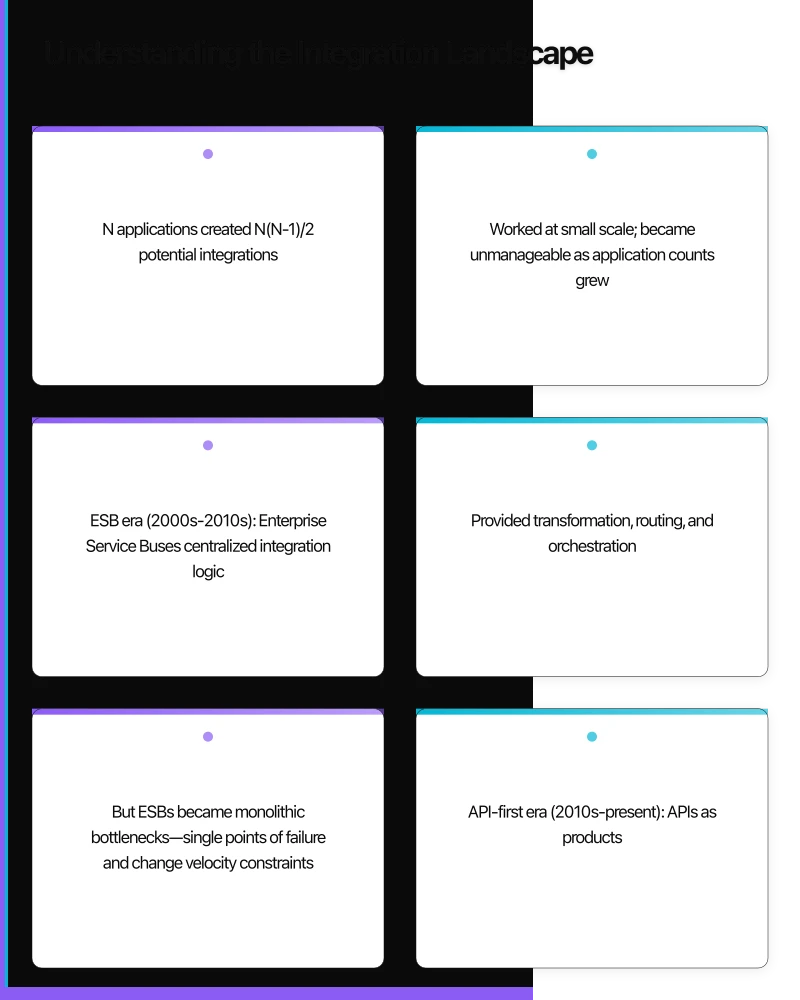
Point-to-point era (1990s-2000s): Applications connected directly. N applications created N*(N-1)/2 potential integrations. Worked at small scale; became unmanageable as application counts grew.
ESB era (2000s-2010s): Enterprise Service Buses centralized integration logic. Provided transformation, routing, and orchestration. But ESBs became monolithic bottlenecks—single points of failure and change velocity constraints.
API-first era (2010s-present): APIs as products. Self-service consumption. Decentralized ownership with centralized governance. API gateways manage traffic, security, and observability.
Event-driven integration (emerging): Asynchronous, decoupled communication through event streaming. Complements API-based integration for different use cases.
Modern integration strategies typically combine API-based and event-driven approaches, with API gateways providing the management layer for synchronous communications.
Integration Architecture Components
A modern enterprise integration architecture includes:
API Gateway: Traffic management, security enforcement, rate limiting, request/response transformation. The front door for API consumers.
API Management Platform: Developer portal, API lifecycle management, analytics, monetization. The administrative layer for API programs.
Service Mesh: Service-to-service communication within clusters. Traffic management, security, observability for internal services.
Event Streaming Platform: Apache Kafka, Amazon Kinesis, Azure Event Hubs, or Confluent. Asynchronous, durable event communication.
Integration Platform: iPaaS solutions for connector-based integrations, workflow automation, and data synchronization.
These components serve different purposes and often coexist. The challenge is defining clear boundaries and appropriate use cases for each.
API Gateway Architecture Patterns
Pattern 1: Edge Gateway
The edge gateway pattern positions the API gateway at the network perimeter, managing all external API traffic:
Characteristics:
- Single entry point for external API consumers
- Handles authentication, authorization, rate limiting
- Provides SSL termination
- Manages request routing to backend services
Advantages:
- Simplified security perimeter
- Centralized policy enforcement
- Consistent consumer experience
- Simplified monitoring and logging
Considerations:
- Can become bottleneck at scale
- Requires high availability investment
- May not suit internal service communication
When to use: Standard pattern for external API exposure. Most organizations start here.
Pattern 2: Microgateway / Sidecar
The microgateway pattern distributes gateway functionality alongside services:
Characteristics:
- Lightweight gateway deployed per service or per pod
- Handles service-specific concerns
- Coordinates with central control plane
- Common implementation: Envoy proxy in service mesh
Advantages:
- Scales with services
- No central bottleneck
- Service-specific policy customization
- Reduced network hops for internal traffic
Considerations:
- More complex deployment
- Requires sophisticated control plane
- Potential consistency challenges
When to use: Kubernetes-native architectures, high-scale microservices, when service mesh is already adopted.
Pattern 3: Federated Gateway
The federated gateway pattern combines multiple gateways with unified governance:
Characteristics:
- Domain-specific gateways for different business units or regions
- Central management plane for policy and observability
- Consistent API standards across federation
- Apollo Federation for GraphQL; similar patterns for REST
Advantages:
- Domain autonomy with central governance
- Regional compliance requirements
- Organizational alignment with business units
- Reduced blast radius from gateway issues
Considerations:
- More complex management
- Requires mature governance processes
- Cross-gateway transaction complexity
When to use: Large enterprises with distinct business domains, global organizations with regional requirements, GraphQL architectures.
Pattern 4: Multi-Layer Gateway
The multi-layer pattern uses different gateways for different purposes:
Characteristics:
- External gateway for partner/customer APIs
- Internal gateway for cross-service communication
- Separate concerns and policies per layer
- Clear security boundaries between layers
Advantages:
- Purpose-appropriate capabilities per layer
- Defense in depth
- Independent scaling and evolution
- Clear separation of concerns
Considerations:
- Multiple products to manage
- Increased operational complexity
- Potential for inconsistent policies
When to use: Organizations with distinct external and internal API requirements, security-sensitive industries, complex compliance requirements.
API Gateway Selection
Build vs. Buy
The build vs. buy decision for API gateways:
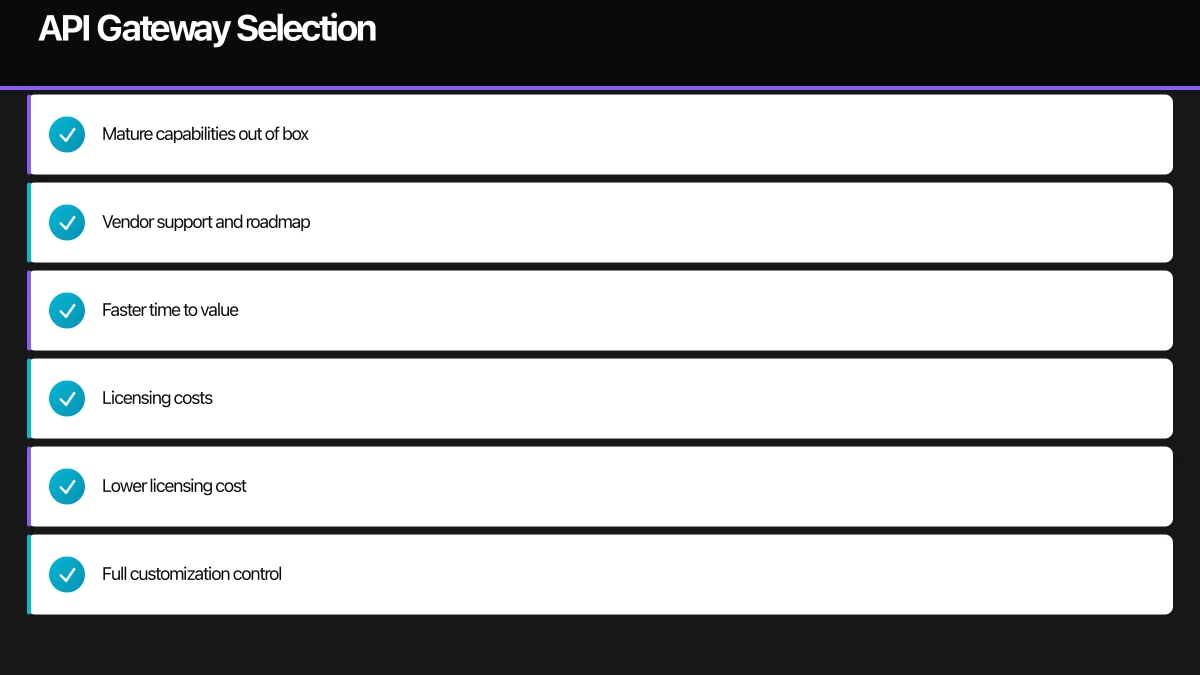
Commercial platforms (Kong, Apigee, MuleSoft, AWS API Gateway, Azure API Management):
- Mature capabilities out of box
- Vendor support and roadmap
- Faster time to value
- Licensing costs
Open source platforms (Kong OSS, Tyk, KrakenD, Apache APISIX):
- Lower licensing cost
- Full customization control
- Active communities
- Self-support responsibility
Cloud-native services (AWS API Gateway, Azure API Management, GCP API Gateway):
- Deep cloud integration
- Managed operations
- Provider lock-in considerations
- May lack advanced features
For most enterprises, commercial or cloud-native platforms provide faster time to value. Open source suits organizations with strong platform engineering capabilities and specific customization requirements.
Selection Criteria
Evaluate API gateway platforms against:
Traffic management:
- Rate limiting granularity
- Load balancing algorithms
- Circuit breaker support
- Caching capabilities
Security:
- Authentication protocols (OAuth, OIDC, mTLS, API keys)
- Authorization integration (RBAC, ABAC, OPA)
- Threat protection (injection, DDoS)
- Certificate management
Developer experience:
- Developer portal quality
- Documentation generation
- SDK generation
- Sandbox environments
Operations:
- High availability architecture
- Horizontal scaling
- Multi-region support
- GitOps compatibility
Observability:
- Metrics and dashboards
- Distributed tracing integration
- Logging and search
- Alerting capabilities
Extensibility:
- Plugin architecture
- Custom transformation support
- Language options for extensions
- WebAssembly support
Enterprise Integration Patterns
Beyond gateway architecture, integration success depends on applying appropriate patterns:
Request-Response Patterns
API Composition: Aggregate data from multiple backend services into a single consumer response. Gateway or dedicated composition layer handles orchestration.
Backend for Frontend (BFF): Create purpose-built APIs for specific client types (mobile, web, partner). Optimizes payloads and interactions for each context.
Strangler Fig: Gradually replace legacy systems by routing traffic through gateway to new implementations while legacy handles remaining functionality.
Anti-Corruption Layer: Isolate domain model from external systems’ data formats and semantics. Translate at integration boundary.
Event-Driven Patterns
Event Notification: Publish events when state changes. Consumers subscribe to relevant events. Enables loose coupling and eventual consistency.
Event-Carried State Transfer: Include sufficient state in events that consumers don’t need to call back for details. Reduces chattiness and coupling.
Event Sourcing: Store state as sequence of events rather than current state. Enables audit trails, temporal queries, and replay.
CQRS (Command Query Responsibility Segregation): Separate read and write models. Optimize each for its purpose. Often combined with event sourcing.
Data Integration Patterns
Change Data Capture (CDC): Capture database changes as events. Stream to consumers without modifying source applications. Tools: Debezium, AWS DMS, Fivetran.
Data Virtualization: Present unified view of distributed data without physical consolidation. Query federation across sources.
Batch Integration: Scheduled bulk data transfers. Still appropriate for many scenarios—large volumes, tolerance for latency, simple requirements.
Security Architecture
API security requires defense in depth:
Authentication and Authorization
OAuth 2.0 / OpenID Connect: Standard for API authentication. Use appropriate flows for different client types:
- Authorization Code + PKCE for public clients
- Client Credentials for service-to-service
- Device Authorization for constrained devices
JWT tokens: Stateless authorization. Embed claims for authorization decisions. Implement appropriate token lifetimes and refresh mechanisms.
API keys: Simple authentication for low-risk APIs. Not suitable for high-value or user-specific access.
mTLS: Mutual TLS for service-to-service authentication. Certificate-based identity. Important for zero-trust architectures.
Threat Protection
Rate limiting: Prevent abuse and ensure fair usage. Apply at multiple levels (global, per-consumer, per-endpoint).
Input validation: Reject malformed requests before processing. Schema validation, size limits, content type enforcement.
Injection protection: Guard against SQL injection, XML injection, command injection. Sanitize inputs, use parameterized queries.
DDoS mitigation: Upstream protection (CDN, cloud provider services) plus gateway-level controls.
Zero Trust Principles
Modern API security adopts zero trust:
Never trust, always verify: Authenticate every request regardless of network location.
Least privilege: Grant minimum necessary access. Fine-grained authorization rather than broad permissions.
Assume breach: Design for detection and containment, not just prevention.
Continuous verification: Re-validate authorization throughout session, not just at initial authentication.
Operational Excellence
Observability
API observability requires three pillars:
Metrics: Request rates, latencies (p50, p95, p99), error rates, throughput. Aggregate and per-API granularity.
Logging: Request/response details (appropriately sanitized), processing events, errors. Structured logging for queryability.
Tracing: Distributed tracing across services. Correlation IDs through the request path. Integration with APM tools.
Dashboard essentials:
- Overall platform health
- Top APIs by traffic
- Error rates and types
- Latency distributions
- Consumer-specific views
Lifecycle Management
APIs are products with lifecycles:
Versioning strategy: URI versioning (/v1/), header versioning, or content negotiation. URI versioning is most common and most visible.
Deprecation process: Announce deprecation with timeline. Monitor usage to understand impact. Provide migration guidance. Maintain deprecated versions for committed period.
Change management: Backward-compatible changes when possible. Breaking changes require version increments. Communicate changes through developer portal and changelogs.
Contract testing: Validate that API implementations match specifications. Catch breaking changes before deployment.
Performance Optimization
Caching: Cache responses at gateway level where appropriate. Consider cache invalidation strategy. Respect caching headers.
Compression: Compress response payloads. Significant bandwidth and latency benefits for larger payloads.
Connection pooling: Reuse connections to backends. Significant performance benefit, especially for HTTPS.
Async processing: Return immediately for long-running operations. Provide status endpoint or callback for results.
Organizational Considerations
API Program Structure
Successful API programs require organizational structure:
API Product Management: Define API strategy, prioritize development, understand consumer needs. Business-oriented role, not purely technical.
Platform Engineering: Build and operate gateway infrastructure, provide self-service capabilities, ensure reliability.
Domain API Teams: Own domain-specific APIs. Understand business context. Publish APIs through platform.
API Governance: Define standards, review APIs for consistency, manage change. Federated model works better than central control.
Developer Experience
Internal and external developers are API consumers. Their experience matters:
Documentation: Clear, complete, example-rich. API reference plus conceptual guides. Keep updated with API changes.
Developer portal: Self-service registration, key management, usage analytics. Sandbox environments for testing.
Support channels: Clear escalation paths. Response time expectations. Community forums for peer support.
SDKs and tools: Generate client libraries. Provide Postman collections, CLI tools, code samples.
Governance Without Bureaucracy
API governance should enable, not obstruct:
Style guides: Document conventions for naming, versioning, error handling, pagination. Automate validation where possible.
Review processes: Lightweight review for standard patterns. Deeper review for novel or high-risk APIs.
Certification levels: Tiered requirements based on API criticality. Not every API needs the same rigor.
Automation: Lint APIs against style guides automatically. Integrate checks into CI/CD pipelines.
Looking Forward
Several trends are shaping enterprise integration:
GraphQL adoption: Growing enterprise adoption for flexible data access. Federation enabling scalable architectures. Specialized gateway capabilities emerging.
AsyncAPI standardization: Specification for event-driven APIs maturing. Tooling ecosystem developing. Enables contract-first design for events.
AI-augmented integration: Machine learning for anomaly detection, automated documentation, intelligent routing. Early but promising.
Platform engineering: Integration platforms as internal products. Self-service consumption. DevOps principles applied to integration.
Strategic Recommendations
For CTOs developing integration strategy:
-
Treat APIs as products. Invest in documentation, developer experience, and lifecycle management. APIs with consumers have obligations.
-
Match patterns to problems. Edge gateway for external APIs, service mesh for internal, event streaming for async. Different problems need different solutions.
-
Prioritize security from the start. Retrofitting API security is difficult and risky. Build authentication, authorization, and threat protection into the platform.
-
Invest in observability. You cannot manage what you cannot see. Comprehensive metrics, logging, and tracing are not optional.
-
Balance governance and agility. Standards and review processes should accelerate good APIs, not obstruct all APIs. Automate enforcement where possible.
-
Plan for evolution. Integration needs change. Choose platforms and patterns that can evolve. Avoid architectural decisions that create long-term lock-in.
The organizations that succeed with integration treat it as a strategic capability—a platform that enables business agility, partner connectivity, and digital innovation—rather than a tactical necessity to be minimized.
For strategic guidance on enterprise integration architecture and API platform strategy, connect with me to discuss approaches tailored to your organization’s context and requirements.
Strategy needs execution. Cloud Geeks publishes practical cloud computing and cybersecurity guides for Australian businesses ready to act.
I lead Ganda Tech Services, where we turn digital strategy into results through specialist cloud, web design, and mobile app teams across Sydney.
About the Author
Ashish Ganda is the founder of Ganda Tech Services, a Sydney-based technology consultancy specialising in cloud infrastructure, web development, and mobile app solutions for Australian businesses.
Digital Transformation Roadmap 2026
A 12-month framework for Australian SMBs ready to modernise — phases, tools, and milestones.
Almost done
Check your inbox and click the confirmation link to get your download.