API Strategy: Building Enterprise Integration Architecture
Introduction
APIs have evolved from technical plumbing to strategic assets. They’re how systems communicate, how partners integrate, how mobile apps connect, and increasingly, how businesses create platform value.
Yet many enterprises approach APIs tactically—building them project by project without coherent strategy. The result is inconsistent interfaces, duplicated functionality, and integration complexity that compounds over time.
This guide covers how to build an API strategy that serves both immediate integration needs and long-term platform ambitions.
Why API Strategy Matters
Integration Complexity
Modern enterprises run dozens or hundreds of applications:
- Core business systems (ERP, CRM, HRM)
- Departmental applications
- Customer-facing systems
- Partner integrations
- Acquired company systems
Without deliberate API design, integration becomes point-to-point spaghetti. Each new connection adds complexity. Changes become risky. Innovation slows.
Platform Potential
APIs enable platform models:
- Partners build on your capabilities
- Customers integrate with their systems
- Internal teams compose services flexibly
- New products launch faster
But platform potential requires platform-quality APIs—not internal interfaces exposed externally.
Developer Experience
APIs are products with developers as customers:
- Internal developers building applications
- Partner developers integrating
- Third-party developers creating value
Poor developer experience means slow adoption, support burden, and missed opportunities.
API Strategy Components
API Classification
Not all APIs serve the same purpose:
Private APIs
Internal integration between systems:
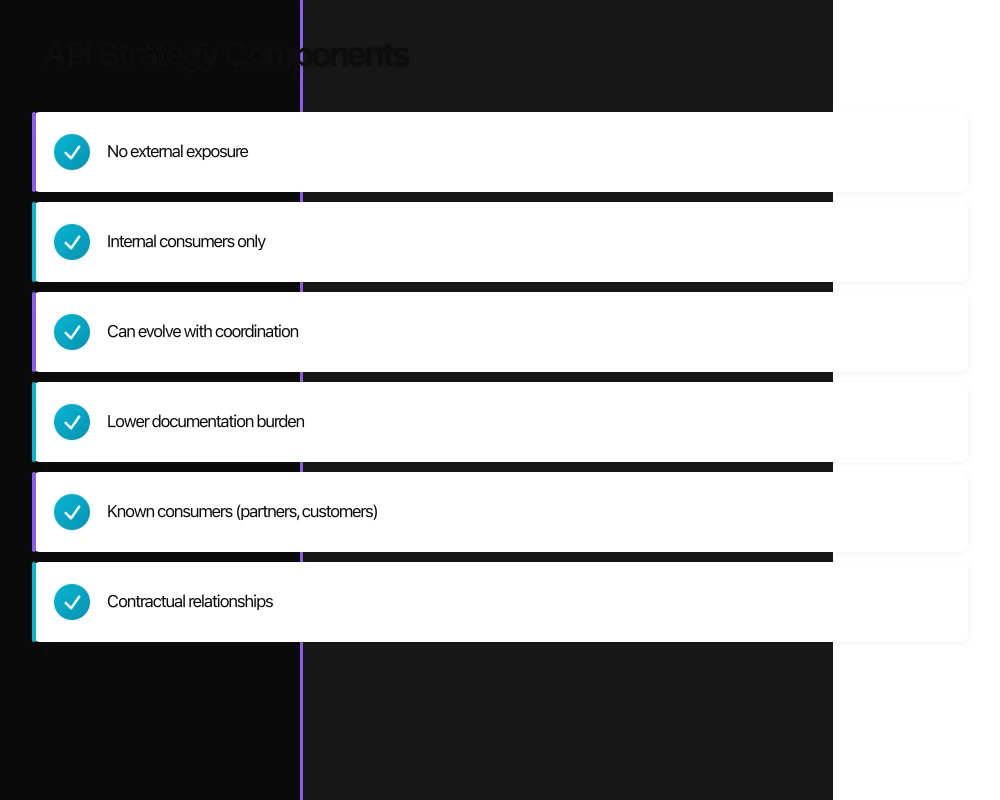
- No external exposure
- Internal consumers only
- Can evolve with coordination
- Lower documentation burden
Partner APIs
Controlled external access:
- Known consumers (partners, customers)
- Contractual relationships
- Support commitments
- Versioning requirements
Public APIs
Open external access:
- Unknown consumers
- Self-service onboarding
- Extensive documentation
- Strong backward compatibility
Strategy should clarify which APIs fall into each category and what standards apply to each.
API Design Principles
Consistency
APIs across the organisation should feel similar:
- Common naming conventions
- Consistent authentication patterns
- Standard error formats
- Predictable behaviour
Developers learning one API should find others familiar.
Simplicity
APIs should be as simple as possible for their purpose:
- Clear resource models
- Intuitive operations
- Minimal required parameters
- Progressive complexity for advanced use
Stability
APIs should be reliable over time:
- Clear versioning strategy
- Deprecation policies
- Backward compatibility commitments
- Change communication processes
Technology Choices
REST vs GraphQL vs gRPC
Each has appropriate uses:
REST
- Widely understood
- Good tooling ecosystem
- Suitable for most use cases
- Simpler caching
GraphQL
- Client-specified data needs
- Reduced over-fetching
- Good for complex, related data
- Higher server complexity
gRPC
- High-performance service-to-service
- Strong typing with Protocol Buffers
- Streaming support
- Less suitable for browser clients
Most enterprises use REST as default, with alternatives for specific needs.
API Gateways
Centralised API management through gateways:
- Authentication and authorisation
- Rate limiting and throttling
- Analytics and monitoring
- Request/response transformation
Options include Kong, Apigee, AWS API Gateway, Azure API Management.
Design Standards
Resource Modelling
RESTful Principles
Design around resources, not operations:
Good:
GET /customers/123
POST /orders
PUT /products/456

Avoid:
GET /getCustomer?id=123
POST /createOrder
POST /updateProduct
Consistent Naming
Establish conventions:
- Plural nouns for collections (
/customers,/orders) - Lowercase with hyphens (
/order-items, not/orderItems) - Logical hierarchy (
/customers/123/orders)
Request and Response Formats
Standard Structures
Define templates for common patterns:
Success Response:
{
  "data": { ... },
  "meta": {
    "timestamp": "2023-08-20T10:30:00Z",
    "requestId": "abc-123"
  }
}
Error Response:
{
  "error": {
    "code": "VALIDATION_ERROR",
    "message": "Invalid customer ID format",
    "details": [ ... ]
  },
  "meta": {
    "timestamp": "2023-08-20T10:30:00Z",
    "requestId": "abc-123"
  }
}
Pagination
Standard approach for collections:
{
  "data": [ ... ],
  "pagination": {
    "page": 1,
    "pageSize": 20,
    "totalItems": 153,
    "totalPages": 8
  }
}
Versioning Strategy
Options
- URL path versioning:
/v1/customers - Header versioning:
Accept: application/vnd.api.v1+json - Query parameter:
/customers?version=1
URL versioning is most visible and commonly used. Choose one approach and apply consistently.
Version Lifecycle
Define clear policies:
- How long versions are supported
- Deprecation notice periods
- Migration support provided
- Breaking change criteria
Security Standards
Authentication
Standardise across APIs:
- OAuth 2.0 for external APIs
- API keys for simple integrations
- JWT tokens for session context
- Mutual TLS for high-security needs
Authorisation
Define access control patterns:
- Scopes for OAuth tokens
- Role-based access
- Resource-level permissions
- Rate limiting by consumer
Governance and Management
API Lifecycle
Design Phase
Before implementation:
- API design review
- Schema definition (OpenAPI/Swagger)
- Security assessment
- Consumer input
Development Phase
During implementation:
- Adherence to standards
- Automated testing
- Documentation generation
- Security testing
Deployment Phase
Going live:
- Gateway configuration
- Monitoring setup
- Developer portal listing
- Communication to consumers
Retirement Phase
End of life:
- Deprecation notice
- Migration support
- Usage monitoring
- Final decommissioning
API Governance
Design Review
Review APIs before implementation:
- Consistency with standards
- Appropriate resource modelling
- Security considerations
- Documentation completeness
Change Management
Control API changes:
- Breaking vs non-breaking classification
- Approval processes for breaking changes
- Consumer notification requirements
- Rollback capabilities
Developer Portal
Self-Service Access
Enable developers to help themselves:
- API catalogue and discovery
- Interactive documentation
- Sandbox environments
- API key management
Documentation Standards
Consistent, complete documentation:
- Getting started guides
- Reference documentation
- Code examples in multiple languages
- Use case tutorials
Implementation Approach
Phased Rollout
Don’t try to transform everything at once:
Phase 1: Foundation
- Establish standards and guidelines
- Deploy API gateway infrastructure
- Document existing APIs
- Pilot with one team or domain
Phase 2: Adoption
- Broader team adoption
- Developer portal launch
- Training and enablement
- Metrics and monitoring
Phase 3: Optimisation
- Advanced governance
- Partner programme
- API analytics
- Continuous improvement
Team Structure
Centralised vs Federated
Central API Team
Provides:
- Standards and governance
- Gateway infrastructure
- Developer portal
- Design review support
Federated Ownership
Product teams own:
- Their specific APIs
- Implementation and maintenance
- Consumer support
- Evolution decisions
Balance central standards with team autonomy.
Legacy Integration
Existing Systems
Most enterprises have systems that weren’t built API-first:
- Wrap with API facades
- Use integration platforms
- Gradual modernisation
- Accept some inconsistency
Don’t let perfect be the enemy of progress.
Measuring Success
Technical Metrics
Availability and Performance
- API uptime percentages
- Response time distributions
- Error rates by API
- Throughput capacity
Quality Metrics
- Standard compliance rates
- Documentation completeness
- Test coverage
- Security scan results
Business Metrics
Adoption
- Number of consumers
- API call volumes
- New integrations per period
- Developer portal engagement
Value Creation
- Partner integrations enabled
- Internal development velocity
- Time to new integrations
- Revenue enabled by APIs
Developer Experience
Satisfaction
- Developer surveys
- Support ticket volumes
- Time to first successful call
- Documentation feedback
Common Challenges
Inconsistency Across Teams
Different teams build different styles of APIs.
Solution:
- Clear, accessible standards
- Design review process
- Shared tooling and templates
- Examples and patterns
Legacy System Constraints
Old systems can’t expose modern APIs.
Solution:
- API facade layers
- Integration middleware
- Gradual modernisation
- Accept pragmatic compromises
Version Management
Multiple versions create maintenance burden.
Solution:
- Clear versioning policy
- Aggressive deprecation
- Consumer migration support
- Monitoring of version usage
Security vs Usability
Security requirements create friction.
Solution:
- Appropriate security for risk level
- Good developer tooling
- Clear documentation
- Self-service where safe
Conclusion
API strategy is infrastructure for the digital enterprise. Done well, it enables integration, supports partners, accelerates development, and creates platform possibilities. Done poorly, it creates technical debt that compounds over time.
Start with clear principles and standards. Build governance that enables rather than blocks. Invest in developer experience. Measure what matters.
APIs are products. Treat them accordingly, and they become strategic assets rather than technical afterthoughts.
Sources
- Jacobson, D., Brail, G., & Woods, D. (2012). APIs: A Strategy Guide. O’Reilly Media.
- Higginbotham, J. (2021). Principles of Web API Design. Addison-Wesley.
- Google Cloud. (2023). API Design Guide. https://cloud.google.com/apis/design
- Microsoft. (2023). Web API Design Best Practices. https://docs.microsoft.com/en-us/azure/architecture/best-practices/api-design
Strategic guidance for technology leaders building enterprise integration capabilities.
For the practitioner’s view on mobile app development and app store success, explore Awesome Apps — where strategy meets the app store.
My consultancy Ganda Tech Services operates three specialist divisions covering cloud infrastructure, web development, and mobile apps for Australian businesses.
About the Author
Ashish Ganda is the founder of Ganda Tech Services, a Sydney-based technology consultancy specialising in cloud infrastructure, web development, and mobile app solutions for Australian businesses.
Tech Stack Selection Guide 2026
Choose the right tools for your Australian business — without the vendor hype or overlapping spend.
Almost done
Check your inbox and click the confirmation link to get your download.