
Enterprise Search Architecture: Elasticsearch at Scale
Search has evolved from a feature to an expectation. Users expect fast, relevant search across every enterprise application — customer-facing product catalogues, internal knowledge bases, log analytics platforms, and operational dashboards. The quality of the search experience directly impacts user satisfaction, operational efficiency, and in the case of e-commerce, revenue.
Elasticsearch has become the dominant platform for enterprise search, and with good reason. Its distributed architecture scales horizontally, its full-text search capabilities are mature and performant, and its near-real-time indexing supports use cases from product search to log analytics to security monitoring. The Elastic Stack ecosystem (Elasticsearch, Kibana, Logstash, Beats) provides a comprehensive platform for data ingestion, search, analysis, and visualisation.
But Elasticsearch at enterprise scale is not a simple deployment. Clusters serving terabytes of data, handling thousands of queries per second, and supporting dozens of use cases require careful architecture, diligent operational practices, and strategic governance. The gap between a working Elasticsearch cluster and a production-grade enterprise search platform is significant, and it is in this gap that most enterprises encounter challenges.
Cluster Architecture for Enterprise
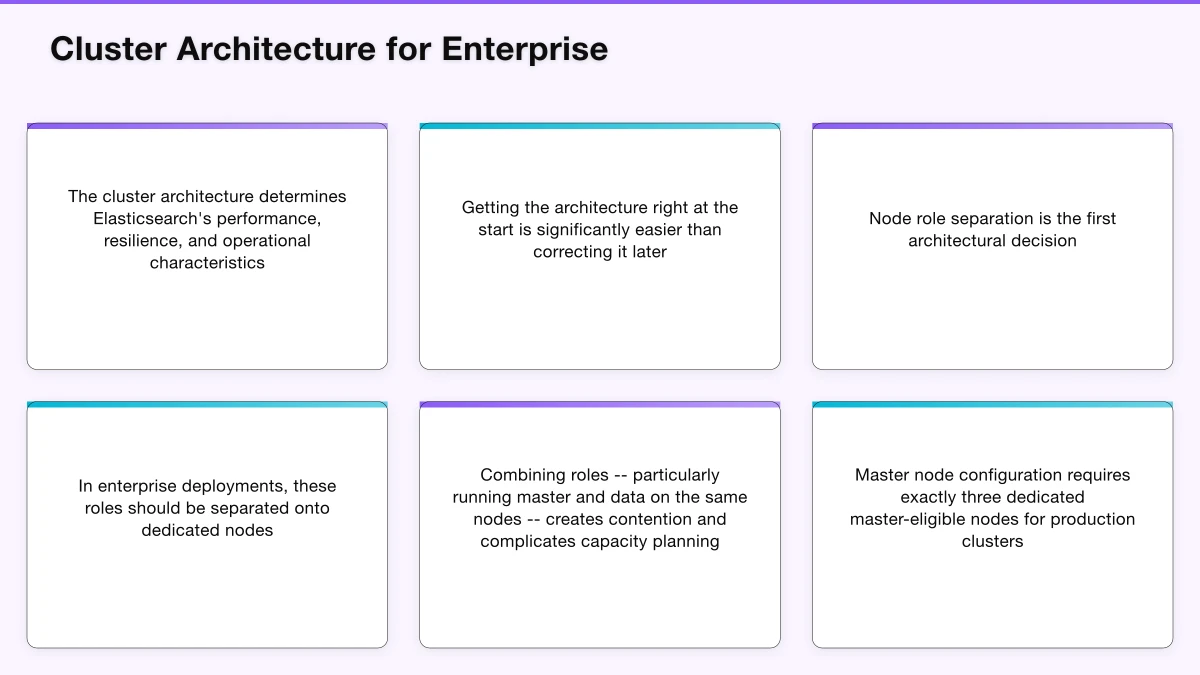
The cluster architecture determines Elasticsearch’s performance, resilience, and operational characteristics. Getting the architecture right at the start is significantly easier than correcting it later.
Node role separation is the first architectural decision. Elasticsearch supports dedicated node roles: master-eligible nodes manage cluster state, data nodes store and query data, coordinating nodes route queries to the appropriate data nodes, and ingest nodes perform data transformation. In enterprise deployments, these roles should be separated onto dedicated nodes. Combining roles — particularly running master and data on the same nodes — creates contention and complicates capacity planning.
Master node configuration requires exactly three dedicated master-eligible nodes for production clusters. This provides the quorum needed for leader election while avoiding the split-brain scenarios that can corrupt cluster state. Master nodes do not need large storage or powerful CPUs, but they need reliable, low-latency networking and sufficient memory to hold the cluster state.
Data node sizing depends on the workload profile. Search-heavy workloads benefit from fast storage (SSDs) and sufficient memory for the filesystem cache. Analytics-heavy workloads benefit from higher CPU capacity for aggregation processing. The general guidance is to allocate no more than thirty to forty gigabytes of data per gigabyte of JVM heap, and to limit JVM heap to thirty-one gigabytes to benefit from compressed ordinary object pointers. Exceeding these thresholds degrades performance.
Shard strategy is among the most consequential design decisions. Each index is divided into shards, and each shard is a self-contained Lucene index. Too few shards limits write throughput and prevents effective distribution across data nodes. Too many shards creates overhead — each shard consumes memory and file handles, and queries that span many small shards incur coordination overhead. The target is shards between ten and fifty gigabytes for most use cases. The number of shards should be determined by the expected index size and the desired write throughput.
Index lifecycle management (ILM) automates the progression of data through hot, warm, cold, and delete phases. Hot nodes with fast storage serve actively queried data. Warm nodes with larger, slower storage serve less frequently accessed data. Cold nodes with the cheapest storage serve archival data that is rarely queried. ILM policies automate the rollover, migration, and deletion of indices based on age, size, or document count. For enterprise deployments with significant data volumes, ILM is essential for managing storage costs while maintaining search performance.
Data Modelling and Relevance
Elasticsearch’s effectiveness depends heavily on how data is modelled and how search relevance is tuned. These are not infrastructure concerns — they require collaboration between engineers, data architects, and domain experts.
Mapping design defines how documents are structured and how fields are indexed. The mapping determines which fields are searchable, how they are analysed (tokenised, normalised, stemmed), and how they are stored. Careful mapping design is essential for search relevance — a product search that does not properly analyse product names, descriptions, and categories will deliver poor results regardless of how well the cluster is configured.
The analysis chain — the sequence of character filters, tokenisers, and token filters that transform text into searchable terms — is the heart of full-text search quality. For enterprise search, this typically includes language-specific analysis (stemming, stop word removal), synonym expansion (mapping domain-specific terminology), and custom tokenisation for specialised content (part numbers, codes, technical identifiers). Getting the analysis chain right requires iterative tuning based on real search queries and relevance evaluation.
Search relevance tuning goes beyond the analysis chain to encompass boosting strategies (weighting certain fields or document types more heavily), function scoring (incorporating factors like recency, popularity, or business priority into the relevance score), and query design (combining full-text search with structured filters to provide precise, relevant results).
For enterprises serving multiple search use cases from a single cluster, index templates standardise mappings and settings across similar indices, while index aliases provide stable query endpoints that can be remapped without client changes. These mechanisms support operational flexibility and reduce the risk of breaking changes.
Operational Excellence
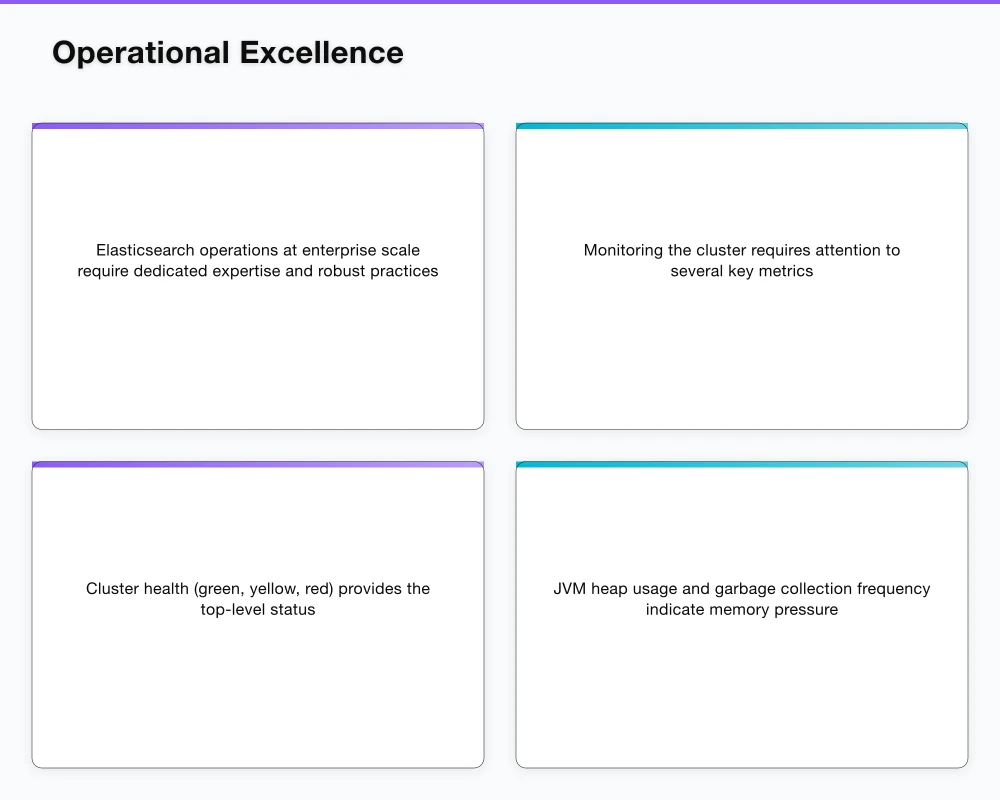
Elasticsearch operations at enterprise scale require dedicated expertise and robust practices.
Monitoring the cluster requires attention to several key metrics. Cluster health (green, yellow, red) provides the top-level status. JVM heap usage and garbage collection frequency indicate memory pressure. Search and indexing latency reveal performance characteristics. Thread pool rejections indicate capacity exhaustion. Shard count and size distribution reveal balance issues. Pending tasks on the master node indicate control plane congestion.
Capacity planning must account for data growth, query growth, and the resource overhead of operations like merges and replica recovery. Elasticsearch’s resource consumption is not linear — adding data increases memory requirements for the filesystem cache, adding shards increases coordination overhead, and adding queries increases CPU and network demand. Regular capacity reviews, informed by growth trends and planned business initiatives, prevent capacity-related performance degradation.
Backup and recovery using Elasticsearch’s snapshot and restore mechanism provide point-in-time backup to repositories (S3, Azure Blob Storage, GCS, shared filesystems). Snapshot lifecycle policies automate backup scheduling and retention. Regular restore testing validates that backups are usable — a backup that has never been restored is an assumption, not a guarantee.
Security in Elasticsearch encompasses authentication (integrating with the enterprise identity provider through SAML or OIDC), authorisation (role-based access control with field-level and document-level security), encryption (TLS for node-to-node and client-to-node communication), and audit logging. The security features, available in the Elastic Stack’s basic licence since version 6.8, should be enabled for every enterprise deployment.
Upgrade management for Elasticsearch requires planning due to breaking changes between major versions and the rolling upgrade process for minor versions. Maintaining currency with Elasticsearch releases is important for security patches and feature access, but upgrades should be tested thoroughly in non-production environments before production execution.
The enterprise that invests in these architectural and operational fundamentals builds a search platform that serves the organisation reliably at scale — supporting the diverse search and analytics use cases that modern enterprise applications demand.
Need to turn digital strategy into a web presence? Cosmos Web Tech covers website design, SEO, and e-commerce for Australian SMBs.
These insights are drawn from my work leading Ganda Tech Services — helping Australian businesses navigate digital transformation through cloud, web, and mobile.
About the Author
Ashish Ganda is the founder of Ganda Tech Services, a Sydney-based technology consultancy specialising in cloud infrastructure, web development, and mobile app solutions for Australian businesses.
Digital Transformation Roadmap 2026
A 12-month framework for Australian SMBs ready to modernise — phases, tools, and milestones.