Enterprise Streaming Architecture: Kafka, Pulsar, and Platform Strategy
Introduction
Event streaming has evolved from niche technology to enterprise infrastructure standard. What began as a solution for log aggregation now powers real-time analytics, event-driven architectures, and the connective tissue between modern distributed systems.
For CTOs evaluating streaming investments, the decisions are consequential. Streaming platforms become deeply embedded in application architectures—the data they carry, the integrations they enable, and the operational patterns they require all create long-term dependencies.
This guide examines enterprise streaming strategy: when streaming delivers value, how to evaluate platform options, and what operational maturity is required for production success.
The Strategic Case for Streaming
Beyond Batch Processing
Traditional enterprise data architectures relied on batch processing:
- Collect data throughout the day
- Process overnight in batch jobs
- Deliver insights the next morning
This pattern served for decades but creates inherent limitations:
- Decisions based on stale data
- Batch job failures create cascading delays
- No support for real-time customer experiences
- Integration complexity with point-to-point connections
Streaming inverts this model: process data as it arrives, deliver insights immediately, react to events in real-time.
Use Cases Driving Adoption
Real-Time Analytics
Dashboards and metrics with seconds of latency:
- Operational monitoring and alerting
- Customer behaviour analysis
- Financial transaction monitoring
- Supply chain visibility
Event-Driven Architecture
Decoupled services communicating through events:
- Microservices integration
- Domain event propagation
- Saga orchestration
- CQRS implementations
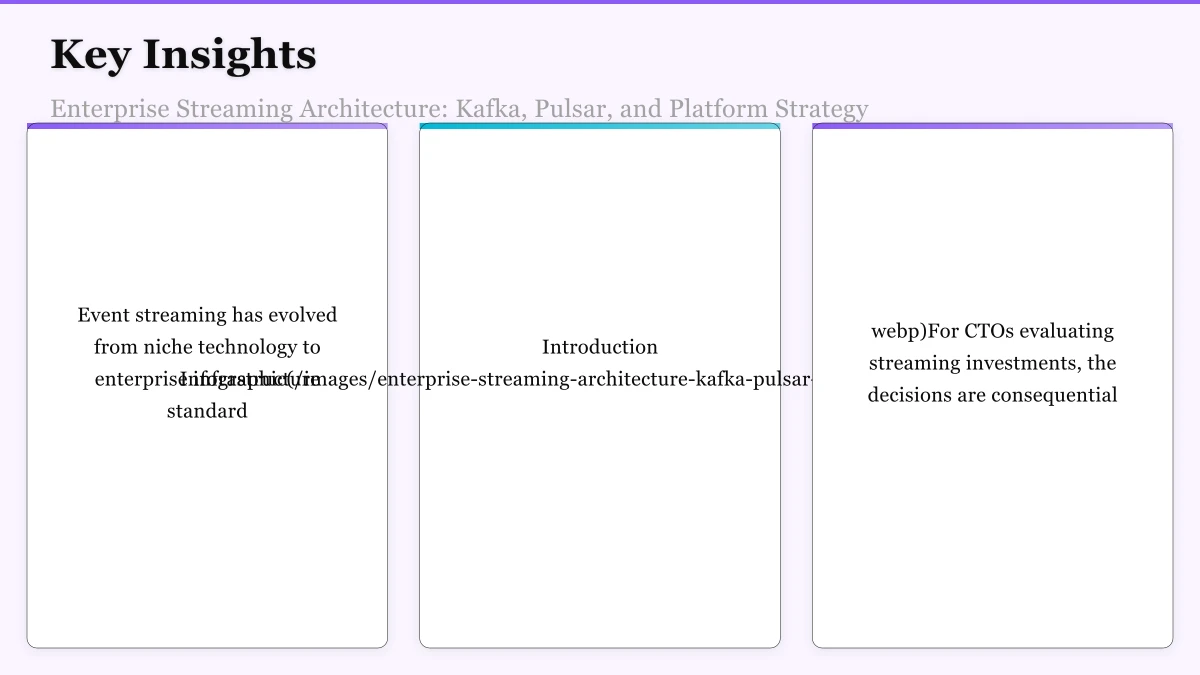
Data Integration
Central nervous system for enterprise data:
- Change data capture from databases
- System-to-system integration
- Data lake and warehouse population
- Third-party data ingestion
Stream Processing
Continuous computation on flowing data:
- Fraud detection with immediate response
- Personalisation engines
- IoT data processing
- Machine learning feature computation
Business Impact Potential
Streaming investment typically delivers value through:
Speed to Insight
- Reducing analytics latency from hours to seconds
- Enabling proactive rather than reactive decisions
- Supporting real-time customer experiences
Operational Efficiency
- Eliminating batch job maintenance burden
- Reducing integration complexity through standardisation
- Enabling self-service data access patterns
New Capabilities
- Real-time personalisation previously impossible
- Event-driven automation opportunities
- Competitive differentiation through responsiveness
Platform Landscape
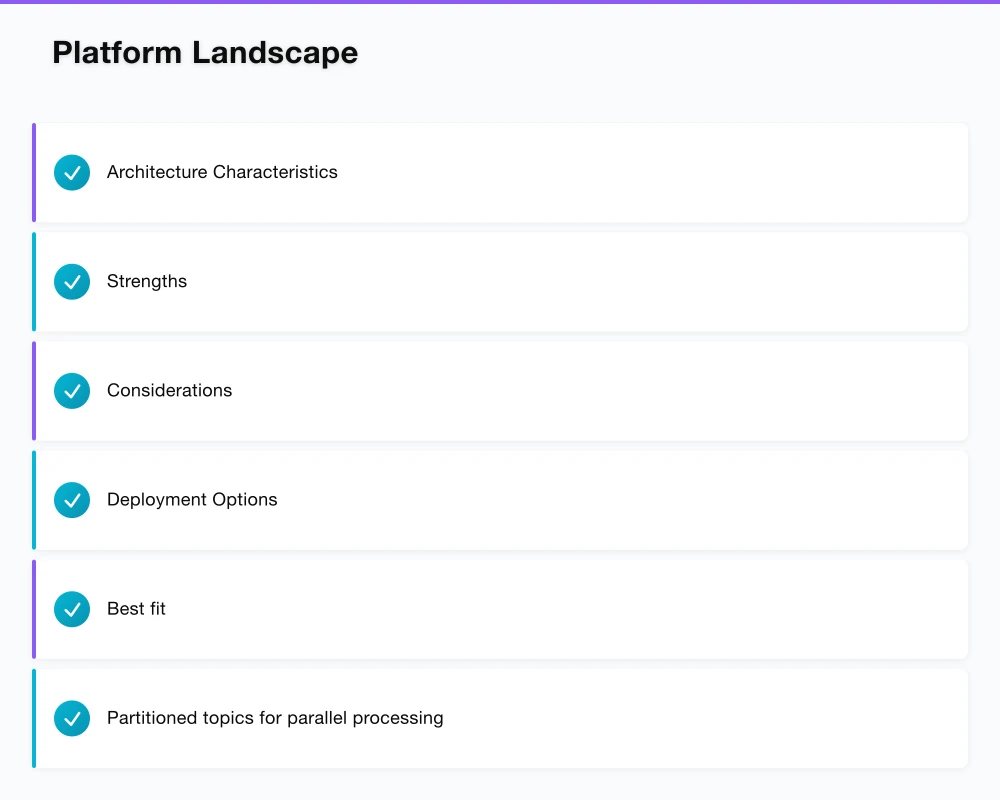
Apache Kafka
The market leader, originally developed at LinkedIn and now stewarded by the Apache Software Foundation with commercial support from Confluent.
Architecture Characteristics
Kafka uses a distributed commit log architecture:
- Partitioned topics for parallel processing
- Consumer groups for scalable consumption
- Replication for fault tolerance
- Log compaction for state management
Strengths
- Ecosystem maturity: Kafka Connect, Kafka Streams, KSQL, extensive third-party integrations
- Performance: Proven at extreme scale (trillions of messages per day at leading tech companies)
- Community: Largest community, most resources, widest talent pool
- Stability: Battle-tested across thousands of production deployments
Considerations
- Operational complexity: Requires expertise for production management
- Storage architecture: Coupled storage and compute, less flexible for some patterns
- Multi-tenancy: Requires careful configuration for isolation
- Geo-replication: Possible but complex to configure correctly
Deployment Options
- Self-managed on infrastructure
- Confluent Cloud (fully managed)
- Amazon MSK (managed Kafka on AWS)
- Azure Event Hubs (Kafka-compatible)
- Instaclustr, Aiven, and other managed providers
Apache Pulsar
Developed at Yahoo and contributed to Apache Foundation, with commercial support from StreamNative.
Architecture Characteristics
Pulsar separates storage and compute:
- Apache BookKeeper for persistent storage
- Stateless broker layer for serving
- Native multi-tenancy with isolation
- Built-in geo-replication
Strengths
- Architecture flexibility: Separated storage enables independent scaling
- Multi-tenancy: Built-in tenant and namespace isolation
- Geo-replication: Native support for cross-region deployment
- Unified messaging: Supports both streaming and queuing patterns
- Tiered storage: Automatic offloading to object storage
Considerations
- Ecosystem maturity: Smaller ecosystem than Kafka, though growing
- Operational complexity: More components to manage (brokers + BookKeeper)
- Community size: Smaller talent pool, fewer resources
- Commercial support: Less extensive than Confluent offerings
Deployment Options
- Self-managed on infrastructure
- StreamNative Cloud (fully managed)
- DataStax Astra Streaming
- Limited cloud provider managed options
Amazon Kinesis
AWS-native streaming service, tightly integrated with AWS ecosystem.
Strengths
- AWS integration: Native connections to Lambda, Firehose, Analytics
- Operational simplicity: Serverless model reduces management
- Scaling: Automatic scaling within limits
- Cost model: Pay-per-use without infrastructure overhead
Considerations
- AWS lock-in: Not portable to other environments
- Capability limitations: Less flexible than Kafka for complex patterns
- Scale constraints: Per-shard limits require careful design
- Ecosystem: Limited to AWS services and partners
Best fit: AWS-committed organisations with moderate scale requirements.
Azure Event Hubs
Microsoft’s managed streaming service with Kafka compatibility.
Strengths
- Azure integration: Native connections to Azure services
- Kafka compatibility: Can migrate existing Kafka workloads
- Enterprise features: Built-in security and compliance
- Serverless tier: Consumption-based pricing option
Considerations
- Azure lock-in: Primary value within Azure ecosystem
- Kafka compatibility gaps: Not 100% feature parity
- Performance variance: Shared infrastructure impacts
Best fit: Azure-committed enterprises seeking managed streaming.
Google Cloud Pub/Sub
Google’s managed messaging service for event-driven systems.
Strengths
- Global scale: Google’s infrastructure backing
- Simplicity: Minimal operational overhead
- GCP integration: Native BigQuery, Dataflow connections
- Serverless: True pay-per-message pricing
Considerations
- Different semantics: Not Kafka-compatible, different API model
- GCP lock-in: Limited value outside GCP
- Ordering limitations: Requires careful design for ordered processing
Best fit: GCP-native workloads prioritising simplicity over flexibility.
Evaluation Framework
Requirements Assessment
Before platform selection, clarify requirements:
Volume and Velocity
- Messages per second (average and peak)
- Message size distribution
- Growth projections over 3-5 years
- Burst handling requirements
Latency Requirements
- End-to-end latency tolerance
- Processing latency budgets
- Delivery guarantee needs (at-least-once, exactly-once)
Durability and Retention
- Data retention requirements
- Compliance and audit needs
- Replay capability requirements
- Recovery time objectives
Operational Context
- Team expertise and preferences
- Existing infrastructure investments
- Multi-cloud or hybrid requirements
- Security and compliance constraints
Comparison Matrix
| Factor | Kafka | Pulsar | Kinesis | Event Hubs |
|---|---|---|---|---|
| Ecosystem | Excellent | Good | AWS-focused | Azure-focused |
| Performance | Excellent | Excellent | Good | Good |
| Operations | Complex | Complex | Simple | Moderate |
| Multi-tenancy | Configuration | Native | Limited | Good |
| Geo-replication | Complex | Native | Limited | Built-in |
| Cost at Scale | Lower | Lower | Higher | Moderate |
| Portability | High | High | AWS-only | Azure-primary |
Decision Framework
Choose Kafka when:
- Ecosystem and community support are priorities
- Team has or can develop Kafka expertise
- Running in multiple cloud environments
- Maximum third-party integration options needed
- Confluent partnership provides value
Choose Pulsar when:
- Multi-tenancy is primary requirement
- Geo-replication is critical from day one
- Tiered storage offers significant cost benefit
- Starting fresh without Kafka investment
- Queue semantics needed alongside streaming
Choose Managed Cloud Services when:
- Minimising operational overhead is priority
- Committed to single cloud provider
- Scale requirements fit within service limits
- Integration with cloud-native services dominates
Architecture Patterns
Event-Driven Microservices
Streaming platforms enable decoupled service communication:
Service A → Event Topic → Service B
                       → Service C
                       → Service D
Design Considerations
- Event schema management and evolution
- Consumer group coordination
- Error handling and dead letter patterns
- Event sourcing and replay capabilities
Best Practices
- Define clear event contracts with schema registry
- Design for consumer failure and retry
- Implement idempotency in consumers
- Plan for schema evolution from the start
Change Data Capture
Stream database changes for downstream consumption:
Database → CDC Connector → Streaming Platform → ConsumersPopular CDC Tools
- Debezium (open source, Kafka Connect based)
- AWS DMS for Kinesis
- Fivetran, Airbyte for managed CDC
Considerations
- Database performance impact
- Schema change handling
- Ordering guarantees
- Initial snapshot management
Real-Time Analytics Pipeline
Feed analytical systems with streaming data:
Sources → Streaming Platform → Stream Processing → Analytics Store
                            → Data Lake/Warehouse
                            → Real-time Dashboards
Processing Options
- Kafka Streams (embedded in applications)
- Apache Flink (dedicated stream processor)
- Spark Streaming (batch-oriented streaming)
- Cloud-native options (Kinesis Analytics, Dataflow)
Hybrid Architecture
Most enterprises combine streaming with existing patterns:
Streaming for:
- Real-time event propagation
- Low-latency integration
- Event sourcing
Batch for:
- Large-scale transformations
- Historical reprocessing
- Cost-optimised analytics
The goal is appropriate tool selection, not dogmatic streaming everywhere.
Production Operations
Capacity Planning
Sizing Considerations
Broker sizing depends on:
- Message throughput requirements
- Message size distribution
- Replication factor
- Consumer parallelism needs
- Storage retention period
Scaling Patterns
Kafka:
- Add brokers and rebalance partitions
- Increase partition count (one-way operation)
- Separate clusters for isolation
Pulsar:
- Scale brokers independently from storage
- Add BookKeeper nodes for capacity
- Leverage tiered storage for cost
Cost Optimisation
- Right-size retention periods
- Use tiered storage where available
- Optimise message formats (compression, serialisation)
- Monitor and eliminate unused topics
Monitoring and Observability
Key Metrics
Platform health:
- Broker availability and leadership distribution
- Replication lag and under-replicated partitions
- Request latency (produce, consume)
- Disk and memory utilisation
Consumer health:
- Consumer lag by group and partition
- Processing throughput
- Error rates and retries
- Rebalance frequency
Tooling
- Prometheus/Grafana for metrics
- Confluent Control Center or equivalent
- Custom dashboards for business metrics
- Alerting for operational thresholds
Security Implementation
Authentication
- SASL mechanisms (SCRAM, OAUTHBEARER, Kerberos)
- TLS client certificates
- Cloud provider IAM integration
Authorisation
- ACLs for topic-level access control
- RBAC for administrative operations
- Integration with enterprise identity systems
Encryption
- TLS for data in transit
- At-rest encryption for persistent storage
- Key management integration
Compliance
- Audit logging for access and operations
- Data classification and handling
- Retention policy enforcement
- Cross-border data considerations
Disaster Recovery
Recovery Objectives
Define requirements:
- RPO (Recovery Point Objective): How much data loss is acceptable?
- RTO (Recovery Time Objective): How quickly must service restore?
Replication Strategies
Kafka:
- MirrorMaker 2 for cross-cluster replication
- Confluent Replicator for commercial option
- Consider replication lag in RPO calculations
Pulsar:
- Native geo-replication between clusters
- Synchronous or asynchronous options
- Built-in failover capabilities
Recovery Procedures
- Documented failover processes
- Regular DR testing
- Automated failover where appropriate
- Client reconfiguration strategies
Organisational Readiness
Team Capabilities
Successful streaming requires expertise:
Core Skills
- Distributed systems fundamentals
- Platform administration and tuning
- Performance analysis and optimisation
- Security configuration
Development Skills
- Event-driven design patterns
- Schema management
- Consumer implementation best practices
- Testing approaches for streaming
Build vs Buy
Consider managed services if:
- Limited streaming expertise available
- Operational simplicity prioritised
- Scale fits within managed service limits
- Budget allows for premium pricing
Invest in self-managed if:
- Scale economics favour self-hosting
- Customisation requirements exist
- Multi-cloud deployment needed
- Team expertise available or buildable
Governance Framework
Platform Standards
Establish and enforce:
- Topic naming conventions
- Schema requirements and registry usage
- Retention and partitioning standards
- Security baseline configurations
Change Management
Control changes that affect consumers:
- Schema evolution policies
- Breaking change communication
- Topic lifecycle management
- Consumer coordination
Cost Management
Track and allocate costs:
- Chargeback by team or application
- Usage monitoring and optimisation
- Budget alerting and controls
Implementation Roadmap
Phase 1: Foundation (Months 1-3)
Infrastructure
- Deploy platform in non-production
- Establish monitoring and alerting
- Configure security baseline
- Document operational procedures
Enablement
- Train core team on platform
- Develop internal documentation
- Create starter templates
- Establish support model
Pilot
- Select low-risk use case
- Implement end-to-end
- Validate operational readiness
- Gather lessons learned
Phase 2: Expansion (Months 4-9)
Production Deployment
- Promote to production environment
- Implement disaster recovery
- Establish SLAs and monitoring
- Build operational runbooks
Use Case Expansion
- Onboard additional applications
- Develop patterns and libraries
- Create self-service capabilities
- Expand team expertise
Governance
- Implement topic lifecycle management
- Deploy schema registry
- Establish change management
- Create cost tracking
Phase 3: Optimisation (Months 10-12+)
Scale and Performance
- Tune for production workloads
- Optimise resource utilisation
- Implement auto-scaling where possible
- Address operational pain points
Advanced Capabilities
- Stream processing implementations
- Complex event processing
- Real-time ML feature stores
- Event sourcing patterns
Platform Maturity
- Self-service onboarding
- Internal platform as a product
- Continuous improvement process
- Advanced monitoring and automation
Strategic Recommendations
For Greenfield Implementations
Starting fresh offers flexibility:
- Start with clear use cases rather than building infrastructure seeking applications
- Choose managed services initially to reduce operational burden
- Establish governance early before technical debt accumulates
- Plan for growth but don’t over-engineer for hypothetical scale
For Migration from Existing Systems
Moving from legacy integration:
- Map current integration patterns to understand full scope
- Prioritise by value and complexity for migration sequencing
- Run parallel systems during transition with careful cutover
- Preserve optionality for rollback during migration
Platform Strategy
For enterprise-wide streaming:
- Standardise on primary platform to consolidate expertise
- Allow exceptions with justification for specific requirements
- Invest in platform team to support adoption
- Treat platform as product with roadmap and stakeholder management
Conclusion
Streaming platforms represent fundamental infrastructure for modern enterprises. The shift from batch to real-time, from point-to-point to event-driven, from rigid to responsive—streaming enables all of these transformations.
The platform selection decision should match organisational context: technical requirements, team capabilities, existing investments, and strategic direction. Kafka remains the safe choice with maximum ecosystem support. Pulsar offers architectural advantages for specific requirements. Managed services trade flexibility for operational simplicity.
Whatever platform is selected, success depends on operational maturity, clear governance, and sustained investment in team capabilities. The technology is proven—the challenge is organisational readiness to leverage it effectively.
Sources
- Confluent. (2025). State of Data Streaming Report. Confluent Research.
- Apache Software Foundation. (2025). Apache Kafka Documentation. https://kafka.apache.org/documentation/
- Apache Software Foundation. (2025). Apache Pulsar Documentation. https://pulsar.apache.org/docs/
- Narkhede, N., Shapira, G., & Palino, T. (2023). Kafka: The Definitive Guide, 2nd Edition. O’Reilly Media.
Strategic guidance for technology leaders building real-time data infrastructure.
For the practitioner’s view on cloud, IT, and cybersecurity, explore Cloud Geeks — where strategy meets infrastructure.
My consultancy Ganda Tech Services operates three specialist divisions covering cloud infrastructure, web development, and mobile apps for Australian businesses.
About the Author
Ashish Ganda is the founder of Ganda Tech Services, a Sydney-based technology consultancy specialising in cloud infrastructure, web development, and mobile app solutions for Australian businesses.
Digital Transformation Roadmap 2026
A 12-month framework for Australian SMBs ready to modernise — phases, tools, and milestones.