Enterprise Database Sharding: A Strategic Guide to Horizontal Scaling
Introduction
Every successful application eventually confronts database scaling limits. The single-instance database that served admirably during growth becomes a bottleneck as transaction volumes climb, data accumulates, and latency requirements tighten. Vertical scaling—bigger servers, faster storage—provides temporary relief but eventually reaches physical and economic limits.
Sharding—distributing data across multiple database instances—offers horizontal scalability that vertical approaches cannot match. Yet sharding introduces significant complexity: distributed transactions, cross-shard queries, data redistribution, and operational overhead that makes previously simple tasks complicated.
The decision to shard and the approach chosen have profound implications for application architecture, development velocity, operational burden, and ultimately, business agility. This guide examines how enterprise technology leaders approach sharding decisions, the implementation strategies that succeed, and the alternatives that may better serve specific contexts.
When Sharding Becomes Necessary
Recognising Scaling Limits
Several signals indicate approaching single-instance limits:
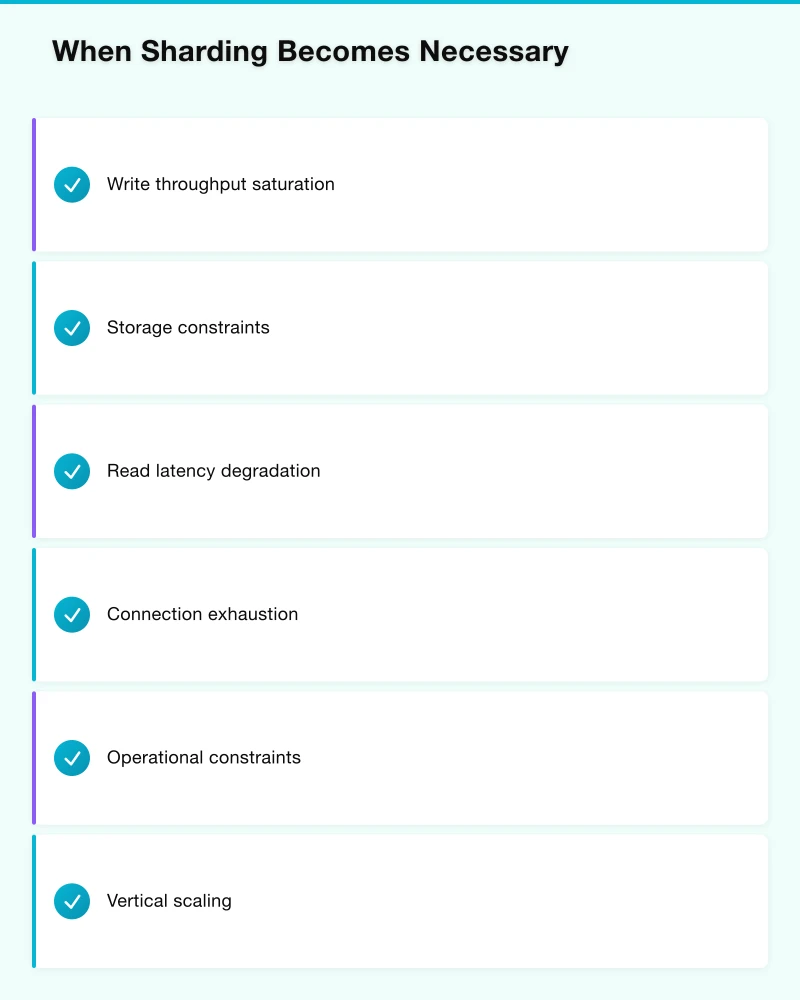
Write throughput saturation: Write operations competing for locks, replication lag increasing, transaction response times growing
Storage constraints: Dataset approaching single-node storage limits (typically in the multi-terabyte range for traditional RDBMS)
Read latency degradation: Indexes growing too large for memory, query plans becoming inefficient, cache hit rates declining
Connection exhaustion: Application instances competing for limited database connections
Operational constraints: Backup windows expanding, maintenance operations impacting availability, recovery times exceeding requirements
Exhausting Alternatives First
Sharding is expensive in complexity. Before committing, exhaust simpler approaches:
Vertical scaling: Larger instances, faster storage (NVMe), more memory. Cloud providers offer increasingly powerful instances. A single well-optimised PostgreSQL instance can handle millions of transactions per hour.
Read replicas: Offload read traffic to replicas, reducing primary load. Works well when read-to-write ratios are high.
Query optimisation: Inefficient queries often cause scaling problems. Proper indexing, query rewrites, and schema optimisation can provide substantial headroom.
Caching layers: Redis or Memcached can absorb read traffic, reducing database load dramatically.
Connection pooling: PgBouncer, ProxySQL, or application-level pooling reduces connection overhead.
Archival strategies: Move historical data to cold storage. Active datasets are often a fraction of total data.
If these approaches are insufficient, sharding becomes the path forward.
The Build vs Buy Decision
Before implementing custom sharding, consider managed alternatives:
Distributed databases: CockroachDB, TiDB, YugabyteDB provide PostgreSQL/MySQL compatibility with built-in distribution. They trade some single-node performance for automatic scaling.
Cloud-native solutions: Amazon Aurora, Azure Hyperscale, Google Spanner offer managed scaling beyond traditional limits.
Application-level partitioning: Some applications naturally partition (multi-tenant SaaS, geographically distributed systems) and can use separate database instances without true sharding.
Custom sharding makes sense when:
- Existing investments in specific database technology are substantial
- Performance requirements demand optimisation that general solutions don’t provide
- Data sovereignty requirements preclude certain managed options
- Operational expertise already exists for the database platform
Sharding Strategy Selection
Shard Key Design
The shard key—the attribute that determines which shard holds each record—is the most consequential sharding decision. It determines:
- How evenly data distributes across shards
- Which queries can be satisfied by single shards
- Whether related data co-locates
- How costly redistribution will be
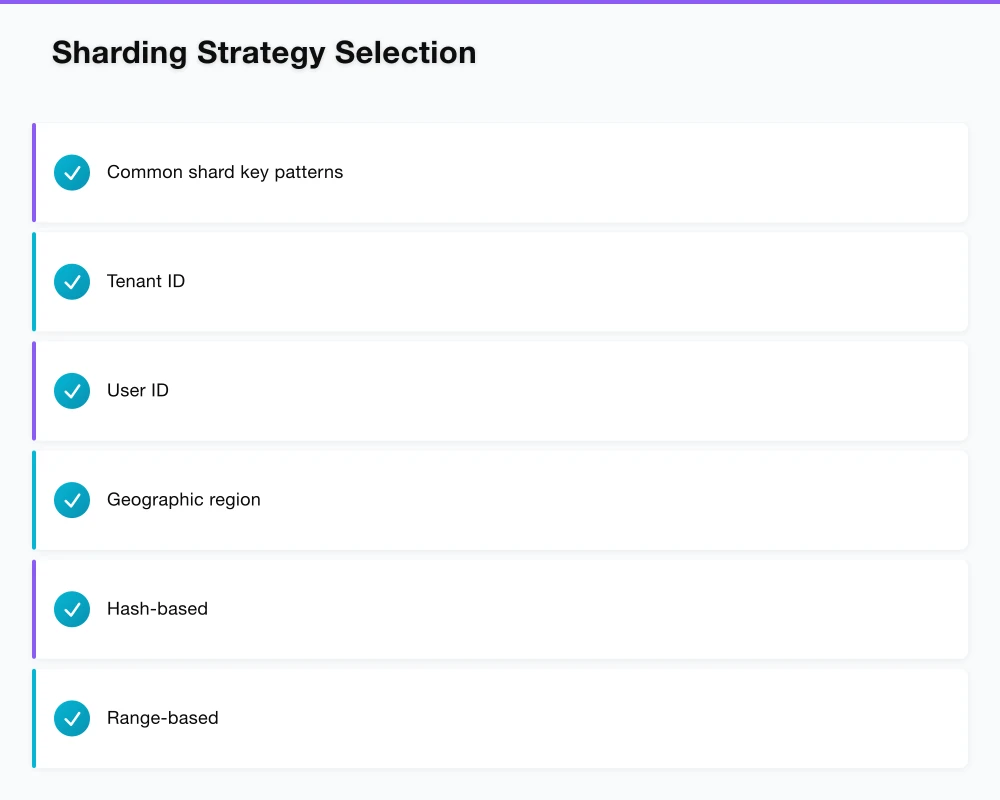
Common shard key patterns:
Tenant ID (multi-tenant applications): All data for a tenant on one shard. Queries within a tenant are local. Works well when tenants have similar sizes.
User ID: Similar to tenant ID but for consumer applications. Each user’s data is co-located.
Geographic region: Data localised to user geography. Supports data residency requirements and reduces latency.
Hash-based: Hash of primary key distributed uniformly. Prevents hotspots but eliminates co-location benefits.
Range-based: Sequential ranges on each shard. Supports range queries but risks hotspots on growing ranges.
Composite: Multiple attributes combined (e.g., tenant + date). Balances co-location with distribution.
Shard key selection criteria:
- High cardinality: Enough distinct values to distribute evenly
- Query alignment: Most queries include the shard key
- Stability: The key shouldn’t change after creation
- Even distribution: Avoids hotspot shards
- Growth accommodation: Supports adding shards without full redistribution
Sharding Approaches
Application-level sharding: Application code determines shard routing. Provides maximum control but embeds sharding logic throughout the codebase.
Proxy-based sharding: A proxy layer routes queries to appropriate shards. Applications connect to the proxy like a regular database. Examples include Vitess (MySQL) and Citus (PostgreSQL).
Database-native sharding: Some databases support built-in sharding. PostgreSQL has declarative partitioning; MySQL has NDB Cluster.
Enterprise Recommendation
For most enterprises, proxy-based sharding provides the best balance:
- Application changes are minimised
- Sharding logic is centralised
- Operational tooling integrates with the proxy
- Migration from single-instance is manageable
Vitess, developed at YouTube and now a CNCF project, has emerged as the leading proxy-based MySQL sharding solution. Citus (now part of Microsoft) provides similar capabilities for PostgreSQL.
Data Co-location Strategies
Effective sharding keeps related data together:
Parent-child co-location: Orders and order items on the same shard, keyed by order ID. Queries for an order’s items are local.
Reference table replication: Small, rarely-changing tables (countries, currencies, status codes) replicated to all shards. Joins remain local.
Denormalisation: Duplicate data to avoid cross-shard joins. Accept some inconsistency risk for performance.
Application-level joins: Retrieve from multiple shards and join in application code. Acceptable for analytical queries, problematic for transactional workloads.
Implementation Architecture
Routing and Query Processing
Routing layer responsibilities:
- Parse incoming queries
- Extract shard key from query predicates
- Route to appropriate shard(s)
- Aggregate results from scatter-gather queries
- Handle cross-shard transactions (if supported)
Query types by complexity:
Single-shard queries (ideal): Query includes shard key, routes to one shard, executes as normal.
Scatter-gather queries (acceptable for reads): Query lacks shard key, executes on all shards, results aggregated. Performance degrades with shard count.
Cross-shard transactions (problematic): Transactions spanning shards require distributed coordination. Two-phase commit adds latency and failure complexity.
Schema Management
Sharded environments require coordinated schema changes:
Online DDL: Tools like gh-ost (MySQL) or pg-repack (PostgreSQL) enable schema changes without locking.
Rolling deployments: Apply schema changes to one shard at a time, validating before proceeding.
Backward compatibility: Schema changes must maintain compatibility with running application versions during rollout.
Schema versioning: Track which schema version each shard runs, coordinating application deployments accordingly.
Vitess provides sophisticated schema management, including diff detection and coordinated rollout across shards.
Rebalancing and Resharding
As data grows or distribution skews, shards need rebalancing:
Adding shards: Split existing shards to accommodate growth. Requires data migration and routing updates.
Removing shards: Consolidate when utilisation is low. Less common but necessary for cost optimisation.
Rebalancing: Move data between shards when distribution becomes uneven.
Approaches:
Background migration: Copy data to new shard while serving from old. Cut over when synchronised. Requires application awareness of migration state.
Double-write: Write to both old and new locations during migration. More complex but enables simpler cutover.
Online resharding: Vitess and similar systems support online resharding with minimal application impact.
Resharding is operationally expensive. Design shard counts with future growth in mind—better to start with more shards than to reshard frequently.
Operational Considerations
Monitoring and Observability
Sharded systems require enhanced monitoring:
Per-shard metrics:
- Query latency distribution
- Connection utilisation
- Storage growth rate
- Replication lag (if using replicas)
- Lock contention
Cross-shard metrics:
- Scatter-gather query frequency
- Data distribution skew
- Total query throughput
- Cross-shard transaction rates
Alerting strategy:
- Individual shard health
- Distribution imbalance thresholds
- Aggregate performance degradation
- Capacity thresholds per shard
Backup and Recovery
Traditional backup strategies don’t apply directly:
Challenges:
- Point-in-time recovery requires coordination across shards
- Backup timing may create inconsistency
- Recovery testing must validate cross-shard consistency
Approaches:
Consistent snapshots: Pause writes across all shards, snapshot, resume. Creates availability impact.
Transaction log coordination: Use logical replication or change data capture to establish consistent points.
Shard-level backups with reconciliation: Accept that restoring individual shards may create temporary inconsistencies; design application to handle.
Disaster Recovery
Multi-shard disaster recovery adds complexity:
Geographic distribution: Shards distributed across regions for resilience. Adds latency for cross-region queries.
Failover coordination: When a shard fails, traffic must route to replicas. Coordination ensures consistency.
Recovery time objectives: Per-shard recovery is faster than full-system recovery. Plan accordingly.
Testing: Regular DR testing must cover multi-shard failure scenarios.
Connection Management
Connection pooling becomes critical at scale:
Per-shard pooling: Application or proxy maintains pools to each shard. Pool sizing must account for total connection budget across shards.
Proxy-level pooling: Vitess and similar proxies pool connections, reducing per-application-instance requirements.
Connection limits: Total connections = shards × replicas × application instances. Math grows quickly.
Common Challenges and Mitigations
Cross-Shard Queries
The challenge: Queries without shard keys scatter to all shards, creating load and latency.
Mitigations:
- Design schema to include shard key in common query patterns
- Maintain secondary indexes or search systems for cross-shard queries
- Accept that some queries will be expensive; monitor and optimise
- Use read replicas for analytical queries that must scatter
Distributed Transactions
The challenge: Transactions spanning shards require two-phase commit or similar coordination, adding latency and failure modes.
Mitigations:
- Design to avoid cross-shard transactions where possible
- Use eventual consistency where business requirements allow
- Implement saga patterns for complex workflows
- Accept some inconsistency window with compensation logic
Hotspot Shards
The challenge: Uneven distribution concentrates load on specific shards.
Mitigations:
- Choose high-cardinality shard keys
- Monitor distribution metrics and rebalance proactively
- Implement split strategies for oversized shards
- Use consistent hashing to distribute more evenly
Operational Complexity
The challenge: Every operation becomes N operations across shards.
Mitigations:
- Automate operations with tooling designed for sharded environments
- Use managed services where appropriate
- Invest in operational tooling and runbooks
- Build expertise through gradual rollout
Migration Strategy
Phased Approach
Moving from single-instance to sharded architecture should be incremental:
Phase 1: Preparation
- Implement proxy layer between application and database
- Establish monitoring for sharding-relevant metrics
- Audit queries for shard key presence
- Identify and refactor problematic access patterns
Phase 2: Shadow Mode
- Route traffic through proxy to single-instance
- Validate proxy correctness with production traffic
- Identify queries that would scatter or require cross-shard transactions
Phase 3: Pilot Sharding
- Shard a single table or subset of data
- Run in shadow mode comparing results
- Build operational experience with limited scope
Phase 4: Full Migration
- Extend sharding to remaining data
- Migrate data to new shard topology
- Cut over traffic incrementally
- Maintain rollback capability throughout
Phase 5: Optimisation
- Tune shard count and distribution
- Refine query patterns based on production experience
- Automate operational procedures
Rollback Planning
Every migration phase should have a rollback path:
- Maintain ability to return to single-instance
- Keep data synchronised bidirectionally during transition
- Test rollback procedures before cutover
- Define decision criteria for when to rollback
Alternative Approaches
NewSQL Databases
Distributed SQL databases handle sharding automatically:
CockroachDB: PostgreSQL-compatible, globally distributed, serializable transactions across regions.
TiDB: MySQL-compatible, HTAP capable, automatic horizontal scaling.
YugabyteDB: PostgreSQL/Cassandra compatible, geographic distribution.
Tradeoffs:
- Lower single-node performance than traditional RDBMS
- Operational complexity of distributed systems
- Relative immaturity compared to PostgreSQL/MySQL
- Strong consistency across shards at latency cost
When to consider:
- Starting fresh without legacy database investment
- Geographic distribution is primary requirement
- Development velocity valued over raw performance
- Operational team is small, favouring managed complexity
Database-Specific Scaling
PostgreSQL options:
- Citus for sharding with PostgreSQL compatibility
- Native partitioning for single-node data distribution
- Amazon Aurora PostgreSQL for managed scaling
MySQL options:
- Vitess for proxy-based sharding
- ProxySQL for connection management and simple routing
- Amazon Aurora MySQL for managed scaling
Polyglot Persistence
Sometimes the answer isn’t sharding a single database but distributing across purpose-built systems:
- Transactional data in RDBMS
- High-volume time-series in specialised stores
- Search workloads in Elasticsearch
- Caching in Redis
- Analytics in data warehouses
Polyglot persistence trades consistency for specialisation—each system optimised for its workload.
Decision Framework
Should You Shard?
Yes, if:
- Vertical scaling is economically prohibitive
- Read replicas and caching don’t address write bottlenecks
- Data volumes genuinely exceed single-node capacity
- You have operational expertise to manage complexity
- Your access patterns align well with sharding
No, if:
- Query patterns require frequent cross-shard operations
- Transactional requirements span would-be shard boundaries
- The team lacks distributed systems experience
- Managed alternatives can meet requirements
- Current performance is adequate with optimisation
Shard Key Selection Checklist
- Is cardinality sufficient for even distribution?
- Do most queries include this attribute?
- Will the attribute remain stable over record lifetime?
- Can related data be co-located using this key?
- Does this support future growth patterns?
Implementation Readiness
- Is the development team trained on distributed systems patterns?
- Are operational runbooks prepared for multi-shard scenarios?
- Is monitoring infrastructure ready for per-shard visibility?
- Have DR and backup strategies been validated?
- Is there budget for increased operational overhead?
Conclusion
Database sharding is a powerful scaling technique that, when appropriately applied, enables systems to grow beyond what any single database instance can support. However, it introduces substantial complexity that affects every aspect of application development and operations.
The decision to shard should come after exhausting simpler alternatives and with clear understanding of the ongoing costs. Application-level sharding embeds distribution logic throughout the codebase. Proxy-based sharding centralises routing but requires new operational expertise. Distributed SQL databases automate sharding but sacrifice some single-node performance.
For CTOs, the strategic considerations extend beyond technical implementation. Sharding affects development velocity—cross-shard features take longer to build. It affects operational burden—more components mean more potential failures. It affects team skills—distributed systems expertise becomes essential.
The enterprises that succeed with sharding approach it as an architectural evolution rather than a point solution. They invest in team training, operational tooling, and observability infrastructure. They design shard keys carefully, understanding that this decision constrains future flexibility. They plan for resharding, knowing that initial decisions may need revision as business requirements evolve.
Database scaling challenges will only increase as data volumes grow and real-time requirements intensify. Technology leaders who understand sharding’s tradeoffs can make informed decisions about when and how to deploy this powerful but demanding capability.
Sources
- Kleppmann, M. (2017). Designing Data-Intensive Applications. O’Reilly Media.
- Vitess. (2025). Vitess Documentation: Sharding. https://vitess.io/docs/concepts/shard/
- Percona. (2024). MySQL Sharding Best Practices. Percona.
- Google Cloud. (2025). Database Sharding Patterns. https://cloud.google.com/architecture/database-sharding
- CockroachDB. (2025). Distributed SQL Database Architecture. https://www.cockroachlabs.com/docs/
Strategic guidance for technology leaders scaling database infrastructure at enterprise scale.
Strategy needs execution. Cloud Geeks publishes practical cloud computing and cybersecurity guides for Australian businesses ready to act.
I lead Ganda Tech Services, where we turn digital strategy into results through specialist cloud, web design, and mobile app teams across Sydney.
About the Author
Ashish Ganda is the founder of Ganda Tech Services, a Sydney-based technology consultancy specialising in cloud infrastructure, web development, and mobile app solutions for Australian businesses.
Digital Transformation Roadmap 2026
A 12-month framework for Australian SMBs ready to modernise — phases, tools, and milestones.