Enterprise RAG Architecture: Transforming Knowledge Management at Scale
Enterprise knowledge management has reached an inflection point. After decades of failed attempts to capture institutional knowledge through wikis, intranets, and document management systems, Retrieval-Augmented Generation is delivering what previous technologies promised but never achieved: making organizational knowledge truly accessible and actionable.
The shift is profound. Where traditional knowledge management required users to know exactly what they were looking for and navigate complex taxonomies, RAG systems understand natural language queries, synthesize information from multiple sources, and generate contextually relevant responses. For CTOs, this represents both a significant technical undertaking and a transformational business opportunity.
Why RAG Matters for Enterprise Knowledge
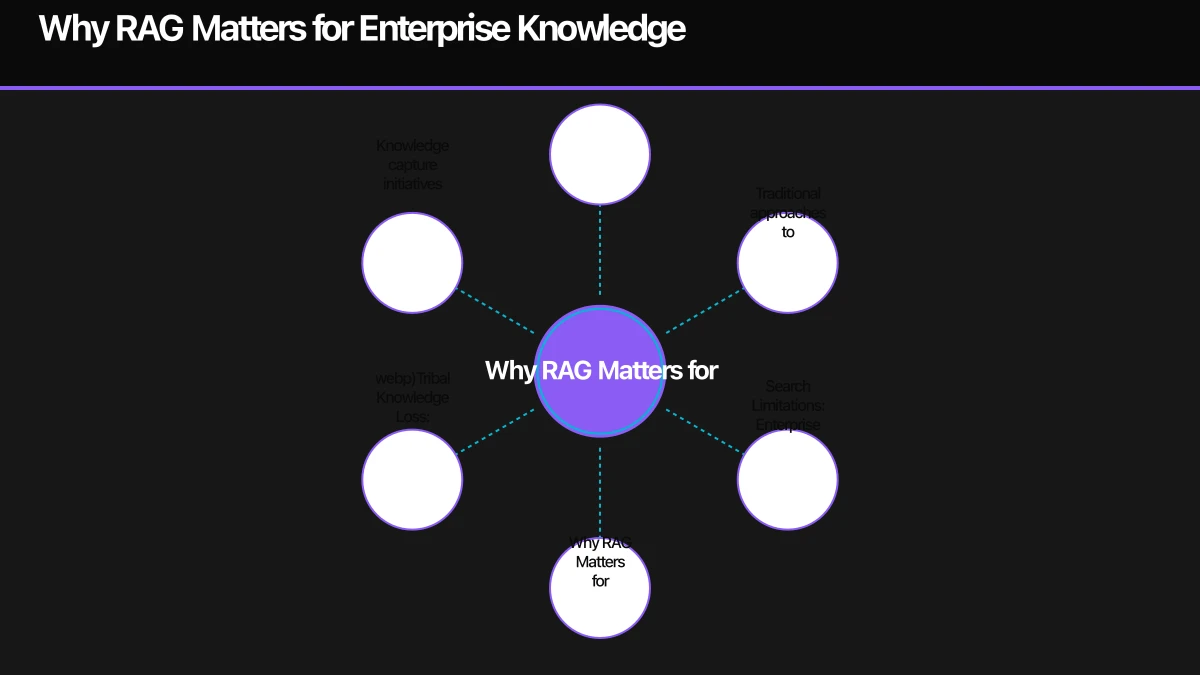
Organizations accumulate vast stores of institutional knowledge: technical documentation, project histories, customer interactions, research findings, policy decisions, and operational insights. Traditional approaches to surfacing this knowledge have consistently underperformed.
Search Limitations: Enterprise search engines index documents but struggle with context and intent. Searching for “customer onboarding issues” might return thousands of documents without synthesizing the actual patterns and solutions buried within them.
Tribal Knowledge Loss: Critical expertise resides in employees’ heads, walking out the door with every departure. Knowledge capture initiatives rarely succeed because documentation requires effort while providing limited benefit to the documenter.
Information Overload: Even when knowledge is documented, finding relevant information requires knowing where to look and having time to synthesize multiple sources. Decision-makers often operate with incomplete information because comprehensive research is impractical.
RAG fundamentally changes this dynamic by combining large language models’ natural language understanding with precise retrieval from enterprise knowledge stores. Users ask questions in plain language. The system retrieves relevant context from organizational data sources. The LLM synthesizes this context into coherent, actionable responses.
RAG Architecture Fundamentals
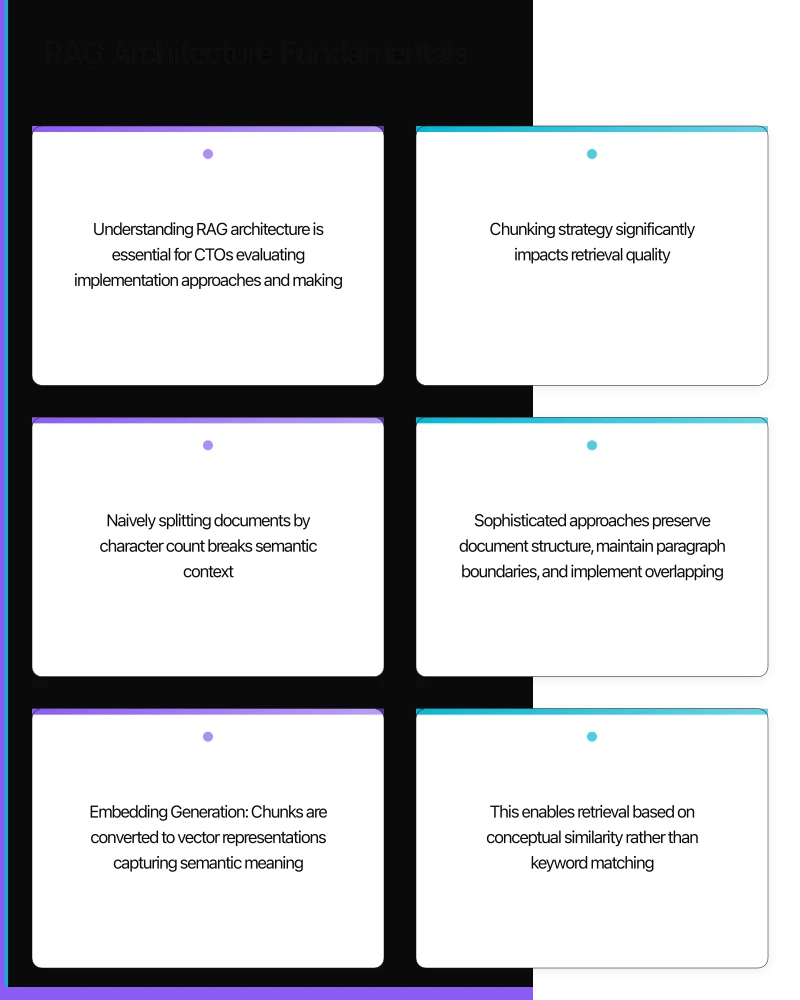
Understanding RAG architecture is essential for CTOs evaluating implementation approaches and making informed build-versus-buy decisions.
The Retrieval Pipeline
RAG systems begin with ingestion: converting enterprise documents, databases, and data sources into formats suitable for semantic retrieval.
Document Processing: Raw documents undergo extraction (handling PDFs, Office documents, HTML, and specialized formats), chunking (splitting documents into semantically coherent segments), and enrichment (adding metadata, classifications, and relationships).
Chunking strategy significantly impacts retrieval quality. Naively splitting documents by character count breaks semantic context. Sophisticated approaches preserve document structure, maintain paragraph boundaries, and implement overlapping chunks ensuring context continuity.
Embedding Generation: Chunks are converted to vector representations capturing semantic meaning. This enables retrieval based on conceptual similarity rather than keyword matching. A query about “reducing customer churn” retrieves relevant content even if source documents discuss “improving retention” or “decreasing attrition.”
Leading embedding models have evolved significantly through 2025. OpenAI’s text-embedding-3-large remains popular for general purpose applications, while specialized models from Cohere and Jina AI optimize for specific use cases. Open-source alternatives including Nomic Embed and BGE-M3 provide comparable quality with deployment flexibility.
Vector Storage: Embeddings require specialized storage enabling fast similarity search across potentially billions of vectors. The vector database landscape has matured considerably, with enterprise-ready options including Pinecone, Weaviate, Qdrant, and Milvus. Cloud providers have integrated vector capabilities into existing databases, with PostgreSQL’s pgvector extension and MongoDB Atlas Vector Search offering familiar operational models.
The Generation Pipeline
Retrieved context flows into the generation pipeline, where large language models synthesize responses.
Context Assembly: The retrieval pipeline returns ranked results. Context assembly determines what information reaches the LLM, typically constrained by context window limits. Strategies include selecting top-k results, re-ranking using cross-encoder models, and implementing maximum marginal relevance to ensure diversity.
Prompt Engineering: System prompts establish response parameters: tone, format, citation requirements, and handling of uncertain or conflicting information. Prompt engineering for enterprise RAG requires careful attention to hallucination mitigation, source attribution, and appropriate hedging when evidence is limited.
Response Generation: The LLM generates responses grounded in retrieved context. Temperature settings balance creativity against factual precision. Enterprise applications typically use lower temperatures prioritizing accuracy over novelty.
Post-Processing: Generated responses undergo validation for factual grounding, format compliance, and safety filtering. Advanced implementations implement fact-checking pipelines comparing claims against retrieved sources.
Enterprise RAG Patterns
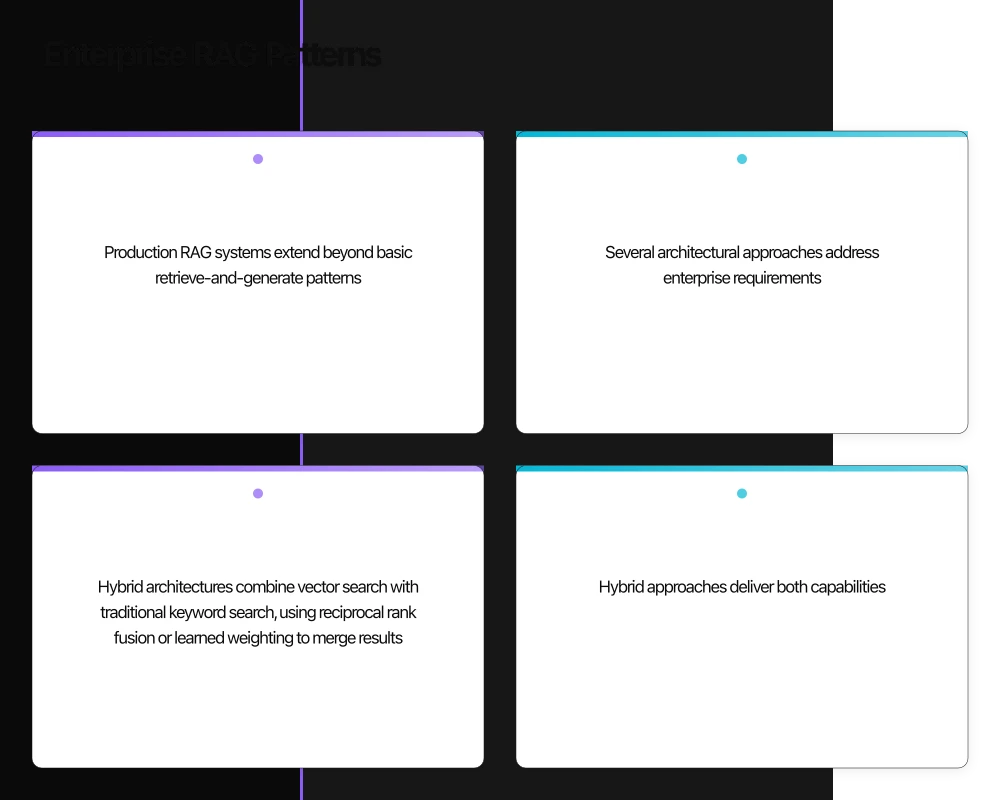
Production RAG systems extend beyond basic retrieve-and-generate patterns. Several architectural approaches address enterprise requirements.
Hybrid Search
Pure vector search excels at semantic similarity but struggles with specific identifiers, technical terms, and exact-match requirements. Hybrid architectures combine vector search with traditional keyword search, using reciprocal rank fusion or learned weighting to merge results.
Financial services organizations implementing RAG for regulatory document retrieval, for instance, require exact matching for regulation numbers and section references while benefiting from semantic understanding for conceptual queries. Hybrid approaches deliver both capabilities.
Multi-Index Architectures
Enterprises maintain diverse knowledge stores with different characteristics. Technical documentation differs from customer support conversations, which differ from financial reports. Multi-index architectures maintain separate retrieval indices with specialized processing pipelines, routing queries to appropriate indices based on intent classification.
A product engineering organization might maintain indices for code documentation, architectural decision records, customer feedback, and incident reports. Queries about system design retrieve from architecture indices. Customer problem inquiries search support and feedback repositories.
Agentic RAG
Complex queries require multiple retrieval steps, with initial results informing subsequent searches. Agentic RAG architectures implement LLM-powered agents that decompose complex questions, execute iterative retrieval strategies, and synthesize multi-step findings.
Consider a query like “What were the key factors in our successful Australian market entry and how might they apply to our planned Singapore expansion?” This requires retrieving Australian market analysis, identifying success factors, understanding Singapore market context, and synthesizing applicable insights. Agentic architectures handle this complexity through automated query decomposition and iterative retrieval.
Graph-Augmented RAG
Knowledge graphs capture relationships between entities: people, products, concepts, and events. Graph-augmented RAG combines vector retrieval with graph traversal, enriching context with relational information.
For enterprise applications, this enables queries like “Who has expertise in our payment processing integration?” to return not just documentation mentioning payment processing but people associated with relevant projects, their team structures, and related technical capabilities.
Data Strategy for Enterprise RAG
RAG system effectiveness depends fundamentally on data quality and coverage. Technical architecture alone cannot compensate for inadequate knowledge foundations.
Source Identification and Prioritization
Enterprises typically underestimate the scope of valuable knowledge repositories. Beyond obvious sources like documentation wikis and SharePoint, valuable knowledge resides in:
- Email threads and meeting recordings
- Slack channels and Teams conversations
- Support tickets and customer interaction logs
- Project management tools and issue trackers
- Code repositories and technical specifications
- Legacy document management systems
Prioritization should balance knowledge value against accessibility and processing complexity. High-value, easily accessible sources provide early wins. Complex sources with unique knowledge justify additional investment.
Data Quality and Governance
RAG systems inherit data quality problems from source systems, potentially amplifying them through confident-sounding responses based on inaccurate information. Data governance for RAG requires:
Source Authority: Establishing which sources are authoritative for specific topics prevents conflicting information from creating inconsistent responses. Product specifications from the engineering database should override marketing collateral.
Currency Tracking: Time-sensitive information requires freshness indicators. RAG responses about current pricing or policy should cite recent sources, with appropriate caveats for potentially outdated information.
Access Control Alignment: RAG systems must respect source access controls. Information restricted to specific roles or classifications should remain restricted when surfaced through RAG interfaces.
Continuous Knowledge Capture
Static knowledge bases degrade quickly as organizations evolve. Sustainable RAG deployments implement continuous knowledge capture:
Automated Ingestion Pipelines: Source systems trigger ingestion when content changes, maintaining index currency without manual intervention.
Conversation Mining: User interactions with RAG systems reveal knowledge gaps. Questions without satisfactory answers indicate areas requiring knowledge capture investment.
Expert Contribution Workflows: Making knowledge contribution frictionless increases capture rates. Integration with existing workflows (capturing Slack explanations, meeting insights, code review discussions) reduces documentation burden.
Security and Compliance Considerations
Enterprise RAG deployments require careful attention to security, privacy, and regulatory compliance.
Data Protection
RAG systems aggregate information from multiple sources, creating potential for unintended data exposure. Security architecture must address:
Embedding Security: Vector embeddings can potentially be reverse-engineered to recover source content. Sensitive data requires appropriate protection even in embedded form.
Retrieval Access Control: Query results must respect source document permissions. A user without access to confidential HR policies should not receive RAG responses drawing on those policies.
LLM Data Handling: Using external LLM providers raises data residency and confidentiality concerns. Many enterprises require on-premises or private cloud deployments for sensitive knowledge bases.
Regulatory Compliance
Specific industries face additional requirements:
Healthcare (HIPAA): Patient information in knowledge bases requires stringent access controls and audit trails.
Financial Services: Regulations governing customer data, trading communications, and financial advice apply to RAG-generated responses.
Legal: Attorney-client privilege and work product protections must extend to RAG systems accessing legal matter information.
Audit and Explainability
Regulated environments require demonstrating how RAG systems arrive at specific responses. Implementation should capture:
- Query text and user context
- Retrieved sources with relevance scores
- Context provided to the LLM
- Generated response with timestamp
- Any post-processing modifications
This enables investigating problematic responses, demonstrating reasoning, and improving system quality over time.
Implementation Approach
RAG implementations benefit from iterative approaches that deliver early value while building toward comprehensive capabilities.
Phase 1: Proof of Value
Initial deployment should target a specific, high-value use case with manageable scope. Common starting points include:
- Technical documentation search for engineering teams
- Policy and procedure queries for operations staff
- Product knowledge for sales and support teams
This phase validates the approach, builds organizational capability, and identifies integration requirements before broader deployment.
Phase 2: Production Hardening
Moving from pilot to production requires addressing enterprise requirements:
Scalability: Handling concurrent users, large document volumes, and acceptable latency.
Reliability: High availability, graceful degradation, and incident response procedures.
Operations: Monitoring, alerting, performance optimization, and cost management.
User Experience: Interface refinements based on pilot feedback, integration with existing workflows.
Phase 3: Expansion and Sophistication
Successful production deployment enables expansion:
Additional Knowledge Sources: Incorporating broader knowledge bases, specialized repositories, and real-time data sources.
Advanced Capabilities: Implementing agentic patterns, graph augmentation, and multi-modal retrieval.
Custom Models: Fine-tuning embedding models and LLMs on domain-specific content for improved performance.
Measuring RAG Success
Quantifying RAG system value requires metrics spanning technical performance and business impact.
Technical Metrics
Retrieval Quality: Precision and recall of retrieved documents, measured through relevance judgments on sample queries.
Generation Quality: Factual accuracy, source grounding, and response relevance assessed through human evaluation and automated testing.
System Performance: Query latency, throughput, and availability against service level objectives.
Business Metrics
Knowledge Access: Queries answered successfully, time saved compared to manual research, and reduction in redundant questions to subject matter experts.
Decision Quality: Improvements in decision outcomes enabled by better information access, though attribution can be challenging.
Knowledge Capture: Growth in knowledge base coverage, contributor participation, and knowledge freshness.
User Satisfaction
Regular user surveys and feedback mechanisms assess whether the system meets actual needs. Usage patterns reveal adoption and value: are users returning? Are queries becoming more sophisticated? Are results being acted upon?
The Strategic Imperative
RAG represents more than a technology upgrade for knowledge management. It fundamentally changes how organizations leverage institutional knowledge for competitive advantage.
Organizations implementing RAG effectively will:
- Onboard new employees faster through instant access to institutional knowledge
- Make better decisions with comprehensive information synthesis
- Preserve expertise as the workforce evolves
- Accelerate innovation by connecting ideas across organizational silos
The technology has matured significantly through 2025. Vector databases scale to enterprise requirements. LLMs provide strong synthesis capabilities. Integration patterns for common enterprise systems exist. The remaining challenges are organizational: data governance, change management, and sustained investment in knowledge capture.
For CTOs, the question is no longer whether to implement enterprise RAG but how aggressively to pursue this capability. Early movers are establishing knowledge advantages that will compound over time. The window for catching up narrows as leaders extend their head start.
References and Further Reading
- Lewis, P., et al. (2020). “Retrieval-Augmented Generation for Knowledge-Intensive NLP Tasks.” Advances in Neural Information Processing Systems.
- Gao, L., et al. (2024). “Retrieval-Augmented Generation for Large Language Models: A Survey.” arXiv preprint.
- Anthropic. (2025). “Best Practices for Enterprise RAG Deployments.” Anthropic Documentation.
- Pinecone. (2025). “Vector Database Performance Benchmarks.” Pinecone Labs.
- Gartner. (2025). “Market Guide for Retrieval-Augmented Generation Platforms.” Gartner Research.
If this strategic perspective has you considering a mobile channel, Awesome Apps provides actionable app development and ASO guidance.
These insights are drawn from my work leading Ganda Tech Services — helping Australian businesses navigate digital transformation through cloud, web, and mobile.
About the Author
Ashish Ganda is the founder of Ganda Tech Services, a Sydney-based technology consultancy specialising in cloud infrastructure, web development, and mobile app solutions for Australian businesses.
AI Strategy Primer for Australian Business Leaders
A practical framework for AI adoption in 2026 — cut through the hype and start with what matters.