
Enterprise Mobile Strategy in the Post-App Era
The average smartphone user downloads zero new apps per month. This statistic, consistently validated by research from comScore and App Annie, challenges the fundamental assumption underlying most enterprise mobile strategies: that building a native app and publishing it to the App Store and Google Play is the optimal path to reaching mobile users.
We are entering what I call the post-app era — not because mobile apps are disappearing, but because the app-centric model of mobile engagement is being supplemented and in many cases replaced by alternative delivery mechanisms. For CTOs, this shift demands a rethinking of how enterprises invest in mobile capabilities.
The Economics of Enterprise Mobile Apps
The traditional approach to enterprise mobile strategy involves building native iOS and Android applications, maintaining separate codebases (or adopting cross-platform frameworks), navigating app store approval processes, and continuously updating applications to support new OS versions and device capabilities.
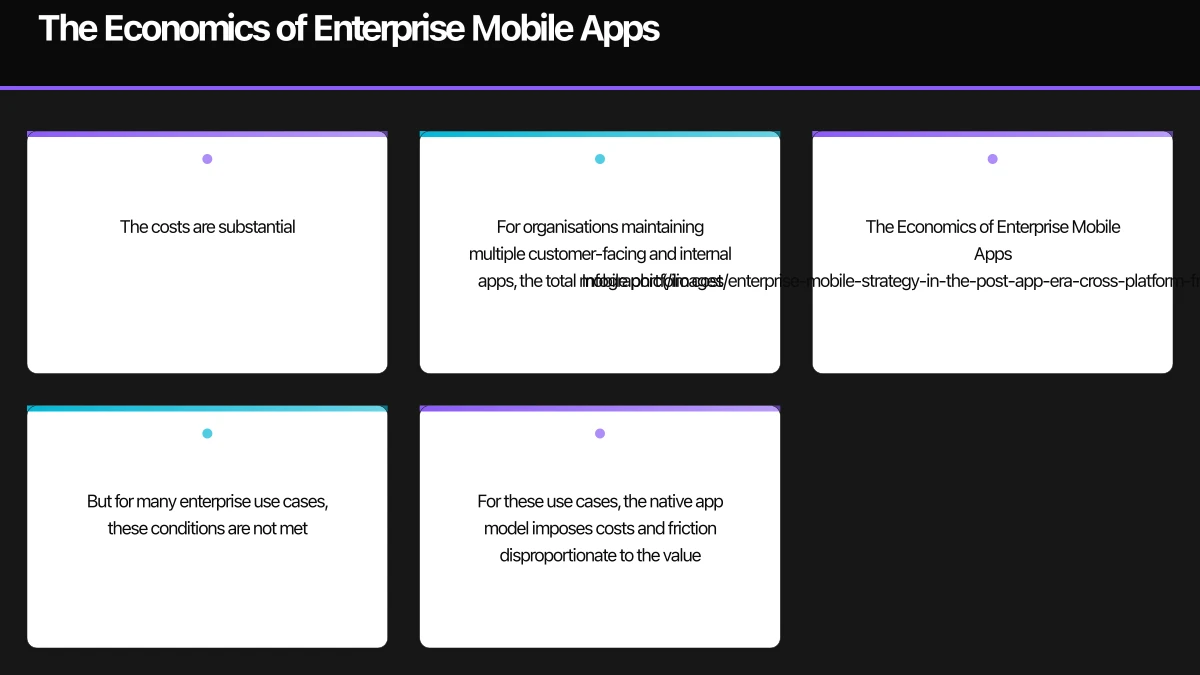
The costs are substantial. A well-built enterprise native app typically requires an initial investment of several hundred thousand to several million dollars, depending on complexity, followed by ongoing maintenance costs of twenty to thirty percent of the initial build per year. For organisations maintaining multiple customer-facing and internal apps, the total mobile portfolio cost can be staggering.
These costs are justified when the app delivers sufficient value to justify installation, when users engage frequently enough to keep the app installed, and when the app requires native device capabilities that cannot be delivered through other channels. But for many enterprise use cases, these conditions are not met.
Consider the typical enterprise B2B application: used by a specific audience, accessed periodically rather than daily, requiring authentication and data entry rather than device-native features like camera access or push notifications. For these use cases, the native app model imposes costs and friction disproportionate to the value delivered.
Progressive Web Apps: The Web Catches Up
Progressive Web Apps (PWAs) represent the most significant shift in mobile delivery since the introduction of app stores. PWAs are web applications that use modern browser capabilities to deliver app-like experiences: offline functionality, push notifications, home screen installation, and near-native performance.
The technical foundation of PWAs rests on three capabilities: Service Workers for background processing and offline support, Web App Manifests for installation and branding, and HTTPS for security. These capabilities are now well-supported across Chrome, Safari, Edge, and Firefox, though iOS Safari still lags in some areas.
For enterprise CTOs, PWAs offer several strategic advantages:
Single Codebase: A PWA is a web application first, which means a single codebase serves desktop and mobile users. This dramatically reduces development and maintenance costs compared to maintaining separate native apps alongside a web presence.
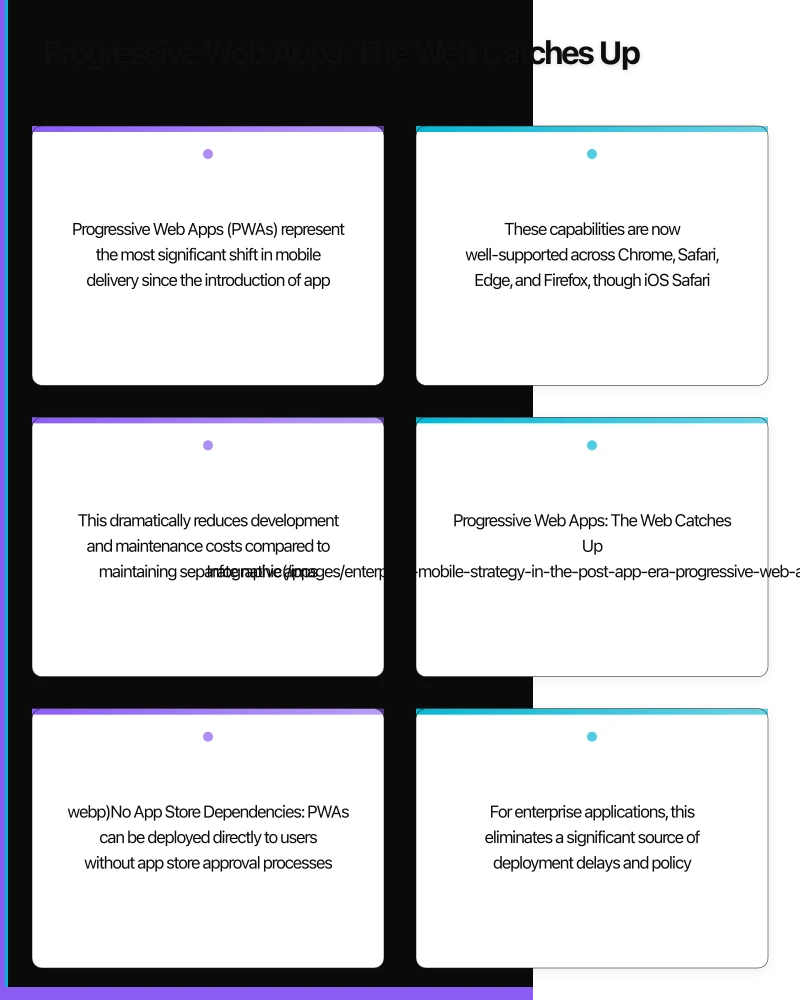
No App Store Dependencies: PWAs can be deployed directly to users without app store approval processes. For enterprise applications, this eliminates a significant source of deployment delays and policy constraints. Updates are immediate — users always access the latest version.
Reduced Friction: Users can access a PWA through a URL, without downloading or installing anything. For enterprise applications where the user may need access infrequently or for a limited period, this dramatically reduces the barrier to engagement.
Discoverability: PWAs are indexable by search engines, unlike native apps whose content is invisible to web crawlers. For customer-facing applications, this improves organic discoverability.
The trade-offs are real, however. PWAs on iOS still cannot access certain device capabilities (Bluetooth, NFC, some sensor APIs), push notifications on iOS remain limited, and the app store ecosystem provides distribution and monetisation mechanisms that PWAs must replicate through other means.
Organisations like Starbucks, Twitter, and Pinterest have demonstrated that PWAs can deliver native-like experiences with significant performance and engagement improvements. Starbucks reported that their PWA is 99.84 percent smaller than their native iOS app while delivering comparable functionality for ordering workflows.
Cross-Platform Frameworks: Pragmatic Native
When native device capabilities are genuinely required, the question becomes how to deliver them efficiently. The cross-platform framework landscape has matured significantly, with React Native and Flutter emerging as the dominant options.
React Native, backed by Facebook, allows development in JavaScript and React, producing truly native UI components. Its advantage lies in the enormous React ecosystem and the ability to share business logic between web and mobile codebases. Companies like Shopify, Bloomberg, and Discord use React Native for significant portions of their mobile applications.
Flutter, developed by Google, uses the Dart programming language and renders its own UI rather than mapping to native components. This gives Flutter pixel-perfect control across platforms but creates a visual experience that can diverge from platform conventions. Its performance characteristics and hot-reload development experience have driven rapid adoption since its 1.0 release in 2018.
For enterprise decision-making, the choice between these frameworks depends on existing team skills, the importance of platform-native look and feel, and the degree of code sharing with web applications. React Native favours organisations with JavaScript expertise and existing React web applications. Flutter favours organisations building new applications where consistent cross-platform appearance is valued over platform-native feel.
The critical strategic point is that both frameworks have reached a maturity level where they can serve enterprise requirements. The era of dismissing cross-platform frameworks as producing inferior experiences is over for the vast majority of use cases.
The Strategic Mobile Decision Framework
Rather than defaulting to native app development, I recommend CTOs evaluate mobile investments through a decision framework that considers the user context, required capabilities, and total cost of ownership.
Start with the Web: If the application can be delivered as a responsive web application with progressive enhancement for mobile devices, this should be the default choice. The web reaches all devices without installation friction, can be enhanced with PWA capabilities for offline use and push notifications, and maintains a single codebase.
Elevate to Cross-Platform When Needed: If the application requires device capabilities beyond what the web platform provides — advanced camera integration, background processing, Bluetooth or NFC access, complex animations — a cross-platform framework provides native capabilities with a single codebase. The investment is higher than a PWA but significantly lower than maintaining separate native apps.
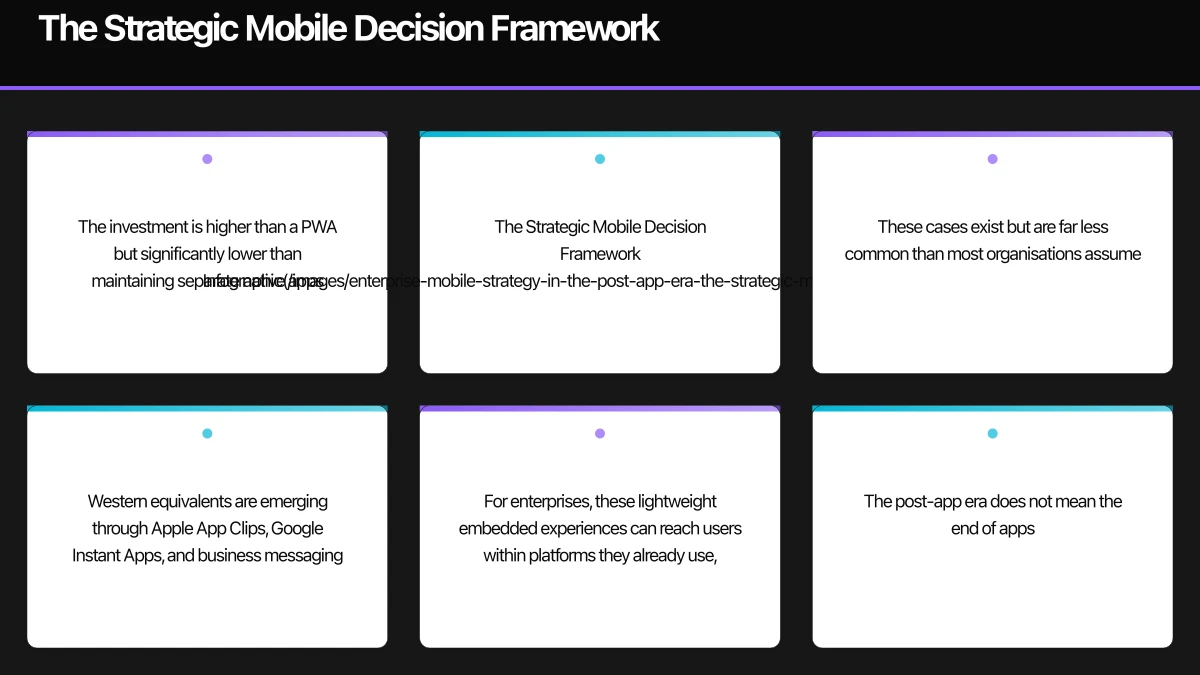
Go Native for Differentiation: Reserve fully native development for applications where the mobile experience is a core competitive differentiator, where platform-specific capabilities are essential (ARKit, HealthKit, Google Pay APIs), or where performance requirements exceed what cross-platform frameworks can deliver. These cases exist but are far less common than most organisations assume.
Consider Embedded and Mini-App Patterns: The super-app model, where lightweight applications run within a host platform, is well-established in Asian markets through WeChat, Alipay, and Grab. Western equivalents are emerging through Apple App Clips, Google Instant Apps, and business messaging integrations. For enterprises, these lightweight embedded experiences can reach users within platforms they already use, without requiring a standalone app.
The post-app era does not mean the end of apps. It means the end of apps as the default answer to every mobile question. The CTO who approaches mobile strategy with a portfolio mindset — matching delivery mechanisms to use cases rather than defaulting to the most expensive option — will deliver better outcomes at lower cost.
Mobile is not a channel. It is the primary computing context for most of the world. The strategic question is not whether to be mobile, but how to be mobile in a way that is sustainable, cost-effective, and aligned with how users actually behave. The answer, increasingly, is not another app.
A digital strategy without mobile is incomplete. Awesome Apps publishes practical guides on building apps that Australian users love.
As founder of Ganda Tech Services, I work with Australian businesses to align technology investments with business growth — across cloud, web, and mobile.
About the Author
Ashish Ganda is the founder of Ganda Tech Services, a Sydney-based technology consultancy specialising in cloud infrastructure, web development, and mobile app solutions for Australian businesses.
Tech Stack Selection Guide 2026
Choose the right tools for your Australian business — without the vendor hype or overlapping spend.