
Enterprise Mobile Backend Strategy: Architecture Decisions That Scale
Introduction
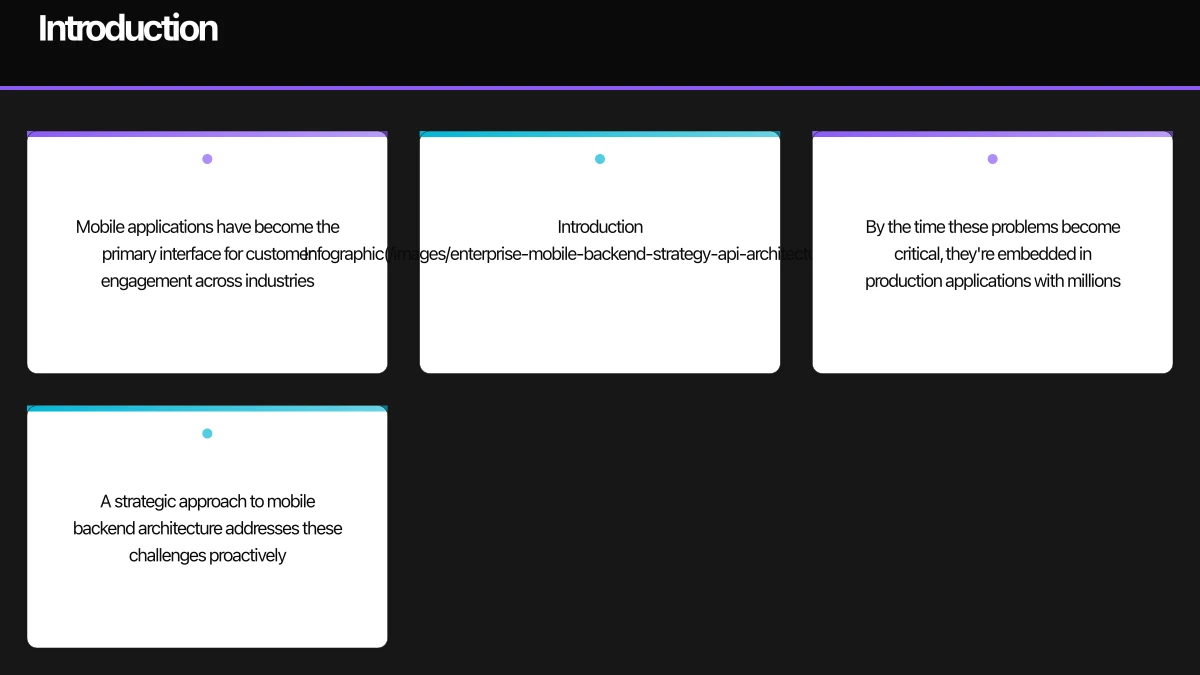
Mobile applications have become the primary interface for customer engagement across industries. Yet many enterprises treat mobile backends as an afterthought—bolting mobile APIs onto existing systems without considering the unique demands of mobile clients.
This approach creates problems that compound over time: performance issues on cellular networks, battery drain from inefficient protocols, synchronisation nightmares between devices, and security vulnerabilities from inconsistent authentication. By the time these problems become critical, they’re embedded in production applications with millions of users.
A strategic approach to mobile backend architecture addresses these challenges proactively. The decisions made early—API design patterns, data synchronisation strategy, authentication architecture—determine whether mobile applications delight users or frustrate them.
Mobile-Specific Challenges
Network Reality
Mobile applications operate in fundamentally different network conditions than web or internal applications:
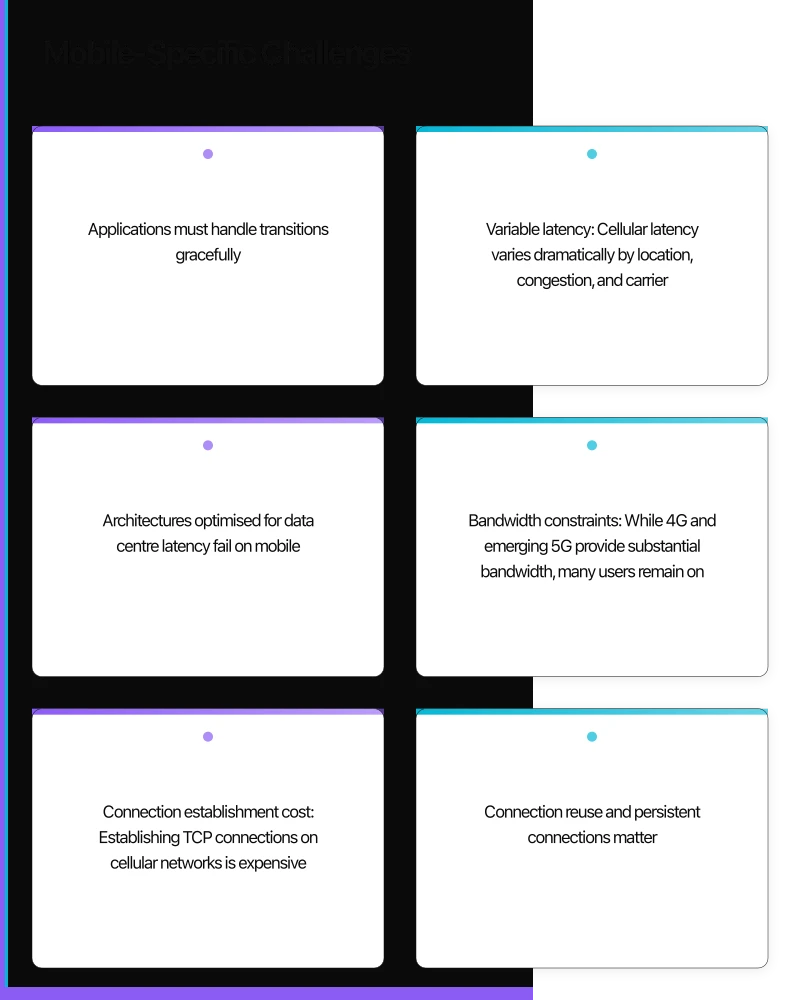
Intermittent connectivity: Users move between WiFi, cellular, and no connectivity. Applications must handle transitions gracefully.
Variable latency: Cellular latency varies dramatically by location, congestion, and carrier. Architectures optimised for data centre latency fail on mobile.
Bandwidth constraints: While 4G and emerging 5G provide substantial bandwidth, many users remain on congested networks or limited data plans.
Connection establishment cost: Establishing TCP connections on cellular networks is expensive. Connection reuse and persistent connections matter.
These conditions require architectural decisions that web developers rarely consider.
Client Constraints
Mobile devices impose constraints absent from server or desktop environments:
Battery sensitivity: Network activity, GPS, and computation drain battery. Backends that require frequent polling or heavy client processing create user-visible battery impact.
Storage limitations: While device storage has grown, applications can’t assume unlimited local storage. Synchronisation strategies must account for storage constraints.
Platform diversity: iOS and Android have different capabilities, limitations, and best practices. Backend designs must accommodate both without sacrificing platform-native experiences.
Update latency: Unlike web applications, mobile apps update through app stores with review delays. Backend changes requiring client updates take days or weeks to reach users.
API Architecture Patterns
REST vs GraphQL for Mobile
The REST vs GraphQL debate has particular relevance for mobile backends:
REST advantages for mobile:
- Simpler caching at all layers (HTTP caches, CDNs, client caches)
- Better tooling and debugging
- Predictable performance characteristics
- Wider developer familiarity
GraphQL advantages for mobile:
- Precise data fetching reduces over-fetching on bandwidth-constrained connections
- Single request can retrieve complex object graphs
- Strong typing reduces client-server contract errors
- Introspection supports tooling and documentation
My recommendation for most enterprise contexts: start with REST, adopt GraphQL selectively.
REST works well for straightforward CRUD operations and resource-oriented APIs. GraphQL provides value when clients need flexibility in data fetching—particularly when mobile and web clients have different data needs from the same backend.
A hybrid approach is practical: REST for simple operations, GraphQL for complex data fetching. API gateways can unify these behind a consistent authentication and routing layer.
Backend for Frontend (BFF) Pattern
Mobile clients have different needs than web clients or internal APIs. The Backend for Frontend pattern creates dedicated backend services for each client type:
[iOS App] --> [iOS BFF] --> [Core Services]
[Android App] --> [Android BFF] --> [Core Services]
[Web App] --> [Web BFF] --> [Core Services]
BFF benefits for mobile:
Optimised payloads: Mobile BFFs can aggregate data from multiple services into mobile-optimised responses, reducing round trips.
Platform-specific logic: Push notification handling, device capability detection, and platform-specific features live in the BFF.
Independent evolution: Mobile BFFs can evolve independently of core services, enabling mobile-specific optimisations without affecting other clients.
Security boundary: BFFs can enforce mobile-specific security policies and reduce attack surface exposed to mobile clients.
The cost is operational complexity—more services to deploy and maintain. For enterprises with substantial mobile investment, this complexity is justified.
API Versioning Strategy
Mobile’s app store update model makes API versioning critical. When you deploy a new backend, users may be running app versions from months ago.
Effective versioning approaches:
URL path versioning (/v1/users, /v2/users): Simple and explicit. Easy to route and monitor. Requires maintaining multiple implementations.
Header versioning (Accept-Version: 2): Cleaner URLs but harder to debug and cache. Works well with API gateways.
Additive changes only: Rather than versioning, maintain backward compatibility. Add new fields, never remove. This works until breaking changes are unavoidable.
Regardless of approach:
- Support at least two major versions simultaneously
- Communicate deprecation timelines clearly to mobile teams
- Monitor version distribution to understand upgrade patterns
- Force upgrades only when absolutely necessary (security vulnerabilities)
Data Synchronisation
Offline-First Architecture
Mobile applications must function without constant connectivity. Offline-first design treats the server as a synchronisation target rather than a required dependency.
Core principles:
Local-first data: Primary data store is on device. Server synchronisation happens when connectivity allows.
Conflict resolution: When offline changes conflict with server state, resolution strategy must be defined. Options include last-write-wins, server-wins, client-wins, or merge logic.
Eventual consistency: Users understand that offline changes may take time to propagate. Design UI to communicate synchronisation status.
Selective sync: Not all data needs offline availability. Prioritise based on use patterns—frequently accessed data offline, large media streamed.
Synchronisation Patterns
Several patterns address mobile data synchronisation:
Timestamp-based sync: Track modification timestamps. Client requests changes since last sync. Simple but requires consistent server clocks and careful handling of deletions.
Event sourcing: Synchronise events rather than state. Client replays events to build local state. Enables sophisticated merge logic but increases complexity.
Operational transformation: Used by collaborative applications (Google Docs). Transforms concurrent operations to maintain consistency. Complex to implement correctly.
CRDTs (Conflict-free Replicated Data Types): Data structures designed for automatic merge without coordination. Excellent for specific use cases but not universally applicable.
For most enterprise mobile applications, timestamp-based synchronisation with defined conflict resolution provides adequate capability without excessive complexity.
Real-Time Updates
Many mobile applications need real-time server-to-client updates: messaging, notifications, live data feeds.
Options include:
WebSockets: Persistent bidirectional connection. Efficient for high-frequency updates. Requires connection management and reconnection logic.
Server-Sent Events (SSE): Simpler than WebSockets for server-to-client only. Good browser support, adequate mobile support.
Long polling: Simpler to implement but less efficient. Appropriate for lower-frequency updates where WebSocket complexity isn’t justified.
Push notifications: Platform push services (APNs, FCM) for background updates. Appropriate for user-visible notifications, not for data synchronisation.
For most mobile backends, a combination works well: WebSockets for in-app real-time features, push notifications for background alerts.
Authentication and Security
Mobile Authentication Patterns
Mobile authentication has unique considerations:
Token-based authentication: JWTs or opaque tokens rather than sessions. Tokens stored securely on device, included in API requests.
Refresh token rotation: Access tokens expire quickly (minutes to hours). Refresh tokens enable seamless renewal without re-authentication.
Biometric authentication: iOS Face ID/Touch ID and Android Biometric enable convenient re-authentication. Integrate with secure token storage.
Device binding: Associate tokens with device identifiers. Detect token use from unexpected devices.
Secure storage: Platform-specific secure storage (iOS Keychain, Android Keystore) for credentials. Never store secrets in plain text or shared preferences.
Certificate Pinning
Certificate pinning ensures mobile apps communicate only with legitimate servers, preventing man-in-the-middle attacks even with compromised certificate authorities.
Implementation considerations:
- Pin to intermediate certificates, not leaf certificates, to enable rotation
- Include backup pins for disaster recovery
- Plan for pin update mechanism in case of compromise
- Test certificate rotation in staging environments
Certificate pinning is essential for applications handling sensitive data (financial, healthcare, authentication).
API Security
Mobile APIs face unique threats:
Reverse engineering: Mobile binaries can be decompiled. Assume API contracts are public. Don’t rely on client-side secret hiding.
API key protection: API keys embedded in apps are extractable. Use keys for identification (rate limiting, analytics), not authorisation.
Rate limiting: Protect against automated attacks. Implement per-user and per-device rate limits.
Input validation: Never trust client input. Validate all parameters server-side even if clients validate.
Platform Services
Push Notification Architecture
Push notifications are critical for mobile engagement but complex to implement correctly:
Platform integration: APNs (iOS) and FCM (Android/cross-platform) have different APIs and capabilities. Abstract platform differences behind a unified notification service.
Token management: Device tokens change. Implement token refresh handling and cleanup of invalid tokens.
Targeting and segmentation: Support user segments, topics, and individual targeting. Enable A/B testing of notification content.
Analytics: Track delivery, opens, and conversion. Use data to optimise notification strategy.
Preference management: Respect user preferences. Provide granular notification controls.
Backend-as-a-Service Evaluation
Backend-as-a-Service platforms (Firebase, AWS Amplify, Azure Mobile Apps) offer accelerated development at the cost of platform dependency.
Appropriate for:
- Rapid prototyping and MVPs
- Simple data models with standard patterns
- Teams lacking backend expertise
- Applications where vendor lock-in is acceptable
Less appropriate for:
- Complex business logic requiring custom processing
- Strict data residency or compliance requirements
- Applications requiring fine-grained control over infrastructure
- Long-term strategic platforms where lock-in poses risk
Hybrid approaches work well: use BaaS for commoditised features (authentication, basic data storage) while maintaining custom backends for differentiating logic.
Performance Optimisation
Latency Reduction
Mobile users are sensitive to latency. Every hundred milliseconds matters.
Optimisation strategies:
Geographic distribution: Deploy backends close to users. Use CDNs for static content and consider edge computing for dynamic content.
Connection reuse: HTTP/2 multiplexing and connection pooling reduce connection establishment overhead.
Payload optimisation: Return only necessary data. Compress responses. Consider binary protocols (Protocol Buffers, MessagePack) for high-frequency APIs.
Caching layers: CDN caching for public content, API response caching for personalised content where appropriate, client-side caching with proper invalidation.
Prefetching: Anticipate user needs. Prefetch likely-needed data during idle time.
Battery-Conscious Design
Backend design affects client battery consumption:
Batch requests: Combine multiple small requests into batched operations. Radio wakes for each request drain battery.
Push over poll: Use push mechanisms rather than polling. Polling keeps radios active.
Delta sync: Synchronise only changes, not full data sets. Reduces data transfer and processing.
Compression: Gzip or Brotli compression reduces data transfer, saving battery on radio usage.
Monitoring and Observability
Mobile-Specific Metrics
Standard backend metrics don’t capture mobile experience. Add:
Client-perspective latency: Measure request timing from client, not just server processing time.
Network failure rates: Track failures by network type (WiFi, cellular) and carrier.
API version distribution: Understand which app versions are active to inform deprecation decisions.
Device and OS distribution: Performance varies by device capability and OS version.
Sync conflict rates: High conflict rates indicate synchronisation design issues.
Error Tracking
Mobile error tracking requires correlation between client and server:
Request correlation IDs: Include unique identifiers in requests, logged on both client and server.
Client error reporting: Integrate crash reporting (Crashlytics, Sentry) with backend logs.
Client logging: Capture client-side logs for debugging, with privacy-appropriate retention.
Conclusion
Mobile backend architecture requires deliberate consideration of the unique constraints and requirements of mobile clients. Network variability, offline requirements, platform diversity, and update latency all influence architectural decisions.
The patterns that work—BFF architecture, offline-first design, robust authentication, platform-specific optimisation—share a common theme: they treat mobile as a first-class concern rather than an afterthought.
For CTOs responsible for mobile-dependent businesses, investing in mobile backend architecture pays returns in user experience, development velocity, and operational stability. The alternative—treating mobile backends as simple API exposures—creates technical debt that becomes increasingly expensive to address as mobile usage grows.
Start with clear understanding of mobile-specific requirements. Design architectures that address those requirements explicitly. Build teams that understand both backend systems and mobile client constraints. The integration of these perspectives creates mobile experiences that users love and businesses depend upon.
Mobile backend strategy sits at the intersection of distributed systems, mobile platform expertise, and user experience. For enterprises where mobile is critical to customer engagement, getting this architecture right is a strategic imperative that deserves executive attention and investment.
For hands-on web development and SEO advice, visit Cosmos Web Tech — our specialist web design and digital marketing blog.
Ganda Tech Services is my technology consultancy, bringing together cloud infrastructure, web development, and mobile expertise for Australian businesses.
About the Author
Ashish Ganda is the founder of Ganda Tech Services, a Sydney-based technology consultancy specialising in cloud infrastructure, web development, and mobile app solutions for Australian businesses.
Digital Transformation Roadmap 2026
A 12-month framework for Australian SMBs ready to modernise — phases, tools, and milestones.
Almost done
Check your inbox and click the confirmation link to get your download.