
Enterprise Mobile Backend Architecture in the Cloud Era
Introduction
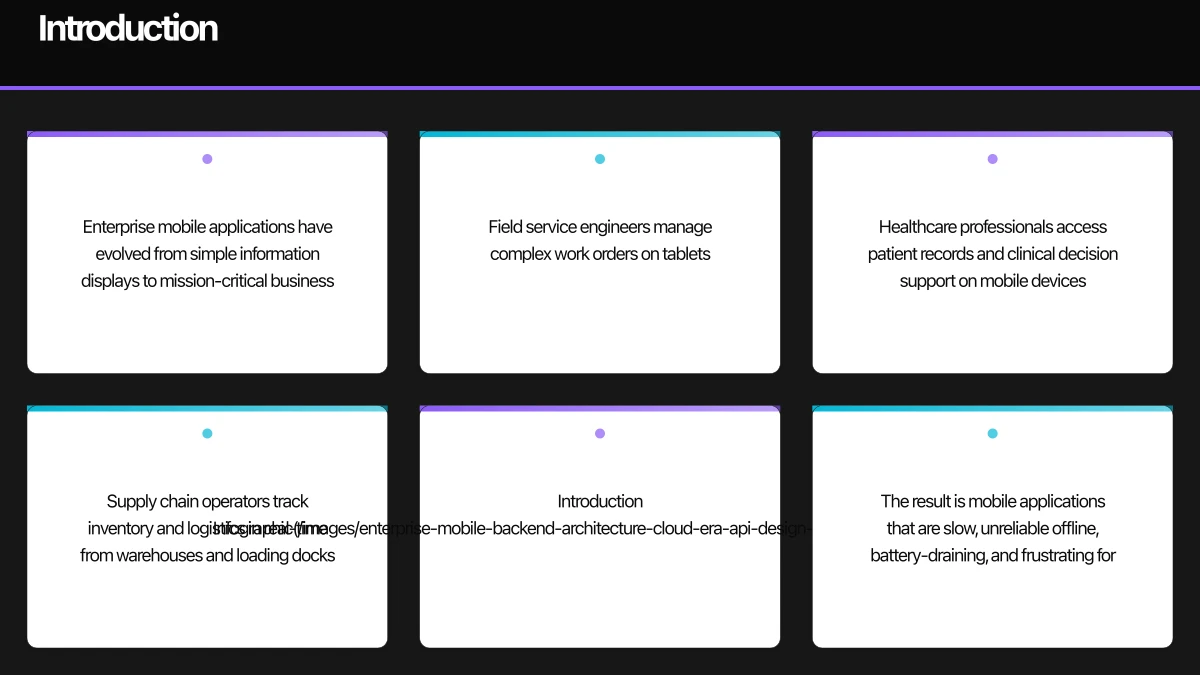
Enterprise mobile applications have evolved from simple information displays to mission-critical business tools. Field service engineers manage complex work orders on tablets. Healthcare professionals access patient records and clinical decision support on mobile devices. Supply chain operators track inventory and logistics in real-time from warehouses and loading docks. These applications demand backend architectures that provide reliability in unreliable network conditions, real-time data synchronisation, security appropriate for enterprise data, and performance that meets user expectations shaped by consumer mobile experiences.
Yet many enterprise mobile backends are designed as afterthoughts, bolted onto architectures originally conceived for web applications or batch processing. The result is mobile applications that are slow, unreliable offline, battery-draining, and frustrating for the workers who depend on them. The backend architecture must be designed specifically for the mobile consumption context from the beginning.
For CTOs and enterprise architects, mobile backend architecture is increasingly strategic. Mobile-first workforces, IoT device proliferation, and the expectation of anywhere-anytime access to enterprise systems make the quality of mobile backend architecture a competitive differentiator. This analysis presents the architectural patterns and strategic considerations that distinguish robust enterprise mobile backends.
API Design for Mobile Consumption
The API layer is the contract between mobile applications and backend services. For mobile clients, API design decisions have outsized impact because mobile networks are slower, less reliable, and more expensive than fixed networks, and mobile devices have constrained battery, memory, and processing resources.
Traditional REST APIs designed for web consumption often create problems for mobile clients. Multiple sequential API calls to assemble a single screen’s data create latency that compounds over high-latency mobile networks. Over-fetching, where the API returns large payloads containing data the mobile client does not need, wastes bandwidth and battery. Under-fetching, where the API does not return enough data, forces additional round trips.
GraphQL addresses several of these problems by allowing the client to specify exactly the data it needs in a single request. The mobile client sends a query describing the shape of the data required for a particular screen, and the server returns precisely that data, no more and no less. This eliminates both over-fetching and under-fetching and reduces the number of round trips. For enterprise environments, GraphQL also provides a unified API surface that can aggregate data from multiple backend services, simplifying mobile client development.
However, GraphQL introduces its own considerations for enterprise environments. Query complexity must be controlled to prevent expensive queries from degrading backend performance. Authentication and authorisation must be applied at the field level, not just the endpoint level, because GraphQL exposes a fine-grained data model. Caching is more complex than with REST because GraphQL responses vary by query. These considerations are manageable but require deliberate architectural attention.
Backend-for-Frontend (BFF) is an alternative pattern where a dedicated backend service is built specifically for each mobile platform. The BFF aggregates data from backend microservices, transforms it into the format the mobile client expects, and handles mobile-specific concerns like push notification management and device registration. This pattern provides maximum control over the mobile API contract and allows the BFF to evolve independently of the underlying microservices. The trade-off is the operational overhead of maintaining additional service layers.
Regardless of the API pattern chosen, enterprise mobile APIs should implement several mobile-optimised capabilities. Response compression reduces payload sizes and bandwidth consumption. Pagination with cursor-based navigation enables efficient loading of large datasets. Conditional requests (using ETags or If-Modified-Since headers) allow clients to avoid downloading data that has not changed. Rate limiting protects backend services from misbehaving or compromised mobile clients.
Offline-First Architecture
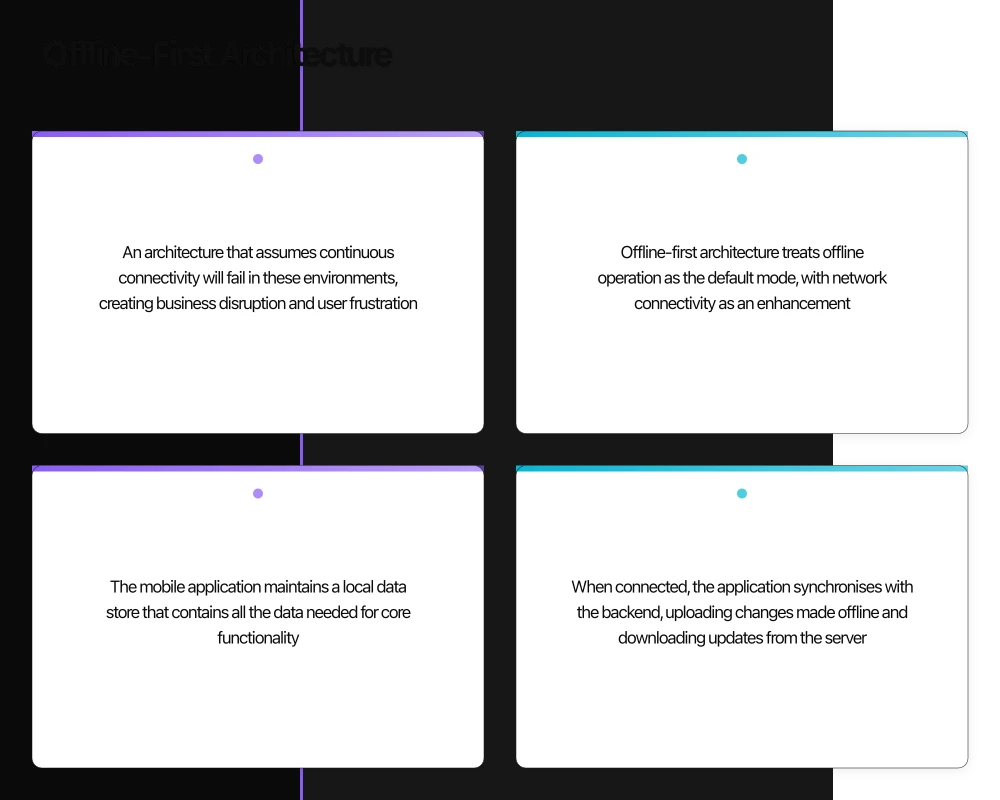
Enterprise mobile applications frequently operate in environments with intermittent or absent network connectivity: underground facilities, remote field locations, areas with poor cellular coverage, and aircraft. An architecture that assumes continuous connectivity will fail in these environments, creating business disruption and user frustration.
Offline-first architecture treats offline operation as the default mode, with network connectivity as an enhancement. The mobile application maintains a local data store that contains all the data needed for core functionality. When connected, the application synchronises with the backend, uploading changes made offline and downloading updates from the server. When disconnected, the application continues to function against its local data store.
The core architectural challenge in offline-first design is conflict resolution. When multiple users modify the same data while offline, or when a user’s offline changes conflict with server-side changes, the system must resolve these conflicts without data loss or business logic violations. Several strategies address this challenge.
Last-write-wins is the simplest strategy, where the most recent change overwrites previous changes. This is appropriate for data where individual field values are independently meaningful and where overwrites do not violate business constraints. It is not appropriate for data where concurrent changes might both be valid and need to be merged.
Operational transformation and conflict-free replicated data types (CRDTs) provide more sophisticated conflict resolution for specific data types. CRDTs are data structures designed to be merged automatically without conflicts. They work well for counters, sets, and certain document structures but are not a general-purpose solution for all enterprise data.
Application-specific conflict resolution implements business logic to resolve conflicts based on domain knowledge. For example, an inventory management system might resolve conflicting stock counts by taking the lower value (conservative approach) or flagging the discrepancy for manual review. This approach provides the most correct results but requires careful design for each data type and business scenario.
The synchronisation protocol should be efficient and resilient. Delta synchronisation, transmitting only changes since the last synchronisation rather than complete datasets, minimises bandwidth consumption. Synchronisation should be resumable, so that a partially completed sync can continue from where it left off rather than restarting from the beginning. Prioritised synchronisation ensures that the most critical data is synchronised first when bandwidth is limited.
Real-Time Data and Push Architecture
Many enterprise mobile use cases require real-time data updates: field service dispatch, logistics tracking, collaborative workflows, and alert notifications. The backend architecture must support efficient real-time data delivery to mobile clients while respecting the battery and bandwidth constraints of mobile devices.
Push notifications are the most battery-efficient mechanism for delivering real-time updates to mobile devices because they use the platform’s built-in push infrastructure (Apple Push Notification service and Firebase Cloud Messaging) rather than maintaining persistent connections from the application. The backend architecture should include a push notification service that can target individual devices, user segments, or topics, and that handles the complexity of multi-platform delivery, retry logic, and delivery confirmation.
WebSocket connections provide bidirectional real-time communication for applications that need lower latency than push notifications or that require streaming data updates. However, WebSocket connections are battery-expensive because they maintain persistent connections, and they are fragile on mobile networks where connections are frequently interrupted. Enterprise mobile backends should use WebSocket connections judiciously, establishing them only when the application is actively using real-time features and closing them when the application enters the background.
Server-Sent Events (SSE) provide a simpler alternative to WebSockets for scenarios that need server-to-client streaming but not bidirectional communication. SSE connections are more resilient to network interruptions because they support automatic reconnection with event ID tracking, allowing the client to resume from where it left off.
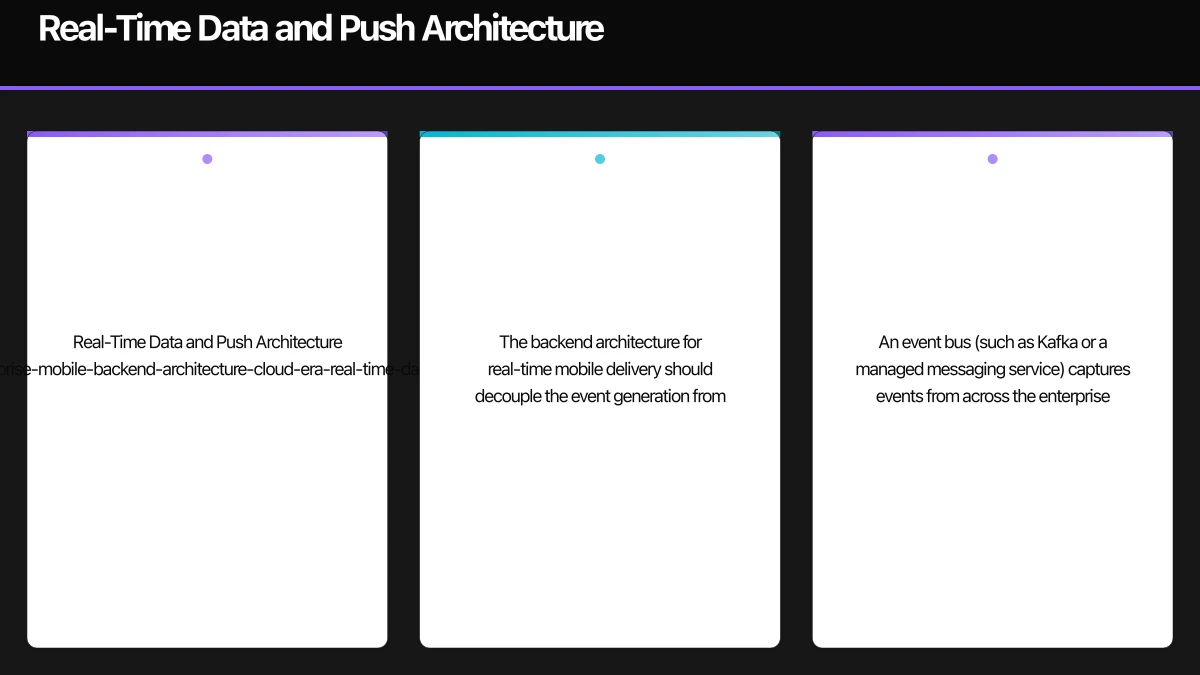
The backend architecture for real-time mobile delivery should decouple the event generation from the delivery mechanism. An event bus (such as Kafka or a managed messaging service) captures events from across the enterprise backend. Delivery services consume from the event bus and route events to the appropriate delivery mechanism (push notification, WebSocket, or SSE) based on the client’s current connection state and the event’s delivery requirements.
Security Architecture for Enterprise Mobile
Enterprise mobile applications access sensitive business data from devices that are inherently less controlled than corporate workstations. The security architecture must protect data in transit, at rest on the device, and against compromised or lost devices.
Authentication should use OAuth 2.0 with PKCE (Proof Key for Code Exchange), which is the recommended flow for mobile applications. This flow avoids storing long-lived credentials on the device and supports integration with enterprise identity providers through OpenID Connect. Token refresh mechanisms should balance security (short token lifetimes) with user experience (avoiding frequent re-authentication).
Certificate pinning prevents man-in-the-middle attacks by verifying that the server’s TLS certificate matches an expected value, even if an attacker has compromised a certificate authority. Enterprise mobile applications handling sensitive data should implement certificate pinning, with a pin rotation mechanism that allows the expected certificate to be updated without requiring an application update.
Device security assessment at the backend level can detect jailbroken or rooted devices, outdated operating systems, and missing security configurations, and enforce appropriate access restrictions. Mobile Device Management (MDM) integration provides additional controls including remote wipe capability, application distribution management, and configuration policy enforcement.
Enterprise mobile backend architecture is a specialised discipline that requires understanding both the constraints of mobile computing and the requirements of enterprise environments. For CTOs investing in mobile workforce enablement, the backend architecture determines whether mobile applications are productive tools or frustrating liabilities. The patterns described here provide the foundation for mobile backends that are performant, resilient, and secure.
Turning mobile strategy into a shipped app? Awesome Apps covers Flutter, React Native, and native development for Australian businesses.
Ash Ganda is the founder of Ganda Tech Services, a Sydney-based technology consultancy delivering cloud, web, and mobile solutions for Australian businesses.
About the Author
Ashish Ganda is the founder of Ganda Tech Services, a Sydney-based technology consultancy specialising in cloud infrastructure, web development, and mobile app solutions for Australian businesses.
Digital Transformation Roadmap 2026
A 12-month framework for Australian SMBs ready to modernise — phases, tools, and milestones.
Almost done
Check your inbox and click the confirmation link to get your download.