The Future of Enterprise ERP: Cloud-Native Transformation
Introduction
Enterprise Resource Planning systems are the operational backbone of large organisations, integrating finance, supply chain, human resources, manufacturing, and customer management into unified platforms. They are also, in many enterprises, the oldest, most customised, and most resistant-to-change technology assets in the portfolio. The tension between ERP’s critical operational role and its architectural rigidity has become acute as enterprises pursue digital transformation, cloud migration, and the agility that modern business demands.
The ERP landscape is in the early stages of a fundamental transformation. SAP’s announcement that maintenance for its Business Suite 7 will end in 2027 (with extended maintenance available until 2030) is compelling its massive installed base to evaluate migration paths. Oracle is pushing its Fusion Cloud ERP suite. A new generation of cloud-native ERP vendors is challenging incumbents with modular, API-first architectures. And the concept of composable ERP, assembling best-of-breed capabilities through integration rather than relying on a single monolithic suite, is gaining strategic credibility.
For CTOs navigating this landscape, ERP transformation is among the most consequential technology decisions they will make. The investment is measured in tens or hundreds of millions of dollars and years of implementation effort. The risk of disruption to core business processes is substantial. And the strategic implications, how the organisation manages its core operations for the next decade or more, are profound.
The Case for ERP Transformation
The case for ERP transformation rests on several converging pressures that are making the status quo increasingly untenable.
Architectural limitations of traditional ERP systems constrain business agility. Monolithic ERP architectures with tightly coupled modules make it difficult to change one business process without affecting others. Heavy customisation, accumulated over decades of adapting the system to business requirements, creates fragility and makes upgrades expensive and risky. On-premises deployment limits scalability and requires ongoing infrastructure investment.
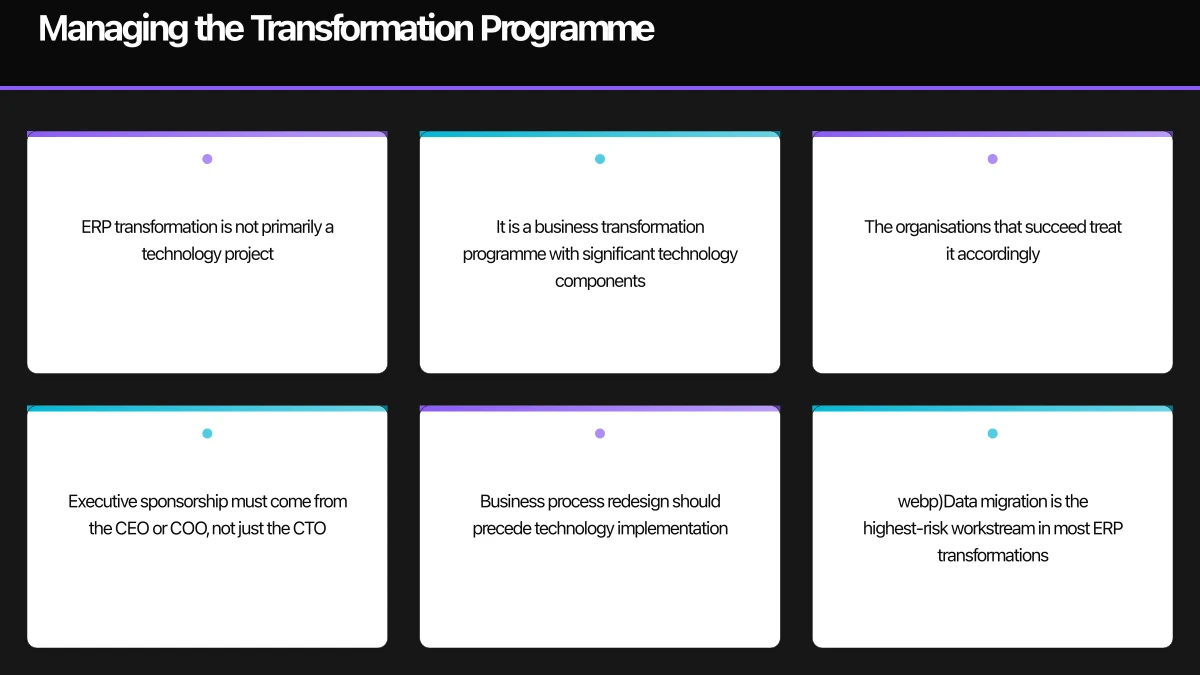
Total cost of ownership for legacy ERP is rising. Specialised skills for aging technologies (ABAP, PeopleSoft, Oracle Forms) are becoming scarcer and more expensive. Hardware refreshes for on-premises deployments require capital expenditure. Licensing models that charge based on named users do not align with modern consumption patterns. The cumulative effect is that legacy ERP costs are increasing even as the systems deliver diminishing returns in terms of business capability.
Business requirements have evolved beyond what traditional ERP was designed to support. Real-time analytics, mobile-first user experiences, ecosystem integration with customers and suppliers, and support for new business models all require capabilities that legacy ERP systems were not architected to provide. Organisations find themselves building satellite systems around the ERP to compensate for its limitations, creating integration complexity and data consistency challenges.
Vendor forcing functions are accelerating decisions. SAP’s 2027 maintenance deadline is the most prominent example, but similar dynamics exist across the ERP landscape. Vendors are investing their development resources in cloud-native platforms and reducing investment in legacy systems, widening the capability gap between old and new over time.
Transformation Approaches: The Strategic Spectrum
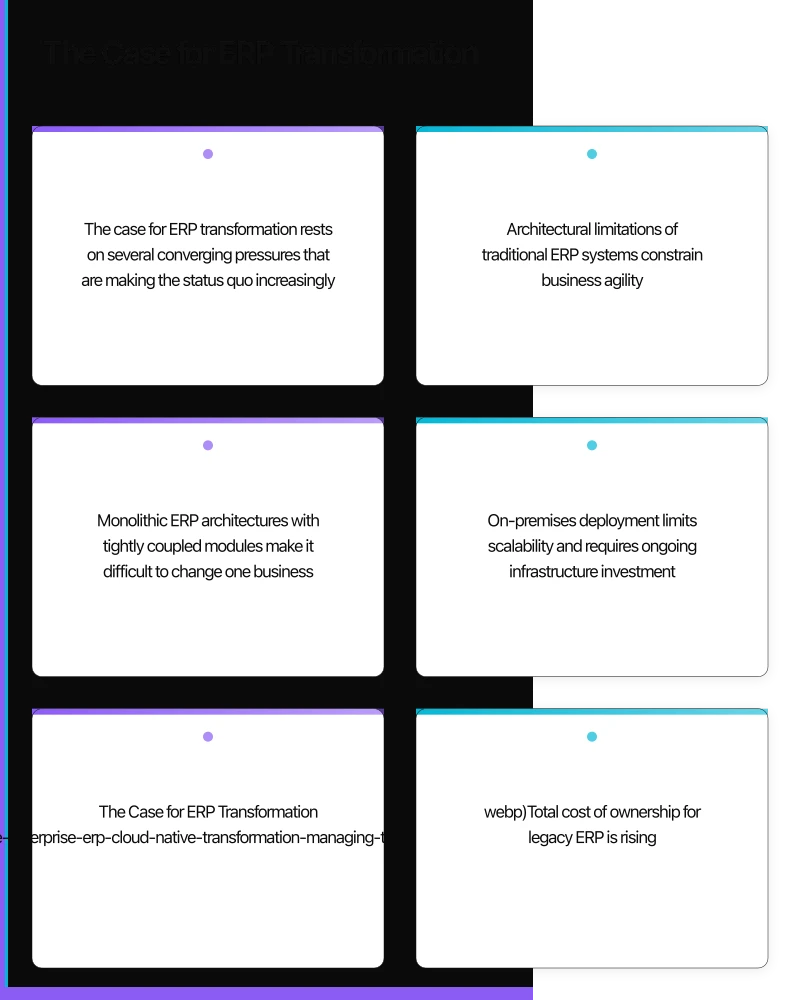
ERP transformation approaches span a spectrum from conservative to aggressive, each with different risk, cost, and benefit profiles.
Lift and shift to cloud migrates the existing ERP system to cloud infrastructure without changing the application architecture. This approach has the lowest risk and shortest timeline but provides the fewest benefits. It addresses infrastructure obsolescence and capital expenditure concerns but does not resolve the architectural limitations that constrain business agility. For organisations seeking to buy time while planning a more fundamental transformation, lift and shift may be a pragmatic interim step.
Re-implementation on the incumbent vendor’s cloud platform (for example, migrating from SAP ECC to S/4HANA Cloud, or from Oracle EBS to Oracle Fusion) preserves the vendor relationship and some institutional knowledge while moving to a modern architecture. The challenge is that re-implementation typically requires re-examining every customisation, business process, and integration in the existing system. Organisations with heavy customisation face a choice between carrying those customisations forward (reducing the benefits of the new platform) or reverting to standard processes (requiring significant business change management).
Best-of-breed replacement assembles a portfolio of specialised cloud applications, each best-in-class for its domain (finance, supply chain, HR, procurement), integrated through APIs and middleware. This composable approach provides maximum flexibility and avoids monolithic vendor lock-in but introduces integration complexity and requires strong integration architecture. The composable ERP concept is theoretically appealing but operationally challenging, and organisations pursuing it must invest heavily in their integration platform capability.
Greenfield implementation on a new platform, whether a next-generation offering from an incumbent vendor or a cloud-native alternative, provides the cleanest architectural outcome but the highest risk and cost. It requires building the new system from requirements rather than migrating the old system, which provides the opportunity to reimagine business processes but also requires every business process to be explicitly defined and validated.
Managing the Transformation Programme
ERP transformation is not primarily a technology project. It is a business transformation programme with significant technology components. The organisations that succeed treat it accordingly.
Executive sponsorship must come from the CEO or COO, not just the CTO. ERP transformation affects every business function and requires decisions about business processes, organisational structure, and operating model that are beyond the technology leader’s authority. A steering committee with representation from finance, operations, supply chain, HR, and IT provides the governance structure needed for decisions that span functional boundaries.
Business process redesign should precede technology implementation. The most common and most expensive mistake in ERP transformation is automating existing processes on a new platform rather than redesigning processes to leverage the new platform’s capabilities. This requires investing in business process analysis, benchmarking against industry best practices, and making deliberate decisions about where to adopt standard processes and where custom processes are genuinely justified by competitive differentiation.
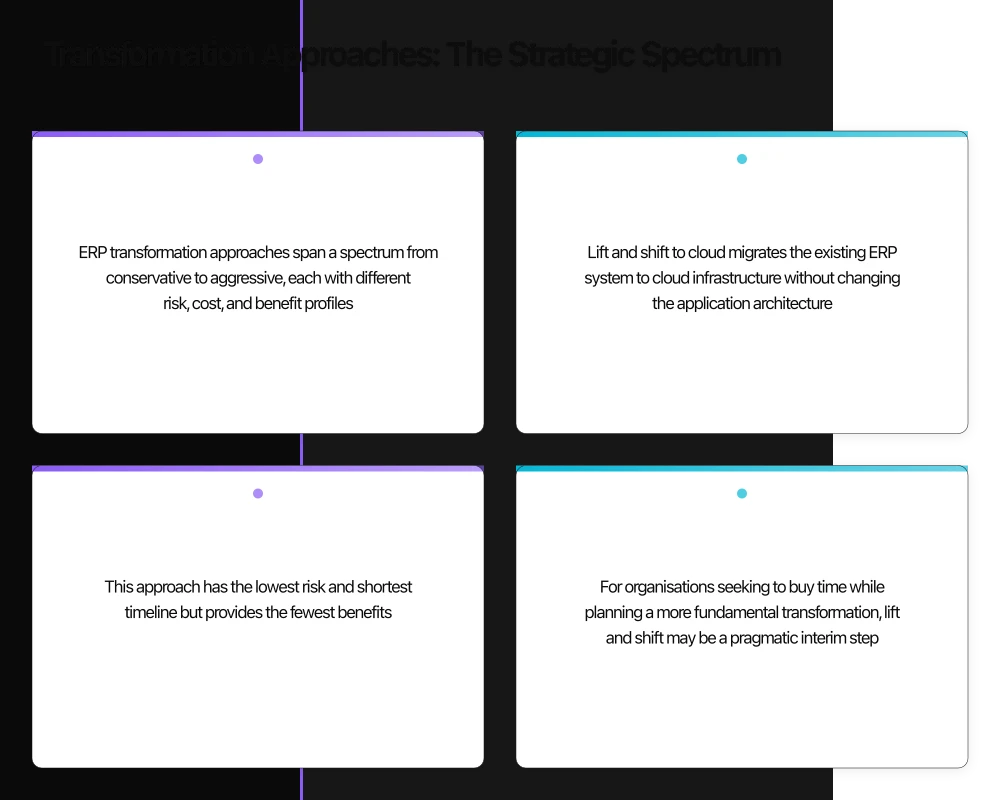
Data migration is the highest-risk workstream in most ERP transformations. Enterprise data accumulated over decades contains inconsistencies, duplicates, obsolete records, and implicit business rules that must be addressed before migration. Data quality assessment and remediation should begin early and continue throughout the programme. The data migration strategy should include comprehensive validation procedures and the ability to execute practice migrations before the final cutover.
Change management is the factor that most frequently determines transformation success or failure. Users who have worked with the existing ERP for years or decades have deeply embedded workflows and expectations. Training, communication, and support programmes must be comprehensive, starting well before go-live and continuing well after. Executive communication about the transformation’s purpose and progress helps maintain organisational support through the inevitable disruptions and frustrations of a major system change.
Programme governance should implement stage-gate reviews that evaluate progress against defined criteria before approving advancement to the next phase. These reviews should assess not just technical progress but business readiness, data quality, change management effectiveness, and risk posture. The willingness to slow down or adjust the programme based on gate review findings distinguishes well-governed transformations from those that proceed on inertia.
The Composable ERP Future
Looking beyond the immediate transformation decision, the trajectory of enterprise ERP is toward greater composability. The monolithic suite model, where a single vendor provides all enterprise management capabilities in a tightly integrated package, is being challenged by the availability of high-quality, cloud-native, API-first applications for every ERP domain.
This trend does not mean the end of ERP suites. Suite vendors provide integration, data consistency, and vendor accountability that best-of-breed compositions must recreate through architecture and governance. But it does mean that the boundary between suite and best-of-breed is blurring, and the integration architecture that connects enterprise management capabilities is becoming as strategically important as the capabilities themselves.
Enterprise architects should design their ERP landscape with composability in mind, regardless of whether the initial implementation uses a suite or a best-of-breed approach. This means investing in integration platforms that can connect diverse applications through APIs and events, establishing master data management capabilities that maintain data consistency across applications, and designing business process orchestration layers that coordinate workflows spanning multiple systems.
The ERP transformation decision is one of the most important technology decisions an enterprise makes. It shapes the operational technology landscape for a decade or more and requires investment that competes with every other strategic initiative on the agenda. For CTOs, the imperative is to approach this decision with strategic clarity: understanding the options, quantifying the costs and benefits, managing the risks, and ensuring that the transformation serves the business strategy rather than merely updating the technology stack.
If this strategic perspective has you thinking about your online presence, Cosmos Web Tech provides actionable web design and SEO guidance.
These insights are drawn from my work leading Ganda Tech Services — helping Australian businesses navigate digital transformation through cloud, web, and mobile.
About the Author
Ashish Ganda is the founder of Ganda Tech Services, a Sydney-based technology consultancy specialising in cloud infrastructure, web development, and mobile app solutions for Australian businesses.
Digital Transformation Roadmap 2026
A 12-month framework for Australian SMBs ready to modernise — phases, tools, and milestones.
Almost done
Check your inbox and click the confirmation link to get your download.