Enterprise API Gateway Strategy: Evaluating Kong, Apigee, and AWS API Gateway
Introduction
APIs have evolved from technical integration points to strategic business assets. The enterprises winning in digital markets expose capabilities through APIs—to partners, customers, internal teams, and increasingly, to AI systems consuming services programmatically. The API gateway sits at the centre of this ecosystem, controlling access, enforcing policies, providing observability, and enabling monetisation.
Yet API gateway selection remains surprisingly contentious. Vendors occupy different positions on the build-vs-buy spectrum. Deployment models range from fully managed cloud services to self-hosted open source. Feature sets overlap substantially while differing in critical details. The “best” gateway depends entirely on organisational context.
This guide provides the strategic framework for evaluating API gateway platforms, with deep analysis of the three dominant enterprise options: Kong, Google Apigee, and AWS API Gateway. More importantly, it addresses the architectural and governance decisions that matter more than gateway selection itself.
The API Gateway Decision Framework
Why Gateway Selection Matters
API gateways impact multiple dimensions of enterprise architecture:
Security Posture: The gateway enforces authentication, authorisation, rate limiting, and threat protection. A weak gateway creates organisation-wide vulnerability.
Developer Experience: Internal and external developers interact with APIs through gateway-mediated interfaces. Poor developer experience slows adoption and increases support burden.
Operational Visibility: Gateway telemetry provides critical insight into API usage, performance, and errors. Gaps in visibility create blind spots for operations and business teams.
Business Enablement: API monetisation, partner onboarding, and ecosystem development depend on gateway capabilities for access management and usage tracking.
Architectural Flexibility: Gateway lock-in constrains future architecture evolution. Portable gateway investments preserve optionality.
Capability Categories
Evaluate gateways across these capability domains:
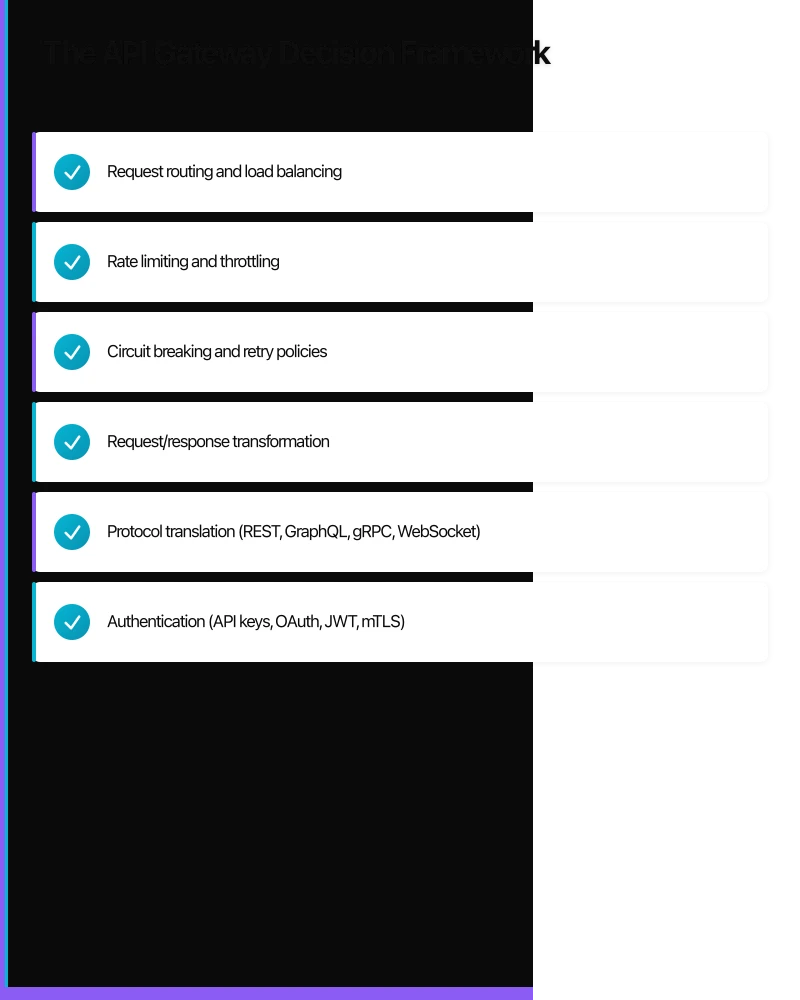
Traffic Management
- Request routing and load balancing
- Rate limiting and throttling
- Circuit breaking and retry policies
- Request/response transformation
- Protocol translation (REST, GraphQL, gRPC, WebSocket)
Security
- Authentication (API keys, OAuth, JWT, mTLS)
- Authorisation and access control
- Threat protection (injection, DDoS)
- Data masking and encryption
- Certificate management
Developer Experience
- Developer portal and documentation
- API discovery and catalog
- SDK generation
- Sandbox and testing environments
- Self-service onboarding
Analytics and Observability
- Traffic analytics and dashboards
- Error tracking and alerting
- Distributed tracing integration
- Custom metrics and logging
- Business intelligence integration
Governance and Lifecycle
- API versioning support
- Deprecation management
- Policy enforcement
- Compliance and audit
- Change management integration
Operational Model
- Deployment options (cloud, hybrid, on-premises)
- High availability and disaster recovery
- Performance and scalability
- Operational complexity
- Total cost of ownership
Platform Deep Dive
Kong Gateway
Kong emerged from the open source community, building enterprise features atop the battle-tested Kong Gateway (formerly Kong Community Edition). Its Nginx and OpenResty foundation delivers exceptional performance.
Architecture
Kong deploys as a distributed system with two primary components:
Data Plane: Proxy nodes that handle API traffic. Stateless design enables horizontal scaling. Performance characteristics derive from Nginx’s event-driven architecture.
Control Plane: Management layer for configuration, policies, and observability. Kong Enterprise adds sophisticated control plane features; Kong Konnect provides this as a managed service.
Strengths
Performance: Kong’s Nginx foundation handles extremely high throughput with low latency. Benchmarks consistently show sub-millisecond proxy overhead.
Extensibility: The plugin architecture supports Lua, Go, JavaScript, and Python. Enterprises can build custom plugins for specific requirements. The ecosystem includes 100+ community and enterprise plugins.
Deployment Flexibility: Kong runs anywhere—Kubernetes, VMs, bare metal, any cloud. This flexibility suits enterprises with hybrid or multi-cloud requirements.
Open Source Foundation: Core gateway functionality is open source, reducing vendor lock-in concerns. Enterprises can start with open source and upgrade to enterprise features incrementally.
Kubernetes Native: Kong Ingress Controller integrates natively with Kubernetes, serving as both ingress and API gateway. This consolidation simplifies architecture.
Considerations
Operational Complexity: Self-managed Kong requires operational expertise. Database management (PostgreSQL or Cassandra), cluster coordination, and upgrade procedures demand capable platform teams.
Developer Portal: Kong’s developer portal capabilities lag behind Apigee. Enterprises prioritising external developer experience may need supplementary tooling.
Learning Curve: Kong’s flexibility creates configuration complexity. Teams new to Kong need ramp-up time to leverage capabilities effectively.
Ideal For
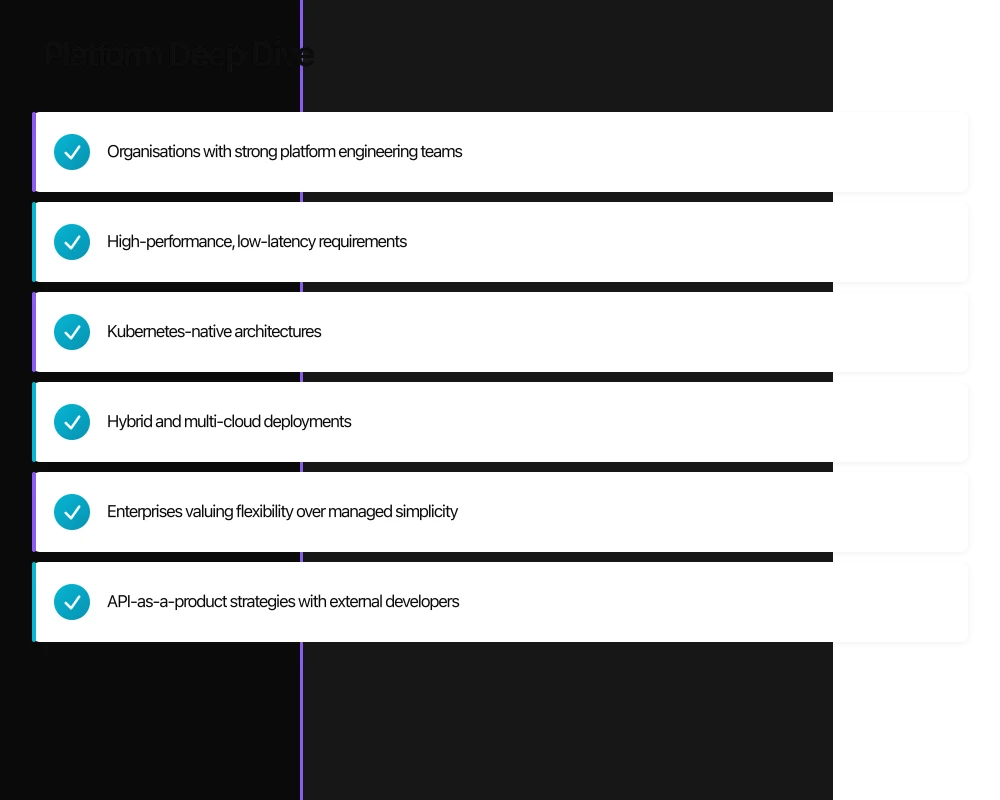
- Organisations with strong platform engineering teams
- High-performance, low-latency requirements
- Kubernetes-native architectures
- Hybrid and multi-cloud deployments
- Enterprises valuing flexibility over managed simplicity
Google Apigee
Apigee predates its Google acquisition, bringing decades of API management heritage. It positions as a full-lifecycle API management platform rather than just a gateway.
Architecture
Apigee offers multiple deployment models:
Apigee X: Fully managed on Google Cloud. Google operates infrastructure; customers manage API configuration and policies.
Apigee Hybrid: Control plane managed by Google; runtime deployed in customer environments (any Kubernetes cluster). Balances managed operations with deployment flexibility.
Strengths
Developer Portal: Apigee’s integrated developer portal leads the market. Documentation rendering, interactive API explorer, self-service registration, and analytics provide comprehensive developer experience.
Analytics and Monetisation: Native capabilities for API analytics, usage tracking, and monetisation suit enterprises treating APIs as products. Built-in support for rate plans, billing integration, and revenue tracking.
Full Lifecycle Management: Apigee addresses the complete API lifecycle: design, develop, secure, publish, analyse, and monetise. Integrated tooling reduces need for point solutions.
Policy Framework: Extensive pre-built policies cover common requirements. Visual policy editor enables configuration without code for many scenarios.
Google Cloud Integration: Deep integration with Google Cloud services (Cloud IAM, Cloud Logging, BigQuery) benefits GCP-centric organisations.
Considerations
Cost Structure: Apigee pricing can surprise organisations at scale. Per-API-call pricing compounds with traffic volume. Model costs carefully before commitment.
Google Cloud Affinity: While Apigee Hybrid runs anywhere, the platform clearly optimises for Google Cloud. AWS or Azure-centric organisations face integration friction.
Flexibility vs. Prescription: Apigee’s opinionated approach accelerates common patterns but can constrain unusual requirements. Custom extensions are possible but less natural than Kong’s plugin model.
Performance Characteristics: Proxy latency exceeds Kong’s for simple passthrough scenarios. The feature richness has overhead costs.
Ideal For
- API-as-a-product strategies with external developers
- Organisations prioritising developer experience
- Google Cloud environments
- Enterprises needing built-in monetisation
- Teams preferring managed operations over flexibility
AWS API Gateway
AWS API Gateway provides managed API gateway capabilities tightly integrated with the AWS ecosystem. Two variants serve different use cases.
Architecture
REST API: Full-featured API gateway with extensive customisation, request/response transformation, and AWS service integration. Higher latency but richer capabilities.
HTTP API: Lightweight, high-performance gateway for simpler requirements. Lower latency and cost but fewer features.
Strengths
AWS Integration: Native integration with Lambda, IAM, Cognito, CloudWatch, and other AWS services creates frictionless serverless architectures. For AWS-native applications, this integration is unmatched.
Managed Operations: Fully managed by AWS—no infrastructure to operate, automatic scaling, built-in high availability. Operational burden approaches zero.
Serverless Fit: Purpose-built for serverless architectures. Lambda integration, usage plans, and consumption-based pricing align with serverless economics.
Cost at Entry: Consumption-based pricing with no minimum commitment suits experimentation and smaller deployments. You pay for what you use.
WebSocket Support: Native WebSocket API capabilities suit real-time applications without additional infrastructure.
Considerations
AWS Lock-In: Deep AWS integration becomes lock-in. Migrating APIs from AWS API Gateway to alternative platforms requires significant effort.
Limited Portability: No hybrid or on-premises option. Multi-cloud strategies require supplementary gateways for non-AWS environments.
Developer Portal Limitations: Basic developer portal capabilities require supplementary tooling for sophisticated external developer programs.
Feature Gaps: Advanced features common in Kong and Apigee (complex routing, GraphQL federation, advanced rate limiting) may require workarounds.
Cost at Scale: Per-request pricing advantageous at low volumes becomes expensive at high scale. Model costs across expected traffic ranges.
Ideal For
- AWS-centric serverless architectures
- Teams prioritising operational simplicity
- Lower-volume API programs
- Internal APIs without complex developer experience requirements
- Rapid prototyping and experimentation
Comparative Analysis
Feature Comparison Matrix
| Capability | Kong Enterprise | Apigee X | AWS API Gateway |
|---|---|---|---|
| Performance | Excellent | Good | Good (HTTP API) |
| Deployment Flexibility | Excellent | Good (Hybrid) | Limited (AWS only) |
| Developer Portal | Good | Excellent | Basic |
| Analytics | Good | Excellent | Good |
| Monetisation | Plugin | Native | Third-party |
| Kubernetes Native | Excellent | Good | Limited |
| Serverless Integration | Good | Good | Excellent (AWS) |
| Multi-Cloud | Excellent | Good | Poor |
| Operational Complexity | Higher | Medium | Low |
| Extensibility | Excellent | Good | Limited |
Cost Considerations
API gateway costs vary dramatically by usage pattern:
Low Volume (under 1M calls/month) AWS API Gateway typically cheapest. Consumption pricing favours low volumes. Kong and Apigee enterprise licenses create floor costs.
Medium Volume (1M-100M calls/month) Costs converge. Platform fit and operational costs matter more than licensing. Factor in team capability costs.
High Volume (over 100M calls/month) Self-managed Kong often cheapest at scale. AWS and Apigee per-call pricing compounds. Infrastructure costs become meaningful for Kong but controllable.
Enterprise Features Factor in costs for features you actually need:
- Developer portal (Apigee advantage)
- Analytics depth (Apigee advantage)
- Plugin ecosystem (Kong advantage)
- AWS integration (AWS advantage)
Strategic Selection Framework
Decision Criteria Prioritisation
Weight these factors based on your context:
Deployment Environment
- AWS-centric → AWS API Gateway strong fit
- GCP-centric → Apigee natural choice
- Multi-cloud/hybrid → Kong provides flexibility
- On-premises requirements → Kong or Apigee Hybrid
API Program Maturity
- Internal APIs only → Simpler requirements, any platform
- Partner APIs → Developer experience matters, Apigee or Kong with portal
- Public API products → Apigee’s developer portal and monetisation shine
Team Capabilities
- Strong platform engineering → Kong’s flexibility valuable
- Operations-averse → Managed options (Apigee X, AWS) reduce burden
- Cloud-native skills → Kubernetes-native options (Kong) align
Performance Requirements
- Ultra-low latency → Kong’s performance advantages
- Standard requirements → All platforms adequate
- Serverless scale-to-zero → AWS API Gateway natural fit
Budget Model
- CapEx preference → Self-managed Kong
- OpEx/consumption → AWS API Gateway, Apigee
- Predictable costs → Platform licensing over per-call pricing at scale
Common Patterns
Pattern: AWS Serverless
For serverless-first AWS architectures, AWS API Gateway provides the path of least resistance. Lambda integration, IAM authentication, and CloudWatch observability come included. Accept the lock-in for operational simplicity.
Pattern: Kubernetes Platform
Organisations building on Kubernetes benefit from Kong Ingress Controller. A single component serves as ingress controller, API gateway, and service mesh gateway (with Kong Mesh). Platform consolidation reduces operational surface area.
Pattern: External Developer Ecosystem
When external developer experience drives business outcomes, Apigee’s integrated portal, analytics, and monetisation capabilities justify the investment. The completeness of the developer journey matters more than raw gateway performance.
Pattern: Hybrid Enterprise
Enterprises spanning cloud and on-premises, or multiple clouds, need portable gateway investments. Kong’s deployment flexibility enables consistent API management across heterogeneous environments without vendor-specific capabilities in each.
Pattern: Gateway Diversity
Large enterprises sometimes deploy multiple gateways for different purposes: AWS API Gateway for AWS-native applications, Kong for Kubernetes workloads, cloud provider native options for specific integrations. Governance frameworks ensure consistency despite platform diversity.
Implementation Considerations
Gateway Governance
Gateway selection is the beginning, not the end. Governance determines long-term success:
API Standards
- Design guidelines (REST conventions, naming, versioning)
- Security requirements (authentication, authorisation, encryption)
- Documentation requirements
- Performance expectations
Policy Consistency
- Standard policy configurations across APIs
- Security baseline enforcement
- Rate limiting defaults
- Observability requirements
Lifecycle Management
- API registration and approval workflows
- Version management procedures
- Deprecation timelines and communication
- Breaking change policies
Operational Standards
- Monitoring and alerting requirements
- Incident response procedures
- Capacity planning guidelines
- Disaster recovery expectations
Migration Considerations
Migrating between gateways or from custom solutions requires planning:
Inventory Current State
- Document all existing APIs
- Capture current policies and configurations
- Identify consumers and dependencies
- Assess traffic patterns
Plan Migration Waves
- Prioritise APIs for migration
- Group related APIs
- Plan for parallel running periods
- Define rollback procedures
Consumer Communication
- Notify API consumers of changes
- Provide migration timelines
- Support testing against new gateway
- Maintain compatibility where possible
Validation
- Functional testing of migrated APIs
- Performance comparison
- Security verification
- Consumer acceptance
The Path Forward
API gateway selection, while important, matters less than the API strategy it enables. The best gateway poorly implemented delivers less value than an adequate gateway well operated with strong governance.
For organisations beginning their API gateway journey:
- Start with strategy: Define what APIs mean for your business before selecting technology
- Assess honestly: Understand your team’s capabilities and operational appetite
- Think lifecycle: Gateways serve API programs, not just individual APIs
- Plan for evolution: Today’s requirements will change; avoid unnecessary lock-in
- Invest in governance: Technology without process produces inconsistency
The API economy continues expanding. Enterprises with mature API strategies and capable gateway infrastructure will capture opportunities that elude those still treating APIs as mere integration plumbing.
Choose deliberately. Implement thoroughly. Govern consistently.
Sources
- Kong. (2025). Kong Gateway Documentation. Kong Inc. https://docs.konghq.com/
- Google Cloud. (2025). Apigee API Management Documentation. Google Cloud. https://cloud.google.com/apigee/docs
- AWS. (2025). Amazon API Gateway Developer Guide. Amazon Web Services. https://docs.aws.amazon.com/apigateway/
- Gartner. (2025). Magic Quadrant for Full Life Cycle API Management. Gartner Research. https://www.gartner.com/en/documents/api-management-mq
- Forrester. (2025). The Forrester Wave: API Management Solutions. Forrester Research. https://www.forrester.com/report/api-management
- OWASP. (2025). API Security Top 10. OWASP Foundation. https://owasp.org/www-project-api-security/
Strategic guidance for enterprise technology leaders building API platforms.
For technical deep-dives on the cloud and IT topics I cover strategically, visit Cloud Geeks — our specialist IT infrastructure blog.
My consultancy Ganda Tech Services operates three specialist divisions covering cloud infrastructure, web development, and mobile apps for Australian businesses.
About the Author
Ashish Ganda is the founder of Ganda Tech Services, a Sydney-based technology consultancy specialising in cloud infrastructure, web development, and mobile app solutions for Australian businesses.
Digital Transformation Roadmap 2026
A 12-month framework for Australian SMBs ready to modernise — phases, tools, and milestones.