
API-First Strategy: Transforming Enterprise Integration
Introduction
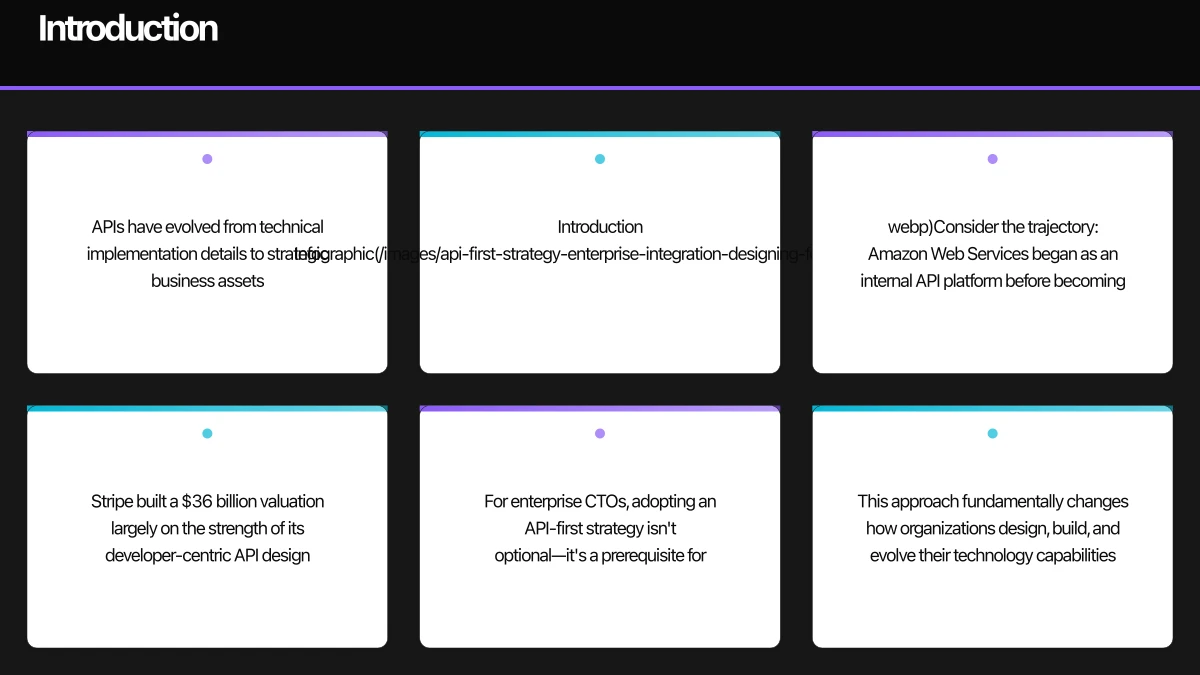
APIs have evolved from technical implementation details to strategic business assets. What began as a mechanism for system integration has become the foundation for digital business models, partner ecosystems, and organizational agility.
Consider the trajectory: Amazon Web Services began as an internal API platform before becoming a $45 billion business. Stripe built a $36 billion valuation largely on the strength of its developer-centric API design. Twilio, Plaid, and countless others have demonstrated that well-designed APIs create network effects, developer loyalty, and sustainable competitive advantage.
For enterprise CTOs, adopting an API-first strategy isn’t optional—it’s a prerequisite for digital transformation. This approach fundamentally changes how organizations design, build, and evolve their technology capabilities. Let me share a strategic framework for API-first transformation.
The API-First Paradigm
Definition and Principles
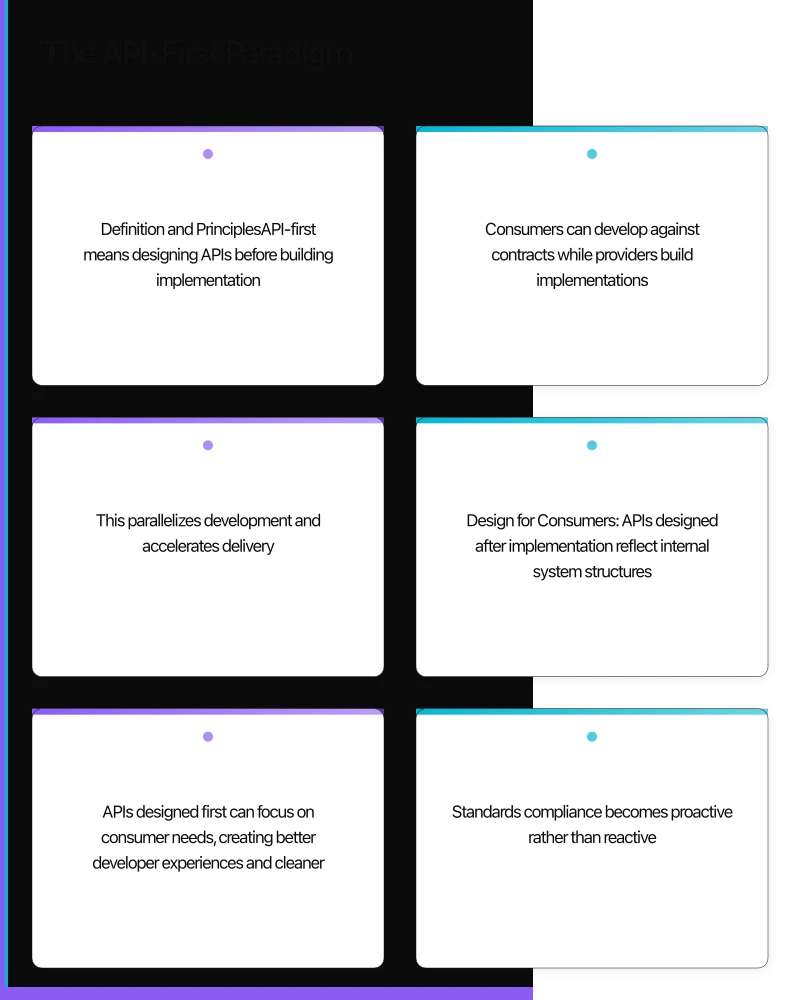
API-first means designing APIs before building implementation. Rather than extracting APIs from existing systems as an afterthought, API-first organizations treat APIs as first-class products, designing contracts before writing code.
This paradigm shift has profound implications:
Contract-First Development: API specifications (OpenAPI, GraphQL schemas) are defined before implementation begins. Consumers can develop against contracts while providers build implementations. This parallelizes development and accelerates delivery.
Design for Consumers: APIs designed after implementation reflect internal system structures. APIs designed first can focus on consumer needs, creating better developer experiences and cleaner abstractions.
Governance Integration: When APIs are designed before implementation, governance can be applied at design time rather than discovered at deployment time. Standards compliance becomes proactive rather than reactive.
Ecosystem Enablement: Well-designed APIs enable ecosystems—internal teams, partners, and potentially external developers can build on your capabilities. Poor API design limits this potential.
Beyond Technical Integration
API-first strategy extends beyond technical integration:
Business Capability Exposure: APIs expose business capabilities, not just data. A well-designed order management API enables partners to place orders, not just query order data.
New Business Models: APIs enable new monetization—API-as-a-product, usage-based pricing, and ecosystem revenue sharing become possible.
Organizational Agility: When capabilities are exposed through stable APIs, underlying implementations can evolve without disrupting consumers. This decoupling enables faster change.
Partner Integration: APIs that partners can self-serve accelerate partnership development. Reducing integration effort from months to days transforms partnership economics.
Designing for Excellence
Design Principles
Effective API design follows established principles:
Consistency: APIs across an organization should share common patterns, naming conventions, and behaviors. Consumers should be able to predict how an unfamiliar API behaves based on experience with other organizational APIs.
Simplicity: APIs should be as simple as possible while meeting requirements. Avoid exposing internal complexity that consumers don’t need.
Stability: API contracts should be stable. Breaking changes should be rare, well-communicated, and version-managed.
Security by Design: Authentication, authorization, and data protection should be integral to API design, not afterthoughts.
Evolvability: APIs should be designed for change. Extensibility points, versioning strategies, and deprecation policies enable evolution without disruption.
REST Design Standards
REST remains the dominant API architectural style for good reasons—it’s well-understood, widely supported, and maps naturally to HTTP. Effective REST design includes:
Resource-Oriented Design: Model APIs around resources (nouns) rather than actions (verbs). Use HTTP methods to indicate actions. POST /orders creates an order; GET /orders/{id} retrieves one.
Consistent Naming: Use plural nouns for collections (/orders, not /order). Use lowercase with hyphens for multi-word resources (/order-items). Be consistent across all APIs.
Meaningful HTTP Status Codes: Return appropriate status codes—200 for success, 201 for creation, 400 for client errors, 500 for server errors. Don’t return 200 with error information in the body.
HATEOAS Consideration: Hypermedia as the Engine of Application State enables discoverable APIs but adds complexity. Consider the tradeoff for your use cases.
Pagination: Implement consistent pagination for collection resources. Common patterns include offset/limit and cursor-based pagination.
Filtering and Sorting: Provide query parameters for filtering (?status=pending) and sorting (?sort=createdAt:desc) on collection resources.
GraphQL Considerations
GraphQL has gained significant adoption since Facebook’s 2015 release, offering an alternative to REST with distinct characteristics:
Advantages: Client-specified queries eliminate over-fetching and under-fetching. Strong typing enables better tooling. A single endpoint simplifies client development.
Challenges: Caching is more complex than REST. Query complexity can create performance risks. The ecosystem, while growing, is less mature than REST.
When to Choose: GraphQL excels for complex data requirements with varied clients (mobile, web, internal). REST may be preferable for simple CRUD operations or when leveraging HTTP caching is important.
Many organizations successfully use both, choosing the appropriate style for each use case.
API Specification
Formal API specifications enable contract-first development, documentation generation, and governance automation:
OpenAPI (Swagger): The industry standard for REST API specification. OpenAPI 3.0 provides comprehensive capabilities for describing endpoints, schemas, authentication, and more.
GraphQL Schema: GraphQL’s type system provides built-in specification through SDL (Schema Definition Language).
AsyncAPI: For event-driven and asynchronous APIs, AsyncAPI provides specification capabilities similar to OpenAPI.
Specification-first development means writing these specifications before implementation, enabling parallel development and early governance review.
Governance and Standards
The Governance Imperative
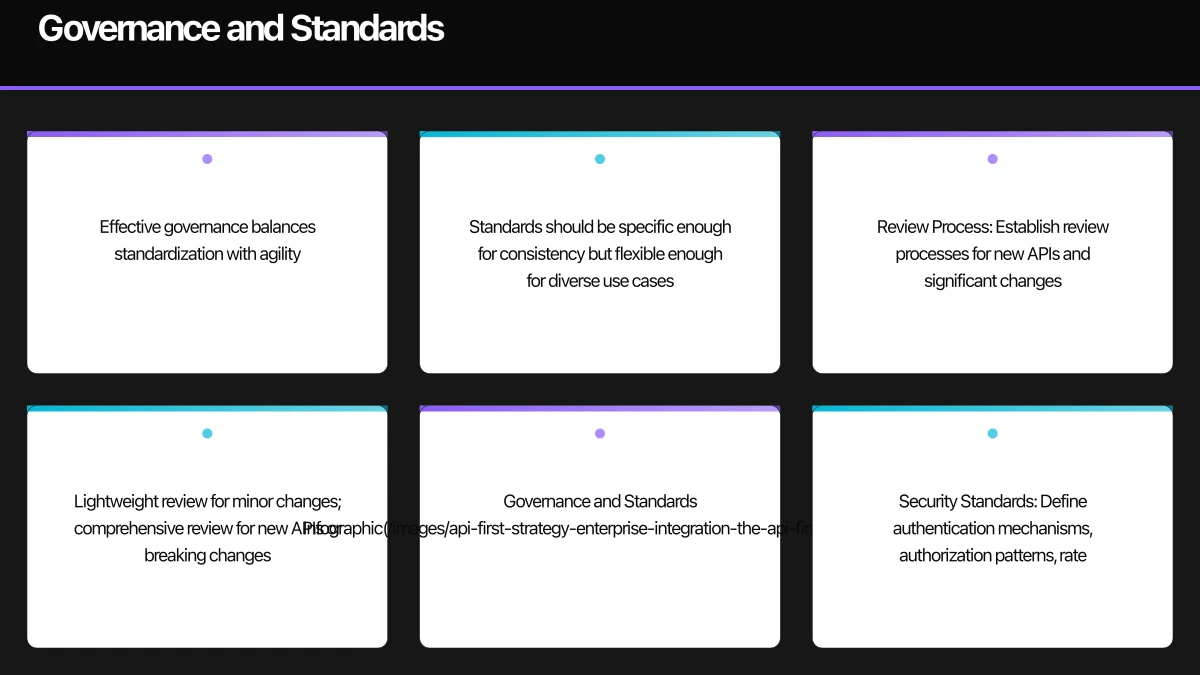
Without governance, API proliferation leads to chaos—inconsistent designs, duplicated capabilities, security gaps, and maintenance nightmares. Effective governance balances standardization with agility.
Governance Framework Components
Design Standards: Document and enforce design standards covering naming conventions, error handling, pagination, versioning, and security. Standards should be specific enough for consistency but flexible enough for diverse use cases.
Review Process: Establish review processes for new APIs and significant changes. Lightweight review for minor changes; comprehensive review for new APIs or breaking changes.
Lifecycle Management: Define API lifecycle stages (design, development, published, deprecated, retired) with clear criteria and processes for each transition.
Versioning Policy: Establish versioning strategy (URL path, header, or query parameter versioning) and policies for introducing and retiring versions.
Security Standards: Define authentication mechanisms, authorization patterns, rate limiting, and data protection requirements that all APIs must meet.
Tooling for Governance
Manual governance doesn’t scale. Tooling enables automated enforcement:
Linting: Tools like Spectral can validate OpenAPI specifications against organizational style guides, catching violations at design time.
API Catalogs: Registries like SwaggerHub or open-source alternatives provide a single source of truth for API specifications, enabling discovery and governance.
Gateway Enforcement: API gateways can enforce policies at runtime—authentication, rate limiting, and access control—providing consistent security across APIs.
CI/CD Integration: Integrate specification linting and breaking-change detection into pipelines, preventing non-compliant APIs from reaching production.
Building the API Platform
Platform Components
An enterprise API platform typically includes:
API Gateway: The front door for API traffic, providing routing, authentication, rate limiting, and analytics. Leading options include Kong, Apigee, AWS API Gateway, and Azure API Management.
Developer Portal: Self-service documentation, sandbox environments, and API key management for internal and external developers.
API Catalog/Registry: Central registry of all organizational APIs with specifications, documentation, and metadata.
Analytics and Monitoring: Visibility into API usage, performance, and errors. Essential for operational management and business intelligence.
Identity and Access Management: Consistent authentication (OAuth 2.0, API keys, JWT) and authorization across APIs.
Build vs. Buy
The API platform can be assembled from managed services, open-source components, or commercial products:
Managed Services: Cloud provider API management (AWS API Gateway, Azure API Management, Google Apigee) reduces operational burden but may limit flexibility.
Commercial Platforms: Products like MuleSoft, Kong Enterprise, or Apigee provide comprehensive capabilities with vendor support.
Open Source: Kong, Tyk, or KrakenD provide gateway capabilities; SwaggerHub or Backstage provide catalog capabilities. Open source offers flexibility and cost savings but requires operational investment.
Most enterprises use a combination, selecting managed services where appropriate and building or buying specialized capabilities.
Versioning and Evolution
Versioning Strategies
APIs must evolve while maintaining backward compatibility. Versioning strategies include:
URL Path Versioning: Include version in URL (/v1/orders, /v2/orders). Simple and explicit, but creates API proliferation and complicates client implementation.
Header Versioning: Version specified in request header. Keeps URLs clean but is less visible and harder to test.
Query Parameter Versioning: Version as query parameter (/orders?version=2). Simple but semantically awkward.
Most organizations use URL path versioning despite its drawbacks, as it provides the clearest developer experience.
Breaking vs. Non-Breaking Changes
Non-Breaking Changes (safe to deploy without version change):
- Adding optional fields to responses
- Adding new endpoints
- Adding optional request parameters
- Adding new error codes (clients should handle unknown codes gracefully)
Breaking Changes (require new version):
- Removing fields from responses
- Changing field types or formats
- Removing endpoints
- Adding required request parameters
- Changing error response structures
Deprecation Policy
Establish clear deprecation policies:
- Announce deprecation with timeline (e.g., 12 months notice)
- Provide migration guidance
- Monitor usage of deprecated versions
- Communicate proactively with affected consumers
- Remove deprecated versions on schedule
Security Considerations
Authentication Patterns
OAuth 2.0: The industry standard for API authentication, supporting various flows (client credentials, authorization code, etc.) for different use cases.
API Keys: Simple authentication for internal or low-security use cases. Should be combined with other security measures for production APIs.
JWT (JSON Web Tokens): Enable stateless authentication with claims-based authorization. Often used with OAuth 2.0.
mTLS: Mutual TLS provides strong authentication for high-security service-to-service communication.
Authorization
Scope-Based Authorization: OAuth scopes define what a client can access. Design scopes around business capabilities, not technical resources.
Attribute-Based Access Control (ABAC): Fine-grained authorization based on user attributes, resource attributes, and environmental context.
API Gateway Enforcement: Gateways can enforce basic authorization at the edge, but complex authorization often requires application-level implementation.
Threat Protection
Rate Limiting: Protect against abuse and ensure fair resource allocation.
Input Validation: Validate all input against schemas, rejecting malformed requests before processing.
Injection Prevention: Sanitize inputs to prevent SQL injection, NoSQL injection, and other injection attacks.
Encryption: Enforce HTTPS for all API traffic. Consider field-level encryption for sensitive data.
Building an API Culture
Developer Experience
API success depends on developer adoption. Invest in developer experience:
Documentation: Comprehensive, accurate, and example-rich documentation. Auto-generated from specifications, supplemented with guides and tutorials.
Sandbox Environments: Let developers experiment without risk. Provide realistic test data and scenarios.
SDKs and Libraries: Provide client libraries for popular languages. Auto-generation from OpenAPI specifications reduces maintenance burden.
Support Channels: Provide accessible support—forums, chat, email—for developers encountering issues.
Internal Advocacy
API-first requires cultural change:
Training: Train developers on API design principles and organizational standards.
Champions: Identify and empower API champions within teams.
Recognition: Recognize excellent API design. Showcase well-designed APIs as models.
Feedback Loops: Collect feedback from API consumers and iterate on designs.
Measuring API Success
Operational Metrics
- API availability and latency
- Error rates by API and error type
- Request volume and patterns
- Rate limit hits
Business Metrics
- Developer adoption (new API keys, active developers)
- API calls per developer
- Time to first API call
- Partner revenue enabled through APIs
Design Quality Metrics
- Standards compliance rate
- Breaking changes frequency
- Documentation completeness
- Developer satisfaction scores
Conclusion
API-first strategy transforms how enterprises build, integrate, and evolve technology capabilities. When done well, APIs become strategic assets that enable organizational agility, partner ecosystems, and new business models.
Success requires more than technical implementation. It requires organizational commitment to design excellence, governance discipline, and developer experience. It requires treating APIs as products with consumers, lifecycles, and quality standards.
For CTOs, API-first represents a significant undertaking—changing how teams design, build, and think about systems. But the payoff—faster integration, more flexible architecture, and enabled ecosystems—justifies the investment.
The organizations that master API-first will have sustainable advantages in a business environment increasingly defined by digital integration and ecosystem participation.
Are you developing an API strategy for your organization? I’d welcome the opportunity to discuss approaches and share perspectives. Connect with me to continue the conversation.
Your digital strategy starts with being found online. Cosmos Web Tech covers SEO, WordPress, and web performance for Australian businesses.
I lead Ganda Tech Services, where we turn digital strategy into results through specialist cloud, web design, and mobile app teams across Sydney.
About the Author
Ashish Ganda is the founder of Ganda Tech Services, a Sydney-based technology consultancy specialising in cloud infrastructure, web development, and mobile app solutions for Australian businesses.
Digital Transformation Roadmap 2026
A 12-month framework for Australian SMBs ready to modernise — phases, tools, and milestones.
Almost done
Check your inbox and click the confirmation link to get your download.