Enterprise Incident Response: Building a Culture of Resilience
The 3 a.m. page that wakes your on-call engineer. The cascade failure that takes down your revenue-generating services. The data inconsistency discovered by a customer before your monitoring catches it. These moments define not just your system’s reliability, but your organization’s character.
In 2024, as enterprises navigate increasingly complex distributed architectures—from microservices sprawl to multi-cloud deployments—incident response has evolved from a technical checklist into a strategic capability. The companies winning in this environment aren’t necessarily those with the fewest incidents. They’re the ones who’ve built cultures where incidents become learning opportunities, where blame gives way to curiosity, and where each failure strengthens the system.
For CTOs leading digital transformation initiatives, the question isn’t whether incidents will occur. It’s whether your organization will emerge stronger from each one.
The Strategic Imperative: Why Incident Response Culture Matters
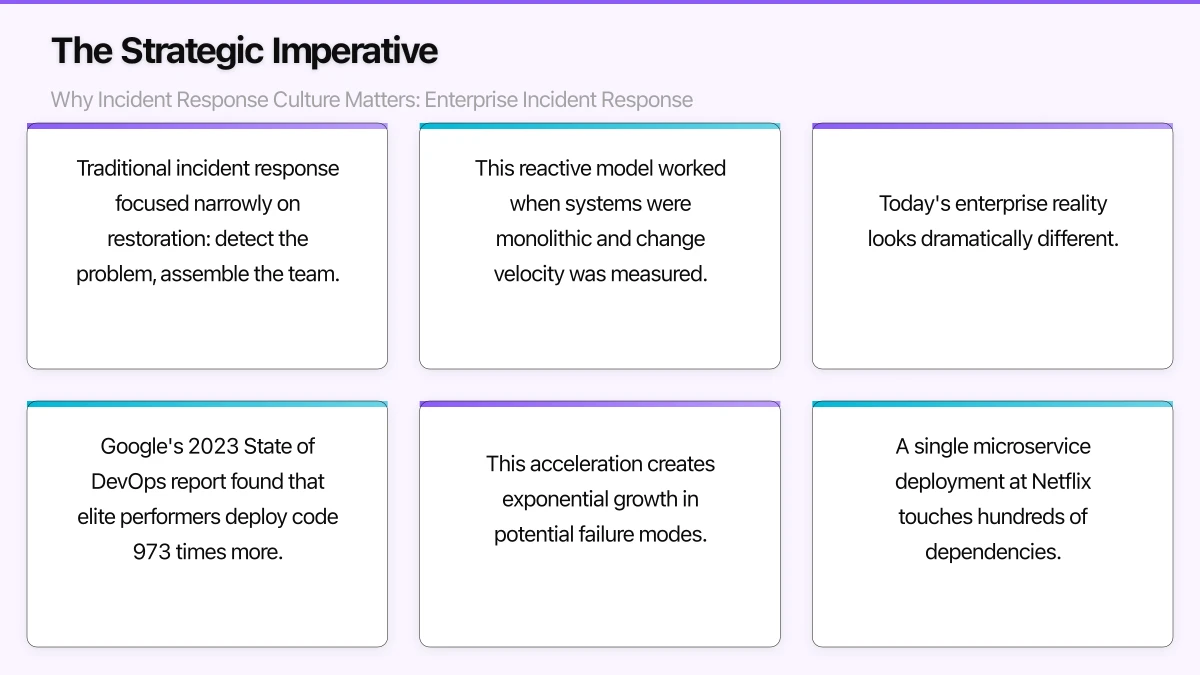
Traditional incident response focused narrowly on restoration: detect the problem, assemble the team, restore service, write a report. This reactive model worked when systems were monolithic and change velocity was measured in quarterly releases.
Today’s enterprise reality looks dramatically different. Google’s 2023 State of DevOps report found that elite performers deploy code 973 times more frequently than low performers. This acceleration creates exponential growth in potential failure modes. A single microservice deployment at Netflix touches hundreds of dependencies. An AWS region disruption can cascade across globally distributed workloads.
The data reveals a stark divide. Organizations with mature incident response cultures experience 60% faster mean time to recovery (MTTR) compared to those treating incidents as isolated technical events. More critically, they demonstrate 2.6 times higher deployment frequency—because engineers aren’t paralyzed by fear of causing outages.
Consider Capital One’s approach following their 2019 security incident. Rather than implementing draconian change controls that would slow innovation, they invested in comprehensive blameless postmortem culture and automated guardrails. By 2023, they’re processing 99% of deployments through automated pipelines while maintaining improved security posture. The difference? They treated the incident as a systems problem requiring cultural evolution, not just technical fixes.
This strategic shift matters because incident response culture directly impacts three business-critical metrics: customer trust (downtime erodes confidence), engineering velocity (fear-based cultures slow deployment), and operational costs (repeated incidents are expensive). Organizations that master this balance don’t just survive incidents—they use them as competitive advantages.
Building the Foundation: Enterprise Incident Response Frameworks
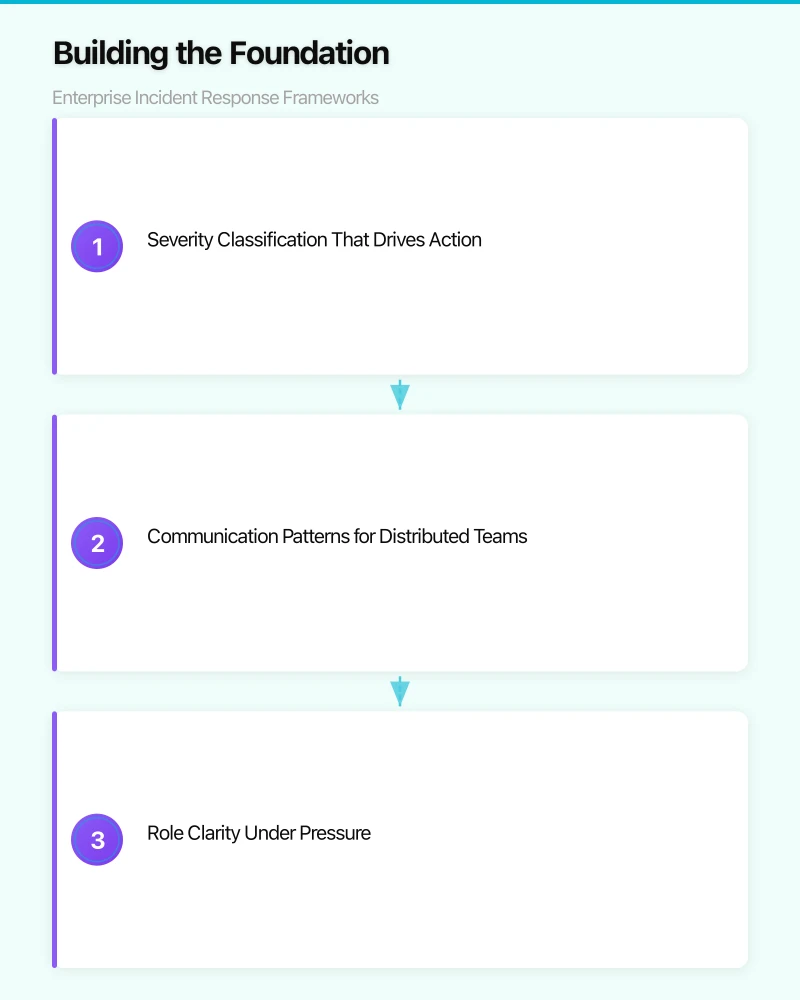
Effective incident response at scale requires systematic frameworks that balance speed with thorough analysis. The most successful enterprises adopt three core components: clear severity definitions, structured communication protocols, and defined role assignments.
Severity Classification That Drives Action
Vague severity definitions create confusion during high-stress situations. Stripe’s public incident framework provides an instructive model. They define SEV-1 as “critical service completely unavailable to all users,” SEV-2 as “significant feature degradation affecting some users,” and SEV-3 as “minor issues with workarounds available.” Each severity triggers specific response protocols.
The key insight: severity should correlate with business impact, not technical complexity. A database connection leak might be technically fascinating but rank as SEV-3 if monitoring catches it before user impact. Conversely, a simple DNS misconfiguration that takes down your authentication service is SEV-1 regardless of how quickly it’s fixed.
PagerDuty’s 2023 Incident Response Benchmark Report found that organizations with well-defined severity classifications resolve SEV-1 incidents 40% faster than those with ambiguous definitions. The difference comes from eliminated decision-making overhead—responders know immediately what resources to mobilize.
Communication Patterns for Distributed Teams
Enterprise incidents rarely affect single teams. A payment processing failure involves backend engineers, database administrators, payment gateway specialists, customer support, and executive stakeholders. Structured communication prevents chaos.
The “hub and spoke” model used by companies like Shopify during Black Friday/Cyber Monday incidents illustrates this well. They designate an Incident Commander (IC) who owns coordination, a Technical Lead who directs investigation, and a Communications Lead who manages stakeholder updates. The IC never touches code during incidents—their job is orchestrating the response.
This separation of concerns proves crucial at scale. When Cloudflare experienced their 2020 global outage, their IC coordinated 47 engineers across 12 time zones while maintaining transparent public status updates every 15 minutes. Post-incident analysis showed this communication discipline prevented the duplicate work and conflicting changes that extend outages.
Critical communication protocol: establish a dedicated incident channel (Slack, Teams) that serves as the source of truth. All status updates, hypotheses, and actions flow through this channel. Side conversations happen elsewhere, but decisions get recorded centrally. This creates an invaluable timeline for post-incident analysis.
Role Clarity Under Pressure
Ambiguity about who does what transforms manageable incidents into prolonged outages. The RACI matrix (Responsible, Accountable, Consulted, Informed) feels like corporate bureaucracy until you’re 45 minutes into a production incident with six engineers proposing conflicting remediation strategies.
LinkedIn’s incident response structure demonstrates sophisticated role design. Their IC has explicit authority to override technical decisions if restoration requires it—even if that means bypassing a principal engineer’s architectural preference. The Technical Lead owns investigation and remediation strategy. The Scribe documents the timeline in real-time, capturing every hypothesis and action. The Communications Lead manages stakeholder updates on a fixed cadence.
This role separation prevents common failure patterns: engineers getting distracted by investigative rabbit holes when restoration should take priority, conflicting remediation attempts that worsen the situation, and stakeholders interrupting technical work demanding status updates.
For enterprises operating follow-the-sun support models, clear role handoffs become essential. Atlassian’s incident playbooks specify exactly what information must be documented before handing an active incident to the next timezone. This includes current system state, hypotheses tested, rollback options attempted, and next investigation steps. The receiving IC can continue seamlessly rather than retracing ground.
Blameless Postmortems: Learning Without Fear
The term “blameless postmortem” has achieved buzzword status, often implemented superficially. True blameless culture requires deeper organizational commitment than simply saying “we don’t blame people.”
What Blameless Actually Means
Blameless doesn’t mean consequence-free or accountability-free. It means recognizing that human error is a symptom, not a root cause. When an engineer accidentally deletes a production database, the blameless question isn’t “why did they make that mistake?” but “what systems allowed that action to be possible?”
Etsy pioneered modern blameless postmortem culture under their VP of Engineering, John Allspaw. Their approach centers on understanding that engineers make decisions based on available information, time pressure, and system design. A deployment that causes an outage seemed like the right decision given what the engineer knew at that moment. The postmortem’s job is exploring why the system made that action seem reasonable.
This perspective shift unlocks honest dialogue. Google’s SRE book describes how blameless culture increased their incident reporting by 35% because engineers stopped hiding mistakes. Every hidden near-miss represents a learning opportunity lost. Organizations that punish mistakes get fewer reported incidents—not because systems are more reliable, but because engineers hide problems.
The litmus test for blameless culture: would an engineer feel comfortable presenting a postmortem about an incident they caused? If the answer is no, your culture isn’t actually blameless.
Conducting Effective Postmortem Meetings
The postmortem meeting is where organizational culture becomes visible. Done poorly, it becomes a blame session disguised with careful language. Done well, it’s collaborative problem-solving that strengthens both systems and teams.
Structure matters. Spotify’s postmortem meetings follow a consistent agenda: timeline review (what happened when), impact analysis (who was affected and how), contributing factors (not “root cause”—complex systems rarely have single causes), action items (specific, assigned, tracked), and lessons learned (what this incident teaches us about our systems).
The “five whys” technique, adapted from Toyota’s manufacturing processes, helps dig beneath surface causes. When Amazon Web Services experienced their 2020 Kinesis outage, their postmortem traced through multiple layers: the service became overloaded (surface), capacity planning didn’t account for exponential growth (deeper), growth models used historical patterns that didn’t capture pandemic-driven usage shifts (deeper still), forecasting processes lacked feedback loops from actual scaling events (root system issue).
Critical facilitation technique: separate the meeting from the document. The written postmortem should be circulated before the meeting. The meeting itself focuses on discussion, questions, and collaborative action planning. This prevents the meeting from becoming a reading exercise and ensures preparation.
PagerDuty’s research shows that organizations holding postmortem meetings within 48 hours of incident resolution achieve 50% better action item completion rates. The context remains fresh, emotional investment remains high, and competing priorities haven’t displaced focus.
Turning Insights Into System Improvements
Postmortems without action items are therapy sessions, not learning systems. The gap between identifying problems and fixing them determines whether your organization actually learns from incidents.
The challenge: postmortem action items compete with feature development, technical debt, and operational work. Without executive sponsorship, they disappear into overflowing backlogs. Microsoft’s Azure team addresses this by allocating 20% of engineering capacity to reliability work—a category that includes postmortem actions. This isn’t optional budget that gets cut when feature pressure increases; it’s protected capacity.
Action items should follow SMART criteria: Specific, Measurable, Achievable, Relevant, Time-bound. “Improve monitoring” is too vague. “Add alerting for database connection pool exhaustion with threshold triggers at 70% and 90% capacity, implemented by March 15” creates accountability.
Track action item completion as a key performance indicator. Shopify publishes quarterly incident reviews that include action item completion percentages. This transparency creates organizational pressure to follow through. When action items languish incomplete, patterns emerge: perhaps the proposed solutions are too expensive, too complex, or address symptoms rather than causes. These patterns themselves become valuable learning.
The most sophisticated organizations implement “incident themes” analysis. By reviewing postmortems quarterly, they identify recurring patterns. If five incidents in three months trace back to inadequate staging environment parity with production, that’s not five separate problems—it’s one systemic issue requiring architectural investment.
Building Organizational Resilience at Scale
Individual incident response excellence matters little if the organization can’t sustain and scale these practices. True resilience emerges from systems thinking applied to culture.
Chaos Engineering and Proactive Resilience
Netflix pioneered chaos engineering with their Chaos Monkey tool, which randomly terminates production instances to ensure systems handle failures gracefully. This counterintuitive approach—deliberately causing problems—builds confidence that incident response procedures actually work.
The principle extends beyond infrastructure. LinkedIn runs “Wheel of Misfortune” exercises where teams simulate incidents using real postmortem scenarios. An engineer plays IC while others role-play various responders. The exercise reveals documentation gaps, unclear responsibilities, and communication breakdowns—all discovered in a training environment rather than during actual outages.
Chaos engineering disciplines engineering investment toward resilience. When you know your systems will be randomly stressed, you build with failure in mind. Circuit breakers, graceful degradation, and comprehensive observability shift from nice-to-haves to requirements.
Gremlin’s 2023 Chaos Engineering Report found that organizations practicing regular chaos experiments experience 40% fewer unexpected production incidents. The experiments surface failure modes before customers encounter them. Equally important, they build organizational muscle memory for incident response under realistic conditions.
Incident Review Cadence and Learning Loops
Individual postmortems create team-level learning. Organizational resilience requires connecting these learnings across teams and over time.
Dropbox conducts monthly “Incident Review Forums” where engineering leaders review major incidents from across the company. These sessions identify cross-team patterns: multiple teams struggling with Kubernetes networking, recurring issues with third-party API reliability, or gaps in observability tooling. This meta-analysis drives platform investments that prevent future incidents company-wide.
The forum format matters. Rather than presentations, Dropbox uses structured discussion. Each incident gets 15 minutes: 3-minute context, 10-minute facilitated discussion focused on systemic factors, 2-minute action capture. This prevents defensive presentations and encourages collaborative problem-solving.
Amazon’s “Correction of Error” (COE) process takes learning loops further. Major incidents require written COEs reviewed by senior leadership. The review focuses on two questions: what mechanisms will prevent recurrence, and what mechanisms will detect similar issues faster if they occur elsewhere? This dual focus on prevention and detection creates defense in depth.
The learning loop closes with measurement. Track leading indicators: postmortem completion rates, action item follow-through, time to detection, time to recovery. Google’s SRE teams publish quarterly reliability reviews showing trends in these metrics. When MTTR increases or postmortem quality decreases, that’s a signal that cultural practices need reinforcement.
Executive Sponsorship and Cultural Investment
Resilience culture fails without executive commitment. When reliability work competes with feature delivery, features usually win—unless leadership explicitly prioritizes resilience.
Stripe’s CTO, David Singleton, sends a company-wide email after every SEV-1 incident summarizing what happened, what they learned, and what they’re changing. This visible leadership accomplishes three things: it normalizes incident discussion (removing stigma), it demonstrates that learning is valued at the highest levels, and it holds the organization accountable for follow-through.
Budget allocation reveals true priorities. Resilience requires investment: chaos engineering tools, observability platforms, dedicated SRE teams, protected time for postmortems and action items. Organizations that treat these as discretionary expenses discover resilience culture collapses under pressure.
The ROI case for resilience investment is straightforward. Gartner estimates average hourly downtime costs for enterprises at $300,000 per hour. A single prevented SEV-1 incident justifies substantial tooling and cultural investment. More subtly, engineer productivity and retention improve when teams operate in psychologically safe environments where mistakes drive learning rather than punishment.
Measuring Success: Resilience Metrics That Matter
“Culture” feels intangible, but organizational resilience manifests in measurable outcomes. The right metrics provide visibility into cultural health while driving continuous improvement.
Incident Frequency and Severity Trends
Track both total incidents and severity distribution over time. Increasing total incidents isn’t necessarily bad if you’re detecting problems faster and most are low-severity. The concerning pattern: increasing SEV-1 incidents despite organizational growth and investment.
Normalize by deployment frequency or traffic volume. An e-commerce platform processing 10x Black Friday traffic compared to baseline should expect proportionally more incidents. The meaningful metric: incidents per million requests or per thousand deployments.
Shopify tracks “incident density”: customer-impacting incidents divided by deployment count. This metric declined 60% from 2019 to 2023 despite 4x increase in deployment frequency. The cultural shift from fear-based change control to comprehensive testing and observability shows up clearly in the data.
Recovery Speed and Detection Gaps
Mean Time to Detection (MTTD) and Mean Time to Recovery (MTTR) are standard SRE metrics, but their trends reveal cultural health. Improving MTTR without improving MTTD suggests you’re getting better at firefighting but not at system observability. Ideal progression: MTTD improves first (you catch problems faster), then MTTR improves (you resolve them faster).
The gap between “incident started” and “incident detected” often dwarfs the resolution time. When GitHub experienced their 2020 database incident, the actual corruption occurred 45 minutes before monitoring alerted. The incident lasted 24 hours total, but 45 minutes of undetected corruption required 23+ hours of data recovery. Post-incident investment in database integrity monitoring improved MTTD dramatically.
Track “customer-detected incidents” separately. Any incident reported by customers rather than monitoring represents an observability gap. Datadog’s internal SLO includes “zero customer-detected outages”—a stretch goal that drives continuous monitoring improvement.
Postmortem Quality and Action Follow-Through
Measure postmortem completion within 48 hours of incident resolution. Late postmortems suffer from memory degradation and reduced stakeholder engagement. LinkedIn maintains a 95% completion rate by treating postmortem writing as part of incident resolution, not a follow-up task.
Action item completion percentage reveals whether learning translates to improvement. Track both completion rates and time-to-completion. Items languishing for months signal either over-ambitious proposals or competing priority problems.
The most sophisticated metric: repeated incident rate. If similar incidents occur within six months, the original postmortem either missed root causes or action items weren’t completed. Atlassian flags these “incident families” for special review by senior engineering leadership.
Cultural Health Indicators
Quantify psychological safety through anonymous surveys: “Do you feel comfortable presenting a postmortem about an incident you caused?” “Would you report a near-miss even if it didn’t cause customer impact?” Organizations with resilience cultures score 80%+ on these questions.
Track participation breadth in incident response. If only senior engineers serve as Incident Commanders, you’re not scaling capabilities. Dropbox measures “percentage of engineers who’ve led at least one incident response” quarterly. By 2023, they’ve reached 65% of engineers, ensuring resilience knowledge distributes broadly.
Review postmortem attendance and engagement. Low attendance suggests meetings aren’t valuable or cultural buy-in is weak. Spotify addresses this by making postmortems genuinely interesting—they focus on learning rather than obligation, feature guest participants from affected customer teams, and strictly limit meeting length.
The Path Forward: From Reactive to Resilient
Building resilience culture is a multi-year journey, not a quarterly initiative. The organizations leading in this space—Netflix, Google, Stripe, Shopify—invested years developing their practices. They also continue evolving; resilience culture is never finished.
For CTOs beginning this journey, start with psychological safety foundations. Engineers must feel safe reporting incidents and mistakes without punishment. This cultural bedrock enables everything else. Run an executive incident review where you openly discuss a significant failure you caused or decision you regret. Model the vulnerability you want from your organization.
Invest in structured incident response frameworks before you need them. Severity definitions, communication protocols, and role assignments feel bureaucratic until they prevent chaos during a midnight outage. Document these frameworks, practice them through game days, and refine them based on actual incident experience.
Commit to blameless postmortems with authentic follow-through. Track action items as rigorously as feature development. Allocate protected engineering capacity to reliability work. Publish incident trends transparently to demonstrate organizational learning.
Build resilience muscle through chaos engineering and incident simulations. Make failure normal in controlled environments so it’s manageable in production. Celebrate teams that discover and fix weaknesses proactively.
The competitive advantage of resilience culture compounds over time. Each incident teaches lessons that prevent future incidents. Each postmortem strengthens organizational systems. Each blameless review builds psychological safety that accelerates innovation.
The enterprises that dominate their industries in coming years won’t necessarily be those with the most sophisticated architectures or largest engineering teams. They’ll be organizations that learned to embrace failure as the price of innovation—and built cultures that grow stronger with each setback.
Your 3 a.m. pages will continue. The question is whether they’re random crises or opportunities to demonstrate organizational resilience. That choice belongs to leadership.
Ready to strengthen your organization’s incident response culture? Contact Ash Ganda for strategic consultation on building enterprise resilience at scale.
Turning strategy into infrastructure? Cloud Geeks covers managed cloud, DevOps, and IT security for businesses putting digital plans into action.
Ash Ganda is the founder of Ganda Tech Services, a Sydney-based technology consultancy delivering cloud, web, and mobile solutions for Australian businesses.
About the Author
Ashish Ganda is the founder of Ganda Tech Services, a Sydney-based technology consultancy specialising in cloud infrastructure, web development, and mobile app solutions for Australian businesses.
Digital Transformation Roadmap 2026
A 12-month framework for Australian SMBs ready to modernise — phases, tools, and milestones.
Almost done
Check your inbox and click the confirmation link to get your download.