
Building an Enterprise Data Governance Framework for the AI Era
The Data Governance Inflection Point
Enterprise data governance has entered a new era. The confluence of AI adoption, expanding privacy regulations, and data-driven decision making has elevated governance from a compliance checkbox to a strategic capability. Organizations that treat data governance as bureaucratic overhead are discovering that poor data quality undermines AI initiatives, regulatory gaps create existential risks, and fragmented data ownership blocks digital transformation.
According to Gartner’s 2024 Data and Analytics Governance Survey, 65% of enterprises cite data governance as a top-three priority for their data strategy—up from 42% in 2021. Yet the same survey reveals that only 28% rate their governance programs as effective.
This gap between priority and execution reflects the difficulty of the challenge. Effective data governance requires balancing competing objectives: enabling innovation while managing risk, democratizing access while protecting privacy, maintaining quality while allowing agility. For technology leaders, building governance frameworks that achieve this balance is now a core competency.
Why Traditional Governance Fails
The Compliance-First Trap
Many governance programs originate from regulatory requirements—GDPR, CCPA, industry-specific mandates. This origin creates a compliance-first mindset that shapes governance as a constraint rather than an enabler.
Symptoms of compliance-first governance:
- Data cataloging viewed as documentation exercise
- Quality metrics focused on regulatory reports
- Access controls that impede legitimate business use
- Governance team seen as the “data police”
The result: shadow data practices proliferate. Business units create their own data stores, analytics teams work around governance processes, and the governed environment becomes increasingly disconnected from actual data usage.
The Technology-First Fallacy
Other organizations approach governance as a technology problem. They purchase data catalogs, quality platforms, and lineage tools expecting that technology will create governance.
Technology enables governance but cannot replace governance. A data catalog that no one updates becomes a graveyard. Quality rules without stewardship accountability create alert fatigue. Lineage tracking without defined processes provides visibility into chaos.
According to Forrester’s 2025 Data Governance Wave, organizations that lead with process and culture before technology selection are 2.3x more likely to report governance program success.
The Centralization Paradox
Traditional governance models assume centralized control. A governance team defines standards, reviews changes, and approves access. This model worked when data volumes were manageable and change velocity was low.
Modern data environments break this model:
- Data volumes exceed centralized review capacity
- Self-service analytics requires real-time access decisions
- AI model training needs governed data pipelines at scale
- Cloud services distribute data across providers and regions
The alternative—federated governance—distributes responsibility while maintaining consistent standards. This approach requires clearer frameworks, better tooling, and cultural alignment across data domains.
A Framework for Modern Data Governance
Principle 1: Governance as Enablement
Reframe governance from “what you can’t do” to “how you can safely do more.” This requires:
Clear value proposition: Articulate what governance enables—faster analytics, trusted AI, confident compliance, reduced risk. Make these benefits visible to data consumers.
Self-service within guardrails: Provide automated access provisioning for classified data. Enable exploration environments with synthetic or masked data. Create golden paths that make the governed approach easier than workarounds.
Metrics that matter: Track time-to-insight alongside compliance scores. Measure data reuse rates. Survey data consumer satisfaction.
Principle 2: Domain-Oriented Ownership
Adopt data mesh principles for governance. Data domains—customer, product, financial, operational—own their data as products:
Domain data stewards: Business-aligned individuals responsible for data quality, semantics, and access within their domain. Not IT roles—business roles with data responsibility.
Data contracts: Explicit agreements between data producers and consumers covering schema, quality, freshness, and access terms.
Federated standards: Central team defines cross-cutting standards (classification taxonomy, privacy rules, security controls). Domains implement within their context.
This model scales because governance responsibility scales with data ownership. The central governance team shifts from gatekeeper to standards body and enabler.
Principle 3: Privacy by Design
Privacy cannot be retrofitted. Build privacy considerations into data architecture from the start:
Data minimization: Capture only necessary data. Question every field—what decision does this enable? Is there a less invasive alternative?
Purpose limitation: Bind data to declared purposes. Technical controls should enforce purpose—not just policy documentation.
Anonymization strategy: Define approaches for different use cases:
- K-anonymity for analytical datasets
- Differential privacy for aggregate statistics
- Tokenization for operational data that requires reversibility
- Synthetic data for development and testing
Retention policies: Automate data lifecycle. Data that must be deleted according to policy should be deleted automatically, not manually.
Principle 4: Quality as Product Attribute
Data quality is not a governance function—it’s a product attribute of data domains. Quality expectations should be:
Defined by consumers: What accuracy, completeness, and timeliness do downstream uses require? Different consumers may have different requirements.
Measured continuously: Automated quality checks in data pipelines. Anomaly detection for statistical distributions. Schema validation for structural expectations.
Visible and accountable: Quality metrics published as part of data product documentation. Domain teams accountable for meeting quality SLOs.
Prioritized economically: Not all data requires the same quality investment. Critical business processes need higher quality. Exploratory analytics can tolerate more variation.
The AI Governance Imperative
AI adoption creates governance challenges that traditional frameworks weren’t designed to address.
Training Data Governance
AI models inherit biases, errors, and privacy risks from their training data. Governance must extend to:
Provenance tracking: Where did training data originate? What were the collection circumstances? Are there consent or licensing constraints?
Bias assessment: What populations are represented? What groups are underrepresented? How might training data distributions affect model fairness?
Quality requirements: Training data quality directly affects model performance. Define quality standards specific to ML use cases.
Version control: As training data changes, model behavior changes. Maintain versioned datasets linked to trained model versions.
Model Governance
Models are data products that require governance:
Model documentation: Input data, training process, performance metrics, known limitations, intended use cases. Model cards provide a structured format.

Performance monitoring: Accuracy degradation, prediction drift, input distribution shifts. Automated alerts when models move out of expected bounds.
Access control: Who can invoke models? Who can see predictions? How are model outputs used in decisions?
Explainability requirements: For high-stakes decisions, can predictions be explained? What documentation is required for regulatory compliance?
AI-Specific Regulatory Considerations
The regulatory landscape for AI is evolving rapidly. The EU AI Act, effective this year, establishes risk categories and governance requirements for AI systems. Key implications:
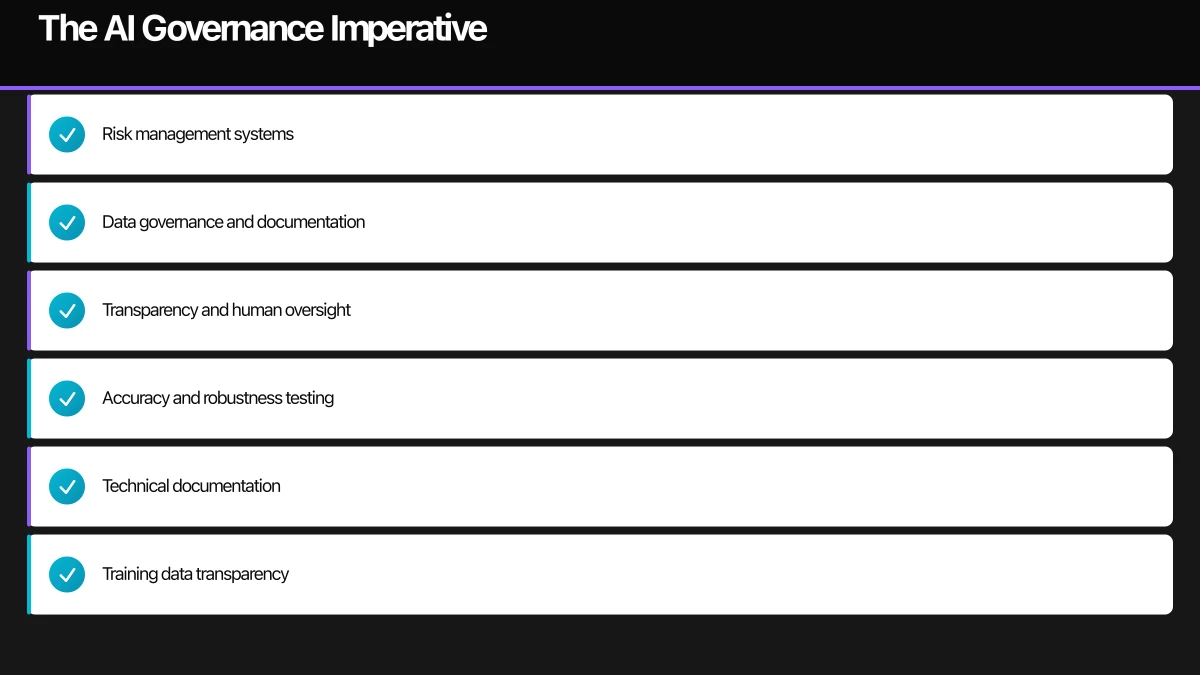
High-risk AI systems (employment, credit, healthcare, law enforcement) require:
- Risk management systems
- Data governance and documentation
- Transparency and human oversight
- Accuracy and robustness testing
General-purpose AI models require:
- Technical documentation
- Training data transparency
- Compliance with copyright rules
Organizations deploying AI should assess their systems against emerging regulatory frameworks now, rather than scrambling to comply after enforcement begins.
Implementation Roadmap
Phase 1: Foundation (Months 1-3)
Assess current state: Document existing governance structures, policies, tools, and pain points. Identify quick wins and critical gaps.
Define governance operating model: Determine centralized vs. federated balance. Define roles: Chief Data Officer, governance council, domain stewards, data engineers.
Establish executive sponsorship: Governance requires sustained organizational commitment. Secure executive champion with authority to resolve cross-functional conflicts.
Create data classification framework: Start simple—three or four classification levels (public, internal, confidential, restricted). More granularity can come later.
Phase 2: Core Capabilities (Months 4-9)
Implement data catalog: Select and deploy cataloging technology. Focus on discoverability—business glossaries, semantic search, usage documentation.
Establish domain ownership: Assign stewards to priority data domains. Define responsibilities and accountability measures.
Deploy access management: Implement role-based access with self-service provisioning for classified data. Integrate with identity management.
Create quality monitoring: Automated quality checks for critical data pipelines. Quality scorecards visible to data consumers.
Phase 3: AI and Advanced Governance (Months 10-18)
Extend governance to AI: Model documentation standards, training data governance, performance monitoring frameworks.
Implement data contracts: Formal agreements between producers and consumers. Automated contract validation.
Deploy lineage tracking: End-to-end visibility from source systems through transformations to consumption. Critical for debugging and compliance.
Establish privacy engineering: Technical privacy controls—anonymization, tokenization, synthetic data generation—as standard capabilities.
Phase 4: Optimization (Ongoing)
Measure and improve: Track governance metrics. Conduct regular maturity assessments. Address emerging gaps.
Automate enforcement: Shift from manual review to automated policy enforcement. Human oversight for exceptions.
Expand federated governance: As organizational capability matures, delegate more responsibility to domains while maintaining standards.
Technology Landscape
Data governance technology has matured significantly. Key categories:
Data Catalogs
Modern catalogs go beyond metadata to enable collaboration, automate discovery, and integrate with operational workflows.
Leaders: Alation, Collibra, Atlan, Informatica Cloud-native options: AWS Glue Data Catalog, Azure Purview, Google Dataplex
Selection criteria:
- Integration with existing data stack
- Active metadata vs. passive documentation
- Collaboration and crowdsourcing capabilities
- AI/ML-specific features (model registry, lineage)
Data Quality Platforms
Shift from batch quality reports to real-time quality monitoring and automated remediation.
Leaders: Monte Carlo, Bigeye, Great Expectations, Soda Integrated options: dbt (data build tool) with testing, Databricks Unity Catalog
Selection criteria:
- Integration with data pipeline tools
- Anomaly detection vs. rule-based checks
- Alerting and workflow integration
- Historical quality trending
Data Lineage
Understand data flow from source through transformation to consumption. Essential for debugging, compliance, and impact analysis.
Approaches:
- Parse-based: Analyze SQL and code to infer lineage
- Runtime: Capture actual data flow during execution
- Manual: Document lineage through metadata
Many organizations use combinations—parse-based for coverage, runtime for critical paths.
Privacy and Access Management
Technical enforcement of privacy policies and access controls.
Categories:
- Data masking and tokenization
- Synthetic data generation
- Attribute-based access control
- Privacy-preserving computation
The convergence of data governance and data security is creating integrated platforms that span catalog, quality, access, and privacy.
Organizational Change Management
Technology and frameworks fail without organizational adoption. Key change management elements:
Executive Alignment
The executive team must visibly support governance:
- Include governance metrics in executive dashboards
- Reference governance in strategic communications
- Allocate budget and staffing
- Hold leaders accountable for their domain’s governance
Incentive Alignment
Governance competes with other priorities. Create incentives:
- Include governance responsibilities in role descriptions
- Factor governance metrics into performance reviews
- Recognize governance contributions publicly
- Make non-compliance visible and consequential
Training and Enablement
People govern data, not systems:
- Role-specific training for stewards, engineers, analysts
- Governance integrated into onboarding
- Clear documentation and self-service resources
- Community of practice for knowledge sharing
Celebrating Success
Governance often prevents bad outcomes rather than creating visible wins. Actively communicate value:
- Share governance-enabled use cases
- Quantify risk reduction
- Highlight compliance achievements
- Tell stories of governance enabling innovation
Measuring Governance Effectiveness
Avoid the trap of measuring governance activity rather than outcomes. Key metrics:
Enablement metrics:
- Time from data request to access
- Data discovery success rate
- Data asset reuse rate
- Self-service provisioning percentage
Quality metrics:
- Quality scores by domain
- Quality SLO attainment
- Data incident frequency and impact
- Time to detect and resolve quality issues
Compliance metrics:
- Privacy policy compliance rate
- Audit finding trends
- Regulatory reporting accuracy
- Data retention compliance
Adoption metrics:
- Catalog coverage and freshness
- Steward engagement
- Policy acknowledgment rates
- Training completion
Report metrics to governance council monthly. Conduct comprehensive maturity assessments annually.
The Path Forward
Data governance in 2025 is more critical and more challenging than ever. AI amplifies both the value of well-governed data and the risks of governance failures. Regulatory complexity continues to increase. Data volumes and diversity expand relentlessly.
For CTOs, the strategic imperative is clear: governance is not optional, and traditional approaches are insufficient. The organizations that thrive will be those that treat governance as an enabler of innovation, distribute responsibility to data domains, embed privacy into architecture, and measure outcomes rather than activities.
The investment is substantial but the alternative—ungoverned data in an AI-enabled, heavily-regulated environment—creates risks that responsible organizations cannot accept.
For guidance on implementing data governance frameworks that balance innovation with compliance, connect with me to discuss approaches tailored to your organization’s context.
For practical web design and SEO guidance, my team at Cosmos Web Tech helps Australian businesses build high-performing websites.
I lead Ganda Tech Services, where we turn digital strategy into results through specialist cloud, web design, and mobile app teams across Sydney.
About the Author
Ashish Ganda is the founder of Ganda Tech Services, a Sydney-based technology consultancy specialising in cloud infrastructure, web development, and mobile app solutions for Australian businesses.
AI Strategy Primer for Australian Business Leaders
A practical framework for AI adoption in 2026 — cut through the hype and start with what matters.
Almost done
Check your inbox and click the confirmation link to get your download.