Enterprise Disaster Recovery Architecture for Multi-Region Deployments
Introduction
Disaster recovery has evolved from a back-office concern involving tape backups and cold standby data centres to a core architectural discipline in the cloud era. The shift to cloud-native architectures, while providing unprecedented elasticity and global reach, has also introduced new failure modes: region-level outages, service-level degradations, and cascading failures across distributed systems that traditional DR plans were not designed to address.
For enterprise architects, the challenge is designing disaster recovery architectures that protect against cloud-scale failures while controlling the substantial costs of multi-region redundancy. Every improvement in recovery capability comes at a cost: additional infrastructure, increased operational complexity, and more sophisticated data replication. The architectural art lies in matching recovery capability to business requirements, investing where the business impact of downtime is highest and accepting calculated risk where it is lower.
This analysis provides a strategic framework for enterprise disaster recovery architecture, focusing on multi-region cloud deployments and the architectural patterns that balance recovery capability against cost and complexity.
Recovery Objectives and Business Alignment
The foundation of any disaster recovery architecture is a clear understanding of business recovery requirements, expressed as Recovery Time Objective (RTO) and Recovery Point Objective (RPO) for each critical system.
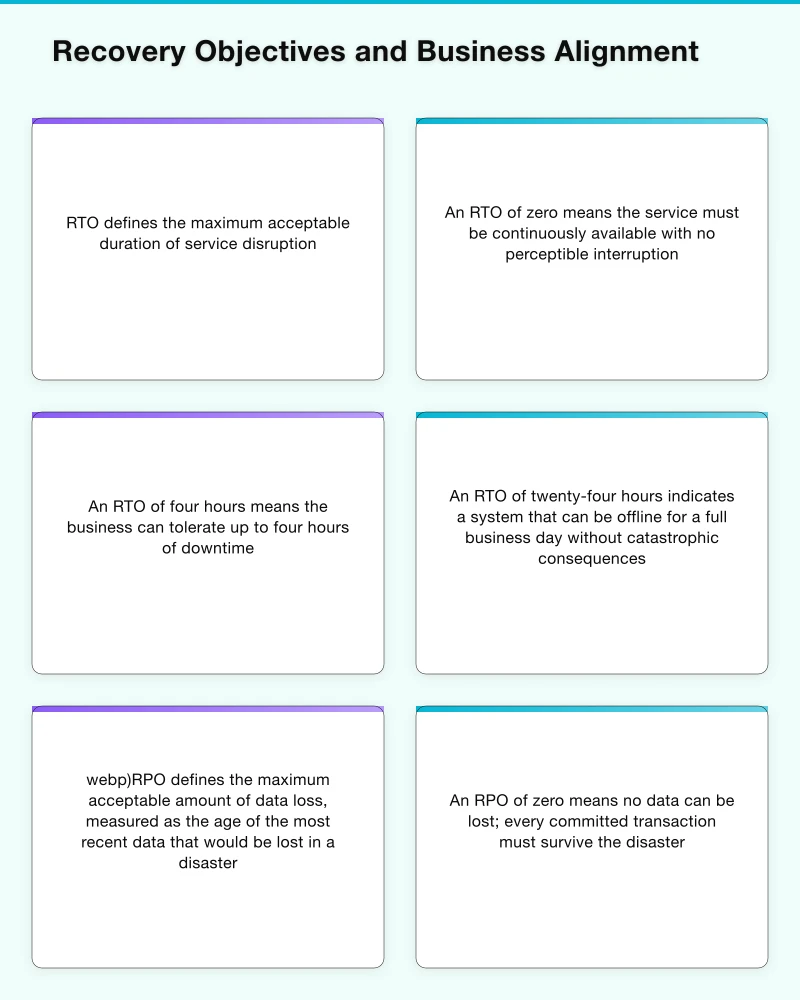
RTO defines the maximum acceptable duration of service disruption. An RTO of zero means the service must be continuously available with no perceptible interruption. An RTO of four hours means the business can tolerate up to four hours of downtime. An RTO of twenty-four hours indicates a system that can be offline for a full business day without catastrophic consequences.
RPO defines the maximum acceptable amount of data loss, measured as the age of the most recent data that would be lost in a disaster. An RPO of zero means no data can be lost; every committed transaction must survive the disaster. An RPO of one hour means the business can tolerate losing up to one hour of recent data. An RPO of twenty-four hours accepts that a full day of data might need to be re-entered or reconstructed.
These objectives must be set by business stakeholders, not technology teams, because they represent business risk decisions. The technology team’s role is to communicate the cost implications of different RTO and RPO targets and to implement architectures that achieve the agreed objectives. The conversation between business and technology is essential because there is often a dramatic mismatch between the recovery capabilities business leaders assume they have and the capabilities their current architecture actually provides.
Not all systems require the same recovery objectives. Classifying systems into tiers based on business criticality enables appropriate investment: Tier 1 systems (customer-facing transactions, real-time operations) may require near-zero RTO and RPO, while Tier 3 systems (internal reporting, development environments) may tolerate hours or days of downtime. This tiered approach prevents the prohibitive cost of applying the highest recovery standard to every system.
Multi-Region Architecture Patterns
Cloud providers offer multiple geographic regions, each comprising multiple availability zones. The disaster recovery architecture pattern should be selected based on the recovery objectives for each system tier.
Backup and restore is the simplest and least expensive pattern. Data is regularly backed up to a secondary region, and in the event of a primary region failure, infrastructure is provisioned in the secondary region and restored from backups. This pattern provides RPO equal to the backup frequency (typically hours) and RTO measured in hours to days (the time to provision infrastructure, restore data, and redirect traffic). It is appropriate for Tier 3 systems where extended downtime is acceptable.
Pilot light maintains a minimal footprint in the secondary region: core infrastructure (database replicas, networking) is running, but application servers are not provisioned. In a disaster, application infrastructure is scaled up from the pilot light, and traffic is redirected. This pattern provides RPO measured in minutes (through continuous database replication) and RTO measured in minutes to hours (the time to scale up application infrastructure). The cost is modest, limited to the continuously running database replicas and core networking.
Warm standby runs a scaled-down but fully functional copy of the production environment in the secondary region. All components are running and receiving replicated data, but at reduced capacity. In a disaster, the secondary environment is scaled up to full production capacity and traffic is redirected. RTO is measured in minutes, as the environment is already running and needs only scaling. RPO depends on the replication lag, typically seconds to minutes for synchronous or near-synchronous replication.
Active-active runs full production environments in multiple regions simultaneously, with traffic distributed across regions during normal operation. There is no primary and secondary; each region serves production traffic and can absorb the full load if other regions fail. This pattern provides the lowest RTO (effectively zero for properly designed systems, as the remaining regions simply absorb additional traffic) and the lowest RPO (as all regions are continuously receiving current data). It is also the most expensive and architecturally complex pattern, requiring careful design for data consistency, traffic routing, and conflict resolution.
Data Replication and Consistency Challenges
Data replication is the most challenging aspect of multi-region disaster recovery because it involves fundamental trade-offs between consistency, availability, and latency, the CAP theorem made concrete.
Synchronous replication ensures that every write is committed in both regions before being acknowledged to the application. This provides zero RPO but introduces write latency equal to the network round-trip time between regions, which can be fifty to two hundred milliseconds for geographically separated regions. For latency-sensitive transactional workloads, this latency penalty may be unacceptable.
Asynchronous replication commits writes locally and replicates them to the secondary region in the background. This eliminates the write latency penalty but introduces a replication lag window during which data exists only in the primary region. If the primary region fails during this window, that data is lost. The RPO equals the maximum replication lag, which depends on network bandwidth, replication throughput, and write volume.
The choice between synchronous and asynchronous replication is a business decision about the trade-off between write performance and data loss tolerance. Many enterprise architectures use a hybrid approach: synchronous replication for the most critical data (financial transactions, customer orders) and asynchronous replication for data that can tolerate some loss (logs, analytics, caches).
Database technology selection influences replication options. Managed cloud databases like Amazon Aurora provide multi-region replication with configurable consistency guarantees. Global database services like Azure Cosmos DB and Google Cloud Spanner offer globally distributed databases with strong consistency, at the cost of write latency. The choice should be driven by the application’s consistency and latency requirements.
Conflict resolution in active-active architectures, where both regions accept writes, requires careful design. If the same record is modified in both regions simultaneously, the system must resolve the conflict. Strategies include last-writer-wins (simple but may lose data), application-level conflict resolution (correct but complex), and conflict-free replicated data types (CRDTs) for specific data structures.
Automated Failover and Recovery Testing
Automated failover reduces RTO by eliminating the human decision-making and manual execution that delay recovery. DNS-based failover using services like Route 53 health checks or global load balancers can detect region failures and redirect traffic within minutes. Application-level failover, where client-side logic retries requests against alternative endpoints, can provide even faster recovery.
However, automated failover introduces its own risks. False positives, where the failover mechanism incorrectly determines that a region has failed, can cause unnecessary disruption. Partial failures, where a region is degraded but not completely failed, create ambiguity that automated systems may not handle correctly. Split-brain scenarios, where both regions believe they are primary, can cause data corruption.
Enterprise architects must design failover mechanisms that balance speed with safety. This typically means automated detection with human-approved failover for ambiguous scenarios, automated failover only when detection confidence exceeds a defined threshold, and clear runbooks for scenarios that require manual judgment.
Recovery testing is the practice that separates theoretical disaster recovery capability from demonstrated capability. Regular DR tests, ranging from tabletop exercises to full failover tests, validate that recovery procedures work, that teams know their roles, and that recovery objectives are achievable. The frequency and scope of testing should match the criticality of the systems being protected. Tier 1 systems should be tested quarterly; lower tiers may be tested annually.
The most valuable testing approach is unannounced failover testing, where the DR test is executed without advance warning to simulate real disaster conditions. This reveals dependencies on key individuals, undocumented procedures, and assumptions that break under pressure. While operationally stressful, unannounced tests provide the most accurate assessment of actual recovery capability.
Enterprise disaster recovery architecture is expensive insurance. The key to making that insurance cost-effective is precise alignment between recovery capability and business requirements, investing heavily where the business impact of failure is highest and accepting calculated risk where it is lower. The architectural patterns, data replication strategies, and testing practices outlined here provide the framework for making those investment decisions deliberately rather than by default.
Your digital strategy starts with being found online. Cosmos Web Tech covers SEO, WordPress, and web performance for Australian businesses.
I lead Ganda Tech Services, where we turn digital strategy into results through specialist cloud, web design, and mobile app teams across Sydney.
About the Author
Ashish Ganda is the founder of Ganda Tech Services, a Sydney-based technology consultancy specialising in cloud infrastructure, web development, and mobile app solutions for Australian businesses.
Digital Transformation Roadmap 2026
A 12-month framework for Australian SMBs ready to modernise — phases, tools, and milestones.