Hybrid Cloud Architecture Patterns for Enterprise
The binary choice between on-premises and public cloud was always a false dichotomy. Most enterprises of meaningful size operate hybrid environments — some workloads in public cloud, some on-premises, and increasingly, some at the edge. The question is no longer whether to adopt hybrid cloud, but how to architect it in a way that maximises flexibility without creating an unmanageable operational burden.
Having worked through hybrid cloud strategies with organisations across financial services, healthcare, and government, I have observed that the most successful architectures share common patterns while the failures share common anti-patterns. The difference typically comes down to whether the organisation approaches hybrid cloud as an intentional architecture or as an accidental accumulation of infrastructure decisions.
Workload Placement: A Decision Framework
The foundational decision in hybrid cloud architecture is workload placement: which workloads run where, and why. This decision should be driven by a clear framework rather than ad hoc choices by individual project teams.
The primary factors that influence workload placement include:
Regulatory and Compliance Requirements: Certain data types and processing requirements mandate specific locations. Financial services data in many jurisdictions must remain within national borders. Healthcare data under regulations like HIPAA has specific requirements about who can access it and how it is stored. These constraints are non-negotiable and should be the first filter in placement decisions.
Data Gravity: Workloads that process large volumes of data should be located close to that data. Moving terabytes of data between clouds or between on-premises and cloud environments is expensive and introduces latency. If your primary data warehouse is on-premises, analytics workloads that depend on it may need to remain on-premises, or the data warehouse needs to migrate first.
Latency Requirements: Real-time applications that serve end users need to be close to those users. Applications that integrate with on-premises systems through synchronous APIs need low-latency connectivity to those systems. Understanding latency requirements at the application level drives placement decisions that a generic cloud-first policy would miss.
Cost Optimisation: Some workloads have predictable, stable compute requirements that are more cost-effective to run on owned infrastructure. Others have variable, bursty demand patterns that benefit from cloud elasticity. The crossover point depends on utilisation rates, but the general principle holds: steady-state workloads can be cheaper on-premises or on reserved instances, while variable workloads benefit from on-demand pricing.
Skill and Operational Maturity: The organisation’s ability to operate and maintain infrastructure is a practical constraint that theoretical architecture must accommodate. If the operations team has deep expertise in VMware but limited cloud experience, an aggressive migration creates operational risk. The workload placement strategy should account for the current state of organisational capability, not just the desired future state.
The output of this framework should be a workload placement policy that project teams can apply consistently. This reduces decision fatigue, ensures compliance, and prevents the fragmentation that occurs when every project makes independent infrastructure choices.
Networking: The Connective Tissue
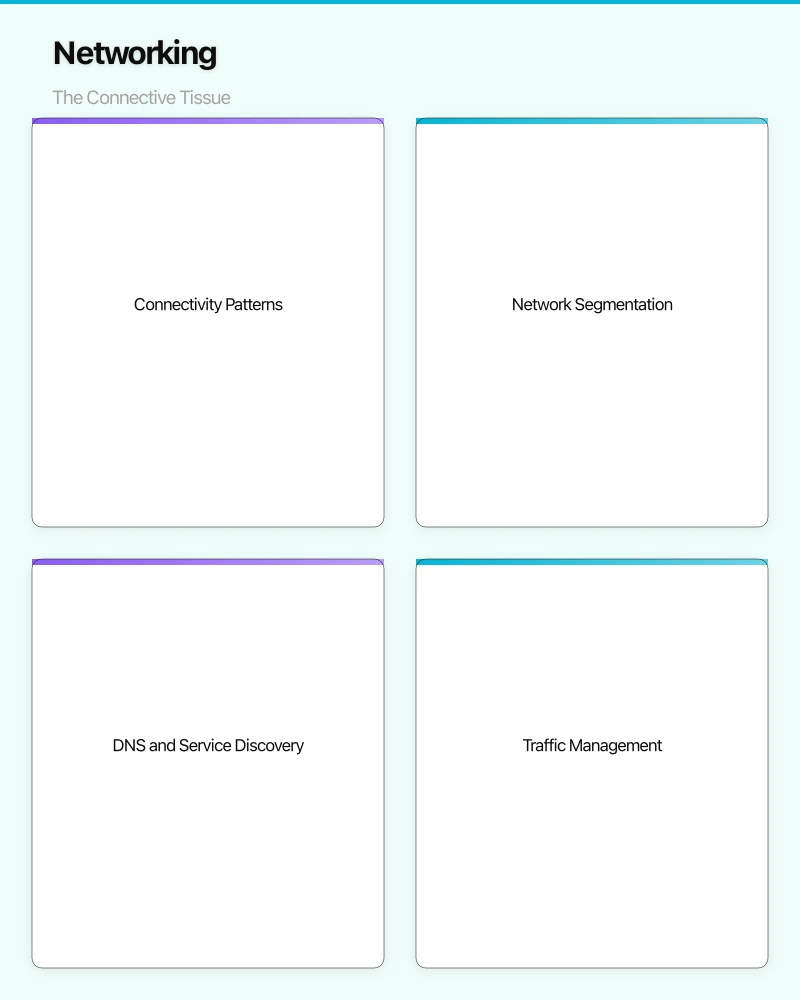
The most technically challenging aspect of hybrid cloud architecture is networking. Workloads distributed across on-premises data centres, multiple cloud providers, and edge locations need to communicate securely and reliably. The networking architecture must provide connectivity, security, and observability across all environments.
Connectivity Patterns: Direct connections between on-premises data centres and cloud providers (AWS Direct Connect, Azure ExpressRoute, Google Cloud Interconnect) provide predictable bandwidth and latency. For organisations with multiple cloud providers, services like Megaport and Equinix Cloud Exchange provide cross-cloud connectivity through interconnection fabrics. VPN connections over the public internet serve as backup connectivity or for less demanding workloads.
Network Segmentation: Security boundaries in hybrid environments need to be consistent regardless of where workloads run. Software-defined networking tools like VMware NSX, Cisco ACI, and cloud-native security groups enable consistent micro-segmentation policies across environments. The goal is to define security policy once and enforce it everywhere.
DNS and Service Discovery: In a hybrid environment, services need to discover each other across infrastructure boundaries. This requires a unified DNS strategy that resolves correctly whether the request originates from on-premises, cloud, or edge environments. Tools like HashiCorp Consul provide service discovery and service mesh capabilities that work across hybrid environments.
Traffic Management: Intelligent traffic routing that considers health, capacity, and locality across hybrid infrastructure requires a global load balancing strategy. This becomes particularly important for disaster recovery scenarios where traffic needs to failover between environments automatically.
The networking architecture is where many hybrid cloud strategies fail. Underinvestment in network connectivity, security, and management creates fragile integrations, security gaps, and operational blind spots. I consistently recommend that organisations invest in networking architecture first, before migrating workloads, to ensure the foundation is solid.
Data Architecture Across Cloud Boundaries
Data is simultaneously the most valuable asset and the most challenging element in hybrid cloud architecture. Data has gravity — it attracts processing workloads to its location — and data movement across cloud boundaries has costs in terms of latency, egress charges, and complexity.
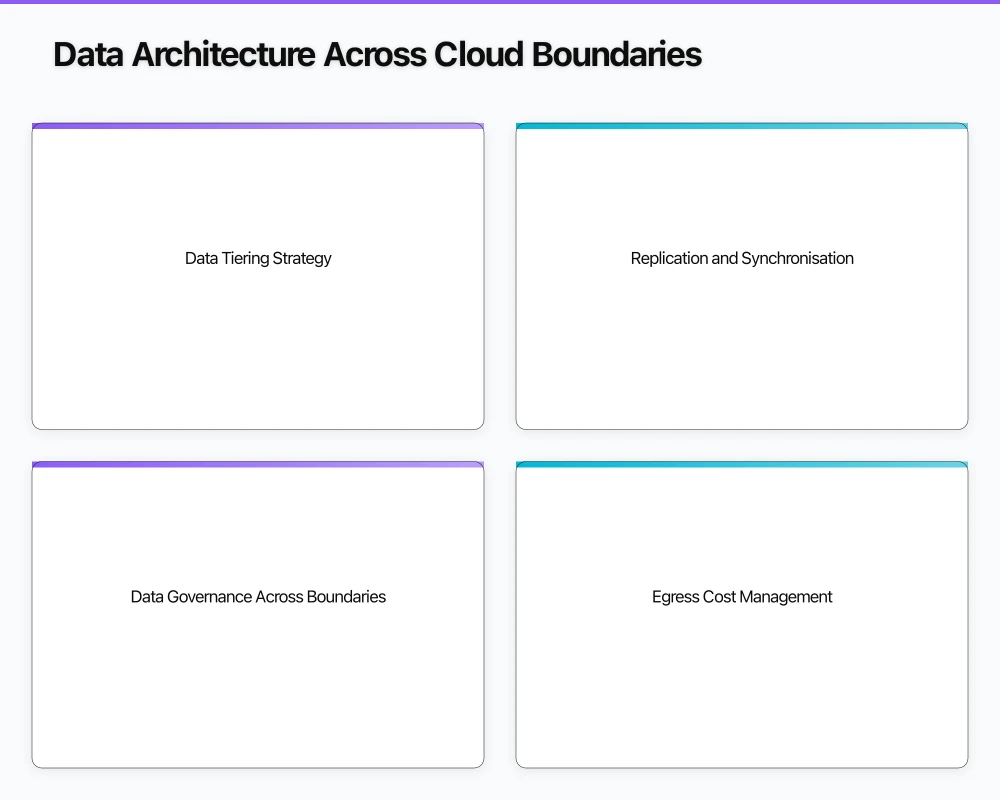
Data Tiering Strategy: Not all data needs to be in the same location. A common pattern is to maintain operational databases close to the applications they serve, replicate data to a centralised analytics platform for reporting and machine learning, and archive historical data in cost-optimised object storage. Each tier can be in a different environment optimised for its access patterns and cost profile.
Replication and Synchronisation: When data must exist in multiple environments, the consistency model matters. Synchronous replication provides strong consistency but requires low-latency connectivity. Asynchronous replication tolerates higher latency but introduces eventual consistency, which applications must be designed to handle. The choice between these models should be driven by application requirements, not infrastructure preferences.
Data Governance Across Boundaries: Data classification, access controls, encryption, and audit logging must be consistent across all environments where data resides. This is particularly challenging because each cloud provider and on-premises platform has different mechanisms for implementing these controls. A data governance layer that abstracts across environments — through tools like Apache Atlas, Collibra, or Alation — becomes essential at scale.
Egress Cost Management: Cloud providers charge for data leaving their networks. In a hybrid architecture where data regularly moves between environments, egress costs can be substantial and often come as a surprise. Architecture decisions should account for data movement patterns and optimise for minimal cross-boundary transfers. Techniques like edge caching, data compression, and strategic placement of data processing jobs help manage these costs.
Governance and Operational Consistency
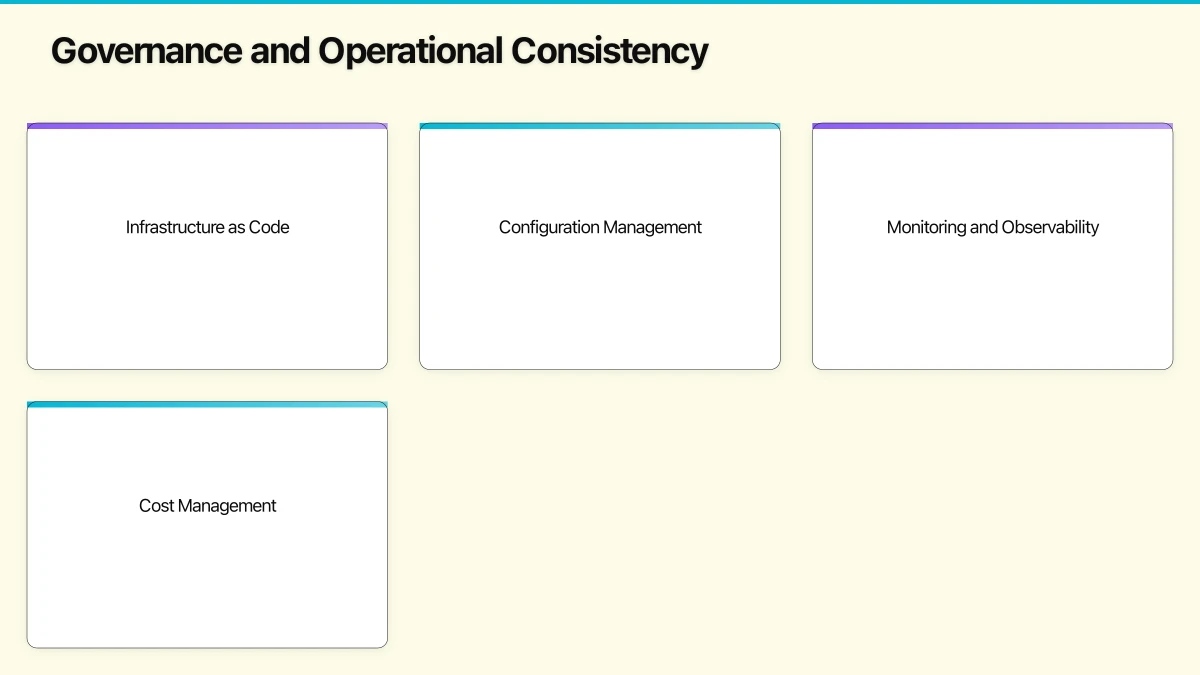
The operational challenge of hybrid cloud is maintaining consistency across environments with different tools, APIs, and operational models. Without intentional governance, hybrid environments quickly become fragmented, with different teams using different tools and processes for fundamentally similar operations.
Infrastructure as Code: Terraform has emerged as the leading tool for managing infrastructure across multiple environments and providers. By defining infrastructure declaratively in code, organisations can apply consistent provisioning processes regardless of the target environment. The key is maintaining a shared module library that encapsulates organisational standards and security requirements.
Configuration Management: Configuration drift between environments is a constant source of incidents. Tools like Ansible, Puppet, and Chef that can manage configuration across hybrid environments help maintain consistency. The shift toward immutable infrastructure, where servers are replaced rather than reconfigured, reduces drift but requires investment in automated deployment pipelines.
Monitoring and Observability: A single pane of glass for monitoring across hybrid environments is essential for operational effectiveness. Platforms like Datadog, Splunk, and open-source stacks based on Prometheus and Grafana can aggregate telemetry from on-premises, cloud, and edge environments. The goal is to detect, diagnose, and resolve issues regardless of where they originate.
Cost Management: Tracking and optimising costs across hybrid environments requires tools that understand the pricing models of each environment. Cloud cost management platforms like CloudHealth, Cloudability, and Apptio provide cross-cloud cost visibility, but integrating on-premises infrastructure costs requires additional effort to create a true total cost of ownership view.
The organisations that manage hybrid cloud effectively treat it as a single operational environment with multiple infrastructure providers, not as separate environments that happen to be connected. This mindset shift — from managing infrastructure to managing services — is the key to making hybrid cloud an asset rather than a liability.
The CTO’s strategic responsibility is to ensure that hybrid cloud architecture decisions are driven by business requirements and evaluated against a clear framework, not made reactively in response to individual project pressures. The hybrid cloud is here to stay. The question is whether your organisation will operate it intentionally or accidentally.
Turning strategy into infrastructure? Cloud Geeks covers managed cloud, DevOps, and IT security for businesses putting digital plans into action.
Ash Ganda is the founder of Ganda Tech Services, a Sydney-based technology consultancy delivering cloud, web, and mobile solutions for Australian businesses.
About the Author
Ashish Ganda is the founder of Ganda Tech Services, a Sydney-based technology consultancy specialising in cloud infrastructure, web development, and mobile app solutions for Australian businesses.
Digital Transformation Roadmap 2026
A 12-month framework for Australian SMBs ready to modernise — phases, tools, and milestones.