Enterprise Disaster Recovery in the Cloud Era: A CTO's Strategic Guide
Disaster recovery has transformed fundamentally in the cloud era. Traditional approaches designed around physical data centers, tape backups, and cold standby sites increasingly fail to address modern enterprise requirements. Cloud-native architectures, distributed systems, and evolving threat landscapes demand reimagined DR strategies balancing resilience, cost, and operational complexity.
For enterprise CTOs, disaster recovery represents a strategic capability rather than merely an insurance policy. Organizations with mature DR capabilities recover faster, maintain customer trust, and increasingly meet regulatory requirements that mandate demonstrated recovery capabilities.
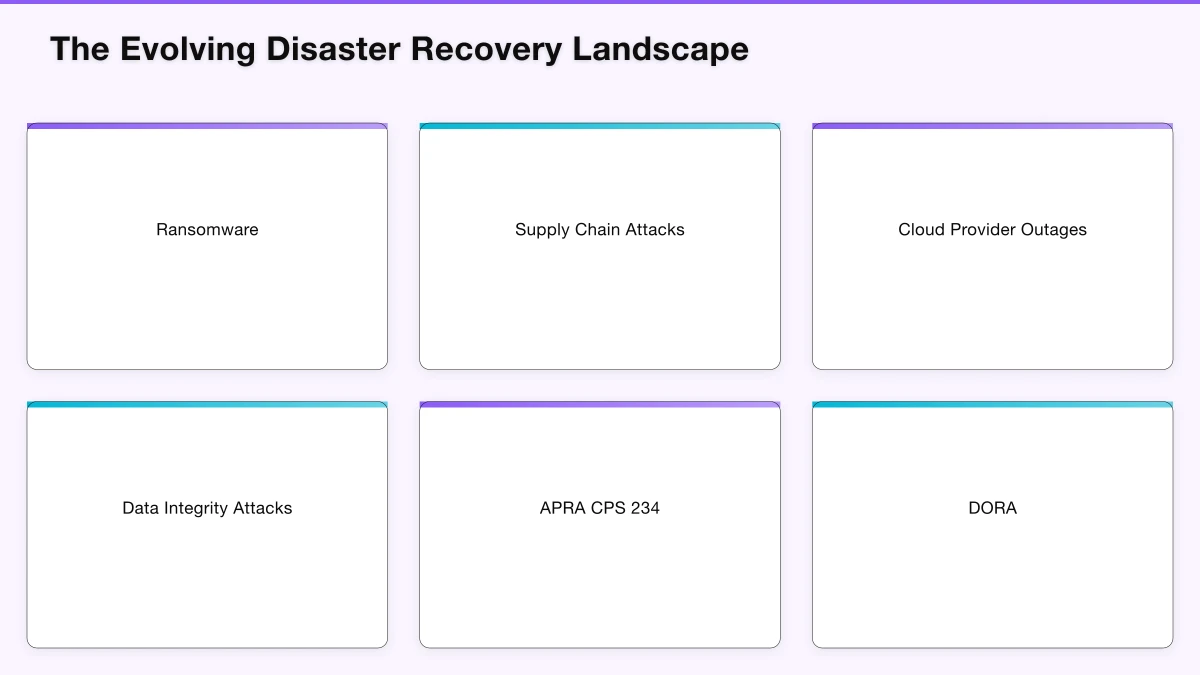
The Evolving Disaster Recovery Landscape
Several converging forces are reshaping enterprise DR requirements in 2025.
Expanded Threat Surface
Modern threats extend beyond traditional natural disasters and hardware failures:
Ransomware: Sophisticated attacks now target backup systems explicitly, making traditional backup strategies potentially ineffective. Recovery requires not just data restoration but verified clean-state reconstruction.
Supply Chain Attacks: Dependencies on third-party services, APIs, and software create indirect vulnerabilities. Disasters affecting critical vendors cascade to dependent organizations.
Cloud Provider Outages: While rare, regional cloud failures impact multiple availability zones. The December 2024 AWS us-east-1 extended outage reminded organizations of cloud concentration risks.
Data Integrity Attacks: Subtle data corruption may propagate through backups before detection. Recovery requires identifying clean restoration points, potentially requiring significant rollback.
Regulatory Evolution
Regulatory requirements increasingly mandate specific DR capabilities:
APRA CPS 234 (Australia): Financial institutions must maintain information security capabilities including recovery from security incidents.
DORA (EU): Digital Operational Resilience Act requires financial entities to demonstrate ICT system recovery capabilities, including regular testing.
Industry-Specific Requirements: Healthcare (HIPAA), critical infrastructure, and government sectors face prescriptive DR requirements.
Compliance now requires not just having DR plans but demonstrating through testing that they actually work.
Architecture Complexity
Modern architectures create DR challenges traditional approaches don’t address:
Microservices: Hundreds of loosely coupled services with complex dependency graphs. Recovering individual services without understanding dependencies creates inconsistent states.
Multi-Cloud and Hybrid: Workloads span multiple clouds and on-premises infrastructure. DR must account for varied infrastructure capabilities and interconnections.
Stateful Services: Databases, message queues, and caches maintain state that must be consistently recovered. Distributed data systems complicate recovery coordination.
DR Strategy Fundamentals
Effective disaster recovery strategy begins with clear requirements and appropriate architectural responses.
Defining Recovery Objectives
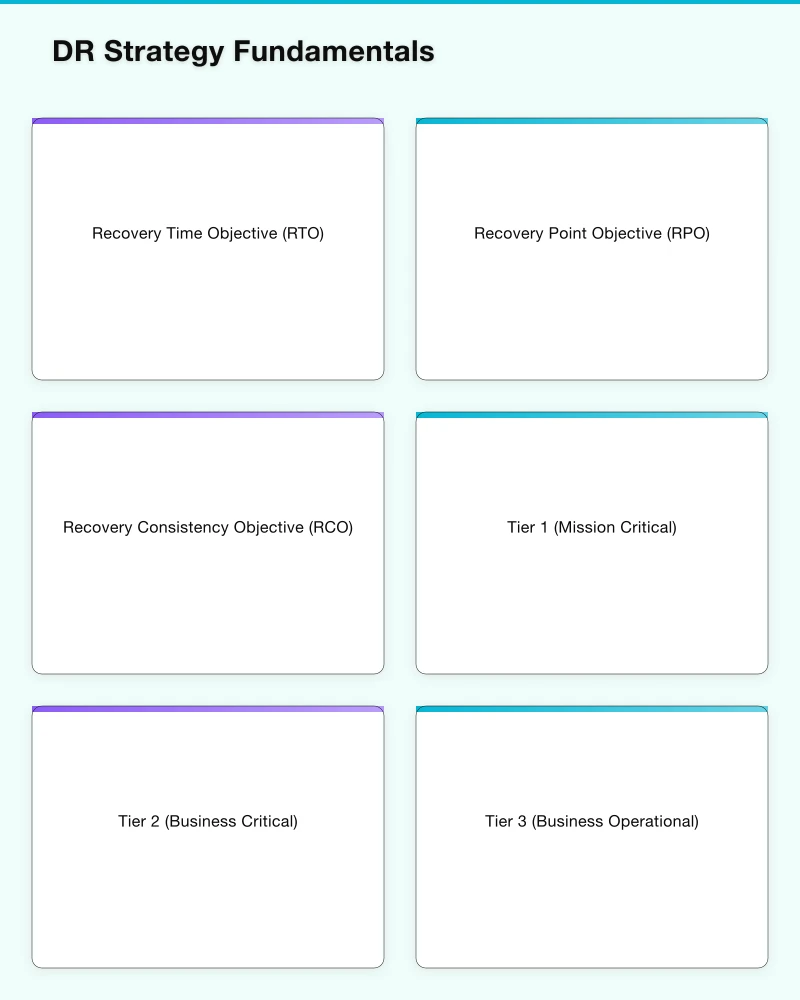
Recovery Time Objective (RTO): Maximum acceptable time from disaster declaration to service restoration. Business impact analysis determines RTO by quantifying costs of extended outages.
Recovery Point Objective (RPO): Maximum acceptable data loss measured in time. An RPO of one hour accepts losing up to one hour of data in disaster scenarios.
These objectives should be defined at the application or service level, not uniformly across the enterprise. Customer-facing revenue systems typically warrant more aggressive objectives than internal administrative applications.
Recovery Consistency Objective (RCO): Less commonly discussed but increasingly important: the degree of data consistency required at recovery. Distributed systems may recover individual components but with inconsistent state across services.
Tiered Recovery Architecture
Not all systems warrant equal DR investment. Tiered approaches allocate resources appropriately:
Tier 1 (Mission Critical): Near-zero RTO/RPO through active-active or hot standby configurations. Automated failover without manual intervention. Highest cost, reserved for systems where outages create immediate significant impact.
Tier 2 (Business Critical): RTO measured in minutes to hours, RPO in minutes. Warm standby environments requiring some startup time. Automated detection with orchestrated recovery procedures.
Tier 3 (Business Operational): RTO measured in hours, RPO in hours. Standby infrastructure that can be provisioned on-demand. Manual recovery procedures acceptable.
Tier 4 (Administrative): RTO measured in days, RPO in hours to days. Recovery from backups to newly provisioned infrastructure. Lowest cost, acceptable for non-essential systems.
Recovery Strategies
Multiple strategies address different requirements and cost profiles:
Active-Active: Traffic served from multiple regions simultaneously. Disaster in one region shifts load to surviving regions. Provides near-instantaneous recovery but requires application architecture supporting multi-region operation.
Hot Standby: Fully operational secondary environment receiving continuous replication. Switchover possible within minutes. Maintains full infrastructure costs in secondary region.
Warm Standby: Scaled-down secondary environment with data replication. Requires scaling up before assuming full load. Reduces standby costs while extending recovery time.
Pilot Light: Minimal infrastructure maintaining data replication. Complete infrastructure provisioned on-demand during recovery. Further reduces costs with longer recovery times.
Backup and Restore: Data backed up to secondary location. Infrastructure provisioned and data restored during recovery. Lowest cost, longest recovery time.
Cloud-Native DR Patterns
Cloud platforms enable DR patterns impractical or uneconomical with traditional infrastructure.
Infrastructure as Code Recovery
Modern infrastructure-as-code practices enable rapid environment reconstruction:
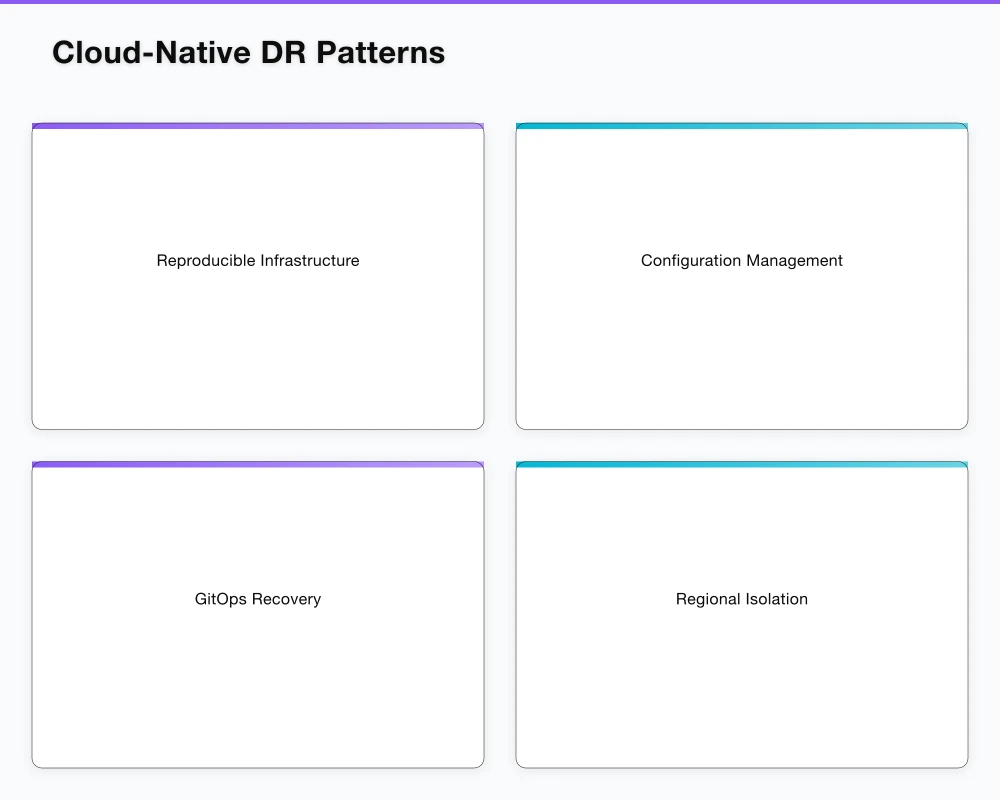
Reproducible Infrastructure: Terraform, CloudFormation, or Pulumi templates define complete environments. Recovery involves applying templates rather than manual configuration.
Configuration Management: Ansible, Puppet, or cloud-native configuration ensures consistent system state. Newly provisioned infrastructure automatically configures correctly.
GitOps Recovery: Environment definitions stored in version control. Recovery involves applying known-good configurations from repository history.
This approach dramatically reduces recovery complexity for infrastructure while highlighting data recovery as the critical path.
Multi-Region Architecture
Cloud providers offer global infrastructure enabling geographic distribution:
Regional Isolation: Distinct regions provide failure isolation. Regional disasters don’t propagate across region boundaries.
Cross-Region Replication: Managed services increasingly offer built-in cross-region replication. Database services, object storage, and messaging systems replicate automatically.
Global Load Balancing: DNS-based or anycast routing directs traffic to healthy regions. Route 53, Cloud DNS, and Azure Traffic Manager enable automated failover.
Managed Service Resilience
Platform-as-a-Service offerings provide built-in resilience:
Managed Databases: Services like Aurora, Cloud SQL, and Azure SQL provide automated backups, replication, and point-in-time recovery.
Serverless Platforms: Functions, containers, and serverless databases handle infrastructure resilience transparently. DR focus shifts to data and configuration.
Global Services: Some services operate globally without regional boundaries. DynamoDB Global Tables, Spanner, and CockroachDB provide multi-region consistency.
Leveraging managed service resilience reduces DR complexity but requires understanding service-specific recovery characteristics.
Data Protection Strategies
Data recovery remains the critical path in most disaster scenarios. Modern approaches extend beyond simple backups.
Backup Architecture
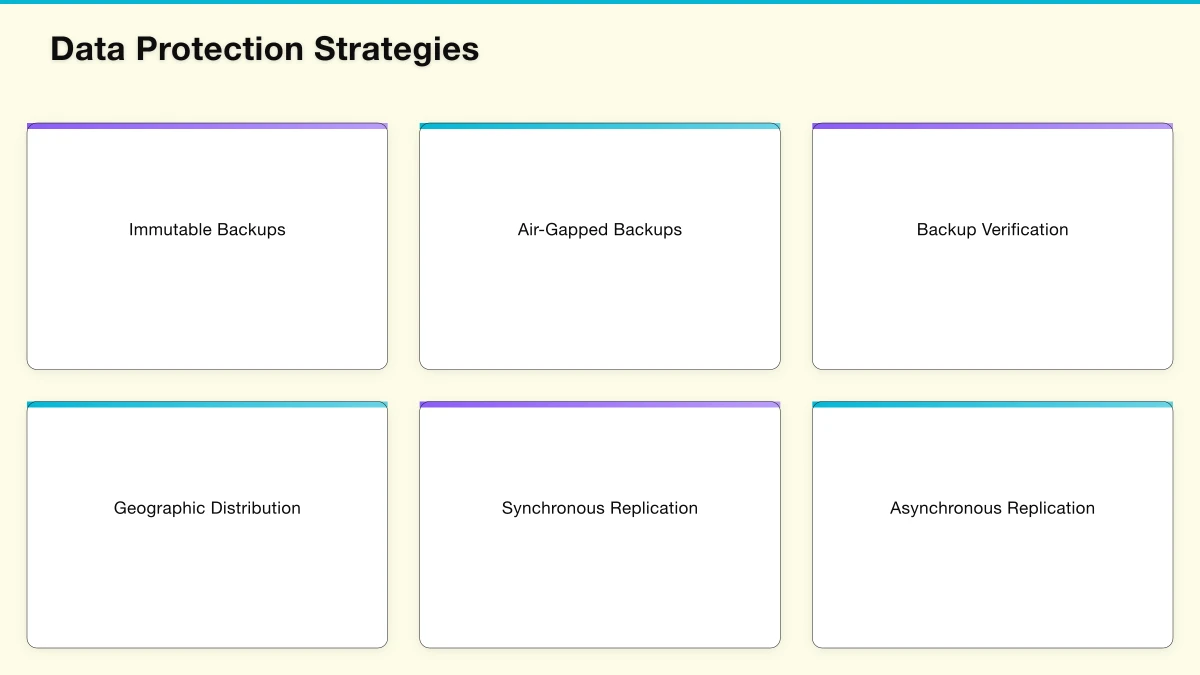
Immutable Backups: Write-once storage prevents ransomware from encrypting or deleting backups. AWS S3 Object Lock, Azure immutable blob storage, and purpose-built backup vaults provide protection.
Air-Gapped Backups: Physically or logically isolated backups accessible only through restricted processes. Provides last-resort recovery when primary and standard backup environments are compromised.
Backup Verification: Regular automated restoration testing verifies backup integrity. Corrupt or incomplete backups discovered during disaster are useless.
Geographic Distribution: Backups stored in separate geographic regions survive regional disasters. Balance geographic separation against data sovereignty requirements.
Replication Strategies
Synchronous Replication: Secondary receives writes before primary acknowledges. Zero data loss (RPO = 0) but latency impact and geographic constraints.
Asynchronous Replication: Secondary updated continuously but may lag primary. Potential data loss equal to replication lag but no latency impact.
Semi-Synchronous: Hybrid approaches with synchronous replication within region, asynchronous across regions.
Point-in-Time Recovery
Beyond snapshots, continuous backup capabilities enable recovery to specific moments:
Transaction Log Archiving: Database transaction logs streamed continuously, enabling recovery to any point.
Change Data Capture: Capturing data changes in real-time for replay to recovery targets.
Event Sourcing: Applications storing events rather than state enable reconstruction to any historical point.
Ransomware Resilience
Ransomware specifically targeting enterprises has evolved sophisticated techniques requiring dedicated countermeasures.
Attack Surface Reduction
Backup Infrastructure Isolation: Separate credentials, networks, and access controls for backup systems. Compromised production credentials shouldn’t access backups.
Immutability Enforcement: Technical controls preventing backup modification or deletion, even by administrators.
Offline Copies: Air-gapped backup copies updated periodically provide last-resort recovery options.
Detection and Response
Anomaly Detection: Monitoring for unusual file system activity, encryption patterns, or backup access patterns indicating attacks in progress.
Rapid Isolation: Capability to quickly isolate infected systems, preventing lateral movement while preserving forensic evidence.
Clean Recovery Identification: Procedures for identifying last-known-good backup state before infection, potentially requiring significant rollback.
Recovery Procedures
Verified Clean Restore: Recovery to isolated environment for verification before production restoration.
Staged Recovery: Recovering systems in dependency order, verifying each stage before proceeding.
Alternative Recovery Paths: When primary recovery infrastructure is compromised, alternative paths using isolated resources.
Testing and Validation
DR plans untested are DR plans that may fail when needed. Modern approaches emphasize continuous validation.
Testing Approaches
Tabletop Exercises: Walkthrough discussions identifying plan gaps without actual system impact. Low cost, valuable for process validation.
Component Testing: Testing individual recovery procedures in isolation. Database restoration, instance recovery, network failover.
Integrated Testing: End-to-end recovery testing including application dependencies and user access validation.
Chaos Engineering: Controlled injection of failures in production or production-like environments. Netflix’s Chaos Monkey approach validates real-world resilience.
Full Failover Tests: Complete cutover to secondary environment serving production traffic. Most realistic but highest risk.
Testing Frequency
Continuous: Automated backup verification, replication monitoring, infrastructure provisioning validation.
Monthly: Component recovery testing, procedure updates, metrics review.
Quarterly: Integrated recovery testing, tabletop exercises, plan updates.
Annual: Full failover testing, comprehensive plan review, third-party assessment.
Testing Documentation
Testing should validate specific assertions:
- Data recovered completely with verified integrity
- Applications functional with appropriate performance
- Recovery completed within RTO
- Data loss within RPO
- Dependencies properly sequenced
- Staff executed procedures correctly
Failed tests are valuable: they reveal gaps before actual disasters.
Organizational Considerations
Technology alone doesn’t ensure recovery. Organizational capabilities determine real-world outcomes.
Roles and Responsibilities
Disaster Recovery Manager: Overall DR program ownership, plan maintenance, testing coordination.
Technical Recovery Teams: Service-specific expertise for executing recovery procedures.
Incident Commanders: Decision authority during disaster events, coordinating response across teams.
Communications Lead: Internal and external communications during incidents.
Clear escalation paths and decision authority prevent confusion during high-stress recovery operations.
Runbook Development
Detailed runbooks capture recovery procedures:
- Step-by-step instructions accessible under stress
- Required credentials and access (securely stored)
- Dependency documentation and recovery sequence
- Verification steps confirming successful recovery
- Rollback procedures if recovery fails
Runbooks should be tested regularly and updated based on test results.
Communication Plans
Internal Communication: Keeping staff informed during incidents, coordinating across teams, managing remote work during site-affecting disasters.
External Communication: Customer notification, regulatory reporting, media response as appropriate.
Vendor Coordination: Engaging cloud providers, critical SaaS vendors, and support resources during recovery.
Cost Optimization
DR capabilities require significant investment. Cost optimization ensures sustainable programs.
Right-Sizing Recovery Tiers
Rigorous business impact analysis prevents over-investment in low-value system recovery while ensuring critical systems receive appropriate protection.
Infrastructure Optimization
Reserved Capacity: Reserving standby infrastructure reduces costs versus on-demand pricing.
Spot/Preemptible Instances: Testing environments can leverage lower-cost interruptible instances.
Storage Tiering: Archive tiers for older backups reduce storage costs while maintaining accessibility.
Deduplication and Compression: Reducing stored data volume directly reduces costs.
Managed Service Leverage
Built-in resilience in managed services often provides better economics than self-managed alternatives. Database-as-a-service with automated backup may cost less than self-managed databases with equivalent protection.
Regulatory and Compliance
Demonstrating DR capabilities increasingly satisfies regulatory requirements.
Documentation Requirements
Recovery Plans: Documented procedures, roles, and responsibilities.
Test Results: Evidence of regular testing with outcomes and remediation.
Risk Assessments: Analysis of disaster scenarios and organizational preparedness.
Business Impact Analysis: Quantified impact of system outages justifying recovery investments.
Audit Readiness
Evidence Collection: Automated capture of backup completion, replication status, and test results.
Control Documentation: Mapping DR controls to regulatory requirements.
Third-Party Assessments: Independent validation of DR capabilities for regulated organizations.
Future Considerations
Several trends shape DR evolution:
AI-Assisted Recovery: Machine learning identifying optimal recovery sequences, predicting failures, and automating response decisions.
Continuous Recovery: Moving beyond point-in-time snapshots to continuous data protection with fine-grained recovery points.
Sustainability: Environmental considerations in DR infrastructure, including power consumption of standby systems and geographic placement.
Edge Computing: DR strategies extending to distributed edge infrastructure, creating new challenges for data consistency and recovery coordination.
Implementation Roadmap
For organizations improving DR capabilities:
Phase 1: Assessment
- Complete inventory of systems requiring protection
- Business impact analysis establishing recovery objectives
- Gap analysis comparing current capabilities against requirements
Phase 2: Foundation
- Backup infrastructure modernization with immutability
- Basic replication for critical systems
- Initial runbook development and testing
Phase 3: Maturation
- Comprehensive replication strategy implementation
- Automated recovery procedures
- Regular testing program establishment
Phase 4: Optimization
- Advanced capabilities (active-active, chaos engineering)
- Cost optimization based on operational experience
- Continuous improvement based on test results and incident learning
Conclusion
Disaster recovery in the cloud era requires reimagining traditional approaches. The capabilities cloud platforms provide, combined with modern threats and regulatory requirements, demand strategic DR programs rather than checkbox compliance exercises.
For enterprise CTOs, DR investment protects business continuity, enables regulatory compliance, and increasingly becomes a competitive differentiator as customers evaluate vendor resilience. The organizations that invest thoughtfully in DR capabilities will weather inevitable disruptions while competitors struggle with prolonged outages and recovery failures.
References and Further Reading
- AWS. (2025). “Disaster Recovery of Workloads on AWS: Recovery in the Cloud.” AWS Whitepapers.
- Google Cloud. (2025). “Disaster Recovery Planning Guide.” Google Cloud Architecture Center.
- Microsoft. (2025). “Azure Resiliency Technical Guidance.” Microsoft Azure Documentation.
- NIST. (2024). “Contingency Planning Guide for Federal Information Systems.” NIST Special Publication 800-34.
- Gartner. (2025). “Market Guide for Disaster Recovery as a Service.” Gartner Research.
- APRA. (2024). “Prudential Standard CPS 234 Information Security.” Australian Prudential Regulation Authority.
If this strategic perspective has you thinking about cloud adoption, Cloud Geeks provides the implementation detail — from AWS setup to security hardening.
My consultancy Ganda Tech Services operates three specialist divisions covering cloud infrastructure, web development, and mobile apps for Australian businesses.
About the Author
Ashish Ganda is the founder of Ganda Tech Services, a Sydney-based technology consultancy specialising in cloud infrastructure, web development, and mobile app solutions for Australian businesses.
Digital Transformation Roadmap 2026
A 12-month framework for Australian SMBs ready to modernise — phases, tools, and milestones.