Enterprise Data Quality Engineering at Scale
Introduction
Data quality is the invisible foundation of every data-driven enterprise initiative. When data quality is high, analytics are trustworthy, machine learning models perform as expected, and business decisions are grounded in reality. When data quality is poor, the consequences cascade: dashboards display misleading metrics, ML models make incorrect predictions, regulatory reports contain errors, and business leaders lose confidence in data-driven decision-making.
Despite its critical importance, data quality in most enterprises remains managed through reactive, manual processes: data analysts discover problems when reports look wrong, data engineers investigate and apply fixes, and the cycle repeats. This reactive approach fails at scale. As data volumes grow, pipeline complexity increases, and the number of downstream consumers multiplies, the probability of undetected quality issues approaches certainty.
Data quality engineering applies the principles of software engineering, automated testing, continuous monitoring, and systematic quality assurance, to the data domain. This shift from reactive quality management to proactive quality engineering is essential for enterprises that depend on data for operational and strategic decision-making.
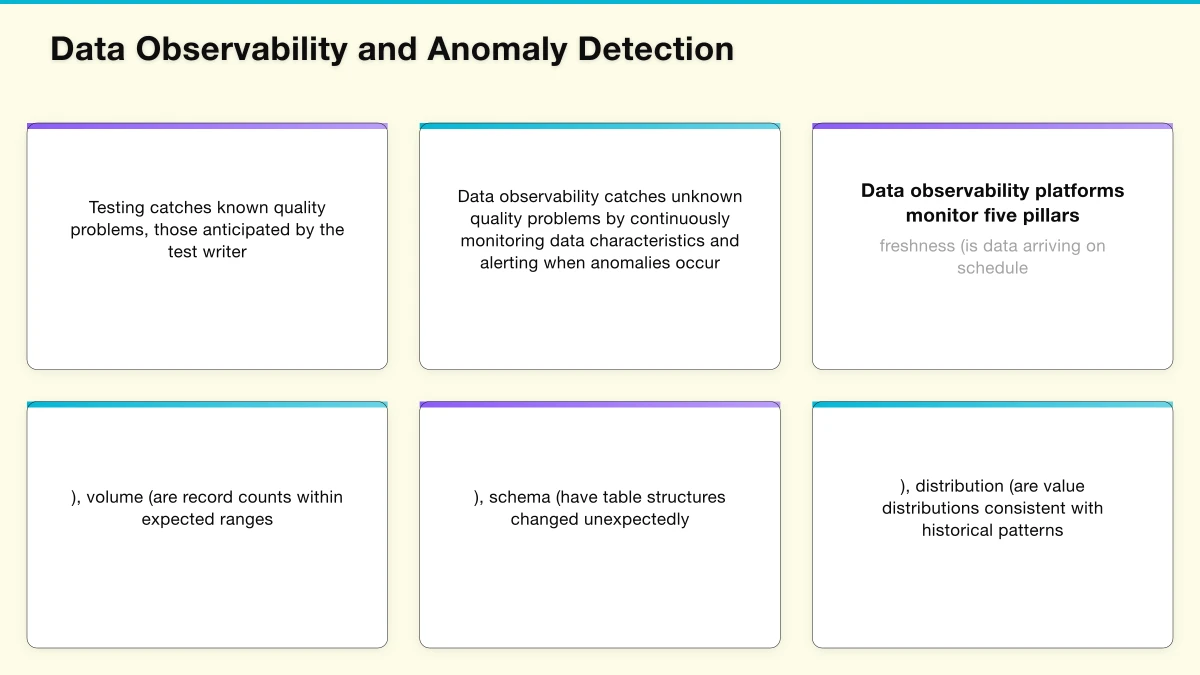
Defining Data Quality Dimensions
Data quality is not a single attribute but a multi-dimensional concept. Understanding these dimensions is the first step toward systematic measurement and improvement.
Accuracy measures whether data values correctly represent the real-world entities they describe. A customer’s address, a transaction’s amount, and a sensor’s reading are accurate when they match reality. Accuracy is the most intuitive quality dimension but often the hardest to measure at scale because verification requires comparison against a source of truth that may not be readily available.
Completeness measures whether all expected data is present. Missing values, missing records, and missing attributes all represent completeness failures. Completeness is relatively straightforward to measure (null rate analysis, record count monitoring) and often the first quality dimension that data teams automate.
Timeliness measures whether data is available when needed. A daily sales report that arrives at noon is less useful than one that arrives at eight in the morning. Timeliness is particularly critical for real-time and near-real-time applications where stale data can lead to incorrect operational decisions.
Consistency measures whether data agrees across different systems, datasets, and time periods. Customer counts in the CRM should match customer counts in the billing system. Revenue figures in the data warehouse should reconcile with the general ledger. Consistency failures often indicate integration problems or differing business logic between systems.
Validity measures whether data conforms to defined formats, ranges, and business rules. Email addresses should be properly formatted. Age values should fall within reasonable ranges. Order quantities should not be negative. Validity checks are the most automatable quality dimension and provide the foundation for data quality testing.
Uniqueness measures whether data is free from unintended duplication. Duplicate customer records, duplicate transactions, and duplicate events all corrupt downstream analysis and operations. Deduplication is a perennial challenge in enterprise data environments, particularly when data is ingested from multiple sources.
Building Data Quality into the Engineering Pipeline
The most effective approach to data quality is building quality checks into the data pipeline itself, treating data tests as first-class artefacts alongside data transformations. This is analogous to the software engineering practice of embedding unit tests and integration tests into the CI/CD pipeline rather than relying on manual QA.
dbt (data build tool), which has become the standard for analytical data transformation, supports data quality testing natively. dbt tests validate data properties at each transformation stage: schema tests verify column types and constraints, custom tests implement business rules, and freshness tests ensure source data is current. When tests fail, the pipeline halts, preventing bad data from propagating to downstream consumers.
Great Expectations provides a more comprehensive data quality testing framework that supports a wider range of data validation scenarios. Expectations (quality assertions) can be defined in code and executed against data at any point in the pipeline. The framework generates documentation and validation reports that provide visibility into data quality trends over time.
Data contracts represent an emerging practice that formalises the agreement between data producers and data consumers. A data contract specifies the schema, quality standards, freshness guarantees, and SLAs for a data asset. Data contracts make implicit expectations explicit and provide a basis for accountability when quality standards are not met. The data contract concept is still maturing, but early adoption by data-forward organisations suggests it will become a standard enterprise practice.
The placement of quality checks in the pipeline matters. Input validation at data ingestion catches quality problems at the source, before they propagate through downstream transformations. Transformation validation ensures that transformation logic produces expected results. Output validation confirms that the final data product meets consumer expectations. A comprehensive quality engineering approach includes checks at all three points.
Data Observability and Anomaly Detection
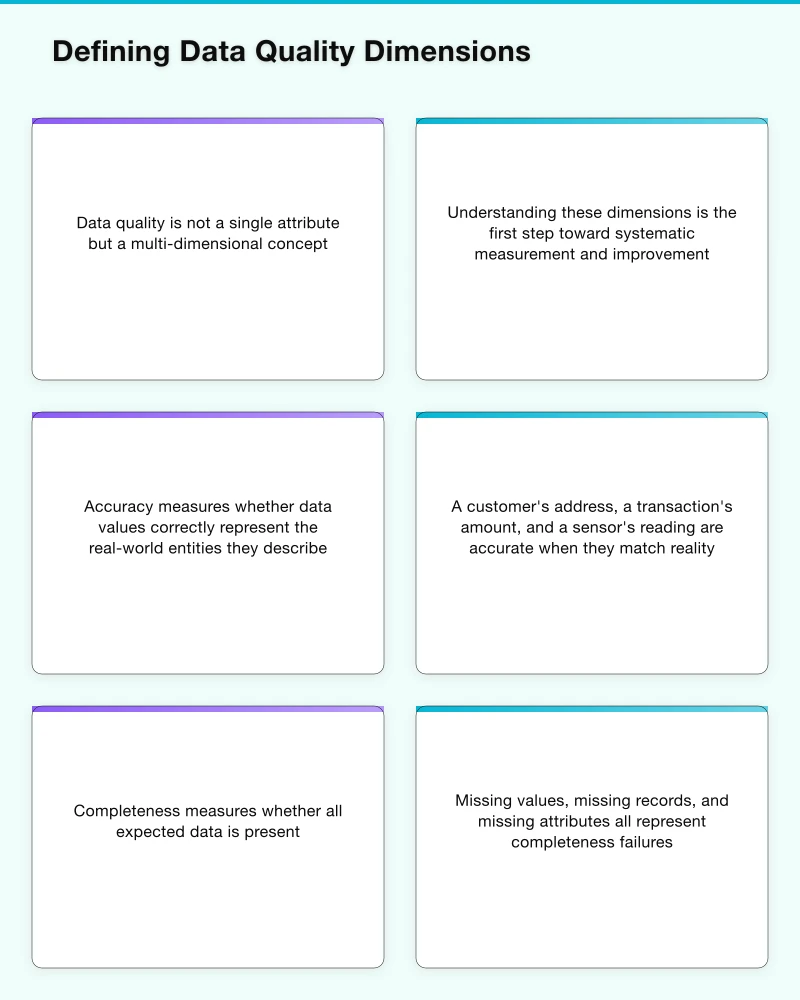
Testing catches known quality problems, those anticipated by the test writer. Data observability catches unknown quality problems by continuously monitoring data characteristics and alerting when anomalies occur.
Data observability platforms monitor five pillars: freshness (is data arriving on schedule?), volume (are record counts within expected ranges?), schema (have table structures changed unexpectedly?), distribution (are value distributions consistent with historical patterns?), and lineage (which upstream changes might be causing downstream quality issues?).
Automated anomaly detection applies statistical methods to identify deviations from historical patterns. A sudden drop in record count, a shift in the distribution of a numeric column, or an unexpected null rate increase can all signal quality problems that would not be caught by predefined tests. Machine learning-based anomaly detection improves over time as the system learns the normal behaviour patterns of each data asset.
The operational model for data observability resembles the application monitoring model that SRE teams use. Alerts should be actionable, routed to the appropriate team, and responded to within defined SLAs. A runbook for common data quality incidents reduces response time and ensures consistent remediation. Post-incident reviews identify root causes and drive preventive improvements.
Tools in the data observability space include Monte Carlo, which provides end-to-end data observability with anomaly detection and lineage; Elementary, which provides dbt-native data observability; and custom implementations built on top of general-purpose monitoring platforms. The choice depends on the organisation’s data stack and the maturity of its data engineering team.
Organisational Accountability and Data Quality Culture
Technology alone does not solve data quality problems. Organisational accountability structures determine whether quality issues are detected, prioritised, and resolved.
Data ownership assigns clear responsibility for each data asset to a specific team or individual. The data owner is accountable for the quality of their data asset, including monitoring quality metrics, responding to quality incidents, and investing in quality improvement. Without clear ownership, data quality is everyone’s concern and therefore no one’s priority.
Data quality SLAs formalise the quality expectations for critical data assets. An SLA might specify that a data asset must have completeness above ninety-nine percent, freshness within one hour, and zero critical validation failures. SLAs provide measurable targets that focus improvement efforts and create accountability when targets are missed.
Quality metrics should be visible and regularly reviewed. A data quality dashboard that tracks quality dimensions across critical data assets, analogous to an SRE team’s service health dashboard, provides the visibility needed for proactive management. Regular data quality reviews, where data owners present quality metrics and improvement plans, create the organisational rhythm that sustains quality investment over time.
The cultural dimension is paramount. Organisations where data quality is treated as “someone else’s problem” will continue to suffer from quality issues regardless of the tools they deploy. Building a data quality culture requires executive sponsorship, clear accountability, visible metrics, and recognition for teams that invest in quality improvement.
Data quality engineering is not a glamorous discipline, but it is a foundational one. Every analytics insight, every ML model prediction, and every data-driven decision is only as reliable as the data it is built on. For enterprise leaders investing in data-driven transformation, investing equally in data quality engineering is not optional; it is a prerequisite for every other data initiative on the roadmap.
For the practitioner’s view on mobile app development and app store success, explore Awesome Apps — where strategy meets the app store.
My consultancy Ganda Tech Services operates three specialist divisions covering cloud infrastructure, web development, and mobile apps for Australian businesses.
About the Author
Ashish Ganda is the founder of Ganda Tech Services, a Sydney-based technology consultancy specialising in cloud infrastructure, web development, and mobile app solutions for Australian businesses.
Digital Transformation Roadmap 2026
A 12-month framework for Australian SMBs ready to modernise — phases, tools, and milestones.
Almost done
Check your inbox and click the confirmation link to get your download.