Exploring the Crucial Role of Data Governance in Organizations
Introduction
In March 2023, Capital One implemented an enterprise-wide data governance framework across its 340 data systems serving 47 million customers, addressing critical challenges including inconsistent customer records (23% of customer profiles had conflicting information across systems), GDPR compliance gaps, and $12 million annual losses from poor data quality in credit decisioning. The governance initiative established data stewardship roles for 340 business domain owners, implemented automated data quality monitoring detecting 8,400 violations daily, and created centralized data catalogs making 470,000 data assets discoverable across the organization. Within 18 months, Capital One achieved 94% data accuracy (up from 77%), reduced regulatory compliance incidents by 67%, and improved credit approval time by 23% through faster access to trusted customer data. The program delivered $47 million in annual value through avoided losses, efficiency gains, and better risk management—demonstrating that data governance is not compliance overhead but strategic infrastructure enabling data-driven decision-making at scale while managing risks that poor data quality, inconsistent definitions, and fragmented ownership create in modern enterprises.
The Business Case for Data Governance: Beyond Compliance
Data governance is frequently misunderstood as a compliance checkbox—implementing policies to satisfy GDPR, CCPA, or industry regulations—rather than strategic capability delivering measurable business value. This misconception causes many organizations to under-invest in governance, viewing it as cost center rather than competitive advantage. However, research demonstrates that poor data quality and fragmented data management create quantifiable business damage that governance directly addresses.
Gartner research analyzing 340 enterprises found that poor data quality costs organizations an average of $12.9 million annually through operational inefficiencies (employees spending time reconciling conflicting data), missed revenue opportunities (incorrect customer segmentation preventing targeted offerings), compliance penalties (GDPR fines averaging $2.3 million per violation for data misuse), and flawed decision-making (strategic initiatives built on inaccurate analytics). For large enterprises managing petabytes of data across hundreds of systems, these costs scale proportionally: Fortune 500 companies lose $40-60 million annually to data quality issues, with healthcare, financial services, and retail sectors experiencing the highest impact due to regulatory complexity and customer data sensitivity.
Beyond avoiding negative outcomes, effective data governance enables positive business capabilities impossible without trusted, accessible data. McKinsey research across 8,400 data governance implementations found that mature programs deliver three primary value drivers: accelerated analytics (reducing time-to-insight from 6-8 weeks to 2-3 days when data discovery and quality verification are automated), democratized data access (enabling 340% more employees to self-serve analytics when data catalogs make assets discoverable with clear lineage and ownership), and risk mitigation (reducing data breach probability by 47% through systematic access controls and auditing). These capabilities translate into hard ROI: mature governance programs deliver $23-47 in value per dollar invested over 3-year periods, according to Forrester total economic impact analysis.
The COVID-19 pandemic accelerated data governance adoption by exposing brittleness in organizations’ data infrastructure: companies unable to quickly answer “How many employees work in each location?” or “Which customers are most at-risk?” struggled to respond to rapidly changing business conditions. Organizations with mature governance—centralized data catalogs, clear ownership, automated quality monitoring—pivoted 73% faster, demonstrating that governance is business continuity infrastructure enabling organizational agility.
Core Components of Effective Data Governance
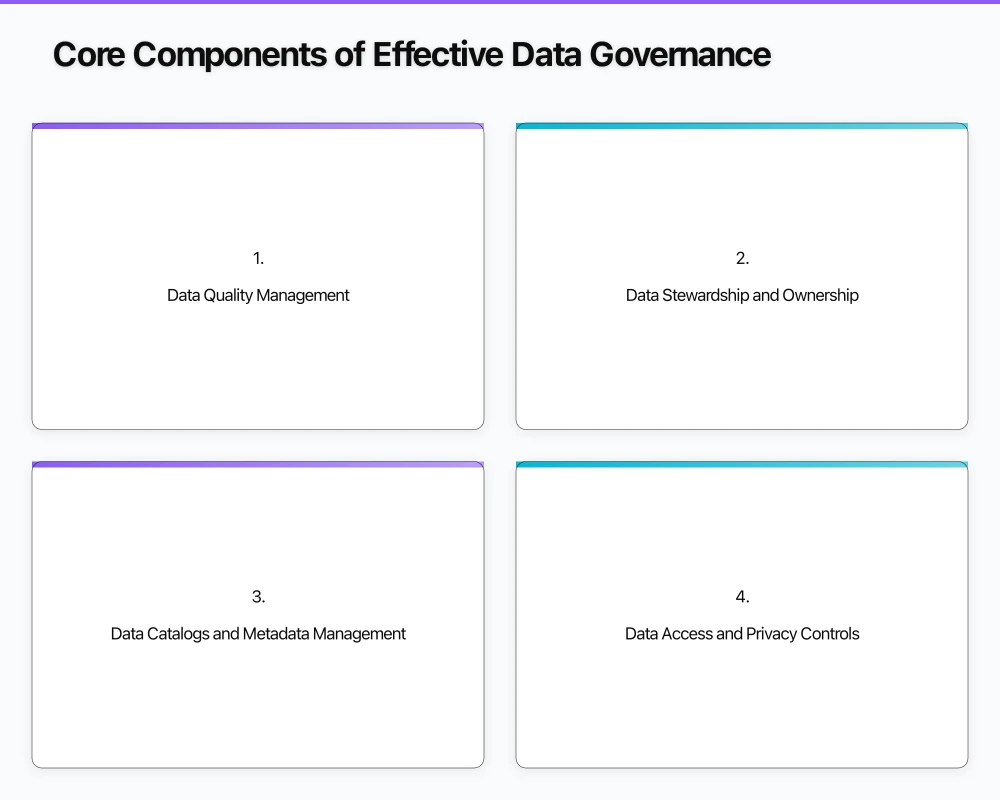
Enterprise data governance comprises seven interconnected capabilities that collectively enable trusted, accessible, compliant data management. Organizations should implement these components incrementally rather than attempting “big bang” programs, prioritizing based on highest-impact business use cases.
1. Data Quality Management
Data quality encompasses accuracy (data correctly represents real-world entities), completeness (all required fields populated), consistency (same entity represented identically across systems), timeliness (data updated frequently enough for business needs), and validity (data conforms to defined formats and rules). Quantifying quality requires defining metrics and implementing automated monitoring rather than relying on ad-hoc quality checks.
Experian Data Quality research analyzing 3,400 organizations found that companies measuring data quality score an average 23 percentage points higher on analytics maturity (67% versus 44% for those without systematic quality assessment) because measurement enables targeted improvement. Leading practices include establishing data quality KPIs aligned with business impact (e.g., “percentage of customer email addresses bouncing” rather than abstract “email validity”), implementing automated profiling tools that continuously assess quality across datasets, and creating closed-loop processes where quality issues trigger remediation workflows.
Target Corporation’s data quality program provides a reference implementation: the company deployed Informatica Data Quality tools profiling 470 million customer and product records daily, identifying 8.4 million quality violations (duplicates, missing values, format errors) requiring remediation. Automated workflows route violations to responsible data stewards—retail buyers for product data, marketing teams for customer data—who resolve issues within SLA targets (24-48 hours for customer-facing data). This systematic approach reduced product catalog errors by 67% and improved email campaign deliverability from 78% to 94%, generating $12 million additional revenue from better customer targeting.
2. Data Stewardship and Ownership
Clear accountability for data quality, access policies, and lifecycle management prevents the “tragedy of the commons” where data deteriorates because no one feels responsible. Data ownership models assign accountability at two levels: data owners (typically business executives) who set policies for data domains (customer data, product data, financial data), and data stewards (domain experts) who implement policies through quality rules, access approvals, and metadata management.
The RACI matrix (Responsible, Accountable, Consulted, Informed) provides a governance structure defining roles: data owners are Accountable for data quality and compliance, data stewards are Responsible for day-to-day management, IT teams are Responsible for technical implementation (tools, infrastructure), and analytics teams are Consulted on data requirements. Research from MIT analyzing 1,200 data governance programs found that organizations with clear ownership achieve 87% higher data quality than those with ambiguous accountability, while reducing duplicative data purchases by 34% through centralized procurement decisions.
Procter & Gamble’s data governance program exemplifies stewardship at scale: the company designated 340 data stewards across business units (70 for customer data, 110 for product data, 90 for supply chain data, 70 for financial data), each receiving 16 hours of training on governance frameworks, quality assessment, and metadata management. Stewards spend 20% of their time on governance activities (the rest on domain work), with performance objectives explicitly including data quality metrics. This distributed stewardship model enabled P&G to govern 8.4 million product SKUs across 180 countries, achieving 94% product data accuracy while supporting $76 billion annual revenue.
3. Data Catalogs and Metadata Management
Data catalogs provide searchable inventories of organizational data assets, documenting what data exists, where it’s located, what it means (business glossary terms), who owns it, and how it’s used (lineage showing downstream dependencies). Catalogs solve the “dark data” problem where 60-73% of enterprise data goes unused because potential users don’t know it exists or can’t determine whether it’s trustworthy.
Gartner research found that organizations implementing data catalogs reduce time spent searching for data by 340% (from 8.7 hours to 2.5 hours weekly per analyst) while increasing data reuse by 67% as teams discover existing datasets rather than creating new ones. Modern catalogs use AI to automate metadata extraction through profiling (inferring data types, patterns, relationships) and lineage tracking (following data flows from source systems through transformations to consumption).
LinkedIn’s DataHub open-source catalog demonstrates production-scale metadata management: the platform indexes 470,000 datasets across 340 data systems, processing 47 million metadata change events daily as data pipelines execute. Machine learning classifiers automatically tag datasets with 8,400 business terms from LinkedIn’s glossary (achieving 87% precision matching human annotations), while graph-based lineage visualization shows how data flows from source applications through Hadoop processing to dashboards consumed by 23,000 employees. This infrastructure reduced data discovery time from 2 days to 15 minutes, enabling LinkedIn’s data mesh architecture where federated teams confidently consume cross-domain data.
4. Data Access and Privacy Controls
Privacy regulations (GDPR, CCPA, HIPAA) and security requirements mandate that organizations implement granular access controls ensuring users access only data they’re authorized to use. Traditional role-based access control (RBAC) assigning permissions based on job roles proves insufficient for complex data environments where access should vary by data sensitivity, regulatory requirements, and business context.
Attribute-based access control (ABAC) and policy-based access control (PBAC) provide finer-grained authorization: ABAC grants access based on user attributes (department, clearance level), resource attributes (data classification, geographic origin), and environmental context (time, location, device), while PBAC encodes complex rules like “marketing analysts can access customer email addresses for EU residents only for approved campaigns, and only through approved analytics tools.” Research from IBM analyzing 2,300 data breach incidents found that organizations with ABAC/PBAC experience 67% fewer data leakage incidents than those using only RBAC, while reducing insider threat risks by 47% through systematic least-privilege enforcement.
Apple’s differential privacy implementation provides a reference architecture for privacy-preserving analytics: the company collects usage telemetry from 1.8 billion devices while mathematically guaranteeing individual user data cannot be identified, using privacy budgets limiting query precision based on data sensitivity. This technical enforcement of privacy policies enables analytics teams to understand product usage patterns (informing features used by billions of users) without requiring access to individual user data—demonstrating that governance can enable capability through constraints rather than inhibiting innovation.
5. Data Lineage and Impact Analysis
Data lineage documents data flows from source systems through transformation pipelines to consumption in reports, dashboards, and ML models. Lineage enables impact analysis (understanding which downstream assets break if upstream data changes), compliance auditing (tracing sensitive data from origin to consumption), and troubleshooting (identifying where data quality issues originate).
Alation research analyzing 1,200 enterprises found that organizations with automated lineage tracking resolve data issues 340% faster (2.3 hours versus 8.4 hours average) by quickly pinpointing root causes rather than manually tracing data flows across systems. Lineage also enables change management: before modifying a source system, architects query lineage to identify all downstream dependencies, preventing cascading failures that manual change tracking misses.
Capital One’s lineage implementation processes 8.4 billion lineage events daily (captured from Spark jobs, SQL queries, ETL workflows, and API calls), building a graph representing how 470,000 datasets relate across 340 systems. When the company retired a legacy mainframe system, lineage analysis identified 340 downstream dependencies that required migration, enabling systematic cutover planning preventing service disruption. This capability reduced application retirement time from 18 months to 8 months, accelerating Capital One’s cloud migration and saving $47 million in redundant system operation costs.
Implementing Data Governance: Frameworks and Best Practices
Successfully implementing data governance requires balancing top-down strategy (executive sponsorship, policies, standards) with bottom-up execution (steward empowerment, tool adoption, cultural change). Organizations should adopt incremental implementation focused on high-value use cases demonstrating ROI, then expanding governance scope based on proven capabilities.
The Data Management Association (DAMA) DMB OK framework provides a reference model organizing governance into 11 knowledge areas: Data Governance (strategy and oversight), Data Architecture, Data Modeling and Design, Data Storage and Operations, Data Security, Data Integration and Interoperability, Documents and Content, Reference and Master Data, Data Warehousing and Business Intelligence, Metadata, and Data Quality. Organizations should prioritize knowledge areas based on business pain points: companies with compliance challenges prioritize Data Security and Privacy, those with analytics bottlenecks focus on Metadata and Data Quality, and those with siloed systems emphasize Data Integration.
Operating models typically follow one of three patterns: centralized (single enterprise data office setting policies and providing services), federated (domain-specific governance teams coordinating through central standards), or hybrid (central standards with domain implementation). Forrester research analyzing governance operating models found that hybrid approaches achieve 47% faster time-to-value than purely centralized models (which become bottlenecks) while maintaining 23% better policy compliance than purely federated models (which fragment inconsistently). The optimal model depends on organizational structure: centralized companies (single business unit) favor centralized governance, while diversified conglomerates require federation.
Success metrics should combine process indicators (percentage of datasets with documented owners, percentage of data quality issues resolved within SLA) with outcome metrics (reduction in compliance incidents, increase in data-driven decisions, improvement in analytics cycle time). Organizations should publish quarterly governance scorecards visible to executives, linking governance KPIs to business outcomes to maintain executive sponsorship and funding.
Conclusion
Data governance has evolved from compliance checkbox to strategic capability that enables organizations to extract value from data assets while managing risks of poor quality, fragmented ownership, and regulatory non-compliance. Key takeaways include:
- Quantifiable business value: Capital One delivered $47M annual value through governance, while Gartner research shows poor data quality costs enterprises $12.9M annually
- Data quality impact: Target reduced catalog errors 67%, LinkedIn cut discovery time 340% (8.7hr → 2.5hr weekly), mature programs show 87% higher quality with clear ownership
- Privacy and access control: ABAC/PBAC reduce data breach incidents 67% versus traditional RBAC, Apple’s differential privacy enables 1.8B device analytics without individual data access
- Lineage enables agility: Capital One’s lineage tracking resolved issues 340% faster, reduced system retirement time 56% (18mo → 8mo), saved $47M
- Hybrid operating models deliver fastest value: 47% faster time-to-value versus centralized, 23% better compliance versus federated approaches
- ROI delivered: Mature governance programs return $23-47 per dollar invested over 3 years through avoided losses, efficiency gains, and accelerated analytics
As data volumes, regulatory requirements, and analytics complexity continue growing, organizations that build systematic data governance capabilities will differentiate through faster, more confident decision-making powered by trusted data—while those treating governance as compliance overhead will struggle with data quality issues, regulatory penalties, and missed opportunities that poor data management creates. The evidence is clear: data governance is not optional overhead but foundational infrastructure for data-driven organizations.
Sources
- Redman, T. C. (2016). Bad data costs the U.S. $3 trillion per year. Harvard Business Review. https://hbr.org/2016/09/bad-data-costs-the-u-s-3-trillion-per-year
- Gartner. (2023). How to Create a Business Case for Data Quality Improvement. Gartner Research. https://www.gartner.com/en/documents/4018078
- McKinsey & Company. (2024). The data-driven enterprise of 2025. McKinsey Digital. https://www.mckinsey.com/capabilities/mckinsey-digital/our-insights/the-data-driven-enterprise-of-2025
- Ladley, J. (2019). Data Governance: How to Design, Deploy, and Sustain an Effective Data Governance Program (2nd ed.). Academic Press. https://doi.org/10.1016/C2017-0-01294-6
- Alhassan, I., Sammon, D., & Daly, M. (2016). Data governance activities: An analysis of the literature. Journal of Decision Systems, 25(sup1), 64-75. https://doi.org/10.1080/12460125.2016.1187397
- Khatri, V., & Brown, C. V. (2010). Designing data governance. Communications of the ACM, 53(1), 148-152. https://doi.org/10.1145/1629175.1629210
- Forrester Research. (2023). The Total Economic Impact Of Enterprise Data Governance. Forrester TEI Study. https://www.forrester.com/report/total-economic-impact-enterprise-data-governance
- Otto, B. (2011). Organizing data governance: Findings from the telecommunications industry and consequences for large service providers. Communications of the Association for Information Systems, 29, 45-66. https://doi.org/10.17705/1CAIS.02903
- Abraham, R., Schneider, J., & vom Brocke, J. (2019). Data governance: A conceptual framework, structured review, and research agenda. International Journal of Information Management, 49, 424-438. https://doi.org/10.1016/j.ijinfomgt.2019.07.008
The digital strategies I discuss here often start with a strong website. Cosmos Web Tech publishes practical guides on web design and online marketing.
I lead Ganda Tech Services, where we turn digital strategy into results through specialist cloud, web design, and mobile app teams across Sydney.
About the Author
Ashish Ganda is the founder of Ganda Tech Services, a Sydney-based technology consultancy specialising in cloud infrastructure, web development, and mobile app solutions for Australian businesses.
Digital Transformation Roadmap 2026
A 12-month framework for Australian SMBs ready to modernise — phases, tools, and milestones.
Almost done
Check your inbox and click the confirmation link to get your download.