Data Quality Management: Building Trust in Enterprise Data Assets
Introduction
Data has been proclaimed the new oil so frequently that the phrase has become cliche. Yet unlike oil, data doesn’t deplete with use—it multiplies. And therein lies both the opportunity and the challenge. Enterprises today swim in data from sources unimaginable a decade ago: IoT sensors, social media feeds, clickstreams, transaction logs, and countless application databases. The volume grows exponentially, but the quality often deteriorates in inverse proportion.
Gartner estimates that poor data quality costs organisations an average of $12.9 million annually. IBM’s research suggests the figure is even higher—$3.1 trillion annually across the US economy. These numbers reflect not just the direct costs of bad data but the cascade of poor decisions, missed opportunities, and eroded customer trust that follows.
For CTOs, data quality is no longer a technical problem to be delegated to database administrators. It’s a strategic imperative that determines whether the organisation’s data investments generate returns or liabilities.
The Data Quality Crisis
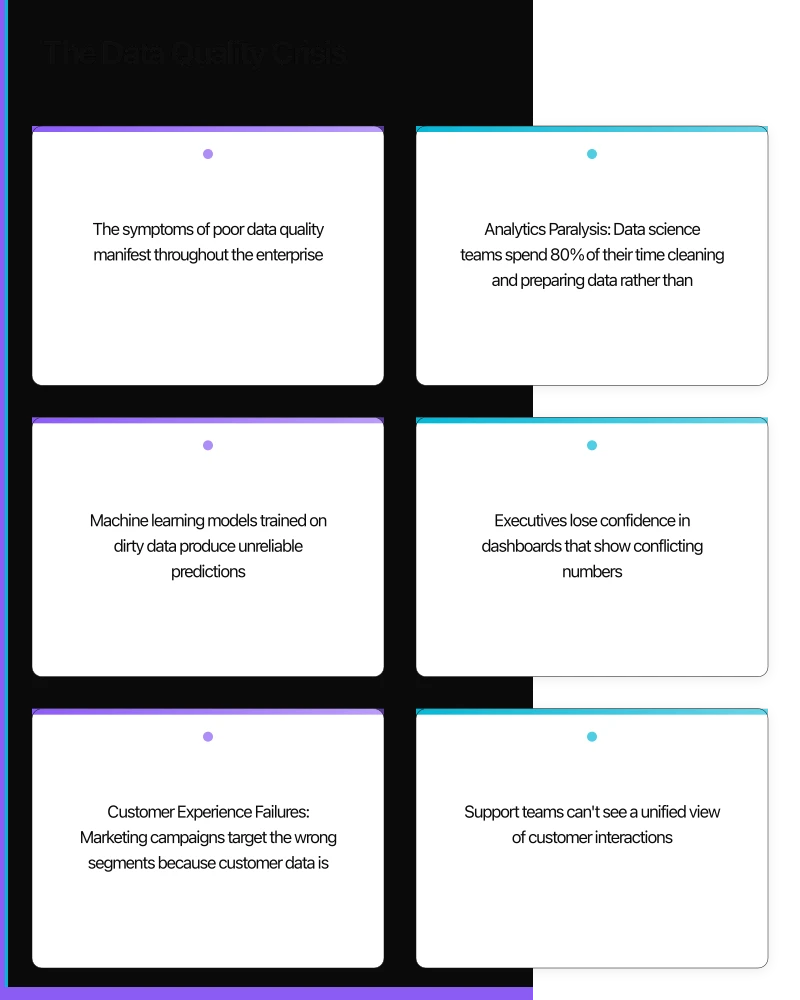
The symptoms of poor data quality manifest throughout the enterprise.
Analytics Paralysis: Data science teams spend 80% of their time cleaning and preparing data rather than analysing it. Machine learning models trained on dirty data produce unreliable predictions. Executives lose confidence in dashboards that show conflicting numbers.
Customer Experience Failures: Marketing campaigns target the wrong segments because customer data is inconsistent across systems. Support teams can’t see a unified view of customer interactions. Personalisation engines recommend irrelevant products based on stale preferences.
Operational Inefficiency: Inventory systems show stock that doesn’t exist or fail to show stock that does. Financial reconciliation requires manual intervention because transaction records don’t match. Supply chain optimisation algorithms make suboptimal decisions based on inaccurate demand signals.
Regulatory Risk: GDPR, CCPA, and industry-specific regulations require accurate record-keeping. Data subject access requests become nightmares when personal data is scattered across systems with no clear lineage. Audit findings reveal data governance gaps that could have been prevented.
These symptoms share a root cause: organisations have invested heavily in data collection and storage while underinvesting in data quality management.
Defining Data Quality
Data quality isn’t a single attribute but a multidimensional concept. Different dimensions matter more or less depending on the use case.
Core Quality Dimensions
Accuracy: Does the data correctly represent the real-world entity or event it describes? A customer’s address is accurate if it matches their actual residence.
Completeness: Are all required data elements present? A customer record missing a contact email may be valid for some purposes but incomplete for marketing outreach.
Consistency: Does the same data appear the same way across different systems? A customer named “John Smith” in one system and “J. Smith” in another creates confusion and potential duplication.
Timeliness: Is the data available when needed and does it reflect current reality? Inventory levels that update hourly may be timely enough for planning but too stale for real-time order promising.
Validity: Does the data conform to defined formats and business rules? A phone number field containing text characters is invalid regardless of what text it contains.
Uniqueness: Can entities be reliably distinguished from one another? Duplicate customer records lead to fragmented interaction histories and inaccurate analytics.
Context-Dependent Quality
What constitutes sufficient quality varies by use case. Approximate location data might be perfectly adequate for regional marketing analysis but unacceptable for logistics routing. Historical data missing some fields might be valuable for trend analysis but unsuitable for machine learning training.
This context-dependence means that data quality management isn’t about making all data perfect—an impossible and expensive goal—but about ensuring data quality meets the requirements of its intended uses.
Building a Data Quality Framework
Effective data quality management requires a framework that addresses people, processes, and technology in equal measure.
Governance Structure
Data quality doesn’t improve without clear ownership. Establish a governance structure that defines responsibilities at multiple levels.
Executive Sponsorship: Data quality initiatives need visible support from senior leadership. Without it, competing priorities will always win. The Chief Data Officer role has emerged in many organisations specifically to provide this executive focus on data as a strategic asset.
Data Stewardship: Stewards are the subject matter experts who understand what data should look like and can identify quality issues that automated tools might miss. They don’t necessarily “own” the data in an IT sense but are accountable for its quality within their domain.
Technical Ownership: Data engineers and database administrators implement the technical controls that enforce quality rules and enable monitoring. They work with stewards to translate business requirements into technical constraints.
Operating Model: Define how these roles interact. Regular data quality review meetings, escalation procedures for critical issues, and change management processes for quality rules all need clear documentation.
Data Quality Dimensions and Metrics
Translate abstract quality dimensions into measurable metrics for your specific data assets.
For a customer master data asset, metrics might include:
- Accuracy: Percentage of email addresses that pass deliverability validation
- Completeness: Percentage of records with all required fields populated
- Consistency: Percentage of records where name matches across CRM and billing systems
- Timeliness: Average delay between customer profile change and system update
- Uniqueness: Duplicate rate as identified by matching algorithms
Set thresholds that reflect business requirements. A 95% completeness rate might be acceptable for optional demographic fields but unacceptable for mandatory fields required for regulatory reporting.
Data Profiling
You can’t manage what you don’t measure. Data profiling provides the baseline understanding needed to identify quality issues and track improvement.
Modern data profiling tools like Informatica Data Quality, Talend Data Quality, or Ataccama ONE can automatically assess data against quality dimensions. They identify:
- Column-level statistics (cardinality, null rates, value distributions)
- Pattern analysis (format inconsistencies, unexpected values)
- Cross-column relationships (dependencies, redundancies)
- Cross-table relationships (referential integrity issues)
Run profiling when onboarding new data sources, after major system changes, and periodically for ongoing monitoring. The insights drive both immediate remediation and longer-term quality improvement initiatives.
Data Quality Rules
Codify quality requirements as rules that can be automatically evaluated.
Technical Rules: Format validations, range checks, referential integrity constraints. These can often be enforced at the database level or during ETL processing.
Business Rules: More complex validations that require domain knowledge. A rule that customer lifetime value cannot be negative is simple; a rule that identifies suspiciously high values based on historical patterns is more sophisticated.
Cross-System Rules: Validations that span multiple systems. Ensuring that an order in the ERP system has a corresponding customer in the CRM requires checking both systems.
Rules should be version-controlled and tested like code. Document the rationale for each rule so future maintainers understand why it exists.
Remediation Workflows
Identifying quality issues is only valuable if they get fixed. Establish workflows for addressing different types of issues.
Automated Remediation: Some issues can be fixed automatically. Standardising address formats, deduplicating obvious matches, and applying default values for missing fields are candidates for automation. But automated remediation requires careful testing—the cure can be worse than the disease if rules are too aggressive.
Manual Review Queues: Issues that require human judgement need efficient review processes. Prioritise by business impact, provide context to help reviewers make decisions, and track resolution times.
Root Cause Analysis: Don’t just fix symptoms. When patterns of quality issues emerge, investigate upstream to understand why bad data is being created. The fix might be a validation rule in the source system, training for data entry staff, or a process change.
Technology Architecture for Data Quality
The market offers a spectrum of data quality tools, from standalone point solutions to comprehensive data management platforms.
Standalone Data Quality Tools
Tools like Informatica Data Quality, Talend Data Quality, and IBM InfoSphere QualityStage offer deep functionality for profiling, cleansing, and matching. They integrate into ETL pipelines and data warehouse loading processes.
Strengths: Mature functionality, extensive transformation libraries, good matching algorithms for complex entity resolution.
Limitations: Often require significant implementation effort, may not integrate well with modern cloud-native architectures, licensing costs can be substantial.
Data Governance Platforms
Platforms like Collibra, Alation, and Informatica Axon combine data cataloguing, lineage tracking, and governance workflows with data quality capabilities. They provide a unified view of data assets across the enterprise.
Strengths: Holistic view of data assets, strong metadata management, workflow capabilities for stewardship.
Limitations: Platform investments require organisational commitment, quality capabilities may be less deep than standalone tools.
Cloud-Native Solutions
Major cloud providers have added data quality capabilities to their platforms. AWS Deequ, Google Cloud Dataprep, and Azure Data Factory include quality profiling and validation features.
Strengths: Native integration with cloud data services, consumption-based pricing, managed infrastructure.
Limitations: Functionality may be less mature than established vendors, potential lock-in to cloud provider.
Open Source Options
Great Expectations has emerged as a popular open-source option for data quality validation, particularly in Python-based data engineering environments. Apache Griffin provides data quality capabilities integrated with the Hadoop ecosystem.
Strengths: No licensing costs, flexibility to customise, active community development.
Limitations: Require more implementation effort, support depends on community or paid add-ons.
Architecture Patterns
Regardless of tools chosen, certain architectural patterns support effective data quality management.
Quality Gates: Implement validation checkpoints in data pipelines that prevent bad data from propagating downstream. A failed quality check might halt a pipeline, route data to remediation queues, or trigger alerts depending on severity.
Centralised Rules Repository: Store quality rules in a central location where they can be managed consistently and applied across multiple pipelines and applications.
Quality Scoring: Assign quality scores to individual records or datasets. Downstream consumers can then make risk-based decisions about whether to use data that falls below ideal quality thresholds.
Lineage Integration: Connect quality metrics to data lineage so that when issues are detected, their origin and downstream impact can be quickly understood.
Master Data Management
Data quality and master data management (MDM) are closely related. MDM establishes authoritative sources for key business entities—customers, products, suppliers, locations—and ensures that these golden records are consistently used across systems.
MDM Styles
Consolidation: A central hub aggregates data from source systems, cleanses and matches it, and provides a unified view for analytics. Source systems continue to operate independently but their data is reconciled centrally.
Registry: A lightweight approach that doesn’t move data but maintains a registry of identities across systems, enabling cross-system queries and reporting without physical consolidation.
Coexistence: Master data is managed both centrally and in source systems, with bidirectional synchronisation keeping them aligned. More complex but allows source systems to benefit from consolidated quality improvements.
Centralised: A single authoritative system manages master data, and all other systems consume from it. Provides the strongest consistency but requires significant integration effort.
Most enterprises use a hybrid approach, applying different styles to different data domains based on business requirements and existing system landscapes.
MDM Implementation Considerations
MDM initiatives are notoriously challenging. Common failure modes include:
- Underestimating the data quality work required before MDM can succeed
- Scope creep that delays value delivery
- Insufficient business engagement in stewardship processes
- Technical architecture that doesn’t scale with data volumes
Start with a focused scope—a single critical data domain—and demonstrate value before expanding. Build stewardship processes iteratively rather than designing the perfect governance model upfront.
Organisational Change Management
Data quality improvement is as much about organisational change as technology implementation.
Building Data Culture
Data quality won’t improve if the people creating data don’t care about it. Building a data-quality culture requires:
Awareness: Help data creators understand how quality issues affect downstream users and business outcomes. The customer service representative entering an address needs to understand that inaccuracy causes delivery failures and customer complaints.
Accountability: Make data quality visible through metrics and dashboards. When teams can see how their data quality compares to targets and peers, improvement becomes a point of pride.
Incentives: Align incentive structures with quality goals. If sales representatives are measured only on deal volume, they have no incentive to ensure CRM data is complete and accurate.
Managing Resistance
Expect resistance from multiple sources.
Source system owners may resist having their data quality measured and reported. Frame quality metrics as diagnostic tools for improvement rather than performance judgements.
Business units may resist governance processes that add steps to their workflows. Demonstrate value by solving real problems they face due to poor data quality.
IT teams may resist taking on quality responsibilities they see as business problems. Establish clear boundaries between technical and business ownership.
Sustaining Momentum
Data quality is a marathon, not a sprint. Initial enthusiasm fades when the hard work of ongoing governance becomes routine.
Regularly communicate wins—business problems solved, costs avoided, capabilities enabled. Refresh governance processes as the organisation’s needs evolve. Invest in automation to reduce the burden of manual quality management.
Measuring Success
Define success metrics that matter to stakeholders.
Business Impact Metrics
- Revenue recovered or protected through improved customer data
- Cost savings from reduced manual data correction
- Cycle time reduction for data-dependent processes
- Compliance risk reduction quantified in audit findings
Operational Metrics
- Data quality scores trending over time
- Issue detection and resolution times
- Percentage of data passing quality gates
- Stewardship task completion rates
Adoption Metrics
- Number of business processes consuming trusted data sources
- Percentage of analytics using governed data
- User satisfaction with data discovery and access
Report metrics at the appropriate level of abstraction for each audience. Executives need business impact; stewards need operational detail.
Looking Ahead
Several trends are reshaping data quality management.
Machine Learning for Data Quality: ML techniques can identify quality issues that rule-based approaches miss, learn matching logic from training examples, and prioritise remediation based on predicted business impact.
Real-Time Data Quality: As enterprises move to streaming architectures, quality validation must keep pace. Detecting and remediating issues in real-time data flows presents new technical challenges.
Data Quality as Code: Treating quality rules as code that lives alongside data pipelines, version-controlled and tested, aligns data quality with modern DevOps practices.
Privacy-Preserving Quality Management: Regulations like GDPR require that personal data be accurate while limiting how it can be accessed and processed. Techniques for assessing quality without exposing raw data are emerging.
Practical Next Steps
For CTOs beginning or reinvigorating data quality initiatives:
Foundation (0-3 months)
- Identify your most critical data domains and their business impact
- Assess current quality through profiling of key assets
- Establish baseline metrics and quality targets
Build (3-9 months)
- Implement governance structure and stewardship processes
- Deploy quality tooling integrated into data pipelines
- Address the highest-impact quality issues identified
Scale (9-18 months)
- Expand coverage to additional data domains
- Mature automation to reduce manual effort
- Integrate quality metrics into broader business performance management
Conclusion
Data quality is not glamorous. It doesn’t generate the excitement of AI initiatives or digital transformation programs. Yet without quality data, those initiatives underperform or fail entirely. The AI model trained on dirty data makes bad predictions. The digital experience powered by incomplete customer profiles delivers poor personalisation.
Investing in data quality is investing in the foundation that makes other data investments successful. It’s the plumbing that must work before the fixtures become useful.
CTOs who recognise this and build systematic data quality capabilities create durable competitive advantage. Their organisations can trust their data, move faster with confidence, and compound their data investments over time. Those who treat data quality as an afterthought will find themselves perpetually cleaning up messes, unable to realise the value their data theoretically contains.
The choice is strategic, and the time to choose is now.
Building a data quality programme for your enterprise? Connect with me to discuss strategies for establishing data governance that delivers measurable business value.
Your digital strategy starts with being found online. Cosmos Web Tech covers SEO, WordPress, and web performance for Australian businesses.
I lead Ganda Tech Services, where we turn digital strategy into results through specialist cloud, web design, and mobile app teams across Sydney.
About the Author
Ashish Ganda is the founder of Ganda Tech Services, a Sydney-based technology consultancy specialising in cloud infrastructure, web development, and mobile app solutions for Australian businesses.
Digital Transformation Roadmap 2026
A 12-month framework for Australian SMBs ready to modernise — phases, tools, and milestones.
Almost done
Check your inbox and click the confirmation link to get your download.