Enterprise Blockchain Beyond Cryptocurrency: Supply Chain and Identity
The conversation around blockchain technology has been dominated by cryptocurrency speculation for too long. While Bitcoin and Ethereum capture headlines, the most transformative applications of distributed ledger technology are quietly reshaping how enterprises manage supply chains, verify identities, and establish trust across organisational boundaries.
As CTOs evaluate blockchain for enterprise use cases, the challenge is separating genuine business value from the noise of speculative hype. This requires understanding where blockchain’s unique properties — immutability, decentralisation, and cryptographic verification — solve real problems that traditional databases and middleware cannot.
Supply Chain Transparency and Provenance
The supply chain represents one of blockchain’s most compelling enterprise use cases. Modern supply chains span dozens of organisations, multiple jurisdictions, and complex regulatory environments. The fundamental problem is trust: how do you verify claims about product origin, handling conditions, and regulatory compliance when data passes through multiple intermediaries?
Traditional approaches rely on centralised databases managed by a single party, or fragmented document trails that are expensive to audit and easy to manipulate. Blockchain introduces a shared, immutable record that no single participant controls.
IBM’s Food Trust network, built on Hyperledger Fabric, demonstrates this at scale. Major retailers like Walmart have reduced the time required to trace food products from farm to store from seven days to 2.2 seconds. This is not a theoretical improvement — it directly impacts food safety response times during contamination events.
For CTOs evaluating supply chain blockchain, the critical architectural decisions include:
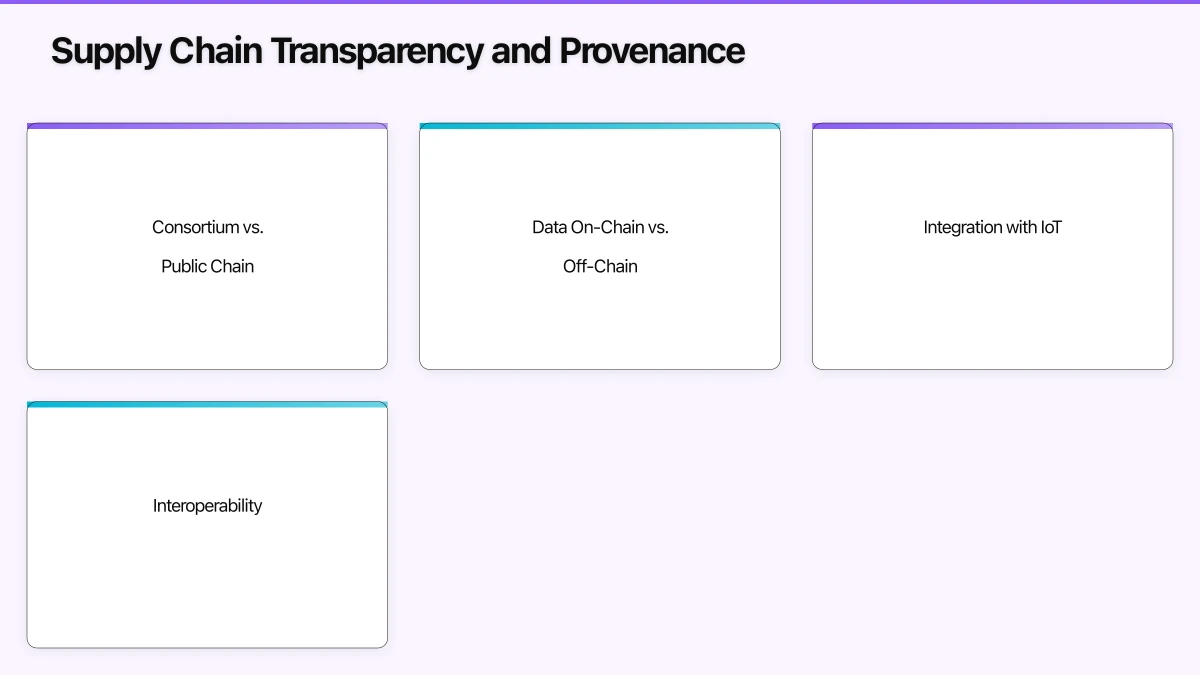
Consortium vs. Public Chain: Most enterprise supply chain implementations use permissioned blockchains where participants are known and vetted. This sacrifices some decentralisation properties but gains transaction throughput, privacy controls, and regulatory compliance. Hyperledger Fabric, R3 Corda, and Enterprise Ethereum remain the dominant platforms.
Data On-Chain vs. Off-Chain: Storing complete supply chain documents on-chain is impractical and expensive. The pattern that has emerged is storing cryptographic hashes and metadata on-chain while keeping full documents in traditional storage systems. This preserves the immutability guarantee while managing storage costs.
Integration with IoT: The value of supply chain blockchain increases dramatically when combined with IoT sensors that automatically record temperature, humidity, location, and handling data. This reduces reliance on manual data entry and creates a more trustworthy audit trail. However, the “oracle problem” — ensuring that data entering the blockchain accurately reflects physical reality — remains a fundamental challenge.
Interoperability: Most enterprises participate in multiple supply chains with different technology stacks. The lack of standardised interoperability between blockchain platforms is a significant practical barrier. Efforts like the Hyperledger Cactus project aim to address this, but cross-chain communication remains immature.
Digital Identity and Verifiable Credentials
Enterprise identity management has been centralised for decades. Organisations maintain directories, issue credentials, and verify identities through hierarchical trust models. This approach creates well-known problems: data breaches expose millions of identity records, users manage hundreds of credentials across services, and identity verification processes are slow and expensive.
Blockchain-based decentralised identity (DID) offers a fundamentally different model. Rather than storing identity data in centralised databases, individuals hold cryptographic credentials in digital wallets. Organisations issue verifiable credentials that can be independently verified without contacting the issuer.
The World Wide Web Consortium (W3C) has been developing standards for Decentralised Identifiers and Verifiable Credentials that provide a technology-neutral foundation. Microsoft’s ION network, built on the Bitcoin blockchain, and the Sovrin Network, built on Hyperledger Indy, represent two different architectural approaches to the same problem.
For enterprise architects, the implications are significant:
Reduced Liability: If an organisation does not store customer identity data, it cannot be breached. This is a compelling argument for privacy-conscious industries like healthcare and financial services, where data breach costs can be catastrophic.
Streamlined Onboarding: Know Your Customer (KYC) processes in financial services are expensive and repetitive. A customer who has been verified by one institution could present a verifiable credential to another, reducing duplication while maintaining compliance. Multiple banking consortiums are exploring this model.
Workforce Credentialing: Verifying professional qualifications, certifications, and employment history is a manual, time-consuming process. Blockchain-based credentials issued by universities, certification bodies, and employers could create a portable, instantly verifiable professional identity.
The challenge is adoption. Decentralised identity systems require a critical mass of issuers, holders, and verifiers to be useful. Individual organisations cannot create this ecosystem alone, which is why industry consortiums and government initiatives are essential to driving adoption.
Governance and Consortium Architecture
The technical architecture of enterprise blockchain is relatively well-understood. The harder problem is governance: how do multiple organisations that may be competitors agree on rules, upgrades, and dispute resolution for a shared infrastructure?
Successful enterprise blockchain deployments invest heavily in consortium governance. This includes:
Legal Framework: Smart contracts may execute automatically, but they operate within legal jurisdictions. The consortium needs clear agreements about liability, intellectual property, data ownership, and dispute resolution. Legal frameworks must account for the unique properties of blockchain, including the difficulty of modifying or deleting on-chain data.
Technical Governance: Who decides when to upgrade the platform? How are new participants onboarded? What happens when a node operator fails to maintain their infrastructure? These operational questions require clear processes and decision-making authority.
Economic Model: Running blockchain infrastructure has costs. The consortium needs a sustainable economic model that distributes costs fairly among participants while incentivising participation. This is particularly challenging when participants are of vastly different sizes.
Regulatory Alignment: Blockchain’s immutability can conflict with regulations like GDPR’s right to erasure. Enterprise implementations need architectural patterns that satisfy both blockchain properties and regulatory requirements, such as storing personal data off-chain with on-chain references that can be invalidated.
The consortiums that have succeeded — Tradelens for shipping, Marco Polo for trade finance, and the Mediledger Network for pharmaceuticals — share a common pattern: they started with a narrow, well-defined use case that delivered clear value to all participants, then expanded scope gradually.
Strategic Evaluation Framework
For CTOs considering blockchain investments, I recommend a structured evaluation that starts with the fundamental question: does this use case genuinely require blockchain, or would a traditional shared database with appropriate access controls achieve the same result?
Blockchain adds value when multiple organisations need to share data without trusting a central authority, when immutability and auditability are critical, and when disintermediation creates efficiency gains. If the data is managed by a single organisation, or if a trusted intermediary already exists and performs adequately, blockchain adds complexity without proportional benefit.
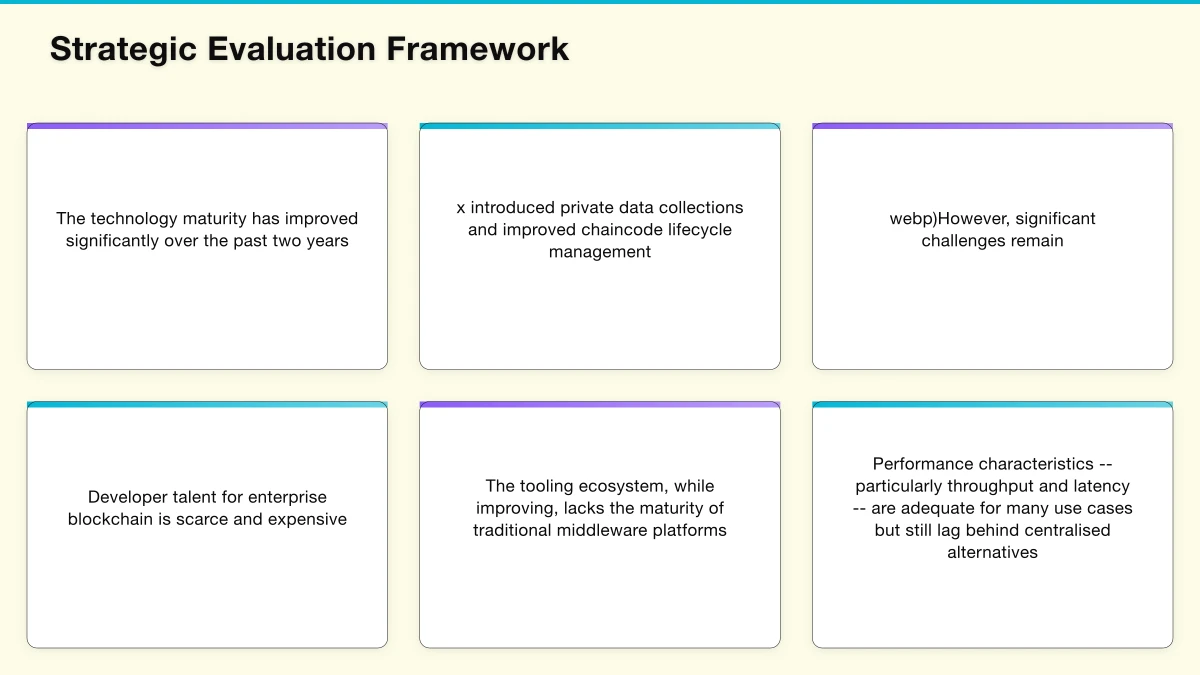
The technology maturity has improved significantly over the past two years. Hyperledger Fabric 2.x introduced private data collections and improved chaincode lifecycle management. Enterprise Ethereum implementations have gained privacy features through projects like Baseline Protocol, which uses the public Ethereum mainnet as a common frame of reference while keeping business data private.
However, significant challenges remain. Developer talent for enterprise blockchain is scarce and expensive. The tooling ecosystem, while improving, lacks the maturity of traditional middleware platforms. Performance characteristics — particularly throughput and latency — are adequate for many use cases but still lag behind centralised alternatives.
The organisations that will extract the most value from blockchain are those that view it as an infrastructure investment in multi-party trust, not a technology solution to a single problem. The supply chain transparency and digital identity use cases discussed here are compelling because they address systemic inefficiencies that affect entire industries, not just individual organisations.
The CTO’s role is to identify where their organisation sits in these emerging ecosystems, evaluate the strategic implications of participation or non-participation, and make measured investments that position the organisation for a future where multi-party trust infrastructure is a competitive necessity, not a novelty.
Strategy without a web presence is invisible. Cosmos Web Tech publishes practical guides on building websites that attract and convert Australian customers.
Ash Ganda is the founder of Ganda Tech Services, a Sydney-based technology consultancy delivering cloud, web, and mobile solutions for Australian businesses.
About the Author
Ashish Ganda is the founder of Ganda Tech Services, a Sydney-based technology consultancy specialising in cloud infrastructure, web development, and mobile app solutions for Australian businesses.
AI Strategy Primer for Australian Business Leaders
A practical framework for AI adoption in 2026 — cut through the hype and start with what matters.