Enterprise Kubernetes Adoption: Beyond the Proof of Concept
The proof of concept is complete. Your engineering team has demonstrated that Kubernetes can run workloads, your architects have validated the networking model, and a handful of stateless applications are humming along in a development cluster. The question facing every CTO in 2021 is not whether Kubernetes works — it is whether your organisation is prepared to operate it as foundational enterprise infrastructure.
The gap between a successful proof of concept and production-grade Kubernetes adoption is where most enterprises stumble. According to the Cloud Native Computing Foundation’s 2020 survey, while 91% of respondents are using containers, only 83% are using Kubernetes in production, and a significant portion of those deployments remain confined to non-critical workloads. The distance between experimentation and enterprise-grade operation is not primarily technical. It is organisational, operational, and strategic.
This is the inflection point where technology decisions become business decisions, and where the CTO’s role shifts from evaluating a platform to championing an operational transformation.
The Organisational Readiness Gap
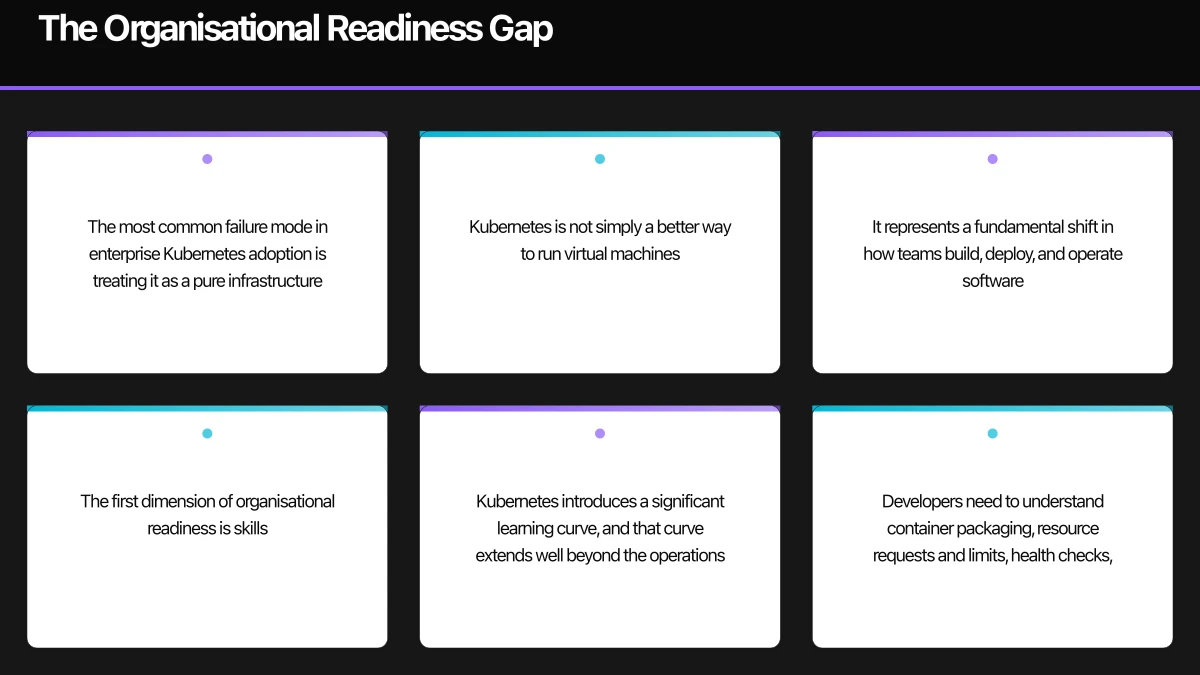
The most common failure mode in enterprise Kubernetes adoption is treating it as a pure infrastructure upgrade. Kubernetes is not simply a better way to run virtual machines. It represents a fundamental shift in how teams build, deploy, and operate software. Organisations that approach adoption without addressing the human and process dimensions consistently find themselves with expensive infrastructure that delivers marginal improvement over what they had before.
The first dimension of organisational readiness is skills. Kubernetes introduces a significant learning curve, and that curve extends well beyond the operations team. Developers need to understand container packaging, resource requests and limits, health checks, and the declarative configuration model. Operations teams must master a new networking paradigm, storage abstractions, and a fundamentally different approach to infrastructure management. Security teams need to rethink their models around workload identity, network policy, and supply chain integrity.
The skills gap is not solved by sending a few engineers to a training course. It requires sustained investment in capability building across multiple teams. Progressive enterprises are establishing internal Kubernetes communities of practice, creating self-service learning paths, and embedding platform expertise within product teams rather than concentrating it in a central infrastructure group.
The second dimension is team topology. Kubernetes adoption works best when organisations embrace a platform team model. This team owns the Kubernetes platform as a product, with internal development teams as their customers. The platform team is responsible for cluster lifecycle management, baseline security policies, observability infrastructure, and developer experience tooling. Without this clear ownership model, Kubernetes clusters become everyone’s responsibility and no one’s priority.
The third dimension is process maturity. Kubernetes assumes — and rewards — a high degree of automation. Organisations still relying on manual change management processes, ticket-based deployments, or monthly release cycles will find that Kubernetes amplifies their existing inefficiencies rather than resolving them. The platform demands CI/CD maturity, infrastructure-as-code practices, and a culture of automated testing. Attempting to layer Kubernetes on top of legacy processes creates complexity without delivering agility.
Platform Architecture Decisions That Matter
With organisational readiness addressed, the technical architecture decisions become consequential. The choices made at this stage will determine the platform’s operational characteristics for years to come.
The cluster topology decision — single large cluster versus multiple smaller clusters — is more nuanced than it appears. Single-cluster models simplify networking and service discovery but create blast radius concerns and complicate multi-tenancy. Multi-cluster architectures improve isolation and allow for environment-specific configurations but introduce complexity in service mesh, observability, and deployment orchestration. Most enterprises landing on a multi-cluster model with a clear taxonomy: separate clusters for production and non-production, potentially segmented by business unit or regulatory boundary.
Networking deserves particular attention. The choice of Container Network Interface (CNI) plugin has long-term implications for performance, security, and operational complexity. Calico, Cilium, and Flannel each bring different strengths. Calico offers mature network policy support and BGP integration for on-premises deployments. Cilium leverages eBPF for high-performance networking and advanced observability. Flannel provides simplicity at the cost of feature depth. The right choice depends on your specific requirements around network policy granularity, performance characteristics, and operational team expertise.
Storage strategy is another critical decision point. Kubernetes’ storage model has matured significantly with the Container Storage Interface (CSI), but stateful workload support still requires careful planning. Enterprises running databases, message queues, or other stateful services on Kubernetes need to evaluate CSI drivers for their specific storage backends, implement robust backup and recovery procedures, and establish clear guidelines for when stateful workloads should — and should not — run on the platform.
The GitOps operating model, championed by tools like Flux and Argo CD, is emerging as the preferred approach to Kubernetes configuration management. By storing all cluster configuration in Git and using reconciliation controllers to enforce desired state, organisations gain auditability, reproducibility, and a natural collaboration model. For enterprises in regulated industries, GitOps provides a compelling answer to compliance requirements around change management and audit trails.
Security as a First-Class Concern
Security in Kubernetes is not an afterthought to be addressed after the platform is operational. It must be embedded from the foundation. The attack surface of a Kubernetes cluster is substantial, and the default configurations are not secure enough for enterprise use.
Pod security is the starting point. The Pod Security Policy (PSP) mechanism, while being deprecated in favour of the Pod Security Standards, remains the primary tool for enforcing security constraints on workloads. Enterprises must define and enforce policies that prevent privilege escalation, restrict host namespace access, enforce read-only root filesystems, and require non-root user execution. These policies should be established as non-negotiable baselines, not optional guidelines.
Image security encompasses both supply chain integrity and vulnerability management. Every container image running in an enterprise cluster should be sourced from a trusted registry, scanned for known vulnerabilities, and signed to verify provenance. Tools like Trivy, Anchore, and Snyk provide scanning capabilities, while projects like Notary and cosign enable image signing and verification. The goal is a continuous pipeline where images are built from known base images, scanned at build time, scanned in the registry, and validated at admission time.
Network policy is the Kubernetes equivalent of microsegmentation, and it is remarkably underutilised. By default, all pods in a Kubernetes cluster can communicate with all other pods — a flat network that would be unacceptable in any traditional enterprise environment. Network policies allow teams to define explicit ingress and egress rules, implementing a zero-trust networking model at the workload level. Every enterprise Kubernetes deployment should start with a default-deny policy and explicitly permit only required communication paths.
RBAC (Role-Based Access Control) configuration in Kubernetes is powerful but complex. Enterprises need to design their RBAC model carefully, mapping organisational roles to Kubernetes permissions with the principle of least privilege. Integration with existing identity providers through OIDC is essential for maintainability. The alternative — managing individual Kubernetes user accounts — does not scale and creates security blind spots.
Building the Path to Production
The journey from proof of concept to production is best executed as a series of deliberate stages, each with clear success criteria before proceeding to the next.
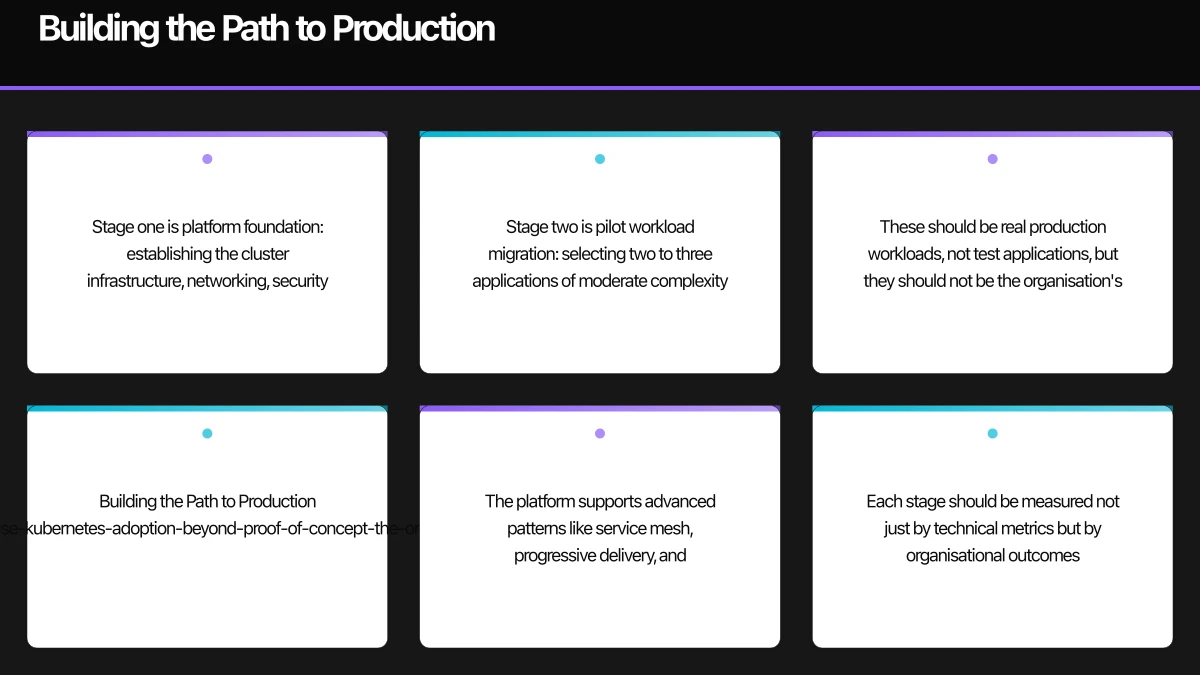
Stage one is platform foundation: establishing the cluster infrastructure, networking, security baselines, and observability stack. Success criteria include automated cluster provisioning, functioning network policies, integrated logging and monitoring, and documented operational runbooks.
Stage two is pilot workload migration: selecting two to three applications of moderate complexity and migrating them to the platform. These should be real production workloads, not test applications, but they should not be the organisation’s most critical systems. Success criteria include successful deployment, validated performance characteristics, completed security review, and demonstrated operational procedures for common scenarios like scaling, rolling updates, and incident response.
Stage three is scaling adoption: expanding the set of workloads on the platform while refining the developer experience and operational procedures. This is where the platform team model proves its value, as the team codifies patterns, builds internal tooling, and creates self-service capabilities that reduce the friction of onboarding new applications.
Stage four is strategic platform: Kubernetes becomes the default deployment target for new applications, and the platform team’s roadmap aligns with the organisation’s broader technology strategy. The platform supports advanced patterns like service mesh, progressive delivery, and multi-cluster federation.
Each stage should be measured not just by technical metrics but by organisational outcomes. Deployment frequency, lead time for changes, mean time to recovery, and change failure rate — the DORA metrics — provide a framework for assessing whether the platform investment is translating into business value.
The Strategic Imperative
Kubernetes adoption is not merely a technology modernisation initiative. It is a strategic investment in organisational agility. The enterprises that successfully navigate this transition will have a platform that accelerates their ability to deliver software, reduces the operational burden of managing infrastructure, and provides a consistent foundation for innovation.
The CTOs who approach this transition with clear-eyed realism about the organisational change required, disciplined attention to architecture decisions, and an unwavering commitment to security will find that the investment delivers returns that extend far beyond infrastructure efficiency. They will have built a platform that enables their organisation to compete in an increasingly software-defined economy.
The proof of concept proved the technology works. The real work is proving your organisation can operate it at the standard your business demands.
For the practitioner’s view on web design and digital marketing, explore Cosmos Web Tech — where strategy meets execution.
My consultancy Ganda Tech Services operates three specialist divisions covering cloud infrastructure, web development, and mobile apps for Australian businesses.
About the Author
Ashish Ganda is the founder of Ganda Tech Services, a Sydney-based technology consultancy specialising in cloud infrastructure, web development, and mobile app solutions for Australian businesses.
AI Strategy Primer for Australian Business Leaders
A practical framework for AI adoption in 2026 — cut through the hype and start with what matters.