Enterprise API Security: OAuth 2.0 and OpenID Connect at Scale
API security is no longer a feature of the application layer — it is a foundational enterprise architecture concern. As organisations decompose monoliths into microservices, expose capabilities through API marketplaces, and integrate with partner ecosystems, the attack surface grows with every new endpoint. OAuth 2.0 and OpenID Connect have become the de facto standards for API authentication and authorisation, but implementing them correctly at enterprise scale presents challenges that go well beyond the protocol specifications.
The gap between understanding OAuth flows in a tutorial and operating a secure, scalable, multi-tenant authorisation system in production is enormous. This article addresses that gap, focusing on the architectural decisions that determine whether an enterprise API security implementation is robust or fragile.
OAuth 2.0 Grant Types: Choosing the Right Flow
OAuth 2.0 defines several grant types (flows) for different scenarios. Choosing the correct flow for each use case is the first and most consequential security decision.
Authorization Code with PKCE: This is the recommended flow for all client-facing applications, including single-page applications, mobile apps, and server-rendered web applications. The Proof Key for Code Exchange (PKCE) extension, originally designed for mobile clients, is now recommended for all public clients by the OAuth 2.0 Security Best Current Practice document. PKCE prevents authorisation code interception attacks without requiring a client secret, which public clients cannot securely store.
For enterprise implementations, the authorization code flow with PKCE should be the default for any application where an end user is present. The implicit flow, which was historically used for SPAs, is no longer recommended due to the security risks of exposing access tokens in URL fragments.
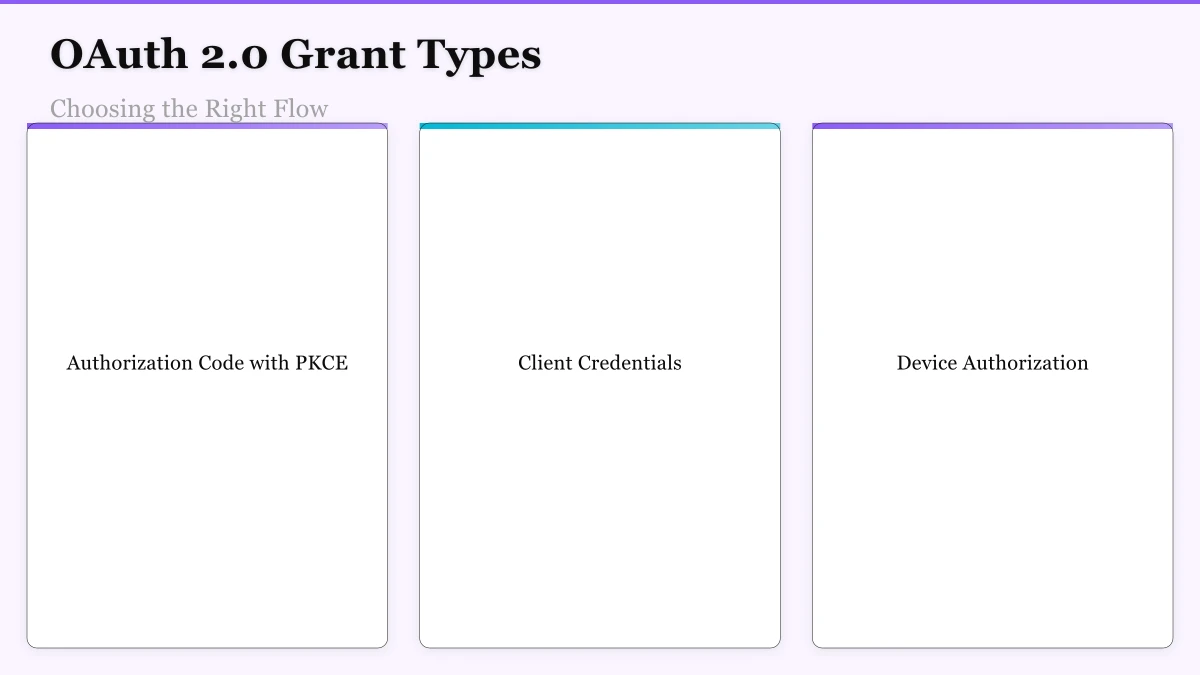
Client Credentials: For service-to-service communication where no end user is involved, the client credentials flow provides machine-to-machine authentication. Each service is issued a client ID and secret (or uses mutual TLS for client authentication), and obtains access tokens directly from the authorisation server.
At enterprise scale, managing client credentials across hundreds of services requires automated provisioning and rotation. Secrets should never be hardcoded or stored in version control. Integration with secrets management platforms like HashiCorp Vault ensures that credentials are dynamically provisioned and automatically rotated.
Device Authorization: For devices with limited input capabilities — smart TVs, IoT devices, CLI tools — the device authorization flow provides a user-friendly authentication experience by delegating to a secondary device. This flow is increasingly relevant as enterprises deploy applications across diverse device types.
Token Architecture and Management
The design of the token system has significant implications for security, performance, and operational complexity.
Access Token Lifetime: Short-lived access tokens (five to fifteen minutes) limit the damage window if a token is compromised. However, shorter lifetimes increase the frequency of token refresh operations, which adds load to the authorisation server and introduces latency. The balance depends on the sensitivity of the protected resources and the organisation’s tolerance for latency.
Refresh Token Rotation: Refresh tokens, which are long-lived credentials used to obtain new access tokens, must be protected carefully. Refresh token rotation — issuing a new refresh token with every access token refresh and invalidating the previous one — detects token theft: if a stolen refresh token is used after the legitimate client has already rotated it, both tokens are invalidated, limiting the attacker’s access window.
Token Format: JWT vs. Opaque: JSON Web Tokens (JWTs) are self-contained tokens that include claims about the subject, scopes, and expiration. They can be validated locally by resource servers without contacting the authorisation server, reducing latency and eliminating a single point of failure. However, JWTs cannot be revoked before expiration without maintaining a revocation list, and they expose claims to anyone who possesses the token.
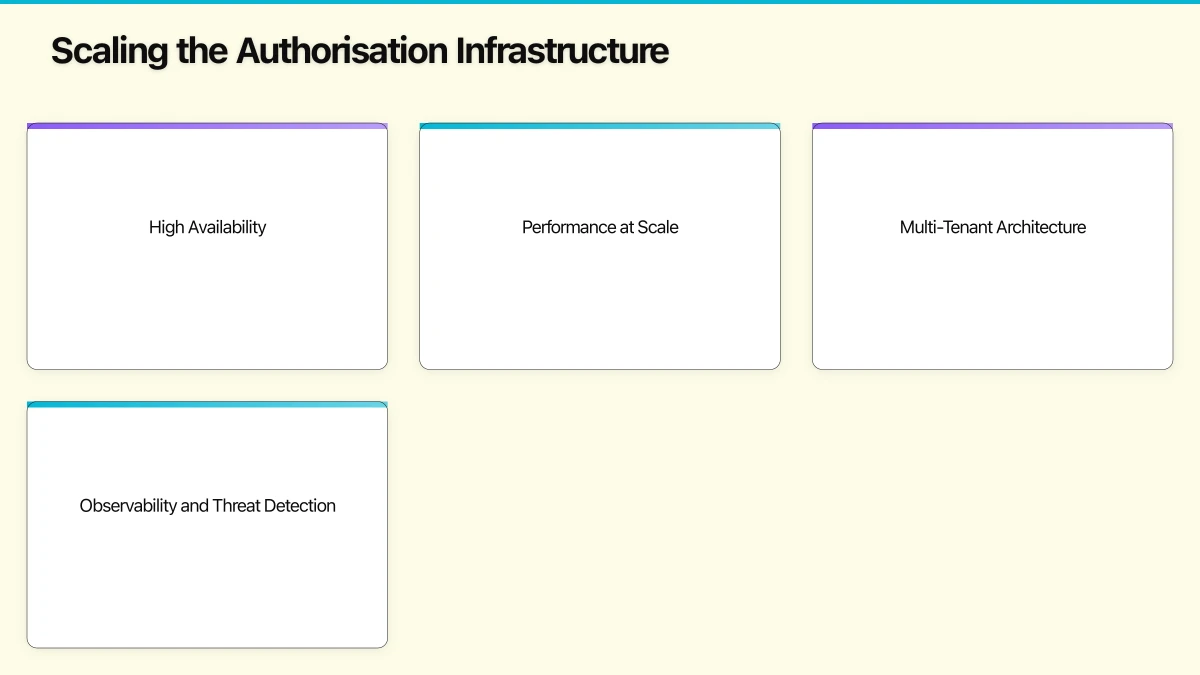
Opaque tokens are random strings that must be introspected by contacting the authorisation server. This enables immediate revocation and keeps claims private, but adds latency and creates a dependency on the authorisation server’s availability.
Enterprise architectures often use both: JWTs for internal service-to-service communication where performance is critical and the network is trusted, and opaque tokens for external-facing APIs where revocation capability is important. The authorisation server issues JWTs internally while providing a token exchange endpoint for external consumers.
Scope Design: OAuth scopes define what an access token is authorised to do. Scope design is an API governance decision that balances granularity with usability.
Overly granular scopes (one per API endpoint) create complex consent dialogues and make it difficult for developers to understand what scopes they need. Overly broad scopes (one per API) provide insufficient access control. The recommended approach groups related operations into logical scopes that align with business capabilities: “read:orders”, “write:orders”, “admin:users” rather than individual endpoint-level permissions.
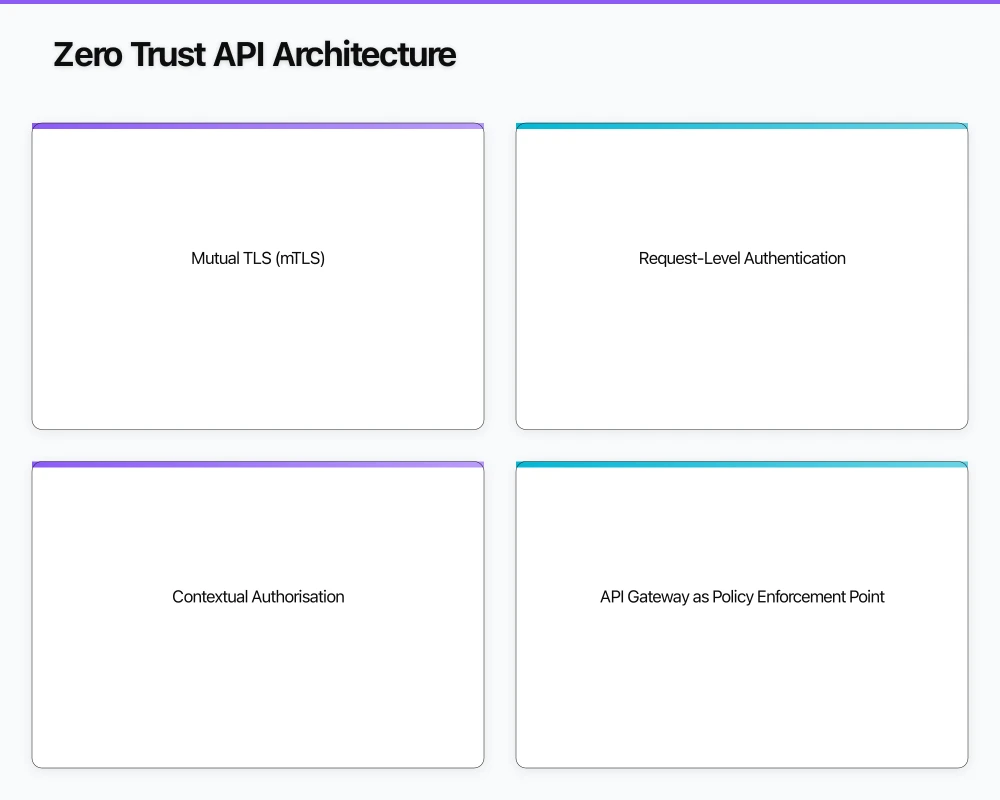
Zero Trust API Architecture
The zero-trust model — “never trust, always verify” — has profound implications for API security architecture. Traditional perimeter-based security assumed that traffic within the corporate network was trustworthy. Zero trust treats every request as potentially hostile, regardless of its origin.
Mutual TLS (mTLS): In a zero-trust API architecture, both the client and server present certificates during the TLS handshake. This ensures that service identity is verified cryptographically, not just through bearer tokens. Service meshes like Istio and Linkerd automate mTLS between services, handling certificate issuance, rotation, and validation transparently.
Request-Level Authentication: Every API request must carry authentication credentials, typically an OAuth access token. No request is exempted based on network origin. This applies to internal service-to-service calls as well as external API requests.
Contextual Authorisation: Beyond “is this token valid and does it have the right scopes,” zero-trust authorisation considers contextual signals: the requesting device’s security posture, the network location, the time of request, and behavioural patterns. This requires an authorisation engine that can evaluate policies based on multiple inputs, not just token claims.
API Gateway as Policy Enforcement Point: The API gateway serves as the primary enforcement point for authentication, rate limiting, and coarse-grained authorisation. Fine-grained authorisation decisions (can this user access this specific resource?) are delegated to the resource server, which has the domain context to make those decisions.
Enterprise API gateways like Kong, Apigee, and AWS API Gateway provide built-in OAuth token validation, rate limiting, and request transformation. The gateway should validate tokens, check scopes, enforce rate limits, and apply threat protection (SQL injection detection, schema validation) before requests reach backend services.
Scaling the Authorisation Infrastructure
At enterprise scale, the authorisation server becomes critical infrastructure. An outage in the authorisation server prevents all API authentication, effectively taking down the entire API ecosystem.
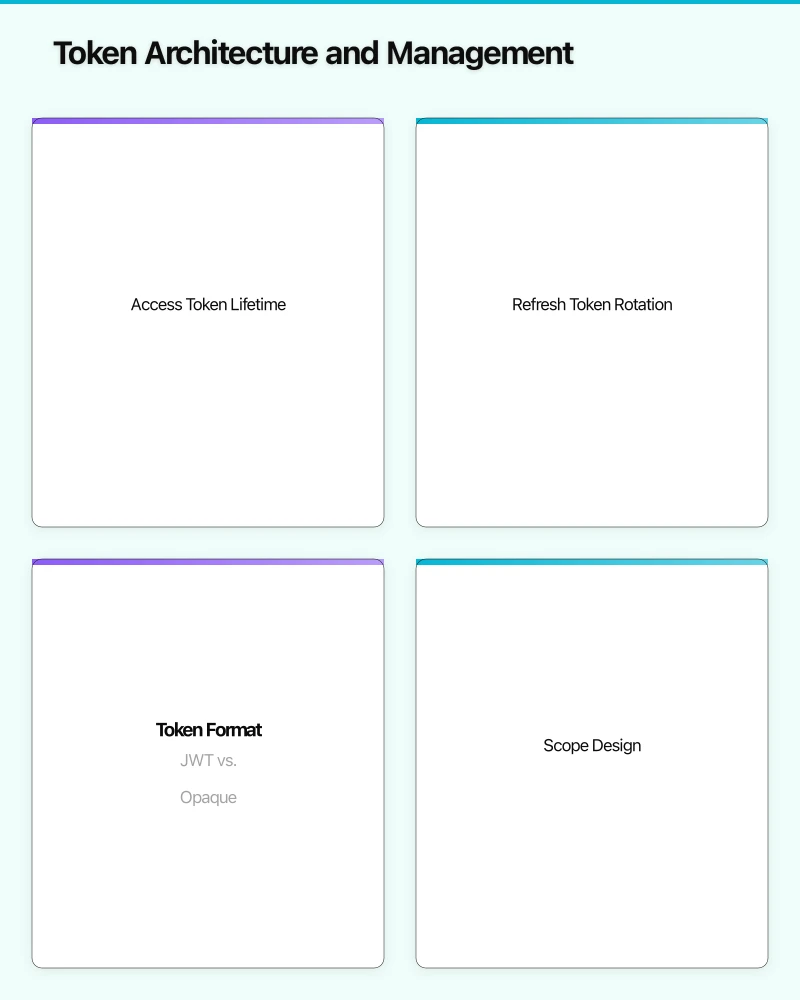
High Availability: The authorisation server must be deployed with the same availability standards as the most critical business systems. This means multi-region deployment, automated failover, and continuous health monitoring. Commercial identity platforms like Okta, Auth0, and ForgeRock provide managed authorisation services with built-in high availability. Self-hosted solutions using Keycloak or ORY Hydra require careful infrastructure design.
Performance at Scale: Token issuance and validation must be fast. At enterprise scale, the authorisation server may handle millions of token operations per day. Caching strategies — caching JWKS (JSON Web Key Set) keys at resource servers, caching token introspection results, and pre-computing consent decisions — reduce the load on the authorisation server and improve response times.
Multi-Tenant Architecture: Enterprises with multiple business units, brands, or partner ecosystems need authorisation infrastructure that supports multiple tenants with isolated configurations, user populations, and policies. The authorisation server’s multi-tenancy model must provide strong isolation while maintaining operational efficiency.
Observability and Threat Detection: Monitoring authentication patterns reveals security threats: credential stuffing attacks appear as high volumes of failed authentication attempts, token abuse appears as unusual access patterns, and privilege escalation appears as scope requests that deviate from historical patterns. Integrating authorisation server logs with SIEM (Security Information and Event Management) platforms enables real-time threat detection.
API security at enterprise scale is an ongoing practice, not a one-time implementation. The threat landscape evolves, new OAuth specifications address emerging risks, and the organisation’s API ecosystem grows continuously. The CTO’s responsibility is to ensure that API security architecture scales with the business, that security standards are enforced consistently across the ecosystem, and that the organisation invests in the identity infrastructure that underpins every API interaction.
Mobile execution is where many digital strategies come to life. Awesome Apps publishes practical guides on app development and mobile UX.
I lead Ganda Tech Services, where we turn digital strategy into results through specialist cloud, web design, and mobile app teams across Sydney.
About the Author
Ashish Ganda is the founder of Ganda Tech Services, a Sydney-based technology consultancy specialising in cloud infrastructure, web development, and mobile app solutions for Australian businesses.
Digital Transformation Roadmap 2026
A 12-month framework for Australian SMBs ready to modernise — phases, tools, and milestones.